


Every kitchen has one. That drawer — usually the one nearest the front door or the counter where you drop your keys — that has quietly become the final resting place for dried-out pens, dead batteries, takeout menus from 2022, and a collection of mystery screws nobody in the house can explain. If you’re searching for how to declutter a junk drawer, chances are yours has crossed the line from “mildly chaotic” to “won’t close unless you slam it.” Here’s the good news: this is the fastest, most satisfying decluttering win in your entire house. You can finish the whole thing in about 25 minutes with a trash bag and a little honesty.
Why Your Junk Drawer Fills Up Faster Than Any Other Spot
The junk drawer isn’t really a drawer problem. It’s a decision problem. Every other drawer in your kitchen has a job description — cutlery, spices, cooking tools. The junk drawer is the one place with no job description at all, so it becomes the staging area for every “I’ll deal with this later” decision in your home.
A rubber band that doesn’t belong in the trash but doesn’t quite belong anywhere else. A key that might be important. A gift card with maybe three dollars left on it. Individually, each item feels too small to make a decision about, so nothing ever leaves. Meanwhile, you keep opening that drawer six times a day because the tape, the scissors, and the phone charger live in there — buried under the growing pile.
The fix isn’t a prettier storage system. The fix is giving every item in that drawer an actual decision, once, today. That’s what we’re doing.

How to Declutter a Junk Drawer: The 25-Minute Method
Set a timer for 25 minutes. This matters — a deadline keeps you from overthinking every item, and almost everyone finishes with minutes to spare. Grab a trash bag, a small box or bag for relocations, and clear a patch of counter space.
Step 1: Dump everything out. Every last thing. Pull the drawer out if you can and tip it onto the counter. The point is to see the full volume at once. Most people are genuinely surprised by how much is in there — it’s always more than you remembered.
Step 2: Wipe the drawer clean. Crumbs, sticky spots, a weird dust of rubber bands and paper clips — clean it out with a damp cloth while it’s empty. An empty, clean drawer is weirdly motivating, and it resets the space in your mind from “junk pit” to “useful storage.”
Step 3: Sort into four piles. Touch every item once and drop it into one of four piles: Keep, Relocate, Recycle or donate, and Toss. One touch, one decision. If you catch yourself thinking about an item for more than ten seconds, it’s telling you something — it probably doesn’t belong in this drawer.
Step 4: Test everything before it goes back. This is the step almost everyone skips, and it’s the one that makes the biggest difference. Click every pen. Press every battery into a flashlight or tester. Squeeze the glue stick, try the tape, check the lighter. Broken, dead, or dried-out items don’t get a second chance — they go straight in the trash bag. You will be shocked how many pens fail this test.
The 4-Pile Sort That Does the Deciding for You
The four piles sound simple, but each one has a specific job. Here’s how to be honest with each:
Keep: Items you actually reach for weekly. Scissors, one good pen, tape, batteries, a small flashlight, a measuring tape, a few rubber bands — the genuine daily-use tools. Be strict. The junk drawer earned its reputation because “might need it” became its admission policy.
Relocate: Things that have a real home somewhere else but got lazy-dropped here. Office supplies belong in the desk drawer. Spare batteries might live better in a utility drawer or the laundry room. Random keys go on a hook by the door. The rule: don’t put anything back in the drawer until everything in the relocate pile is actually in its proper spot.
Recycle or donate: Usable stuff you simply don’t need — the stack of takeout menus (the restaurants are all online now), spare phone cases for phones you no longer own, unopened promotional notepads, the third pair of sunglasses.
Toss: The obvious stuff — dead pens, expired coupons, dried glue sticks, single batteries rolling loose, broken clips, mystery screws, instruction manuals for things you threw away years ago. Don’t donate your trash; let it go.
What to Toss, Test, or Relocate: The Usual Suspects
Every junk drawer contains some version of the same cast of characters. Here’s a quick-reference rundown:
- Dead pens and dried markers: Toss after testing. Keep two working pens maximum. If you have a drawer full of hotel pens “just in case,” a rule for dealing with duplicates will free you from the whole category at once.
- Batteries: Test them. Toss the dead ones (check your local battery recycling drop-off — most hardware stores take them). Keep a small labeled bag or box for the live ones, and date them when you buy them so you know their age.
- Tape, glue, and scissors: Almost always keepers — but only one of each. A drawer with four rolls of tape and three pairs of scissors is a store, not a drawer.
- Takeout menus, coupons, and old receipts: Paper clutter in its purest form. The menus are online, the coupons are expired, and the receipts are faded beyond readability. Recycle the lot — and if paper tends to pile up elsewhere in your house too, our guide to clearing paper clutter walks through the whole house.
- Keys: Every household has at least one key nobody can identify. If a key hasn’t opened anything in over a year, photograph it for reference and let it go. Real keys — house, car, mailbox — belong on hooks or a key tray, not loose in a drawer.
- Cables and chargers: Test against your actual devices. A charger for a phone you upgraded two phones ago is e-waste. Keep one spare of each type you currently use, coiled with a small band.
- Loose screws, nails, and random hardware: Unless you’re in the middle of a project, these migrate to the toolbox or a small labeled parts box. They do not live in the kitchen drawer.
- Condiment packets and sauce cups: Toss. Soy sauce and ketchup packets go stale, and they leak. You have soy sauce in a bottle; you don’t need fourteen packets.
Set Up Simple Zones So It Stays Tidy
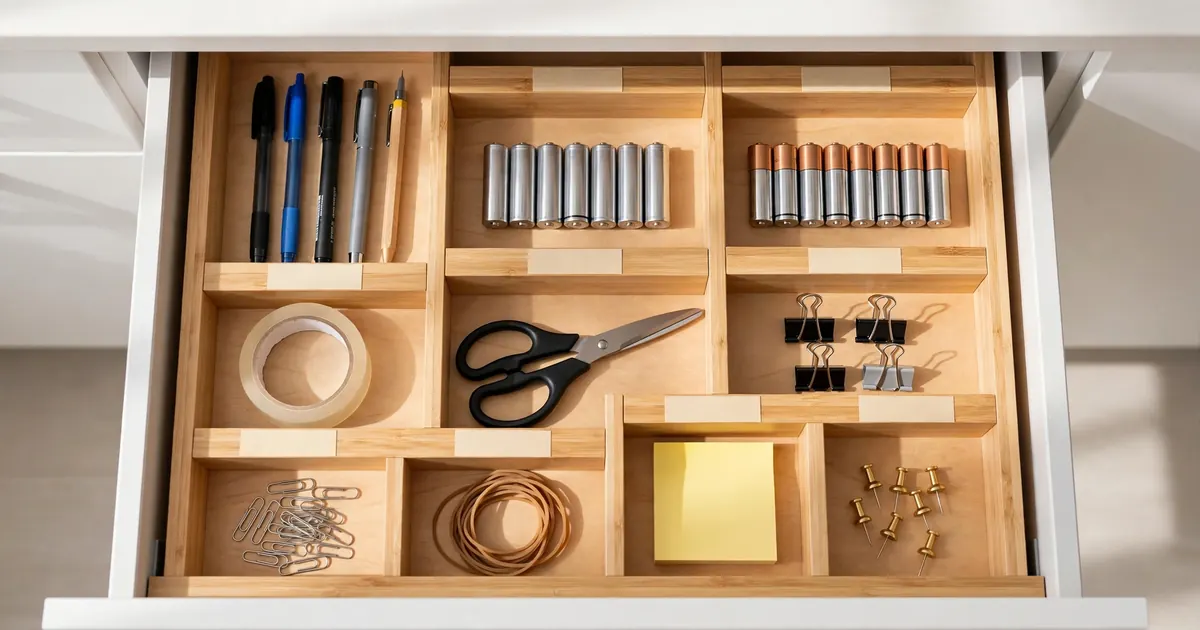
Here’s the thing most organizing advice gets wrong about junk drawers: it doesn’t need a complicated system. It needs a few visible zones so items stop sliding around and mixing together. A cheap drawer divider tray works, but honestly, small boxes, a mug, or a couple of ramekins you already own do the same job. (If you want to go further and rework your kitchen drawers properly, these kitchen drawer organization ideas pair well with what you’re doing here.)
Aim for four or five zones, no more:
- Quick tools: scissors, tape, small flashlight, measuring tape — the things you grab most.
- Writing: two pens, a small notepad or sticky notes.
- Everyday extras: batteries in a labeled bag, a few rubber bands, binder clips.
- Small fixes: a mini screwdriver, super glue, a needle and a couple of safety pins — a tiny repair kit, basically.
- The in-between tray: one small tray or corner for the week’s strays — the receipt you need until Friday, the key your neighbor left. The difference from before: this tray has a boundary and a weekly emptying, which is what makes it a landing zone instead of a junk pit.
Resist the urge to add more zones. Every extra compartment is an invitation for new categories of clutter to move in.
Keeping It From Turning Into a Junk Drawer Again
A decluttered drawer re-fills itself within a month if nothing changes — because the drawer was never the problem; the habit was. Three small habits keep it honest:
The ten-second rule. When you’re about to drop something in the drawer, pause and ask whether it belongs there or in its real home. Ten seconds of effort now saves a full declutter later. Most items belong somewhere else, and walking the extra twelve steps is the whole game.
Empty the in-between tray weekly. That little landing tray is your pressure valve. Once a week — during your ten-minute evening reset, say — dump it, file or toss each item, and start the week empty.
One in, one out. Every time a new item enters the drawer, something leaves. New flashlight? The old one goes. New tape measure? The old one goes to the toolbox. It’s the simplest possible maintenance rule, and it works across your whole house — the drawer is just the easiest place to start.
A Calmer Kitchen, One Drawer at a Time
The junk drawer is the smallest decluttering project in your home and, pound for pound, the most satisfying one. Twenty-five minutes from now you can open that drawer and see everything in it at a glance — tools you actually use, each in its own zone, nothing dead, nothing mysterious. And once you’ve felt that small daily win every time you reach for the scissors, you’ll start eyeing the next drawer. That’s how real, lasting decluttering happens: one small, finished victory at a time.
[…] of the stuff that multiplies in drawers — if your utensil drawer needs the same treatment, our 25-minute junk drawer method works on the same […]
[…] it’s basically the junk drawer of the car, so treat it with the same firm rules you’d use for a junk drawer: keep only what you actually use. Limit it to charging cables, a small pack of tissues, hand cream, and your parking pass or garage […]
[…] tape and scissors together. If you want a step-by-step for this drawer specifically, this guide on how to declutter a junk drawer in 25 minutes breaks it down beautifully. For a longer-term fix, these kitchen drawer organization ideas will […]