
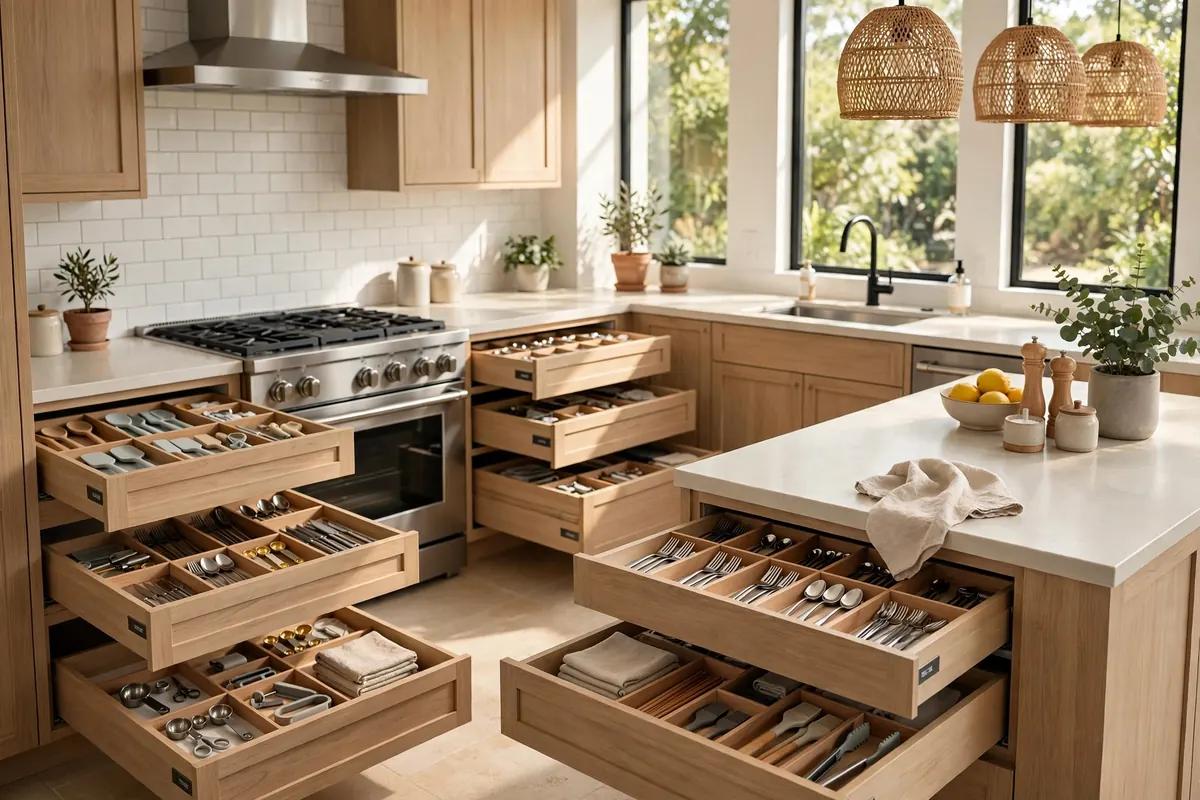

Every home has one: the drawer that swallows batteries, rubber bands, takeout menus, and a screwdriver from 2014. Mine got so bad I once found three pairs of scissors in there and couldn’t tell you where any of them came from. The junk drawer had officially become a junk room with a handle.
Here’s the thing nobody tells you: kitchen drawers are actually the easiest storage in your whole house to fix. They’re small, contained, and one drawer takes twenty minutes tops. These kitchen drawer organization ideas work drawer by drawer, starting with the one you open most and ending with the one you’ve been avoiding.
Why Drawers Beat Cabinets for Daily Cooking
Quick case for drawers before we start: everything in a drawer is visible at a glance and reachable without bending into a dark cabinet. The items you use every day — utensils, spices, wraps — belong in drawers, not on high shelves. If your drawers are currently chaos, you’re paying a small tax of frustration every single morning. Let’s get that back.
Idea 1: Build a Real Utensil System
The utensil drawer is the most-opened drawer in most kitchens, so it gets fixed first. Pull everything out and lay it on the counter — all of it.
Now be honest: how many spatulas does one household need? Keep the ones you actually reach for. The melon baller you used once in 2021, the third wooden spoon, the avocado slicer that never worked right — donate or toss. I kept exactly one of each tool I use weekly, and cooking got noticeably calmer.
Then give every tool a defined slot. An expandable bamboo divider is the workhorse here: it adjusts to your drawer width, the compartments keep things from sliding into a pile, and bamboo wipes clean. One utensil type per compartment — forks with forks, not forks with “miscellaneous.”
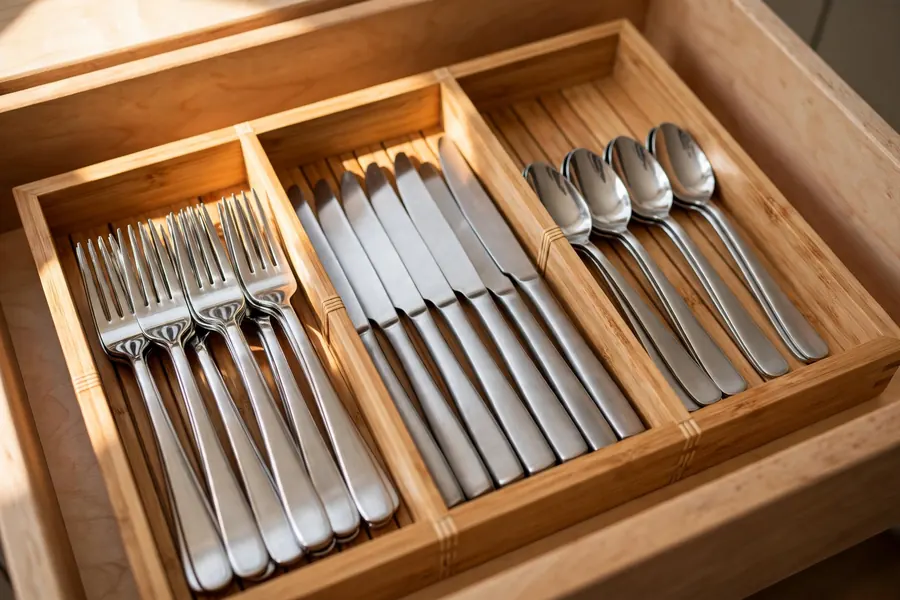
The test going forward: if a new gadget can’t earn its own compartment, it doesn’t move in.
Idea 2: Rescue the Junk Drawer in 20 Minutes
Yes, we’re doing this today. Set a timer for twenty minutes — that’s genuinely all it takes.
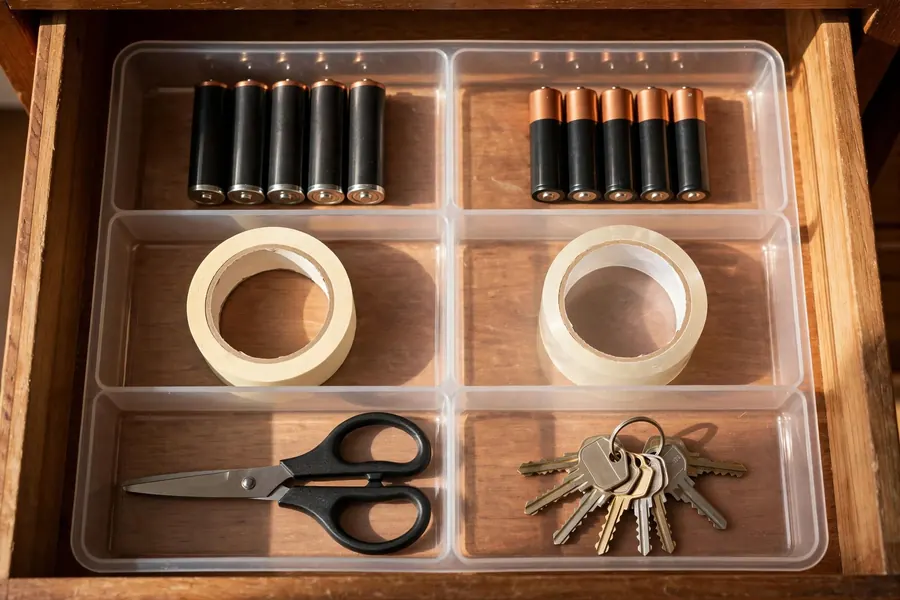
Dump the whole drawer onto the counter and sort into small piles: tools, batteries, tape and scissors, keys, chargers, paper, trash. The trash pile will be bigger than you expect. Dead pens, dried-up glue sticks, expired coupons, takeout menus for restaurants that closed — all of it goes.
What earns a spot back in the drawer: scissors, tape, a screwdriver, batteries, a flashlight, one notepad, one pen that works. That’s a working drawer. What doesn’t: anything you haven’t touched in a year, anything you own three of, and anything whose purpose you can’t name.
Finish with small compartment trays or even repurposed boxes so each category has walls around it. A junk drawer without compartments becomes a junk drawer again within a month — the dividers are what make the rescue stick.
Idea 3: Turn Deep Drawers Into Pot and Pan Stations
Deep drawers are where pots go to become an avalanche. The fix is embarrassingly simple: store pans vertically, like files in a filing cabinet, instead of stacked. A simple vertical rack insert or even a tension rod setup lets you slide one pan out without lifting four others.
Lids are the real troublemakers. Give them their own system — a lid organizer rack on the drawer side, or store lids on the cabinet door next to the drawer. The rule is: no lid should ever sit loose on top of a pan stack again. Loose lids are how the avalanche starts.
Keep this drawer near the stove. It sounds obvious, but I’ve seen plenty of kitchens where the pots live across the room from where they’re used. Cooking flows better when heavy items live close to their workstation.
Idea 4: Give Spices a Drawer of Their Own
If your spices live in a cabinet where you can’t see the back row, you probably own two cumin jars and no idea which paprika is fresh. A spice drawer fixes this completely: lay jars flat in a tiered insert so every label faces up. You see everything at once, and duplicates become obvious.
Decant into matching small jars if mismatched containers bother you, and label the lids — you’ll thank yourself when you’re mid-recipe with floury hands. Alphabetical order sounds fussy until you try it; then it feels like common sense.
No spare drawer? A narrow pull-out or even a tiered riser inside a cabinet gives you most of the same benefit. The principle is visibility: if you can’t see it, you’ll buy it twice.
Idea 5: Measure Before You Buy a Single Organizer
This is the mistake I see most often, and I made it myself: buying beautiful dividers, bringing them home, and discovering they’re half an inch too wide. Measure every drawer — width, depth, and height — before you order anything. Write the numbers in your phone.
Expandable dividers forgive small measuring errors, which is why they’re my default recommendation. Fixed trays look tidier but demand exact measurements. And skip anything with a strong smell or flimsy plastic — you’ll be touching these every day, so buy the decent ones once instead of the cheap ones twice.
For the full cabinet side of this project, How to Organize Kitchen Cabinets: A Step-by-Step System That Sticks pairs perfectly with what you’ve done here.
Idea 6: Zone Each Drawer by Task
The final piece: assign every drawer a job based on where it sits. Cooking utensils and potholders go in the drawer nearest the stove. Prep tools — peelers, measuring cups, mixing spoons — go near the main prep counter. Wraps, bags, and foil go near where you pack lunches or store leftovers.
When every drawer has a task, putting things away stops being a decision. The spatula goes in the cooking drawer because that’s its job. Family members (and guests) can figure out the system without being told, which is the real test of whether your organization actually works.
If your kitchen is short on space overall, our Small Kitchen Organization Ideas That Actually Maximize Space has more ways to squeeze function out of every inch.
Keeping Drawers Organized: The 5-Minute Monthly Reset
Drawers drift. A utensil migrates, a random screw appears, someone puts the pizza cutter in with the baking tools. That’s normal — the fix is a five-minute reset once a month. Pull out the strays, wipe the drawer, put everything back in its compartment. I do mine while waiting for the oven to preheat.
Pair it with a one-in-one-out rule for kitchen tools: a new gadget comes in, an old one goes out. Kitchen drawers have fixed real estate, and respecting that boundary is what keeps the system working years from now.
Frequently Asked Questions
What’s the best drawer organizer material?
Bamboo for utensil drawers — it’s sturdy, looks good, and wipes clean. For junk drawers, inexpensive plastic compartment trays are fine since nobody sees them. Avoid anything flimsy enough to slide around when you open the drawer.
How do I organize drawers without buying anything?
Repurpose what you have: small boxes, jam jars for pens and tools, cut-down cereal boxes as drawer dividers. The system matters more than the materials — compartments and categories work whether they’re bamboo or cardboard.
My drawers are very shallow. What fits?
Shallow drawers are perfect for flat things: spices laid flat, wraps and bags, placemats, or a slim cutlery tray. Keep bulky items in the deep drawers and let the shallow ones handle the flat stuff they’re built for.
Start with the utensil drawer today — twenty minutes, one divider, done. Then tackle the junk drawer tomorrow. By the end of the week, every drawer you open will feel like a small gift instead of a small chore. And if your pantry needs the same treatment, Pantry Organization Ideas on a Budget: A Practical Walkthrough is waiting.
[…] everything without lifting a single jar. For more inspiration on making drawers work harder, our kitchen drawer organization ideas cover inserts and dividers for every drawer in the […]
[…] you into keeping the melon baller. If your drawers need the same treatment beyond utensils, our kitchen drawer organization guide covers the full drawer-by-drawer […]