


Last spring I found my daughter’s field-trip permission slip three days after the deadline, folded into a kitchen-counter pile of pizza coupons, an expired car insurance card, and someone else’s grocery receipt. I had walked past that pile for weeks. Every morning it said deal with me, and every morning I said later, until later turned into a missed field trip and a teary six-year-old. If you want to declutter paper clutter for good, here’s what I learned: the problem was never the paper itself. It was that every single piece demanded a tiny decision, and I had no system for making those decisions fast.
Paper is the sneakiest clutter in any home. A shirt you don’t wear is obviously clutter. But a bank statement from 2019? An instruction manual for a microwave you no longer own? They sit in a gray zone of maybe important, and so they accumulate on counters, in drawers, in that shoebox on top of the fridge. That visual noise greets you while you make coffee every morning. The good news: of all clutter types, paper is the fastest to beat, because most of it isn’t clutter at all — it’s just unprocessed decisions. Give yourself an afternoon, a simple system, and two minutes a day, and those piles never come back.
Why Paper Clutter Multiplies Faster Than Everything Else
Everything else in your house mostly stays put. Your closet doesn’t grow a new shirt on its own. But paper? Paper arrives daily, uninvited, whether you want it or not. The mail carrier delivers whether you sorted yesterday’s batch or not. Your kids bring home permission slips, fundraiser packets, and worksheets with macaroni glued to them. It’s a treadmill, and if you don’t have a routine for stepping off it, the paper just keeps piling.
Then there’s the guilt factor. Throwing away a mug is easy; throwing away a document feels risky. What if the IRS comes asking for that receipt? What if you need the warranty? (You won’t. The warranty expired before the printer broke.) Psychologists call this loss aversion — we weigh a potential future loss more heavily than the certain daily cost of clutter. But the daily cost is real: missed bills that turn into late fees, appointments you forgot, tax documents you can’t find in April, and that low-grade background anxiety of a house that never feels quite handled.
Here’s the reframe that changed everything for me: you are not keeping the paper. You are keeping the information. And information can live in a photo, a scan, a digital statement, or simply your memory of having handled it. Once you separate the information from the physical sheet, about 80 percent of your paper clutter becomes recyclable in the first hour. The remaining 20 percent just needs a home.
How to Declutter Paper Clutter in One Afternoon
Forget buying a filing cabinet, color-coded folders, and a label maker on day one. That’s the classic mistake — organizing supplies before you know what you actually need to store. You don’t need a prettier container for junk. You need a decision system. Here is the exact process I used to clear two years of accumulated paper in a single Saturday afternoon, and the same process I now use with friends when they ask for help.
Step 1: Gather every scrap into one pile
Walk through your house with a laundry basket and collect every loose paper: the kitchen counter pile, the dining table drift, the receipts in your bag, the stack on your nightstand, the mail teetering on the microwave. Every surface, every drawer corner, every I’ll deal with this later stash. Yes, it will look horrifying in one big basket. That’s the point — you’re finally seeing the whole monster instead of its scattered shadows.
Before you start sorting, set up four stations on your cleared dining table: Act (bills to pay, forms to fill), File (long-term keepers), Shred/Recycle (junk plus anything with personal info you no longer need), and a small Question pile capped at 20 pieces, with a one-week decision deadline.

Step 2: Sort fast and ruthlessly
Now work through the basket piece by piece. Your rule: touch each paper once and decide in under ten seconds. Junk mail, catalogs you didn’t request, expired coupons, old grocery lists — straight to recycle, no deliberation. Anything with sensitive information you no longer need goes to shred. The same decision muscle you build maintaining a clutter-free home starts right here: fast, kind, final decisions.
What about the sentimental stuff — your kid’s first report card, the birthday card from your grandmother? Don’t mix those into this session. Put them all in one folder marked Memories — Sort Later and give them their own dedicated evening. Mixing sentimental decisions into a mail-sorting session is how a two-hour project becomes a three-day emotional marathon; there’s a thoughtful approach to decluttering sentimental items when you’re ready. Today is about the mail, the bills, and the piles.
Step 3: Process the Action pile immediately
Build the payoff into the same afternoon: sit down with your laptop, pay the bills, RSVP to the wedding, call about the medical form. Anything that takes under two minutes, do now. For anything bigger, write the specific next step on a sticky note and attach it — a concrete task gets done, a vague one gets avoided.
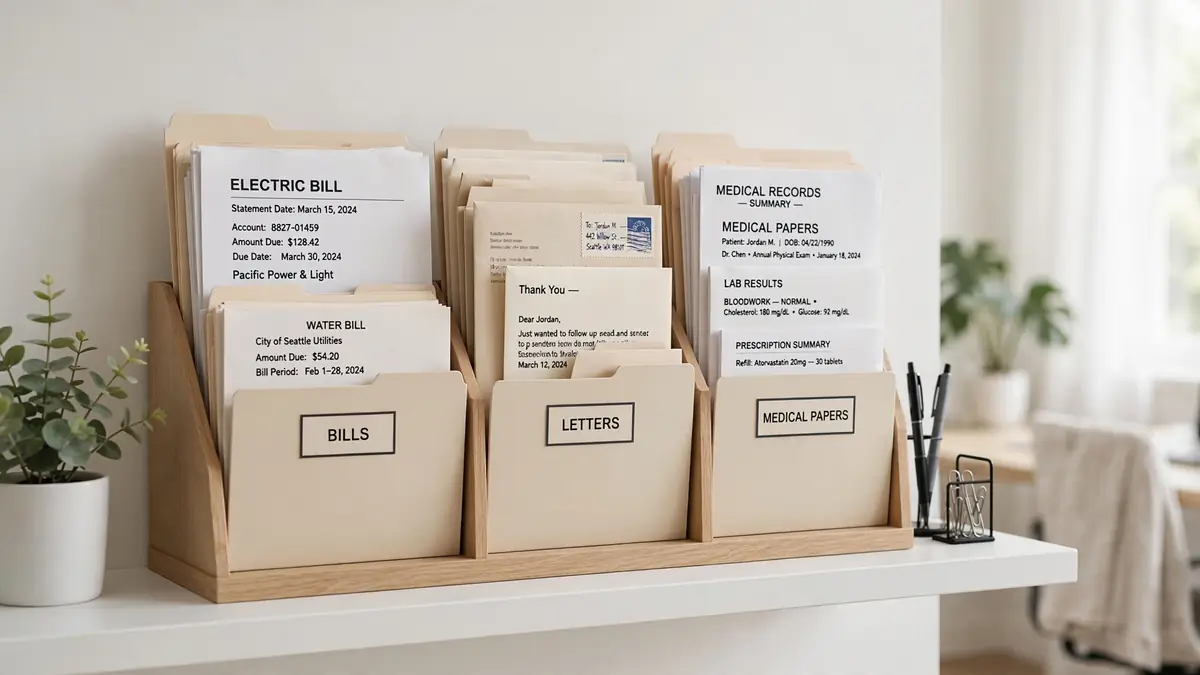
The File pile is what remains. Resist the urge to create thirty categories. Most households need just five to seven: Taxes, Home, Medical, Auto, Kids/School, and Personal ID. Plain manila folders in a desktop file box work perfectly. If you already have a filing cabinet, wonderful — but never buy storage before you know what survives the sort.
What to Keep, Shred, or Recycle: A Simple Retention Guide
The single biggest question I hear is how long do I actually need to keep this? Here are practical, conservative guidelines that work for most US/UK households (adjust for your country’s tax rules):
- Keep forever (in a safe place): birth, marriage, and death certificates; passports; Social Security or national ID cards; property deeds and titles; wills and estate documents. Scan these too, so you have a digital backup.
- Keep for 7 years: tax returns and supporting documents (receipts, W-2s, 1099s, charitable donation records). This is the standard audit window.
- Keep for 1 year: bank statements (or go paperless and download them), pay stubs (keep the last one of the year), medical bills until the claim is settled, insurance policies until renewed.
- Keep until the warranty/service ends: appliance manuals and receipts — though honestly, nearly every manual is available online, and the model number on a phone photo beats a forty-page booklet.
- Shred immediately when done: credit card statements you’ve reviewed, old medical Explanation of Benefits, anything with your full account number, old ID documents.
- Recycle without a second thought: junk mail, catalogs, expired coupons, old magazines and newspapers, envelopes the important letter arrived in (keep the letter, not the envelope), receipts for things you’d never return.
A good test for everything: could I get this information again if I needed it? Your bank can reissue a statement. Your utility company has your billing history. If the answer is yes, the paper is almost certainly not precious. And that dreaded shoebox of receipts? Keep only tax-relevant ones, snap a photo of the rest for expense tracking, and let the box go. If you’ve been meaning to digitize old documents, a proper digital declutter makes the paper-to-digital leap far less intimidating than it sounds.
The Two-Minute Mail Habit: Declutter Paper Clutter Once, Then Never Again
Clearing the backlog is only half the victory. The two-minute mail habit is what keeps you from ever needing another paper-purge afternoon, and it’s embarrassingly simple: deal with your mail the same day it arrives, the moment you walk in the door. Stand over the recycling bin — this is key — and triage every piece in under two minutes.
- Junk and catalogs: straight into recycling, unopened. Don’t even read the cover. If the same catalog comes twice, call or go online to cancel it.
- Bills and action items: into one tray, basket, or wall-mounted inbox labeled Action. Everything in this tray gets handled on your weekly bill day.
- Keepers: file immediately into your five folders. Immediately. Not “later.” The later pile is where clutter is born.
- Kids’ papers: into a dedicated in-box per child. Deal with school papers in the same two minutes: sign what’s needed, photograph the artwork you love, recycle the rest.
Then, once a week — Sunday evenings work beautifully — spend fifteen minutes clearing the Action tray. Pay the bills, file what’s left, shred what’s done. Pair it with something pleasant: tea, music, a podcast. Many people fold this into a simple weekend reset routine so the whole house gets a refresh at once. Fifteen minutes a week is the entire ongoing cost of a paper-free home.
One more high-leverage move: reduce the inflow. Sign up for paperless billing with your bank, utilities, and insurance — most providers offer it in one click. Opt out of pre-approved credit card offers (in the US, optoutprescreen.com; in the UK, the Mailing Preference Service). Unsubscribe from catalogs you never open. Every piece of mail you stop is a piece you never have to sort, file, or feel guilty about again. This is the for good part of the equation.
The Tricky Stuff: Kids’ Papers, Receipts, and Guilt
Let’s be honest about the three categories that make everyone freeze. Kids’ papers first: you do not need to keep every worksheet. Keep one slim folder per child per school year — a few representative pieces, the report card, maybe the truly special art project. Photograph the rest and let the paper go. Your child will not remember the seventeen identical handwriting practice sheets; they’ll remember that you were present. A phone photo keeps the memory without keeping the mountain.
Receipts are simpler than they feel. Ask: is this tax-relevant, or for something I might return? If neither, recycle it. For tax-relevant receipts, snap a photo into a dedicated phone album or scanning app the day you get them — the thermal ink fades within months anyway, so the photo is actually the more reliable record. Business owners: a single monthly habit of photographing receipts beats a shoebox of faded slips every time.
Guilt is the real clutter. The unread magazine you paid for. The letter you meant to answer. Here’s the truth nobody says out loud: keeping a magazine you won’t read doesn’t honor the subscription — canceling the subscription does. Keeping a letter you feel bad about doesn’t answer it — a two-line reply does. Paper is just paper. The people and purposes behind it deserve your action, not your guilt-pile.
Going Paperless Without Losing Your Mind
You don’t have to become a zero-paper household overnight. Start with the easy wins: paperless statements (you probably check everything online anyway), digital receipts at checkout, and a free phone scanning app for warranties and medical records. Name files clearly — 2026-tax-return.pdf, not scan003.pdf — back them up to cloud storage, then shred the originals with confidence.
The goal isn’t a paper-free life. It’s a life where paper has a landing spot, a decision rule, and an exit route: mail lands in the tray, every piece gets a ten-second decision, survivors go to a folder, a photo, or a scan. No elaborate color-coding system required.
A Calmer Counter Is Closer Than You Think
My daughter still mentions the field trip she missed — but she also watched me tame every paper in our house that weekend, and now she has her own little school-paper tray on the counter, which she empties herself. Kids learn systems by watching them.
You don’t need a perfect system. You need a system: one basket for gathering, four quick decisions per piece, two minutes a day, fifteen minutes a week. Start this afternoon — grab the laundry basket, walk your house, and see just how much of that paper is already done with you. Your counter is about to breathe again.
[…] of a pile that no longer judges you. If paperwork is your particular nemesis, our guide to how to declutter paper clutter goes even deeper on taming mail, bills, and […]