

Last spring, I was hunting for a roll of packing tape in the kitchen junk drawer and found four pairs of scissors. Four. In one drawer. Two were blunt, one had tape residue gumming up the blades, and the fourth — the one I actually reached for — worked perfectly. That little moment of drawer archaeology is how I started decluttering duplicates, and honestly, it is the decluttering project with the highest payoff for the lowest effort I have ever done.
Most of us never set out to own seven spatulas, eleven coffee mugs, or five phone chargers for a phone that only needs one. Doubles accumulate quietly: a replacement bought before the original wore out, a gift that overlaps with something you already own, a backup you kept “just in case” and never touched again. Individually they seem harmless. Together, they fill drawers, crowd shelves, and make everyday routines — cooking, getting dressed, charging your phone — feel oddly fiddly and slow.
The fix I’ve landed on is beautifully simple, and I call it the rule of one: for each everyday item, keep one good version — the one you actually reach for — and let the rest go. Not one plate total (that would be silly). But one of each kind you truly need. It sounds strict until you try it, and then it feels like a small miracle.
Why We End Up with So Many Doubles: The Quiet Psychology
Before we talk about the letting-go part, it helps to see the sneaky ways duplicates get in, because you will keep repeating the pattern until you notice it. Nobody sits down and decides to own three potato peelers. It happens in five quiet ways:
- The “I’m sure we’re out of that” purchase. You buy mustard, tape, or batteries assuming you have none — then find two of each already at home. This is the single biggest source of kitchen and utility-drawer doubles.
- Replacing instead of retiring. You buy a new spatula or pair of earbuds, and the tired old one stays “as a backup” you never touch. A year later it is just clutter with seniority.
- Gifts that overlap. A relative buys you a coffee maker when yours works fine. Saying thank you does not obligate you to keep it forever.
- The bargain bundle. Buy-one-get-one and “only a pound more for the set of six.” The unit price is great; the storage cost is not.
- Cleaners. Half-used duplicates gather under the sink like pigeons. Keep one of each type, finish it before opening another, and check dates while you are down there.
Notice what all five have in common: none of them was a conscious choice to own two. Duplicates are almost never intentional. That is exactly why decluttering duplicates feels so good — you are not giving anything up. You are just correcting accidents.
Decluttering Duplicates with the Rule of One: What It Actually Means
Here’s the rule, plainly stated: keep one good version of each thing you use, and one sensible backup only where a failure would genuinely cost you (a spare house key, perhaps one extra phone charger for travel). Everything beyond that is a candidate for donation, resale, recycling, or the bin.
Let me be clear about what this is not. It is not about suffering, and it is not about counting your possessions like a contestant on a reality show. If your household of four genuinely uses four water bottles, that is the right number. The rule of one targets the unchosen extras — the third identical frying pan, the mug collection that quietly grew to fourteen, the five almost-identical black cardigans.
Professional organisers back this up: when asked what minimalists always get rid of after a big declutter, duplicates top the list — extra kitchen gadgets, duplicate bedding, doubled-up cleaning products. It is also the sweet spot of decluttering effort: you do not agonise over your second vegetable peeler the way you agonise over old letters. The decision is almost boring, and boring decisions are wonderful when you have hundreds to make.
The rule of one also pairs beautifully with maintenance systems you may already use. If you follow the one-in-one-out rule, the rule of one is its stricter older sibling: instead of merely keeping your numbers stable, you actively shrink them to what you actually use. Run both together and your home stops gaining clutter almost entirely.
Start in the Kitchen: The Easiest Wins in the Whole House
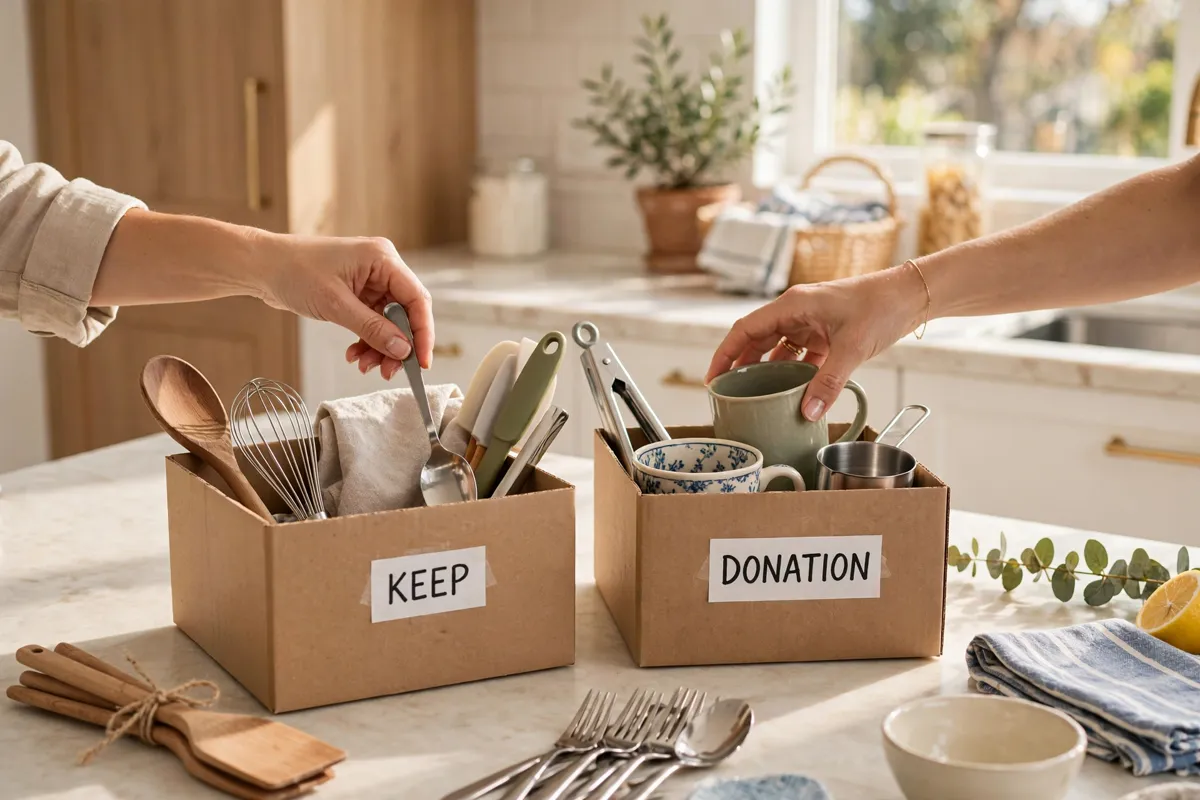
The kitchen is the duplicate capital of the home, which makes it the perfect starting point. Everything here is low-emotion, which means decisions are fast. Pull out every item in one of these categories, line them all up on the counter where you can see them together, and the right number to keep becomes obvious in seconds.
- Coffee mugs and glasses. Keep one per regular coffee drinker plus two or three for guests. If you host six people twice a year, borrow or rent. Fourteen chipped promotional mugs are not a collection; they are a crowd.
- Spatulas, wooden spoons, and ladles. Lay them all out. You will use two, maybe three. The rest — including the one with the melted edge you keep skipping past — can go.
- Plastic containers. Every lidless tub and every lid without a tub goes straight to recycling. Keep five to eight matched pieces, one brand if possible, so they nest and stack.
- Single-use gadgets. The avocado slicer, the strawberry huller, the third garlic press. A sharp knife does all three jobs. Keep the tools you reach for weekly; donate the “clever” ones you forgot you owned.
- Cleaning sprays. Half-used duplicates gather under the sink like pigeons. Keep one of each type, finish it before opening another, and check dates while you are down there.
That last trick — gathering every item of one category into a single visible pile — is the whole secret. When twelve mugs stand on the counter together, you do not need discipline to let four go. The pile does the convincing for you.
The Linen Closet, the Wardrobe, and the Cable Drawer Audit
Once the kitchen is breathing again, take the same pile-and-choose approach to the soft goods and the tech tangles:
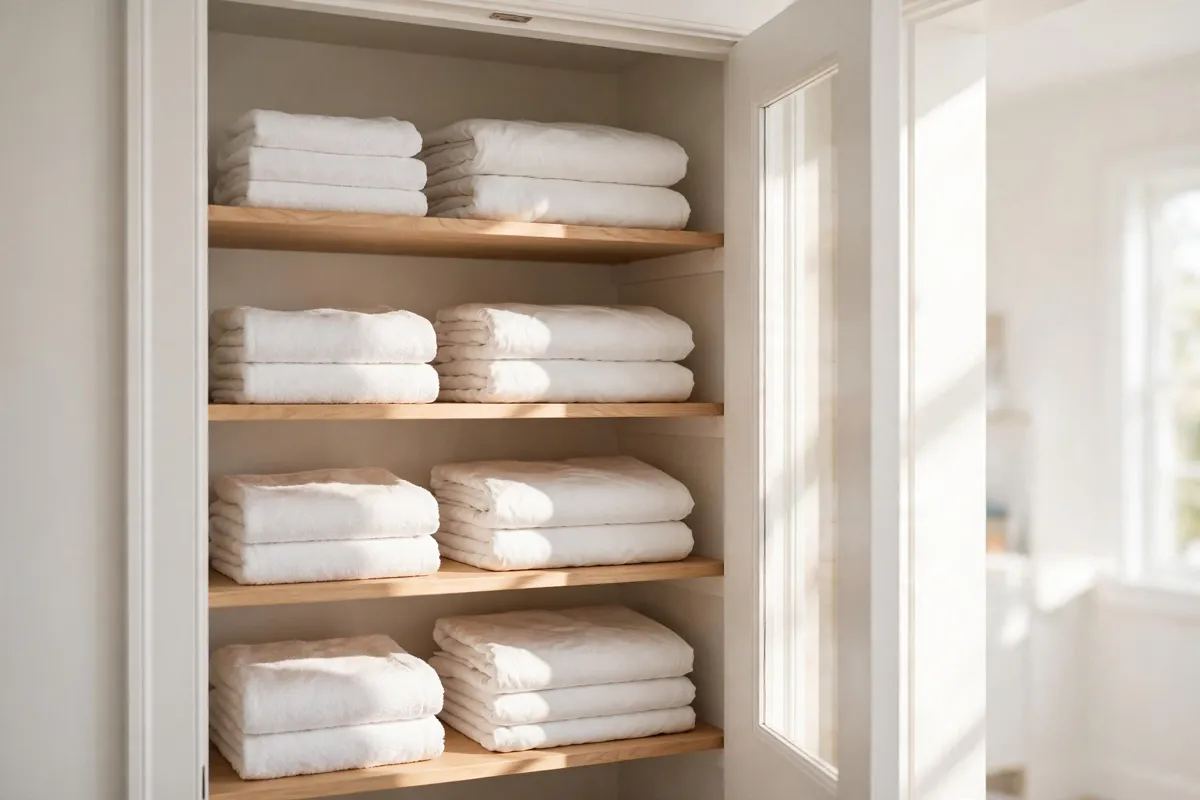
- Towels. Two bath towels per person is plenty — one in use, one in the wash. Add extras only if you regularly host overnight guests. The stack of twelve, including the scratchy promotional ones, is costing you shelf space and laundry sorting time.
- Bedsheets. Two sets per bed, maximum. One on the bed, one clean in the closet. The third set that has sat folded for a year “just in case” is not coming to the rescue.
- The wardrobe echo. Look for the row of the same shirt: three near-identical white tops, four black sweaters. Keep the two you reach for most and release the ones you consistently skip. The skipped ones are not backups; they are proof you already chose your favourites.
- Chargers and cables. Keep one good charger per place you charge (bedside, desk, bag) and recycle the rest — frayed ones are a fire risk anyway. Legacy cables for devices you no longer own go straight to electronics recycling. No ceremony needed.
- Half-used toiletries. Under-sink duplicates of shampoo, lotion, and sunscreen multiply quietly. Consolidate: finish one before opening the next, and check expiry dates — sunscreen stops working properly after a couple of years.
A word on numbers: these are guidelines, not laws. A family of five needs more towels than a solo dweller, and a baker needs more mixing bowls than someone who orders takeaway. The rule of one asks only that each item earns its place by being used, not merely owned.
When It Is Hard: Sentimental Doubles and the “Just in Case” Drawer
So far, everything has been easy — mugs and cables do not have feelings. The doubles that actually slow people down are the emotional ones: your grandmother’s second teacup set, the duplicate baby blanket, the backup blender from a wedding gift that you never unboxed but cannot quite bin because someone chose it for you.
Here is the reframe that helps: the memory lives with you, not in the cupboard. You can honour your grandmother beautifully with one teacup you actually drink from. The other eleven, gathering dust in the attic, are not carrying the memory — you are.
For the genuinely tricky cases, I use a three-step ritual that has never failed me:
- Photograph it first. Take a proper photo of the duplicate — in good light, the way it looked when it mattered. The photo preserves the memory in a fraction of the space, and the act of photographing feels like a respectful goodbye.
- Give the extra a better home. Donate the duplicate to someone who will actually use it, or gift it to a friend who admires it. Turning guilt into generosity transforms the whole emotional equation.
- Run the replacement test. Ask yourself: if I needed this again, could I replace it for very little money, in very little time? If the answer is yes — and for most household doubles it is — then the “just in case” argument quietly collapses. You are not losing the item; you are losing a worry.
If sentimental clutter is your sticking point in general, not just with duplicates, we have a whole guide on decluttering sentimental items that walks through the keepsake box method and the guilt-free goodbye in more depth. And if the inflow of new things is part of the problem, a no-buy month is a surprisingly joyful reset — it breaks the buying habit that creates tomorrow’s duplicates.
Stopping the Doubles from Creeping Back: The Five-Minute Scan
Decluttering duplicates once is satisfying; keeping them gone is where the real calm lives. Fortunately, prevention is much easier than the initial purge. Build these three habits and the doubles will never quietly multiply again:
Shop your own home first. Before buying anything you already own in some form — tape, batteries, that third black sweater — check your drawers. This one habit would prevent most duplicate purchases. Pair it with a twenty-four-hour pause on non-essential buys, and the “I’m sure we’re out of that” purchase almost disappears.
Do a five-minute scan once a season. Set a timer and open one duplicate hotspot per room: the utensil drawer, the mug shelf, the cable drawer, the towel stack. Count, trim, close the drawer. I do mine at the change of seasons — it takes less time than scrolling a feed, and the calm lasts for months.
Do not forget the digital doubles. Most of us carry hundreds of near-identical photos, three note-taking apps doing the same job, and cables for phones we no longer own. A quick pass — deleting burst-mode photo duplicates, keeping one app per job — gives the same lightness in your pocket that the rule of one gives your kitchen. Our guide to digital decluttering walks through the whole process if your phone needs the treatment too.
None of this requires a personality transplant or a weekend-long purge. It is a series of tiny, almost boring decisions — and that is precisely the point. Small, repeatable beats dramatic and exhausting every single time.
The Quiet Payoff
Here is what nobody tells you about decluttering duplicates: the payoff is not just the empty shelf space, lovely as that is. It is the end of the tiny daily frictions — the drawer that finally opens smoothly, the three seconds you no longer spend choosing between seven spatulas, the calm of knowing exactly which charger is yours.
You do not need less of everything. You just need one of most things — one good one, chosen on purpose, used with pleasure. Start with the mugs this weekend. The scissors drawer can wait until you need the tape.
[…] items that deserve better than a dark cave. While you’re deciding, check for duplicates — the rule of one for decluttering duplicates shows how fast doubles pile up in exactly this kind of […]
[…] have multiples of anything — two umbrellas, three pairs of black flats, five tote bags — let the rule of one guide you toward keeping only the best of each kind. Duplicates are the silent bulk of entryway […]
[…] testing. Keep two working pens maximum. If you have a drawer full of hotel pens “just in case,” a rule for dealing with duplicates will free you from the whole category at […]
[…] naps in — and which were just filling square footage. This is the same discipline behind the rule of one: when you see your duplicates side by side, the keepers announce […]
[…] A “no” to the duplicates question means keep the best one and move the rest along — the rule of one for duplicates works beautifully in a gym, where extra sets of the same weight serve […]
[…] thing you haven’t touched since spring. If you want the full logic behind killing duplicates, our rule of one guide covers it in depth — bathrooms are where duplicates multiply […]