


Simple living with kids sounds like a contradiction. Anyone who has stepped on a plastic dinosaur at midnight or opened a cupboard only to be buried under board games knows exactly why. Yet some of the calmest, most welcoming homes I have ever visited belong to families with three children under ten. Their secret is not that their children own nothing, or that they spend every evening tidying. It is that they made a handful of deliberate choices early on, and then let those choices do the heavy lifting day after day.
Here is the honest truth: a family home will never look like a showroom, and it should not. Children play, build, spill, and create, and that is a good thing. The goal is not a spotless house. The goal is a home where you can find what you need, sit down without moving a pile first, and end the day without that heavy, frazzled feeling that the stuff is winning. That is entirely possible, even with small children, a busy schedule, and a modest budget.
Why Simple Living With Kids Feels So Hard
Most of the clutter in a family home does not arrive in one dramatic flood. It creeps in: a party bag here, a school project there, a well-meaning gift from a grandparent, a toy that seemed like a good idea at the shop and was forgotten by Tuesday. Multiply that by every birthday, holiday, and school term, and suddenly every surface is full.
There is also an emotional layer that makes family clutter harder to shift than our own. We keep the tiny shoes because they mark a stage that is already gone. We keep the lopsided clay pot because a small person made it with enormous pride. Guilt whispers that getting rid of things means we do not value the person who gave them. None of that makes you a bad parent or a messy person. It makes you human. But once you see the pattern, you can deal with it kindly rather than letting it quietly take over your home.
It helps to remember that children do not actually need as much as the toy industry suggests. Ask any parent what their child played with longest last month, and the answer is often a cardboard box, a set of wooden blocks, or a much-loved teddy that has seen better days. If you are just beginning to simplify, a gentle beginner’s guide to minimalism can help you set a realistic starting point before you tackle the toy cupboard.
Start With the Floor, Not the Whole House
The biggest mistake families make is trying to declutter the entire house in one weekend. It ends in exhaustion, arguments, and bags of unsorted things sitting in the hallway for a fortnight. Instead, pick one visible area and finish it properly. The living room floor is usually the best place to start, because it is where the family actually lives.
Walk into the room with a laundry basket and remove everything that does not belong there. Not sort, not organise — just remove. Put the basket by the door and return each item to its real home, or into a donation box if it has no home at all. Then look at what is left with fresh eyes. Does the room need that extra chair nobody sits in? Does the coffee table need a tray of magazines nobody reads? One clear room changes how the whole house feels, and it gives you proof that the system works before you move on.
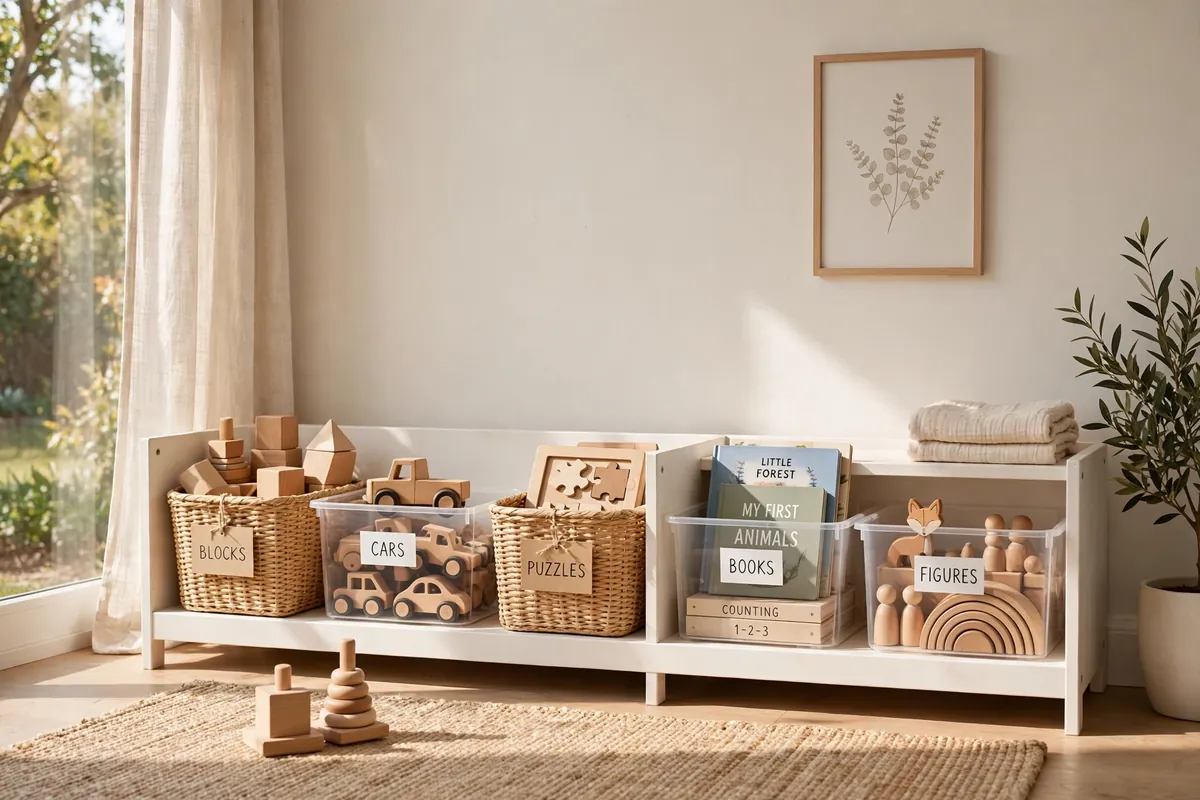
Once the floor is clear, protect it with one simple rule: everything in this room has a home, and the home is easy for a child to use. Low baskets beat high cupboards. Open shelves beat boxes with lids that never get closed. If putting something away takes more than ten seconds, children will not do it — and honestly, most adults will not either. Design for real life, not for a photograph.
The Toy Rotation That Actually Works
Toy rotation is one of those ideas that sounds wonderful in theory and collapses in practice, usually because it becomes another chore. The version that works in real family homes is deliberately simple:
- Keep out roughly a third of the toys. Choose a mix: something to build with, something to pretend with, something creative, and one or two favourites that never rotate out.
- Box the rest in clear, labelled bins in a cupboard, garage, or top of a wardrobe — somewhere accessible to you but not to small hands.
- Swap one bin every week or two, ideally on a Sunday evening or whenever your week turns over. The “new” toys feel exciting all over again, and you have not spent a penny.
- Let go of what never gets chosen. If a toy sits through three rotations untouched, it is safe to donate it. Your child will not miss what they never reach for.
This works because it tackles the real problem, which is not the number of toys your child owns but the number visible at once. A mountain of toys overwhelms a child just as it overwhelms an adult. Fewer choices mean longer, deeper play — and a living room floor you can actually walk across. It also ends the constant cycle of buying something new to spark interest when the interest was only ever buried under too much choice.
Routines That Do the Tidying for You
Willpower is a poor tidying system. Routines are a brilliant one, because they remove the daily decision about when to tidy. You do not need many, and they should be short enough that a tired parent and a reluctant seven-year-old will both actually do them. The families I know who manage this best rely on just a few anchors:
- The ten-minute evening reset. Set a timer after dinner. Everyone tidies until it rings. Ten minutes is short enough to feel painless, and it means you wake up to a calm house instead of yesterday’s chaos.
- One in, one out. A new toy, book, or item of clothing means an old one leaves. Children understand fairness far better than abstract decluttering, and this rule stops the slow creep.
- The landing strip by the door. One hook per person, one basket for school bags, one tray for keys and post. Mornings become dramatically calmer when everything you need is in one place.
- A weekly fifteen-minute family tidy. Put on music, hand out jobs, and make it fast and a little bit fun. Small, regular habits like these are what keep a minimalist home feeling effortless rather than forced.
The trick is to attach each routine to something that already happens — tidying after dinner, resetting before bed, sorting bags when you walk in. Habits that float freely in the day get forgotten. Habits tied to an existing moment happen almost on their own.
Simple Living With Kids Means Fewer, Better Things
Buying less is not about deprivation. It is about noticing what genuinely gets used and loved, and spending your money and space on that instead. A sturdy wooden train set that survives three children is worth ten flimsy gadgets that break by the weekend. Good-quality shoes that fit properly beat a drawer full of pairs that pinch. One beautiful picture book read a hundred times beats a shelf of books nobody opens.
This is especially true around birthdays and holidays, when well-meaning relatives can undo months of careful simplifying in a single afternoon. A kind, early conversation helps enormously: suggest experiences instead of objects — a zoo trip, baking together, a swimming lesson — or a contribution towards one bigger item your child truly wants. If gifts do arrive in volume, a gentle approach to decluttering gifts without guilt can help you keep the love and let go of the object. And if money is tight, remember that a calmer home costs nothing at all: many families find that simple living on a budget actually saves money, because you stop buying duplicates and impulse items you never needed.
With children, involve them in the choosing. Ask which five toys they would take on holiday, or which books they would keep if the shelf could only hold ten. Children are often far more decisive than adults expect, and deciding for themselves teaches them something no tidy room alone can: that they are in charge of their things, not the other way round.
Make Room for the Mess That Matters
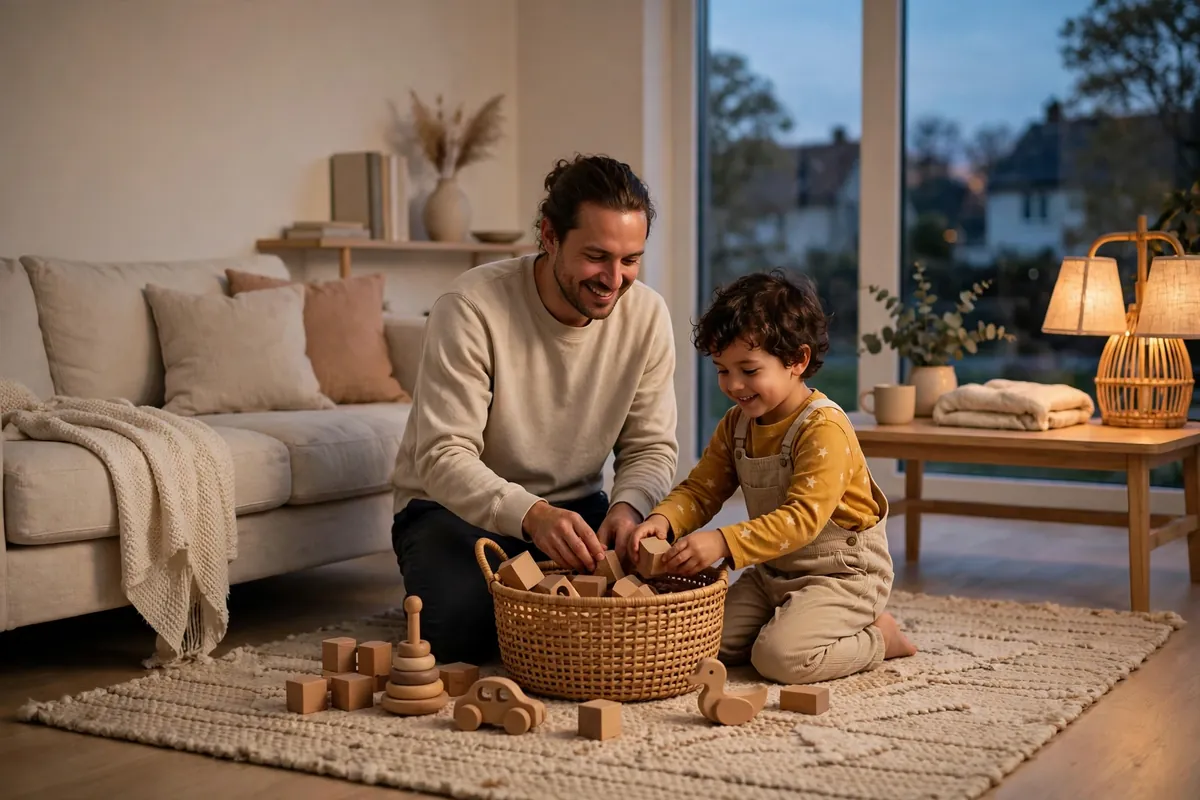
Here is the part that often gets lost in articles about tidy homes: children need mess. Painting, building dens, baking with flour everywhere, mixing potions out of garden leaves — this is how they learn. A home that bans all mess is not calm; it is tense, and children feel that tension. The answer is not less creativity but contained creativity.
Give mess a place and a time. A washable tablecloth for art, a single drawer for craft supplies, a corner of the garden for digging, a baking afternoon where flour on the floor is part of the fun. When the activity ends, the mess ends too, because the supplies go back to their one home. Children accept boundaries far more happily when the boundary is about where and when, rather than a flat no.
It also helps to lower your own bar on the days that matter. A birthday party will be chaotic. A rainy school holiday will produce a living room fort that stays up for three days. That is not failure. That is a family home doing exactly what it is for. Simple living is not a performance to maintain; it is a baseline you return to easily because the systems are already in place.
A Calmer Home, One Small Step at a Time
You do not need to transform your home this week, and you certainly do not need to do it perfectly. Pick one thing from this article — the evening reset, a toy rotation bin, or a single clear surface — and try it for a fortnight. Notice how it feels on a tired Tuesday evening to walk into a room that is mostly calm. That feeling is the whole point.
Simple living with kids is not about having less for the sake of it. It is about making space — space on the floor for building blocks, space in the morning for an unhurried breakfast, space in your head for the people you love instead of the piles you resent. Start small, be kind to yourself on the messy days, and let the calm build, one basket and one routine at a time.