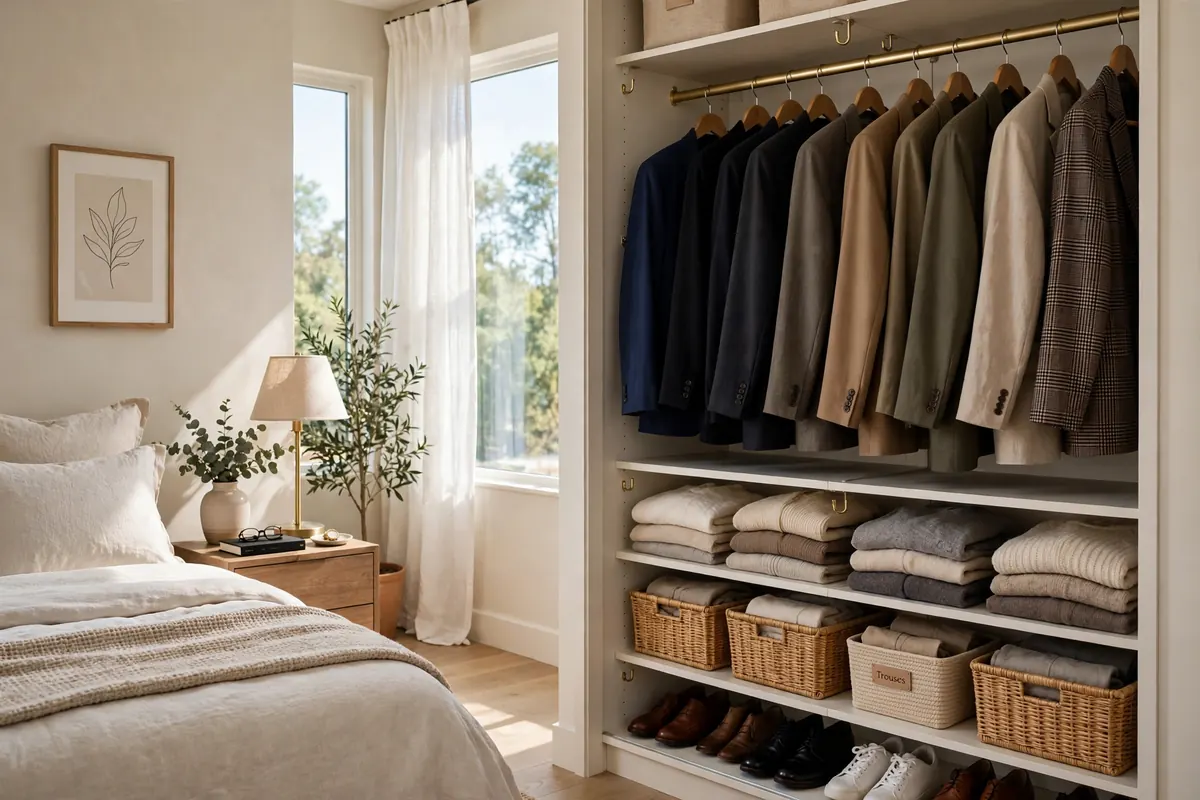

There is a particular kind of morning stress that has nothing to do with traffic or a snoozing alarm. It is the moment you stand in front of an open closet, already dressed from the waist down, holding a shirt that does not quite go with anything, while the clock quietly eats your buffer. Good work wardrobe organization is not about owning a prettier closet. It is about removing that moment entirely, so getting dressed becomes something you barely have to think about.
Most of us do not have a clothes problem. We have a decision problem. A closet stuffed with almost-right pieces, impulse buys, and clothes kept out of guilt forces dozens of tiny choices before breakfast. When you shrink the choices and arrange what is left in the order you actually wear it, mornings get calmer almost overnight.
This guide covers a system that works in real homes: a smaller core rotation, outfits grouped together, a short Sunday prep session, a clear line between work and weekend clothes, and storage habits that keep blazers and shirts looking pressed.
Work Wardrobe Organization Starts With a Smaller, Better Closet
Before you buy a single organizer, edit. Take everything you wear to work out of the closet and lay it on the bed. Then be honest about each piece with three simple questions: does it fit well right now, does it go with at least three other things I own, and have I actually worn it in the last three months? Anything that fails two of the three goes into a bag. You are not throwing it away forever; put the bag somewhere out of sight for a month. If you never reach for it, donate it with a clear conscience.
What remains should form a core rotation of roughly fifteen to twenty-five pieces, depending on how often you do laundry and how formal your office is. Think in building blocks rather than individual favourites: two or three well-fitting trousers or skirts in neutral colours, four to six tops that work under a blazer or cardigan, two blazers, one or two dresses if you wear them, and a coat that suits the season. Neutral bottoms and one patterned or coloured top per outfit give you variety without multiplying decisions.
Pay attention to fit above all else. A shirt that pulls at the buttons or trousers you keep hitching up will sit unworn no matter how smart it looked on the hanger. If a piece is nearly right, a fifteen-minute trip to a tailor is often cheaper than replacing it, and a properly hemmed pair of trousers can make an entire outfit look intentional.
Organize by Outfit, Not by Garment Type
Traditional closets are organized like shops: all shirts together, all trousers together, all jackets together. That makes sense for a shop, but you do not get dressed by garment type. You get dressed by outfit. Grouping complete outfits together is the single change that saves the most time on busy mornings.
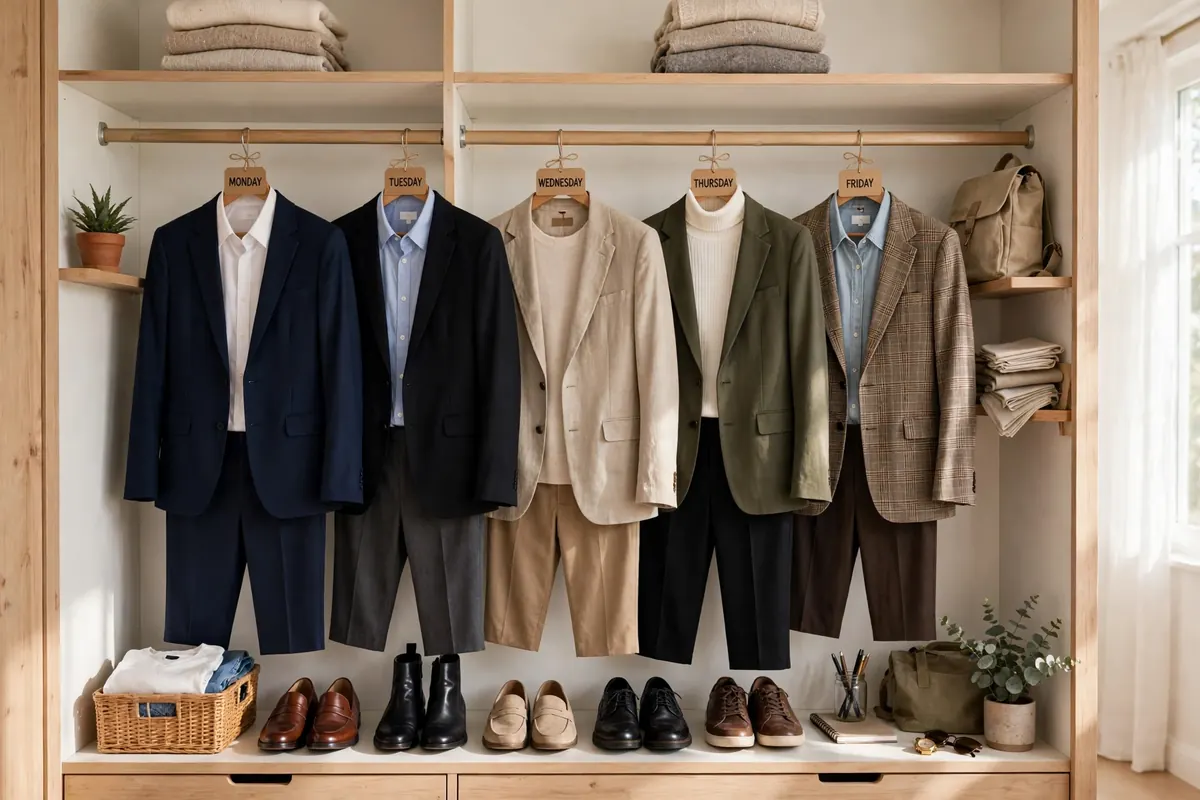
Once your core rotation is chosen, build five to seven outfits you genuinely like wearing, and hang each one together with the pieces in wearing order: blazer on the outside, then the top, then the trousers or skirt behind it. If an outfit needs a specific belt or scarf, loop it over the same hanger so nothing is hunted for at 7 a.m.
This approach has a useful side effect: gaps become obvious. If three of your outfits rely on the same black trousers, you know exactly what to buy next instead of buying another top you do not need.
If your wardrobe changes with the seasons, a proper rotation helps here too. Moving out-of-season coats and heavy knitwear into storage frees rail space for what you actually wear now, and these seasonal closet rotation ideas show how to time the swap so you are never caught out by a sudden cold snap.
The Sunday Five-Outfit Prep Routine
The real secret of stress-free mornings is not a better closet. It is a fifteen-minute ritual on Sunday evening. Check the week ahead: meetings, presentations, a client lunch, a casual Friday, a day you will be mostly at a desk. Then choose five outfits, one per working day, and hang them in order from Monday to Friday at the front of the rail.
While you choose, do a quick condition check on each outfit. Is the shirt clean and pressed? Does the blazer need a lint roll? Are the shoes polished and the right pair actually by the door? Catching a missing button on Sunday is a minor chore. Discovering it on Tuesday morning is a crisis.
Keep the routine realistic. You do not need to iron five shirts in one sitting if that sounds miserable; many people prep two or three outfits and leave the rest of the week to the outfit-grouped rail. The point is that Monday morning, the hardest morning of the week, is already decided before the week begins.
A few small habits make the routine stick:
- Hang tomorrow’s outfit on a single hook on the bedroom door each night, so even a 6 a.m. start feels unhurried.
- Keep a small “ready” section at one end of the rail for freshly laundered work clothes, so clean pieces never get buried behind worn ones.
- Return each outfit to its place the evening you wear it, or straight into the laundry basket, never draped over a chair where it becomes tomorrow’s confusion.
- Note outfits that drew compliments or simply felt great, and repeat them without guilt. A good outfit deserves a second outing.
Many closets serve two lives at once: the office self and the weekend self. When both are mixed together, the rail feels twice as full and half as useful. A clear boundary solves it, even in a small space.
The simplest split is physical. Give work clothes one side of the rail and casual clothes the other, with a single empty hanger or a divider ring marking the border. If you share a closet with a partner, the split runs person by person first, then work versus casual within each person’s section. Nobody should have to push past someone else’s weekend hoodies to find a Monday blazer.
Drawers work the same way. Reserve the top drawer or the most reachable shelf for work essentials: the tops, underlayers, and accessories you reach for most often. Weekend T-shirts and loungewear go lower down or further back.
Accessories deserve the same separation. Work belts, ties, and smart scarves live with the work section, not tangled in a general accessories drawer, and these tie and belt organization ideas keep every accessory visible and wrinkle-free instead of knotted at the bottom of a drawer.
Wrinkle-Free Storage for Blazers and Shirts
Nothing undoes a good outfit faster than wrinkles, and most wrinkles happen in storage, not in wear. The fix is mostly about space and hangers, not expensive gadgets.
Blazers need room. Cramming them shoulder to shoulder crushes lapels and sleeves, and pulling one out drags its neighbours with it. Give each blazer a sturdy, wide wooden or contoured hanger that supports the shoulder line, and leave a finger’s width of air on either side. Button the top button or close the jacket before hanging so it holds its shape, and empty the pockets so nothing pulls the fabric out of line.

Shirts do best on slim velvet hangers, buttoned to the top, with collars turned down neatly. If rail space is tight, hang shirts by colour and sleeve length so you can find the right one without rifling. For shirts you rarely wear, folding is fine, but fold them properly: buttoned up, sleeves folded in, and stacked no more than five or six high so the bottom shirt is not crushed flat.
A handheld steamer is the most useful tool in this whole system. Two minutes of steam the evening before beats ten minutes of ironing in the morning, and it is gentler on delicate fabrics. Keep it where you get dressed, not buried in a cupboard, or you will never use it.
For travel or for pieces between wears, a garment bag protects blazers from dust and from the crush of neighbouring clothes. You do not need one per jacket; a single bag for your two or three most-worn blazers is plenty.
Shoes, Bags, and Small-Space Fixes
Work shoes cause more morning chaos than people admit. They live on the floor, migrate around the house, and the pair you need is always the one you cannot find. Give work shoes a fixed home near the door or at the bottom of the closet: a low rack, a row of clear boxes, or simply a tray per person. Keep it to the pairs you actually wear to work, two to four is plenty, and store the rest elsewhere. Shoes last longer when they are not piled on top of each other, and a pair of shoe trees in leather shoes keeps their shape between wears.
Bags follow the same logic. One work bag in daily use hangs on a hook by the door or on the end of the rail, stuffed lightly so it keeps its shape. Other bags go on a high shelf or in dust bags, not on the closet floor where they get scuffed and forgotten. Empty the work bag every Friday evening; a clean bag on Monday feels like a small fresh start.
Small spaces need the same system, just scaled down. If your closet is a single rail and a shelf, the outfit-grouping method matters even more, because there is no room for drift. Use the shelf for folded knitwear and bags, the rail for hung outfits in weekday order, and the floor for one shoe tray only. A slim over-door rack can hold tomorrow’s outfit, belts, and a scarf without taking a centimetre of floor space. The same principle works beyond the closet too: a tidy drawer system makes mornings easier across the board, and this guide to organizing a dresser pairs well with a small-space wardrobe, since folded work tops and underlayers often live there.
Denim is the one category that often blurs the work-weekend line, especially in offices with a casual dress code. If jeans are part of your working week, treat them like work clothes: keep the smart pairs apart from the weekend pairs, and these jeans organization ideas show how to keep denim tidy without adding another organizer to buy.
Stress-free mornings do not come from a bigger closet or a trendier organizer. They come from fewer, better pieces, outfits that are already decided, a short Sunday ritual, and a clear place for everything from blazers to bags. Start with the edit, group what is left into outfits, and try the Sunday five-outfit prep for two weeks. Most people find the first week feels strange and the second week feels like a relief.
Your mornings belong to you: to breakfast, to a quiet coffee, to getting out of the door without a second thought about what you are wearing. Set the closet up to give them back, and let getting dressed become the easiest part of your day.