
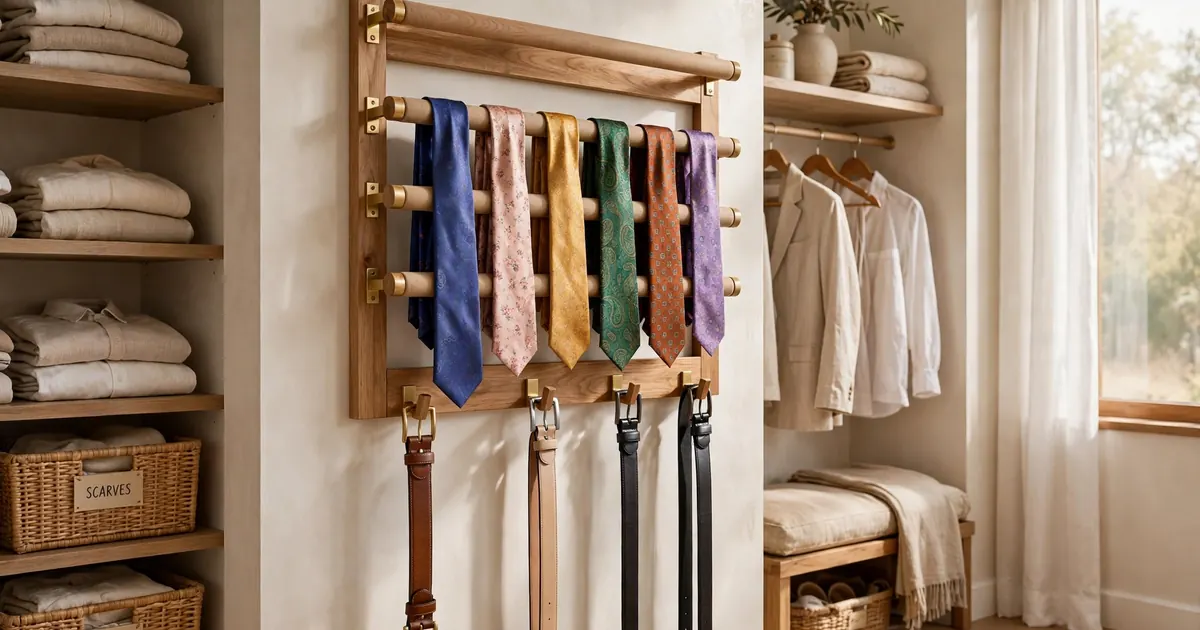

Most mornings, the outfit is the easy part. You reach for the navy blazer, you know which shirt works with it — and then you lose four minutes digging through a drawer where three belts have knotted themselves together and your favorite silk tie is folded into a shape geometry doesn’t have a name for. A good tie and belt organizer solves this quietly and permanently: everything visible, nothing tangled, and your accessories actually last longer because they’re stored the way the materials want to be stored.
This is one of those corners of the closet that people ignore for years because it feels too small to matter. But ties and belts are the most expensive-per-square-inch items most of us own. A decent silk tie costs what five t-shirts cost. A full-grain leather belt should last a decade. Treat them like the drawer rejects they weren’t designed to be, and you’ll replace them twice as often.
Why Ties and Belts Get Ruined in a Messy Closet
Before picking an organizer, it helps to know what’s actually happening to these accessories when they’re tossed in a drawer or draped over a hanger with yesterday’s trousers.
Silk ties are the delicate ones. Every time you fold a tie into a sharp crease — over a hanger bar, knotted around a doorknob, wadded into a travel bag — the silk fibers remember it. Leave a tie folded at a hard angle for a few months and that crease becomes part of the tie. Steam can relax it, but repeated creasing in the same spot thins the fabric until it shines through. Ties also hate being pulled: hanging a tie by its narrow end from a nail stretches the lining unevenly, so the tie starts to twist when you knot it.
Leather belts fail differently. A leather belt develops its cracks exactly where it gets bent at a sharp angle over and over — usually at the spot where it was draped over a hanger or folded in thirds to fit a short drawer. Hanging belts by their buckles sounds tidy, but the full weight of the belt pulls on the buckle stitching and the keeper loop, the two places most likely to fail first. And stacking heavy things on top of belts in a drawer? That presses dents into the leather that never fully come out.
The good news: once you understand the two rules — ties want to hang or roll loosely without sharp folds, belts want to hang straight or roll loosely without sharp bends — choosing storage becomes simple.
Start with a Quick Sort: Keep, Fix, Rehome
No organizer works if it’s holding accessories you don’t wear. Pull everything out — yes, all of it, even the belt behind the ironing board — and sort into three piles.
- Keep: the ties you actually reached for in the past year, and the belts you wear weekly or seasonally. Be honest about the “someday” ties.
- Fix: the belt with the wobbly buckle (a cobbler re-stitches that in minutes, cheaply) and the tie with the loose lining that needs five minutes with a needle.
- Rehome: the frayed tie from your first job interview, the cracked belt, the novelty ties that were funny exactly once. Donate the wearable ones.
Most people cut their collection by a third here, and the remaining pieces suddenly fit in far less space. If you’re sorting a whole closet at once, this little audit pairs naturally with the rotation habit in our guide to seasonal closet rotation — accessories are the easiest category to rotate in and out.
Tie and Belt Organizer Options That Actually Work
There are roughly five organizer types worth considering, and each suits a different closet and collection size. Here’s the honest breakdown of what each does well and where it falls short.
1. Wall-mounted rails and multi-hook racks
The workhorse option. A slim wooden or metal rack with a row of padded hooks or a padded bar mounts to the inside of a closet wall or the back of the door. Each tie drapes over its own hook; belts hang by the buckle with the strap falling straight. Everything hangs at eye level, fully visible, with air circulating around each piece.
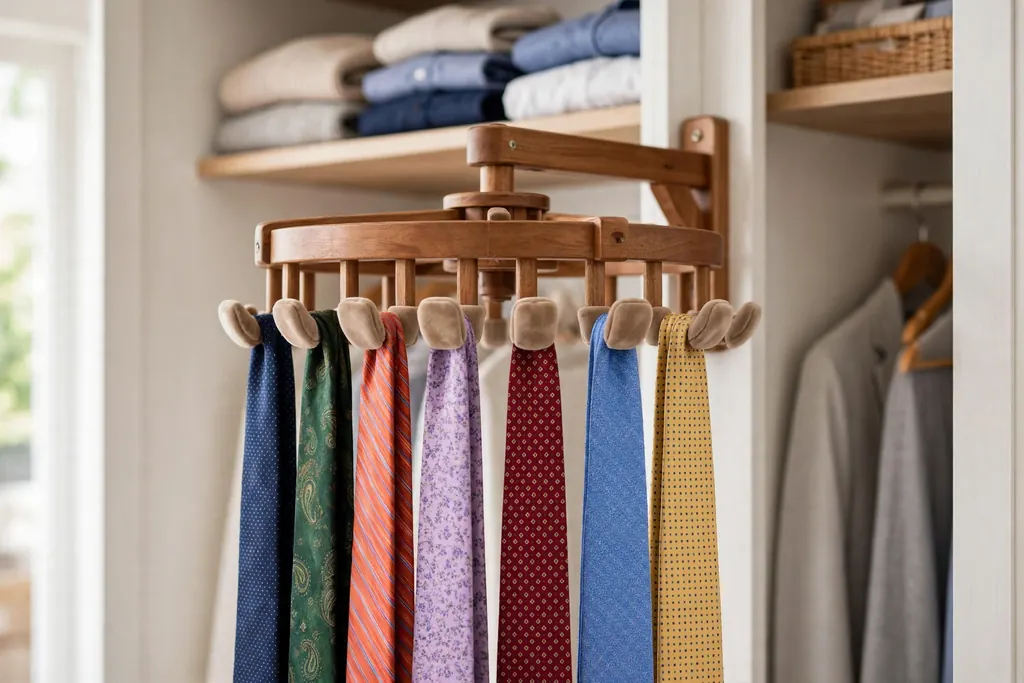
Why it wins for most people: visibility. When you can see all twelve ties at a glance, you wear more of them and stop buying duplicates of shades you already own. Choose a rack with padded or rounded hooks rather than bare metal pegs — thin metal digs into silk and scratches buckle finishes over time. Rotating racks are a nice touch if you own more than a dozen ties, since you can spin to the back row instead of digging behind the front ones.
2. Pull-out belt and tie racks
These mount to the side wall of a closet and slide out like a drawer when you need them, then disappear back into the closet when you don’t. Each rack typically holds 12 to 20 items in about three inches of depth. They’re the premium choice for reach-in closets where wall space is tight but a side panel is free.
The catch is installation — they need screws into something solid, not just drywall, and they cost more than a simple rack. But for a shared closet or a small bedroom closet, they free up an entire drawer’s worth of space. Our reach-in closet organization guide shows where pull-out accessories fit in a tight layout.
3. Divided drawer organizers (roll, don’t fold)
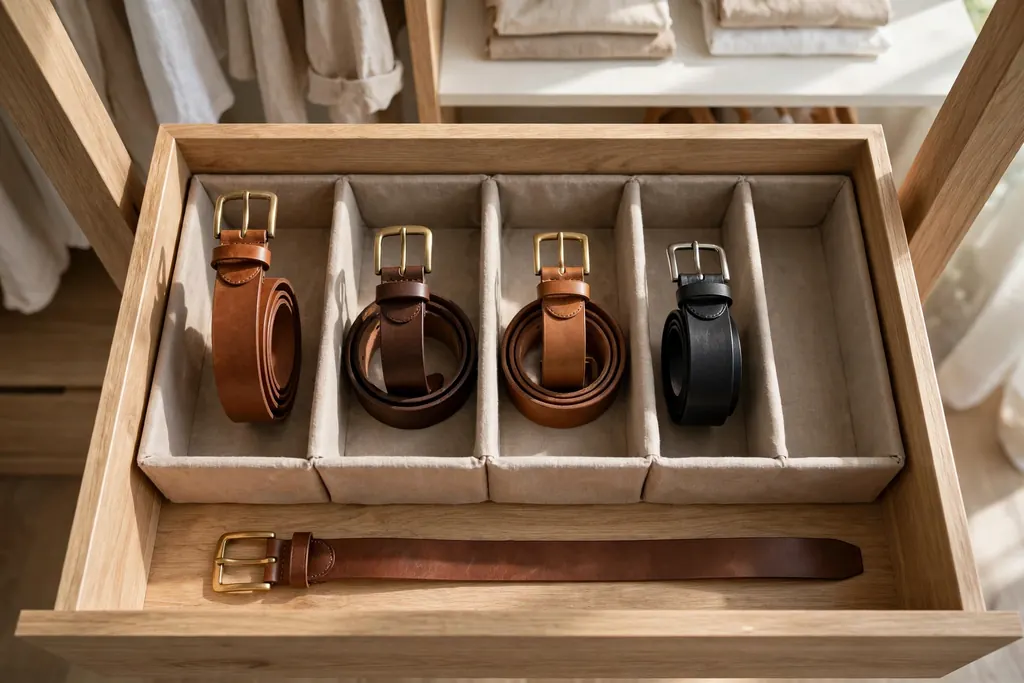
If you have drawer space to spare, this is the gentlest option for leather belts. Loosely roll each belt starting from the buckle end — rolling from the buckle keeps the coil loose and prevents the tight center that cracks leather — and stand each roll upright in its own compartment of a fabric drawer organizer. One compartment per belt, no touching, no stacking.
Ties can be rolled too, loosely, and stood upright the same way — this is how many menswear shops display them. Use fabric dividers rather than rigid plastic: stiff dividers can press lines into silk if a drawer gets overfilled, while fabric flexes. The rule is one tie per compartment, and never pack the drawer so tightly that the rolls compress each other.
4. Over-the-door hook strips
The renter’s friend. A strip of hooks that hangs over the closet door needs zero tools and leaves zero holes, which makes it ideal if your lease is strict about wall mounting. Hang belts on the sturdier hooks and ties on the lighter ones.
Two caveats. First, over-the-door strips swing, and swinging makes ties slide off — look for one with a non-slip back or wedge it so the door closes snugly. Second, hooks without padding are hard on silk; drape ties over hooks with a rounded, coated finish. If you’re in a rental, pair this with the no-drill ideas in our renter-friendly closet organization guide.
5. The humble trouser hanger (the free option)
Here’s the trick from charity-shop veterans: the clamp hangers designed for trousers are excellent belt organizers. Loop a belt through the clamp the way you’d clamp a trouser leg, and hang the hanger on your regular closet rod. Each hanger holds two or three belts, everything hangs straight, and it costs nothing if you already own the hangers. It doesn’t scale past a handful of belts, but for a small collection it’s genuinely good.
Hanging vs. Rolling: What Protects Silk and Leather Best
You’ve probably seen both camps argued passionately online, so here’s the practical verdict:
- Silk ties: hang first, roll second. Draping a tie over a padded rack, wide end hanging straight, is the least stressful position. Loose rolling is the runner-up — perfect for travel and drawers. What damages ties is the sharp fold: never hang a tie over a thin rod where it bends at a hard angle, and never knot a tie to store it.
- Leather belts: roll first, hang straight second. A loosely rolled belt in a divided drawer experiences almost no stress. Hanging works too, but hang the belt with the buckle down so gravity pulls along the strap evenly, and don’t hook belts by their keeper loops — that little loop isn’t structural.
- Woven and canvas belts: these are the forgiving ones. Hang them, roll them, coil them — they bounce back from anything.
One maintenance habit worth adopting: after wearing a tie, unknot it fully and let it rest draped over the rack for a day before storing it rolled. Silk relaxes back into shape given a few hours, and that pause prevents the knot area from developing a permanent pinch. Belts get the same courtesy — let them hang straight overnight after a long day so any bend from the buckle hole relaxes out.
Where to Put Your Tie and Belt Organizer
The best organizer in the world fails if it’s mounted where you can’t reach it comfortably. Placement rules:
- Eye level is king. Mount racks between about 55 and 65 inches from the floor — you should be able to scan the whole row without stretching or crouching. Below that, ties drag on shelves; above it, you’ll stop using the rack because reaching is a chore.
- The door back is free real estate. The inside of a closet door is dead space in most closets, and a flat hook strip or slim rack there adds storage without taking a single inch of rod or shelf space.
- Keep them near the shirts, not the shoes. You choose ties and belts while building an outfit, so they belong in the dressing zone — near shirts, trousers, and the mirror — not in a far corner or a different room.
- Give the collection a boundary. Decide your rack holds, say, fifteen ties. When tie sixteen arrives, one leaves. This one-in-one-out rule is what keeps the system working five years from now instead of slowly overflowing.
In a truly tiny closet, combine methods: a door-back rack for daily ties and belts, plus a divided drawer section for the seasonal pieces you rotate in twice a year. Small closets reward this kind of layering — for more ideas, our closet accessory organization guide covers how to zone a small closet so every category has its home.
The 10-Minute Weekly Reset That Keeps It All Neat
Organized closets don’t stay organized by themselves — they stay organized because of tiny, painless maintenance habits. Once a week, when you’re already in the closet, spend ten minutes on this loop:
- Return any ties or belts that migrated to chairs, dressers, or the bathroom counter back to their hooks or compartments.
- Straighten anything that slid sideways on its hook so it hangs flat again.
- Check for the early warning signs: a tie with a new crease (re-drape it), a belt developing a crack at the buckle hole (condition the leather), a hook that’s working loose.
- Wipe down the rack itself — dust settles on horizontal hooks, and dusty silk looks dull.
That last check matters more than it sounds. A tiny crack caught early gets fixed with leather conditioner; caught late, it becomes a snapped belt. A loose screw tightened now is a rack that lasts years; ignored, it’s a rack that rips out of the drywall and takes paint with it. Small maintenance is what separates a closet that looks good in photos from one that actually stays good.
Ties and belts may be the smallest category in your closet, but they’re the finishing touch on everything you wear — and they’re the items where a little care pays back the most. Pick one organizer style that fits your space, mount it at eye level, roll what goes in drawers, and give the whole thing ten minutes a week. Your mornings get faster, your accessories last years longer, and that drawer that used to be a knot of leather and silk becomes the tidiest corner of the closet.