
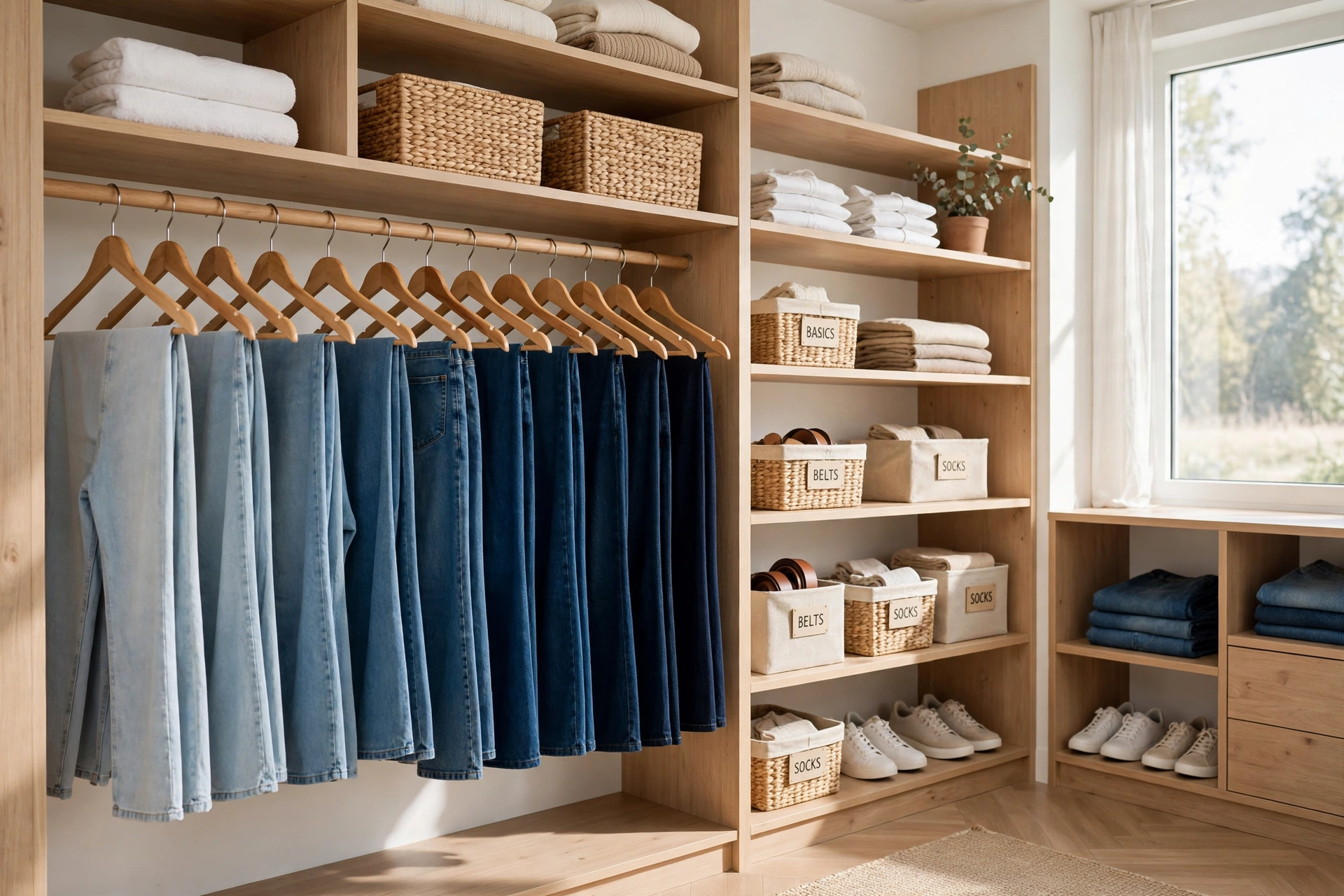

If you own more than three pairs of jeans, you already know the problem. The pair you actually want is always at the bottom of the pile, folded inside another pair, or hiding behind the one you wore last Tuesday. Good jeans organization ideas are not about buying a prettier closet. They are about making every pair visible, easy to grab, and able to hold its shape, so getting dressed stops feeling like a small excavation project every morning.
Jeans are bulky and awkward to store: they slide off hangers, topple off shelves, and crease easily. The fix is a simple system — sort first, choose one storage method that fits your space, and put your most-worn pairs where your hand naturally lands. Keeping it tidy then takes about two minutes, not a weekend overhaul.
Start by Sorting: Jeans Organization Ideas Begin With an Honest Edit
Before you buy a single divider or hanger, take every pair of jeans out of your closet and lay them on your bed. Yes, all of them. You cannot organize what you cannot see, and most of us are surprised by how many pairs we actually own, including the ones we stopped wearing two years ago.
Sort them into four piles:
- Everyday favorites: the two or three pairs you reach for week after week. These earn the best spot in your closet.
- Occasion pairs: dressier dark-wash jeans, wide-leg styles, or white jeans you wear seasonally. These can live a little further back.
- Work or outdoor pairs: jeans you wear for gardening, DIY, or messy jobs. They do not need prime real estate.
- Let go: jeans that no longer fit, have worn-through knees, or simply make you sigh when you put them on. Bag these for donation or recycling right away.
While you sort, note what affects storage: stretchy jeans fold small and bounce back, while rigid denim holds a fold well but takes more room. Heavy raw denim is best hung or stacked in small piles, never crammed into an overstuffed drawer.
If you are working through a wider closet clear-out at the same time, the same sort-first logic applies to the rest of your wardrobe. A tidy approach to closet accessories like belts, scarves, and bags keeps the small things from undoing the good work you do with your jeans.
File-Folding Jeans in a Drawer: See Every Pair at a Glance
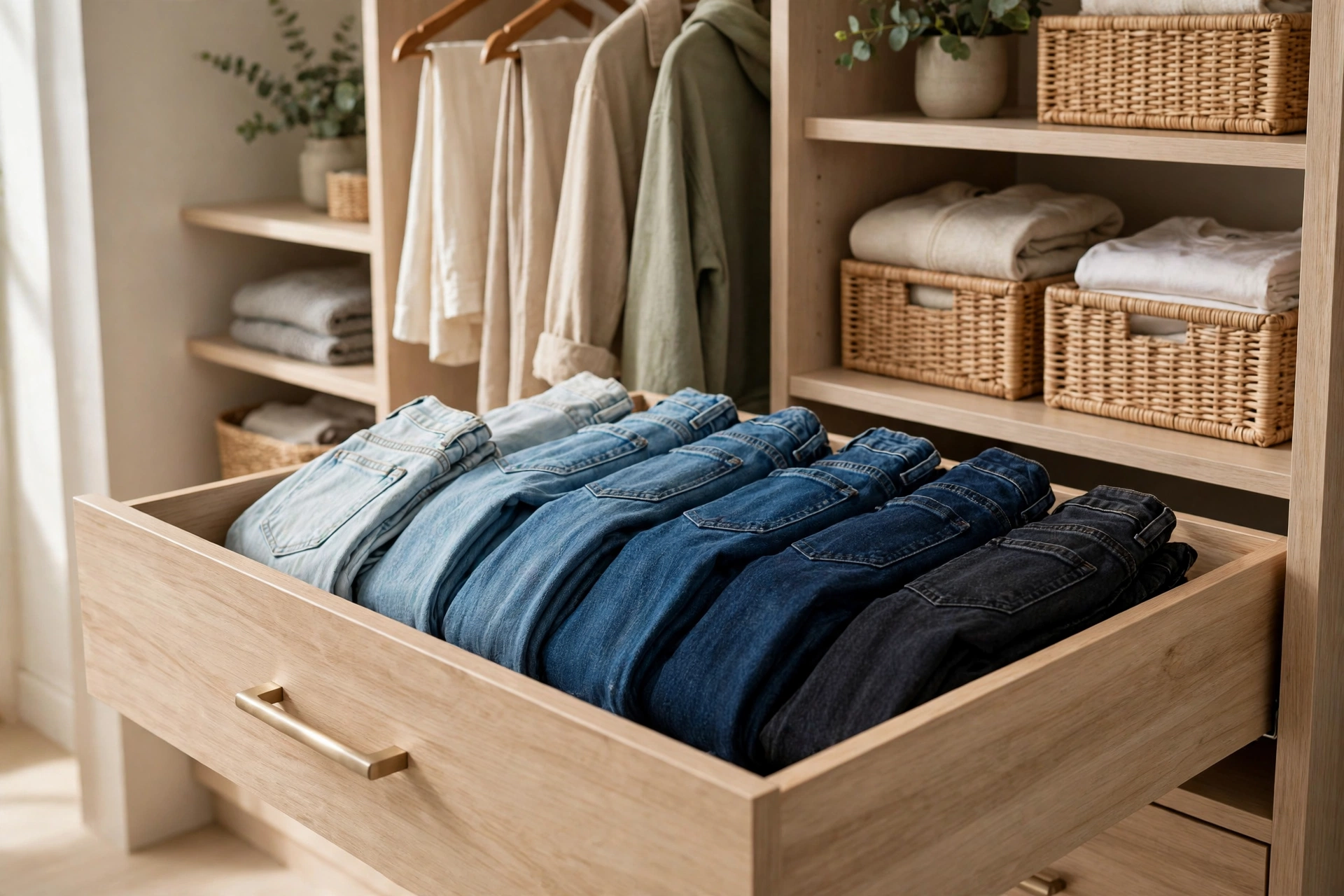
File-folding is the single best method for most people, and it is the one I recommend first. Instead of stacking jeans flat on top of each other, you fold each pair into a compact rectangle and stand it upright in a drawer, like files in a filing cabinet. Every pair is visible the moment you open the drawer, and you can pull one out without disturbing the rest.
Here is how to do it:
- Lay the jeans flat, buttoned and zipped, and smooth out the legs.
- Fold one leg over the other lengthwise, so the jeans form one long, narrow strip.
- Fold the strip into thirds (or quarters for a shallow drawer), smoothing as you go so the fold is flat, not puffy.
- Stand the folded rectangle upright in the drawer, with the folded edge facing up so you can see the wash and any pocket detail.
Arrange the row lightest to darkest wash, or group by style, whichever way you actually search in the morning. Leave breathing room at the end of the row — a drawer packed so tightly you must wrestle a pair out will collapse back into a mess within a week.
File-folding works best in a drawer at least 25 centimetres deep. If your drawer is shallow, fold into quarters rather than thirds, and use a divider to stop the denim row migrating into your T-shirts. For more on dresser drawers, see our guide on how to organize a dresser.
Hanging Jeans: S-Hooks, Clip Hangers, and Multi-Pair Hangers
Hanging is the right call for premium or rigid denim, for jeans you want completely wrinkle-free, and for closets with more rod space than drawer space. The trick is choosing a hanging method that does not let heavy denim slide straight off.
S-hooks are the budget hero. Hook a sturdy metal S-hook over your closet rod, then hang a pair of jeans by one belt loop. Each pair hangs vertically in its own slot, fully visible, and you can slide one off without touching the others. Space the hooks a couple of centimetres apart so the jeans hang flat rather than bunching together. This method is brilliant in small closets because it uses vertical rod space that would otherwise go to waste, and a pack of S-hooks costs very little.
Clip hangers work well for jeans you want to display. Fold the jeans in half lengthwise, then clip the hanger across the folded waistband or the legs, depending on whether you want the front or the back pockets facing out. Hang them with the style you use to identify the pair — the wash, the cut, the pocket stitching — facing toward you as you open the closet.
Multi-pair hangers save rod space. These have several horizontal bars on one hanger, so five pairs hang in the space of one. They are great for a large collection, but they do have a downside: the pair on the bottom bar is the hardest to grab, so put your least-worn jeans there and your favorites on the top bars.
Whichever hanger you choose, hang jeans by wash or by style, and keep everyday pairs at eye level. A lower second rod is a natural home for jeans, since they are shorter than dresses and coats.
Shelf Storage That Stays Neat: Small Stacks and Dividers
Shelves are where good intentions go to die, because a tall stack of jeans is almost guaranteed to topple the moment you pull one from the middle. The fix is simple: keep stacks small and contained.
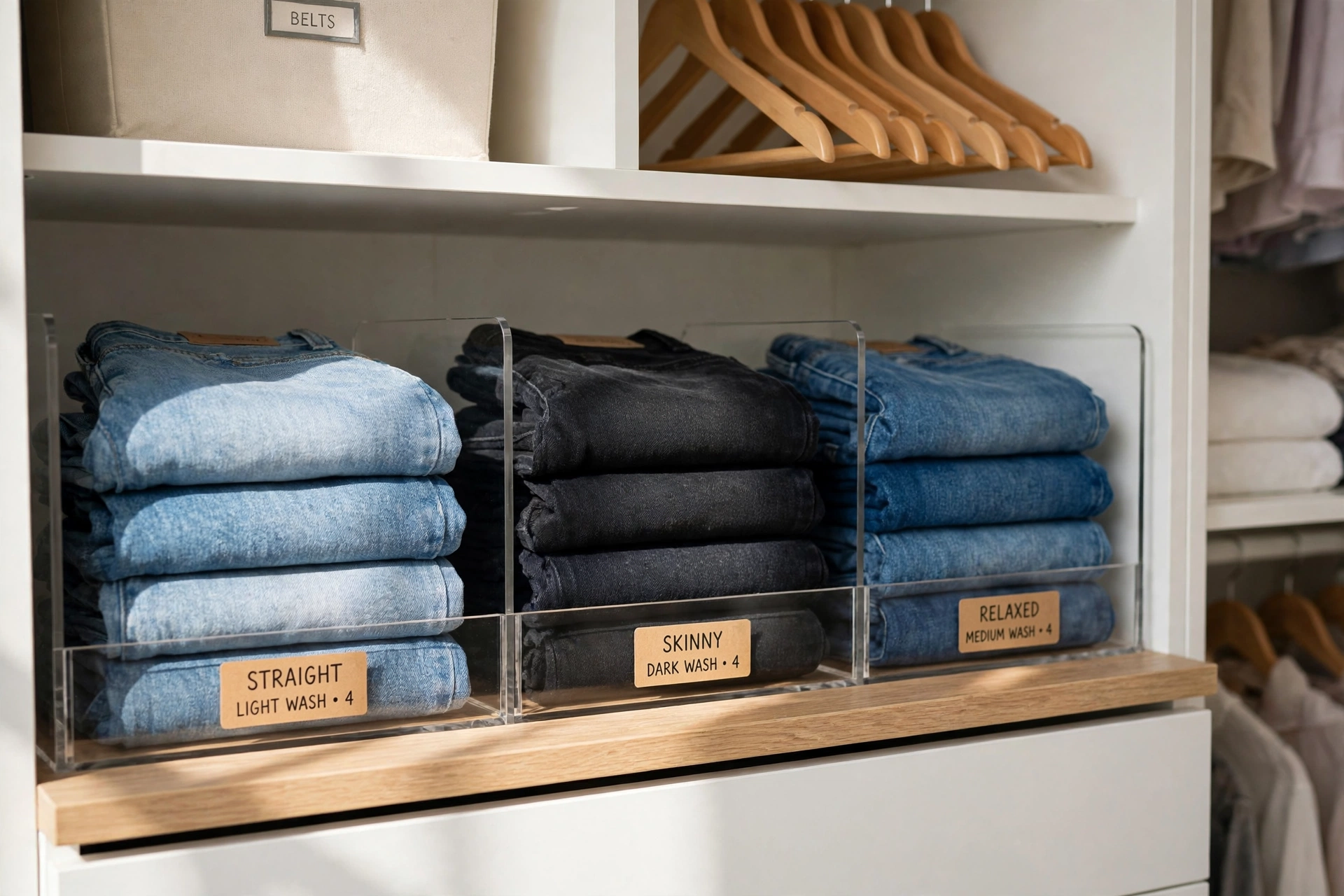
- Limit stacks to four or five pairs. Any taller, and the stack leans, slides, and eventually collapses onto the shelf below.
- Use shelf dividers. A simple vertical divider at each end of a stack stops it from spreading sideways and gives each stack its own little bay.
- Fold consistently. If every pair is folded to roughly the same width, stacks sit flat and stable. One sloppy fold in the middle is what starts the slide.
- Put the most-worn pairs on top of their stack, or at the front. This sounds obvious, but it is the difference between a shelf that stays tidy and one you rebuild every Sunday.
Shelf storage suits jeans you wear less often, like seasonal whites or dressier pairs, because you are not pulling from those stacks daily. It also pairs well with a seasonal rhythm: when you swap your wardrobe for warmer or cooler weather, the off-season jeans can move to a higher shelf or a labelled bin, and the current-season pairs take the easy-access spot. If you want a full framework for that swap, our seasonal closet rotation ideas walk through the same system for your whole wardrobe.
Keeping Jeans in Shape: Care Habits That Protect the Fit
Organization is only half the story. How you treat jeans between wears decides whether they keep their shape or slowly lose it.
First, do not wear the same pair two days running if you can help it. Denim, especially stretch denim, needs a day to spring back. Rotating between two or three pairs actually makes each pair last longer, which is a nice bonus from a system that already makes rotation easy.
Second, wash jeans only when they are genuinely dirty or stretched out, not after every wear. Between washes, air them out for a few hours on a hook rather than folding them straight back while still warm from wear.
Third, button and zip jeans before storing them, whether you fold or hang. An unbuttoned waistband folds unevenly, and an open zip can snag or crease a neighbouring pair. It takes three seconds and it keeps every fold crisp.
Finally, give heavy or raw denim a little extra respect. Raw denim creases sharply if it is folded the same way every time, so alternate the fold direction now and then, and hang it when you have the rod space. Your future self, pulling on a pair that still looks like it did on day one, will be grateful.
Not everyone has a walk-in closet, and jeans organization ideas have to work in the space you actually have. Here are the setups that solve the most common problems:
Tiny closet, no drawers: S-hooks on the rod plus a hanging shelf organizer with cubbies for folded pairs. The hooks handle your everyday jeans, the cubbies handle the rest, and nothing needs a dresser you do not own.
Shared closet: give each person their own zone — one rod section or one drawer each — and agree on one folding method for the household. Two different folding styles in one drawer is how a tidy system quietly falls apart, so pick one and stick to it.
Jeans plus a capsule wardrobe: if you keep a small, intentional wardrobe, group jeans by outfit rather than by wash. Hang or file the jeans you wear with your favourite tops nearby, so getting dressed is one grab, not two searches. This works beautifully alongside a tidy sweater setup too — if your knitwear is already sorted, see our sweater storage ideas for a tidy closet for a matching approach.
Rental or dorm room: an over-the-door organizer with deep pockets can hold two or three rolled pairs, and rolling is genuinely useful here because rolled jeans fit pockets and suitcases better than folded ones. Roll from the waistband down, smooth as you go, and keep one pair per pocket so you can see what you are grabbing.
A two-minute reset that keeps it working.
Every system drifts. The pair you tried on and rejected ends up draped over a chair, the new jeans get tossed on top of a stack, and slowly the closet creeps back toward chaos. The answer is not a bigger overhaul; it is a tiny weekly reset.
Once a week, when you are already in your closet, spend two minutes putting rejected pairs back in their slots, straightening any leaning stack, and pulling forward the pairs you actually wore that week. That is it. A system you reset in two minutes is a system you will still have in six months, while a system that needs an hour of fixing gets abandoned.
And once a season, repeat the quick sort. Letting one or two pairs go each season keeps your collection at a size your closet can actually hold.
Visible, grabbable, and ready to wear.
The best jeans organization is the one you barely notice, because every pair is visible, easy to grab, and still holding its shape when you reach for it. Sort honestly, pick the method that fits your space — file-folding, hanging, or small shelf stacks — and give your everyday pairs the best spot in the closet. Then protect the system with a two-minute weekly reset and a seasonal sort.
Start today with just your jeans, even if the rest of your closet is still a work in progress. Pull them all out, keep the pairs you love, fold or hang them one consistent way, and enjoy the small, daily pleasure of opening your closet and seeing exactly what you own. Getting dressed should feel easy, and with your jeans finally in order, it will.