
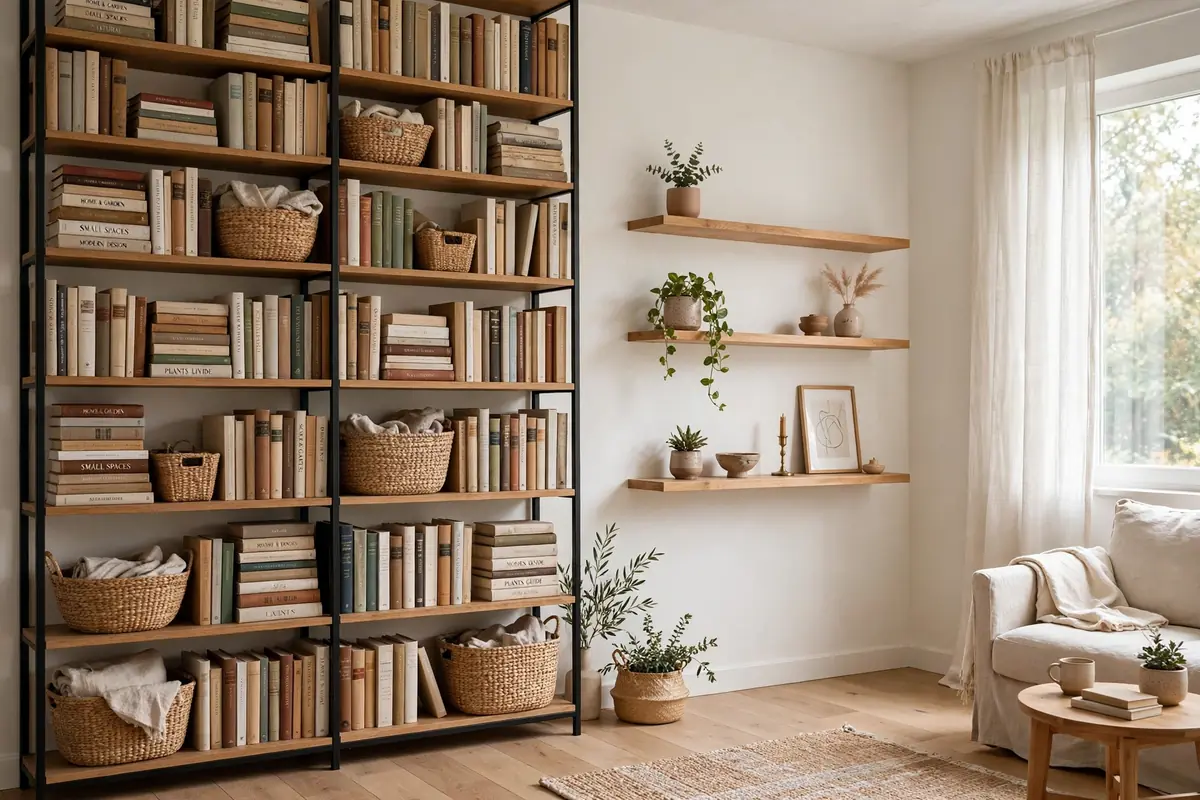

When I moved into my first studio flat, I got 400 square feet and a wardrobe the size of a phone booth. I spent a month trying to Tetris my belongings into the floor space before a friend pointed at the bare walls and said the obvious thing: you’re allowed to use those. That one sentence changed everything. Vertical storage ideas — using the walls, the backs of doors, and all that empty air between your furniture and the ceiling — genuinely doubled what my tiny flat could hold. No renovation, no knocking down walls. Here’s what actually works.
Why Going Vertical Works So Well
Most small homes have the same problem: every storage solution sits on the floor, competing for the same square footage as your sofa, your bed, and your own two feet. Meanwhile the walls sit empty from about waist height up to the ceiling — in a typical room, that’s roughly half the room’s total surface area doing absolutely nothing.
Vertical storage flips that equation. A tall bookcase holds as much as a wide dresser in a third of the footprint. A wall of floating shelves can swallow the contents of an entire sideboard. And because your eye travels upward, rooms with good vertical storage actually feel bigger rather than more cramped — the floor stays visible, and visible floor reads as space.
The other reason it works so well is that it targets “dead zones” — spots you’d never think of as storage until someone points them out. The strip of wall above every door. The six inches beside the fridge. The two feet of air above your kitchen cabinets. The wall behind an open door. None of these can hold furniture, but all of them can hold a shelf, a hook, or a slim rack. Once you start spotting dead zones, you’ll find them everywhere — and each one you claim is floor space you get back.
Floating Shelves: The Hardest-Working Vertical Storage Idea
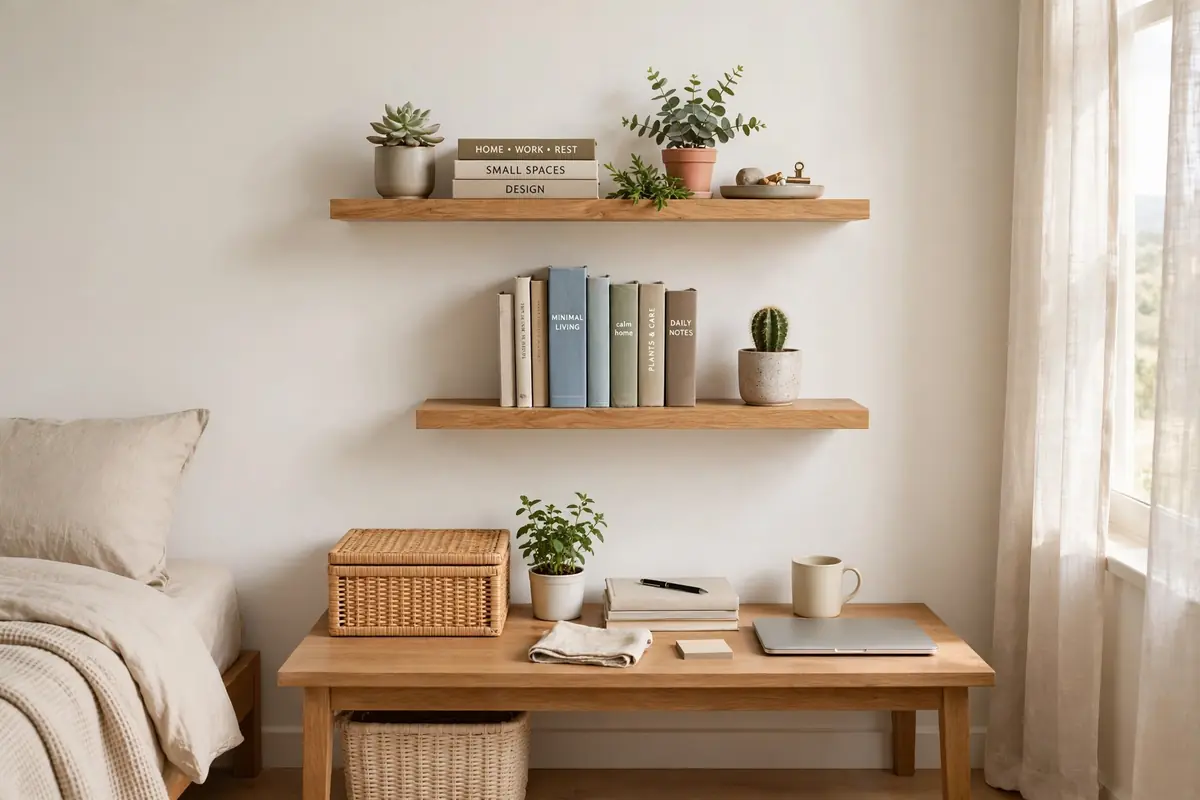
If you take one thing from this list, make it floating shelves. They’re cheap, they hold a surprising amount, and they work in literally every room. In the living room, a row of shelves above the sofa holds books, baskets, and the clutter that used to live on the coffee table. In a small bedroom, shelves above the desk or beside the bed can replace a nightstand entirely — a genuine lifesaver when there’s no floor space for one.
Two practical tips. First, go higher than feels natural: most people mount shelves at eye level and waste the two feet above them. Stagger two rows and reserve the top one for things you grab weekly rather than daily. Second, mix closed and open storage — a couple of pretty boxes or baskets on the shelves hide the ugly-but-necessary stuff like chargers, paperwork, and spare lightbulbs.
One more thing about shelves: they only look good when they’re styled with restraint. The difference between a beautiful shelf and a cluttered one is editing. Group items in odd numbers, leave breathing room between groups, and keep everyday grabs at arm’s height with the decorative pieces up top. If a shelf starts looking busy, take everything off and put back only half — you’ll be amazed how much calmer it feels.
One practical note on weight, because a shelf of art books is not a shelf of paperbacks. Into wall studs, a 60–90 cm shelf on two brackets holds a serious load — think a full row of hardbacks. On drywall alone, use proper hollow-wall anchors and keep it to lighter things: plants, folded linens, baskets. A shelf that sags in the middle was overloaded on day one, so when in doubt, add a third bracket. It’s invisible and it doubles what the shelf can carry.
The Backs of Doors Are Free Real Estate
Every door in your home has a full-sized storage surface that you’re currently using to hold nothing. Over-the-door organizers — the kind that hook over the top with no screws — turn that dead space into a pantry, a cleaning cupboard, or a shoe rack.
The bathroom is where this trick shines brightest. A narrow over-door rack holds toiletries, spare toilet paper, and cleaning supplies that would otherwise eat your under-sink cabinet alive — and if your bathroom is truly tiny, these small bathroom storage ideas squeeze even more out of the space. In bedrooms, an over-door organizer with clear pockets is perfect for accessories, scarves, and the sunglasses collection. In a utility cupboard, it’s where the dusters, cloths, and spray bottles finally get a proper home.
Measure before you buy: most doors need about 5–8 cm of clearance to close over a rack, and a surprising number of organizers are just deep enough to jam. Check the gap between your door and its frame first — a tape measure takes ten seconds and saves a return trip. Shallow wire tiers suit spice jars and small bottles; deeper fabric pockets are better for shoes and cleaning supplies.
Choose Tall and Narrow Over Short and Wide
When you’re buying furniture for a small space, train yourself to look up. A tall, narrow bookcase stores as much as a short, wide one while eating half the floor. A slim tower of drawers slides into the dead gap beside a wardrobe. A floor-to-ceiling wardrobe unit — even a budget flat-pack one — can replace a dresser and a chest of drawers combined.
This pairs beautifully with other small-space strategies. If you’ve already worked through these storage ideas for small apartments, think of vertical storage as the second half of the same system: that guide handles the footprint, this one handles everything above it. And don’t forget the lowest “vertical” zone of all — the space under your bed, which these under-bed storage ideas put to proper work.
Pegboards, Rails, and Hooks: Vertical Storage Ideas for Kitchens and Entryways
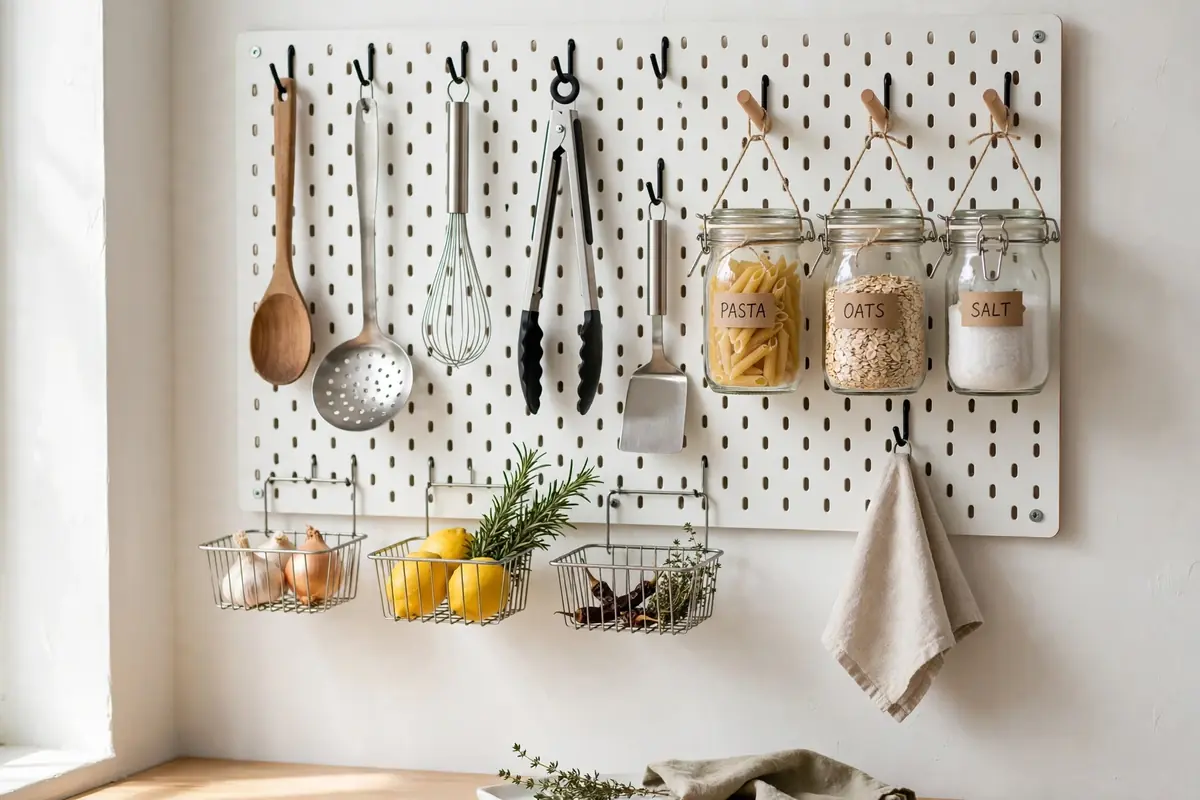
Some of the best vertical storage ideas come from workshops and professional kitchens, where every tool hangs within arm’s reach. A pegboard in the kitchen holds utensils, small pans, and measuring cups on hooks you can rearrange whenever you like — and it frees up an entire drawer. Once that drawer is empty, it’s prime real estate: here’s how to organize a kitchen drawer so it stays useful instead of becoming the new junk drawer. A simple wall rail with S-hooks does the same job more cheaply and looks great doing it.
The entryway is the other big win. A row of sturdy hooks at different heights handles coats, bags, and the dog lead; add one narrow floating shelf above for keys, sunglasses, and post, and the hallway finally stops being a dumping ground. These small entryway organization ideas build a whole system around exactly that principle.
Renter-Friendly Vertical Storage (No Drill Required)
“But I’m renting” is the number one objection I hear, and it’s a fair one — nobody wants to lose a deposit over shelving. The good news: most vertical storage doesn’t need a drill.
- Adhesive hooks and strips: modern adhesive hooks hold several kilos each and remove cleanly. Use them for everything from kitchen utensils to coats to lightweight shelves.
- Tension rods: wedge one inside a cabinet to hang spray bottles beneath the shelf, or inside a wardrobe to double the hanging rail.
- Leaning ladder shelves: they rest against the wall, need at most one tiny anchor screw (often none), and give you four or five tiers of storage in a narrow footprint.
- Over-door everything: hooks, racks, mirrors with storage — if it hangs over a door, your landlord never needs to know.
- Freestanding tall units: a narrow bookcase or tower shelf needs no wall fixing at all in most cases.
One honest caveat: anything heavy or tall enough to tip — a loaded bookcase, especially with kids or pets around — should still be anchored. A single small bracket is a much easier conversation with a landlord than a collapsed shelf.
The High Zone: Above Doors, Windows, and Cabinets
There’s a band of storage space running around the top of every room that almost nobody uses: the 30–60 cm above door frames, window frames, and kitchen cabinets. It’s too high for daily grabs, which is exactly why it’s perfect for the things you need a few times a year.
A single shelf above a bedroom door holds the spare bedding set. Above the kitchen cabinets, lidded baskets swallow the special-occasion serving dishes and the bread maker you only use at Christmas. In a child’s room, a high ledge keeps the Lego collection visible but out from underfoot. The rule for the high zone: if you need a step stool to reach it, it belongs up there — and label the baskets, because you will forget what’s in them by March.
One caution: the high zone is for storage, not display. A row of matching baskets looks intentional; a row of random boxes with the flaps open looks like you gave up. Keep the containers consistent, keep them closed, and dust them twice a year when you swap the contents. Out of sight shouldn’t mean out of mind — just out of the way.
Vertical Storage Mistakes That Make Small Rooms Feel Smaller
Done badly, vertical storage backfires — the room feels more cramped, not less. Here’s what to avoid.
Shelves mounted too low. A shelf at shoulder height chops the wall in half visually. Mount everyday shelves just above eye level and let the space beneath them breathe — the room will feel taller instantly.
Every wall covered. Vertical storage works because of contrast: one strong storage wall makes a room feel organized; four make it feel like a warehouse. Leave at least one wall mostly bare.
Open shelves with no editing. This is the big one. Open storage shows everything, which means everything on it has to earn its visibility. If a shelf holds clutter, it’s not storage — it’s a display of clutter. Baskets and boxes are the compromise: the storage stays, the visual noise goes.
Blocking the light. Never put a tall unit directly beside or across from your main window. Natural light is the scarcest resource in a small home; a bookcase that eats it costs more than the storage is worth. Tall pieces belong on the darkest wall, where they do the least visual damage.
Before you buy a single shelf, walk through your home with fresh eyes and look at the walls. The strip above every door. The wall beside the fridge. The two feet of air above your kitchen cabinets. Measure those spots, then choose storage to fit them — not the other way round. My 400-square-foot studio never got bigger, but once the walls started working, it stopped feeling small. Yours can too.
[…] surprisingly sturdy for lighter items like plants and framed photos. This is also a good moment to think vertically about the rest of the room too, since corners and walls work best as a […]
[…] future self, reaching up with wet hands, will be grateful. These are the same principles behind vertical storage ideas for small spaces that work all over the house — the laundry room just benefits from them more dramatically than […]
[…] A slim rolling cart. A 7-inch-wide rolling cart slides into the gap beside the toilet or vanity and tucks away when not in use. Give each family member one tier in a shared bathroom and the “whose stuff is whose” argument disappears. For the general principles, these ideas pair well with the broader strategies in vertical storage for small spaces. […]
[…] resist using the space at all. If you want to lean into vertical thinking in every room, these vertical storage ideas for small spaces pair perfectly with the tricks […]
[…] in a small home that is pure gold. Pair these vertical habits with the principles in our guide to vertical storage ideas for small spaces, and a hallway stops being dead square […]