
The entryway is the first thing you see when you come home and the last thing you see when you leave. It sets the tone for your whole house — and in most homes, that tone is currently “shoe avalanche with a side of lost keys.”
Mine used to be a narrow hallway where coats, shoes, mail, and bags fought for about four square feet. Fixing it didn’t take a renovation. It took a few small entryway organization ideas, applied in the right order. Here’s the exact playbook.
The Drop Zone Principle
Every entryway needs a drop zone: one defined spot where the stuff you carry in — keys, wallet, mail, sunglasses — lands the second you walk through the door. Without it, those things scatter across every surface in your home, and you spend your mornings hunting for them.
A drop zone can be as small as a tray on a shelf. The size doesn’t matter; the consistency does. Train yourself for one week — everything goes in the tray, every time — and the habit sticks. This single idea eliminates more daily frustration than any furniture purchase.
Go Vertical: Hooks and Wall Storage
In a small entryway, the floor is precious and the walls are free. This is the most important mindset shift: stop trying to fit furniture into four square feet and start using the six vertical feet above it.
A row of sturdy wall hooks holds coats, bags, and dog leashes without touching the floor. Mount them at two heights if you have kids — low hooks they can actually reach, higher ones for adults. One hook per person, minimum, plus one spare for guests. When every coat has a designated hook, the coat pile on the chair disappears on its own.
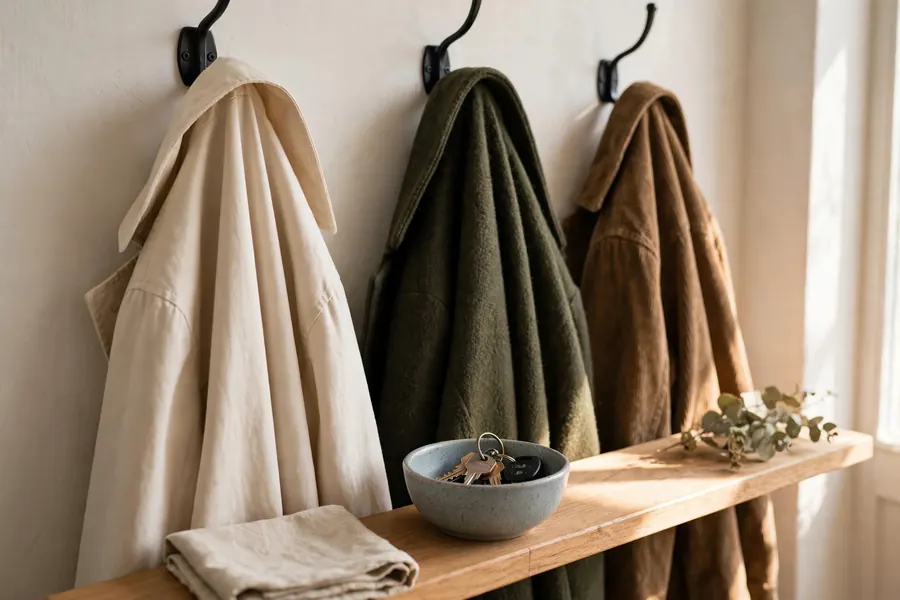
Above the hooks, a narrow floating shelf holds the key bowl, sunglasses tray, and a small plant if you’re feeling fancy. Keep it shallow — six to eight inches deep — so it doesn’t jut into your walking path. In truly tiny hallways, even a wall-mounted key cabinet (the kind with a door) keeps things tidy and out of sight.
Shoes Without the Pile
Shoes are the number one entryway offender. The fix isn’t willpower — it’s a system with a hard limit.
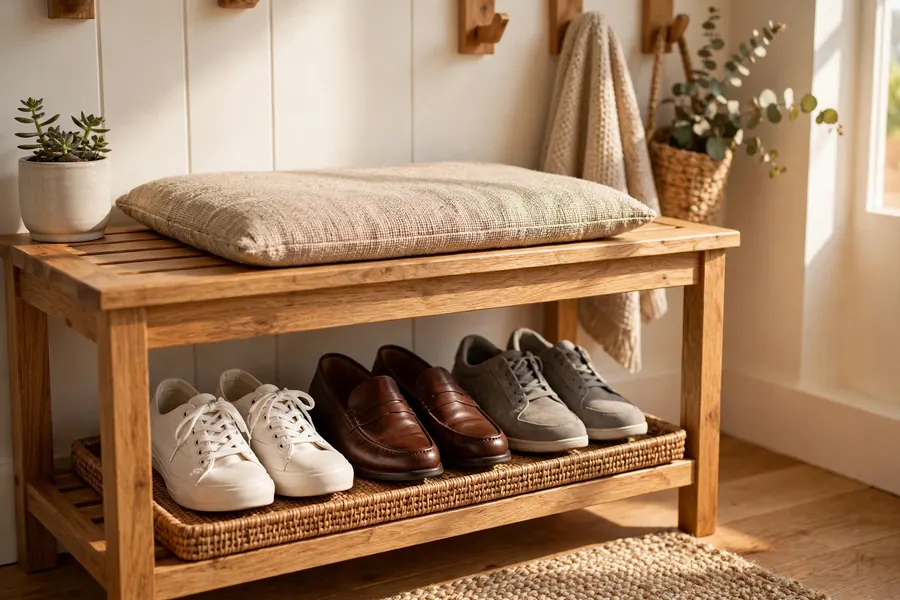
Give each person one pair of daily shoes at the door. Not three, not “the options.” One. Everything else lives in the bedroom closet. A low tray or boot mat defines the boundary: shoes on the tray are fine, shoes on the floor are not. The tray also catches dirt and wet-weather mess, which is half the battle in rainy seasons.
For households that need a bit more, a slim shoe bench with storage underneath doubles as a place to sit while putting shoes on — genuinely useful in a small space, and it keeps pairs contained. Our guide to 10 Best Storage Ideas for Small Apartments and Tiny Homes has more slim-profile picks that work in tight foyers.
Keys, Mail, and the Daily Carry
Keys go in the bowl by the door. Always. The number of mornings this saves is embarrassing to admit — I once spent twenty minutes looking for keys that were in my coat pocket the whole time. The bowl ended that era.
Mail needs its own triage system, or it becomes a paper mountain. A small wall-mounted sorter with two slots — “action” and “recycle” — takes thirty seconds a day. Junk mail goes straight to recycling without ever touching a surface. Bills and letters-to-answer go in the action slot, which you clear once a week. If paper tends to pile up on you, The 15-Minute Declutter Method: 10 Spaces You Can Tidy Today has a great mail routine.
Wallets, sunglasses, and work badges live in the drop-zone tray. The rule: if it leaves the house with you daily, it sleeps in the tray.
Slim Furniture That Earns Its Footprint
In a small entryway, every piece of furniture must justify the floor it occupies. A narrow console table (ten to twelve inches deep) gives you a drop zone surface without blocking the path. A storage bench gives you seating and hidden shoe storage. A tall, narrow cabinet gives you coat storage and uses vertical space.
What doesn’t earn its footprint: decorative tables with no storage, oversized coat racks that wobble, and anything you have to walk around. Measure your walkway and keep at least thirty inches clear — if you have to sidestep your own furniture, it’s too big for the space.
One underrated pick: a wall-mounted fold-down shelf. It’s there when you need a surface for grocery bags, folded flat when you don’t. Perfect for hallways that can’t spare a single inch permanently.
Light and Mirror Tricks for Tiny Foyers
Small entryways often feel smaller than they are because they’re dark. A mirror opposite (or beside) your light source bounces light around and visually doubles the space. It doesn’t need to be big — even a medium round mirror changes the feel completely. Bonus: you get a last look before heading out.
If your entryway has no natural light, a warm plug-in wall sconce or a small lamp on the console beats a harsh overhead every time. Warm light makes a tiny foyer feel intentional instead of cramped. And keep the walls light-colored if you can — dark walls in a four-foot hallway close in fast.
The 2-Minute Entryway Reset
Here’s the maintenance habit: every evening, spend two minutes resetting the entryway. Shoes back on the tray (extras to the closet), coats on hooks, mail triaged, keys in the bowl. Two minutes. That’s it.
This works because the entryway is small — there’s simply not much to reset. But the payoff is outsized: you walk out every morning into a calm, clear space instead of yesterday’s chaos. It genuinely changes how your whole home feels, because it’s the first and last room you experience every day.
For the full room-by-room version of this thinking, How to Declutter Your Home Room by Room: A Beginner’s Complete Guide covers the entryway alongside every other space.
Frequently Asked Questions
How do I organize an entryway with no closet?
Hooks and wall storage replace the closet entirely. A row of hooks for coats, a slim bench or tray for shoes, and a wall shelf for keys and mail cover everything a closet would hold — often better, because everything stays visible.
What if my “entryway” is just a hallway?
Treat a section of the hallway wall as the entryway: hooks, a narrow shelf, and a shoe tray in one defined zone. You don’t need a separate room — you need a defined system in whatever space the door opens into.
How do I stop family members from dumping everything at the door?
Make the right thing the easy thing. If the hook is right there and the shoe tray is right there, most people will use them. Label hooks per person if needed. And model it yourself first — systems spread by example, not by nagging.
Start tonight: clear everything out of your entryway, put back only what belongs, and set up one hook and one tray. Tomorrow morning, notice how different it feels to leave the house. Small space, small effort, surprisingly big payoff.