

Every small room has one — that awkward triangle where two walls meet, home to a dusty plant you forgot to water or a tangle of cables nobody wants to deal with. Here’s the thing, though: your corners are some of the most underused real estate in your home. The right corner storage ideas can claw back square footage you didn’t know you had, turning dead angles into hard-working storage that keeps your floors clear and your small rooms feeling bigger, not busier.
I’ve helped friends organize tiny apartments, and the pattern is always the same. We obsess over closets and cabinets while the four corners of each room sit there, empty, doing absolutely nothing. A single corner, used well, can hold books, shoes, cleaning supplies, or even an entire mini office — all without blocking a single walking path. Below are the corner storage solutions that actually work in real small rooms, room by room.
Floating Corner Shelves: The Easiest Win in Any Room
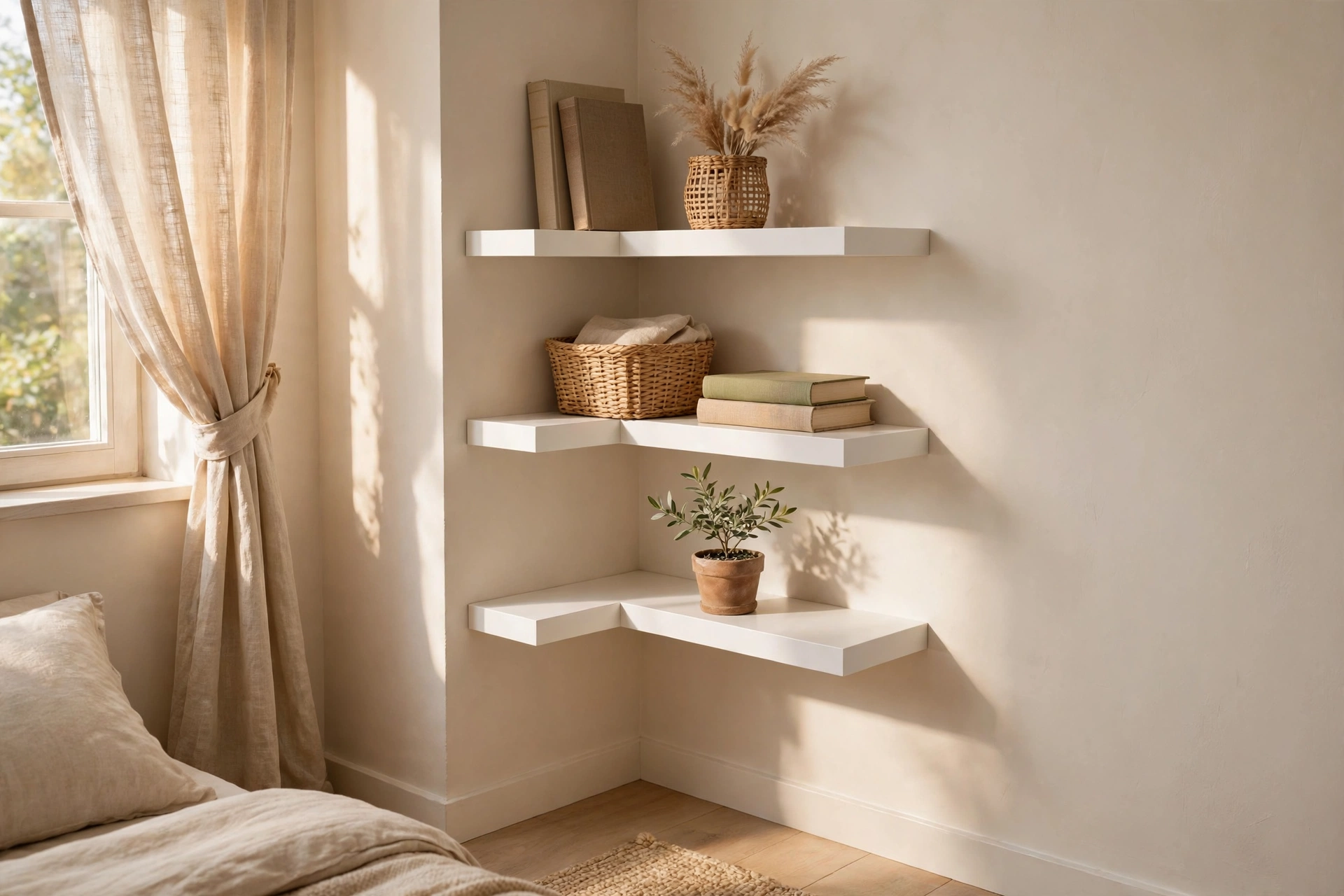
If you only do one thing from this list, make it this. Floating corner shelves are triangular or L-shaped shelves that mount right into the corner of a wall, and they’re the simplest way to turn vertical dead space into storage without touching a single inch of your floor.
In the bedroom, three staggered floating shelves above your nightstand can replace a bulky bookcase entirely — a lamp on the bottom shelf, your current reads in the middle, and a small basket of hand cream and chargers on top. In the bathroom, a two-tier corner shelf holds shampoo, conditioner, and the folded washcloths that currently live in a sad pile on your toilet tank. In the kitchen, a set of short shelves in the corner beside the window turns into a little herb station, with small pots of basil and thyme catching the light.
A few practical tips that make or break the result:
- Keep shelf depth under 12 inches. Deeper shelves in a corner start to feel heavy and cave-like, and things get lost in the dark back wedge.
- Leave about 30% of the shelf empty. Corners photographed on Pinterest look serene because the owners resisted the urge to fill every inch. Negative space is what keeps a corner feeling airy instead of cramped.
- Match the shelf to your wall color. White shelves on white walls visually disappear, so the items on them float. Dark shelves on light walls make a bolder statement — pick your mood.
- Use one anchor, then scatter. Put the heaviest-looking item (a big plant, a stack of books) low, and lighter objects higher. It keeps the corner feeling grounded.
Installation is a Saturday-morning job. Find the studs in both walls with a stud finder, and use L-brackets rated for the weight you plan to store. If you’re renting, look for adhesive or tension-mounted corner shelf units — they’re surprisingly sturdy for lighter items like plants and framed photos. This is also a good moment to think vertically about the rest of the room too, since corners and walls work best as a team.
Corner Cabinets and Towers That Hide the Mess
Open shelving is lovely until you remember that real life includes ugly things: the printer paper, the spare phone chargers, the box of batteries everyone owns but never talks about. That’s where corner cabinets earn their keep. A tall, narrow corner cabinet slides into that dead angle and gives you closed storage — doors that shut, mess that vanishes.
In the living room, a slim corner cabinet with two doors becomes the home for board games, throw blankets, and the remote controls that migrate everywhere. Because it’s tucked into the corner, it reads as part of the room’s architecture rather than another piece of furniture crowding the space. In the bedroom, a tall corner wardrobe or a narrow dresser turned at 45 degrees holds shoes and sweaters that never fit in the closet. In the dining area, a triangular corner cabinet stores serving dishes and the fancy glasses you use four times a year.
What to look for when shopping:
- Measure the angle, not just the width. Corners aren’t always a perfect 90 degrees, especially in older apartments. Bring a tape measure and check both wall lengths before buying.
- Prioritize adjustable shelving. A corner cabinet with fixed shelves locks you into one layout. Adjustable shelves let you reconfigure as your storage needs change.
- Go tall, not wide. A cabinet that’s 24 inches wide and 72 inches tall holds far more than you’d expect and keeps your floor line clean.
- Mix one open shelf into closed cabinets. A single open shelf at eye level for a plant or a candle keeps a tall cabinet from looking like a monolith.
Dead Kitchen Corners: Storage Ideas That End the Black Hole
Kitchen corners deserve their own section because they are the most famously wasted corners in any home. You know the one — the deep cabinet corner where pots go to disappear, or the counter corner collecting appliances you haven’t touched since 2024. Corner storage ideas for the kitchen are less about pretty and more about rescue.
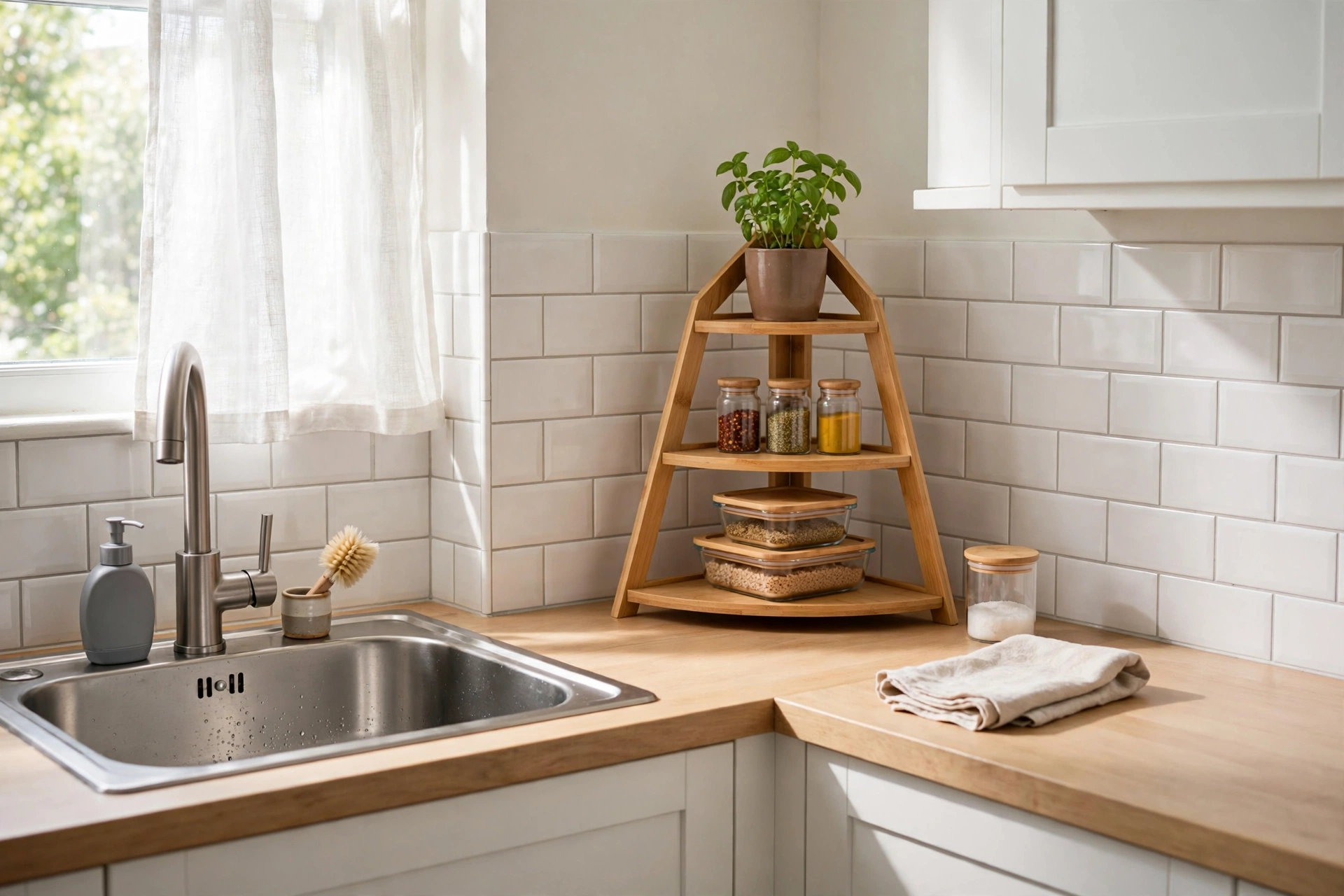
Inside lower cabinets, a lazy susan is the classic fix for a reason: a full-circle or kidney-shaped rotating tray means nothing gets shoved into the dark back corner of the cabinet ever again. For upper cabinets, a corner pull-out shelf — the kind that swings out and toward you when you open the door — brings everything into the light. If your kitchen is a rental and you can’t modify cabinets, a corner countertop organizer works the same magic on the surface: tiered triangular shelves or a rotating tray that corrals your oils, spices, and the coffee gear into one tidy zone.
A few more kitchen-specific moves:
- Stackable containers on a corner riser. One small riser shelf on the counter doubles your vertical space for mugs, spice jars, or stacked food containers — and it stops the slow creep of clutter across the whole counter. For more on keeping counters clear, see our guide to kitchen counter organization ideas.
- Hang it, don’t stack it. A corner-mounted rail with S-hooks holds utensils, mugs, and small pans off the counter entirely. It keeps daily tools at arm’s reach without eating cabinet space.
- Reclaim the gap. Most kitchens have a weird gap between the upper cabinet and the wall in the corner. A narrow tension rod or a small wall-mounted rack there holds paper towels, foil, or cling wrap.
The Corner Desk: Your Tiny Home Office Without a Spare Room
This is one of the most-searched corner storage angles for a reason: an entire workspace in a corner you weren’t using anyway. An L-shaped or small triangular desk wedged into a bedroom or living room corner gives you a dedicated work-from-home spot without surrendering a whole room — or, frankly, any usable floor space at all.
The key to making a corner desk feel intentional rather than cramped is going up. Mount two slim floating shelves above the desk for reference books, chargers, and a small plant. Add a pegboard on one of the adjoining walls for headphones, notebooks, and the to-do list. Slide a narrow rolling cart — the kind that’s barely wider than a stack of notebooks — underneath or beside the desk for files, printer paper, and office supplies. When the laptop closes at 6 PM, the corner still looks like part of the room, not a cubicle that wandered in.
If the room is shared, treat the corner desk like a tiny zone: a small rug underneath, a lamp clipped to the desk edge, and you’re done. The rug especially matters — it visually contains the work area so the rest of the room doesn’t feel swallowed by office vibes. People consistently tell me the corner desk is the one change that made their small bedroom feel bigger, because it finally gave the work stuff a boundary instead of letting it colonize the bed, the dresser, and the floor.
Cozy Corner Nooks That Store While They Seat
Not every corner wants to be pure storage. Sometimes the smartest corner storage idea is a piece of furniture that does double duty — somewhere to sit that quietly swallows clutter at the same time.
A corner bench with hidden storage is the champion here. In a dining nook, a banquette-style corner bench with lift-up seats stores table linens, placemats, and the board games that used to live on top of the bookshelf. In an entryway, a corner storage bench holds shoes and winter gear, with hooks mounted on the wall above for coats and bags. In a kid’s room, a corner cushion bench with a hinged lid becomes the toy box — the one the toys actually go back into, because it’s right there where the playing happens.
Other dual-purpose corner wins:
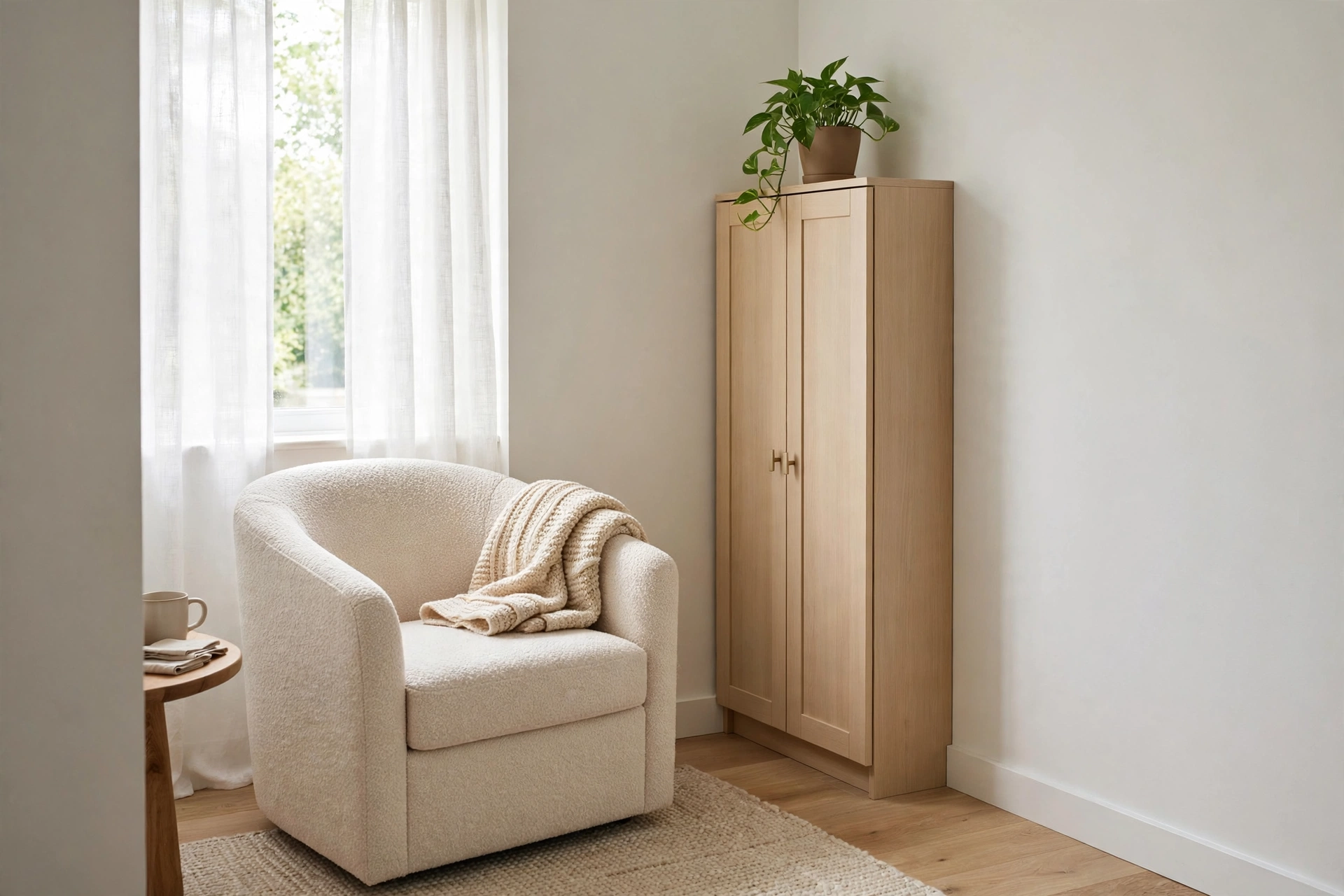
- A corner armchair with a slim bookshelf tucked behind it. The chair hides the shelf, the shelf holds the books, and the whole arrangement becomes a reading nook that took zero extra floor space.
- A storage ottoman pushed into the corner. It works as a footrest, an extra seat when friends visit, and a deep bin for throw blankets or wrapping paper supplies.
- A corner ladder shelf. The A-frame shape fits neatly into the angle of the corner, and the graduated shelves are perfect for plants, photo frames, and baskets — storage and display in one.
In the bedroom, a corner storage bench at the foot of the bed — or just one turned sideways into the corner — is ideal for the stuff that lives in the gray zone between the closet and the laundry basket: tomorrow’s outfit, the book you’re halfway through, the hand weights you actually use. If your bedroom closet is overflowing in general, our bedroom organization ideas will help you find a place for everything else.
Small Corner Habits That Keep It Working
Here’s the honest part: corner storage only works if the corner stays organized. Corners are natural clutter magnets — out of the sightline, easy to toss things into, easy to forget. A few habits keep your corners earning their keep instead of becoming new junk zones:
- Give every corner a job. “Miscellaneous corner” is how clutter happens. Name it: the charging corner, the tea corner, the wrapping-paper corner. Jobs have boundaries.
- Basket everything loose. If a corner holds small items, contain them in one basket or bin each. When the basket is full, something has to go — it’s a built-in limit. And don’t forget what’s under the bed nearby; corners and under-bed space together can absorb an entire room’s overflow.
- Do a monthly corner sweep. Once a month, pull everything out of your corner storage, wipe the shelf or cabinet, and put back only what belongs. Ten minutes, tops — and it pairs perfectly with a regular routine.
- Light it. Dark corners collect clutter because you can’t see what’s in them. A small battery-powered puck light or a clip lamp inside a corner cabinet or above corner shelves makes the space feel used and intentional.
- Respect the sightline. The first thing you see when you walk into a room should never be a crammed corner. Keep the visible corners calmer than the hidden ones.
Start with just one corner this weekend — the one that’s currently holding dust and good intentions. A set of floating shelves or a single slim cabinet can go up in an afternoon, and the change is immediate: the room feels calmer, the floor feels bigger, and suddenly you’ve got storage you never had to “make room” for. That’s the real magic of corner storage ideas — they don’t take space, they find it.