
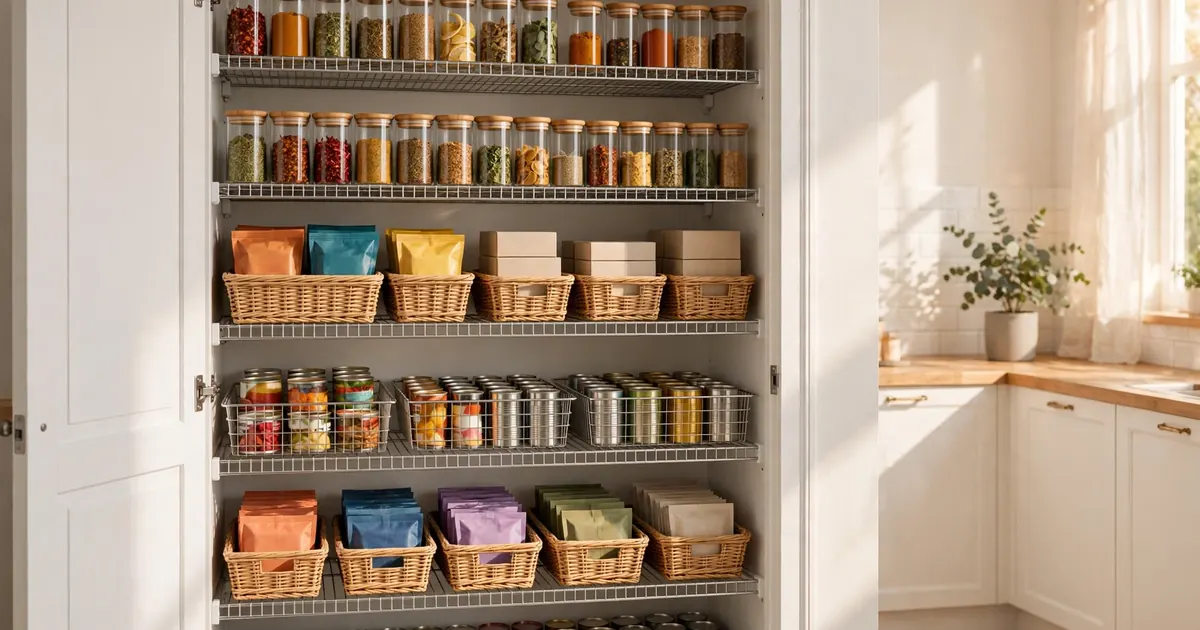

Somewhere in your kitchen there is a slab of perfectly good storage space that you look at a dozen times a day and never really see. It is the back of your pantry door. These pantry door organization ideas will turn that forgotten surface into some of the hardest-working square footage in your kitchen — no drilling, no remodel, and in most cases no tools at all.
I will admit I ignored my own pantry door for years. I had the shelves arranged, the bins labeled, and I still ran out of room. Then one Sunday, while reaching for a packet of yeast that had vanished into the back of a shelf, I noticed the door behind me: completely bare, completely empty, and roughly the size of a small bookcase. It was the moment I realized that organizing a pantry is not just about the shelves. It is about every surface — including the one that swings.
Start With the Door: Measure Before You Shop
Every door-mounted project begins with three numbers, and skipping them is how people end up with a rack that bonks the shelves every time the door closes. Grab a tape measure and check:
- Door width. Most interior pantry doors are 24 to 32 inches wide. Measure the flat inner panel, not the whole door — you need the actual mounting area between any molding.
- Usable height. Measure from the top of the door to a few inches above the floor. Tall, narrow doors are ideal for stacked baskets; short doors need compact, wide designs.
- Depth clearance. This is the one people forget. Close the door slowly with your hand behind it and feel how much gap exists between the door’s inner face and the nearest shelf. Most over-the-door racks need 4 to 7 inches of clearance. If your shelves are deep and sit close to the door, choose a slim rack or skip to the wall-mounted options below.
While you are at it, weigh your ambitions honestly. A standard over-the-door rack comfortably holds light to medium items — spices, packets, tea boxes, snack bars. It is not the place for a gallon of olive oil or a family-size can of crushed tomatoes. Keep the heavy glass and the big cans on the shelves, and let the door carry the light, grabby stuff you reach for every day. That one rule keeps the door closing smoothly and the hinges happy for years.
Pantry Door Organization Ideas: Over-the-Door Wire Racks
If there is a single hero product in the world of pantry door organization ideas, it is the over-the-door wire rack. Two hooks, a frame of slim baskets, zero tools. You lift it over the top of the door, adjust the baskets, and suddenly you have added the equivalent of an entire extra shelf to your pantry.
What makes wire racks so useful is their shape: long and narrow, which matches a door’s proportions perfectly. A typical rack has six to nine tiers, each only three or four inches deep. That shallow depth is a feature, not a flaw — it forces you to store things in a single row where you can see every label. No more reaching past the front jar to find the taco seasoning, no more buying cumin twice because the first one was hiding.
A few things I have learned from using one for two years:
- Put the daily drivers at eye level. Salt, cooking spray, the spices you use three times a week — middle tiers, where your hand lands naturally.
- Reserve the top for back-ups. Extra packets of seasoning, spare sauce sachets, the second box of tea. Visible, but out of the everyday flow.
- Use the bottom tier for kid-friendly items. Small snack cups, applesauce pouches, granola bars. Kids can grab their own snacks without dragging a step stool across the kitchen.
- Watch the swing. Every few months, check that the hooks have not loosened and that the door still closes with a firm click. A rack that has slipped a centimeter can start rattling.
For small pantries in particular, a door rack can be genuinely transformative. If you are working with a tiny pantry to begin with, our guide to small pantry organization ideas pairs beautifully with this upgrade — the door rack handles the small stuff while the shelves keep the big jobs.
Clear-Pocket Organizers: The Renter-Friendly Classic
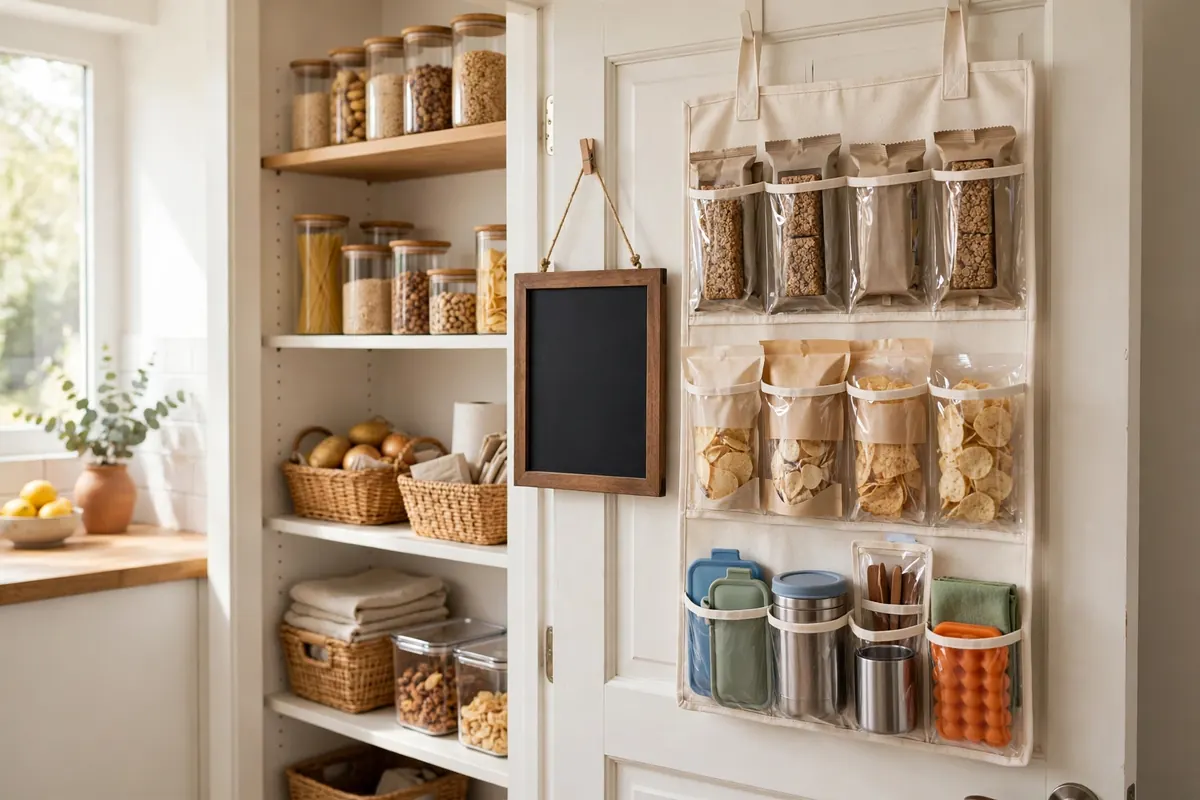
Long before fancy metal racks existed, clever renters were hanging clear-pocket shoe organizers on their pantry doors. The idea is beautifully simple: a fabric panel with rows of transparent pockets that lets you see everything at once, costs very little, and leaves zero marks on the door when you move out.
The key word is clear. Opaque pockets defeat the purpose because you end up digging through them exactly like the junk drawer you were trying to escape. With clear pockets, you can scan the whole door in seconds — gravy packets, taco shells, yeast sachets, sauce mixes, all visible and all in their own little window.
Here is how to make a pocket organizer actually work instead of becoming a vertical junk pile:
- One category per row. Top row: breakfast packets. Next row: baking add-ins. Next: lunchbox snacks. When a row has a job, you stop stuffing random items into it.
- Keep it light. These panels are held by hooks and gravity, not engineering. Packets, bars, sachets, and flat items only — nothing that bulges or weighs down the fabric.
- Cut it to fit if you need to. Many organizers have more rows than a pantry door needs. A pair of scissors and a hem of duct tape turns a 24-pocket shoe organizer into a perfectly sized pantry one.
One honest warning: fabric pockets collect dust and the occasional sticky drip over time. Toss the whole panel in the washing machine on gentle every few months and it comes back fresh. That small habit keeps this budget option feeling intentional rather than sad.
A Door-Mounted Spice Station That Doesn’t Drive You Crazy
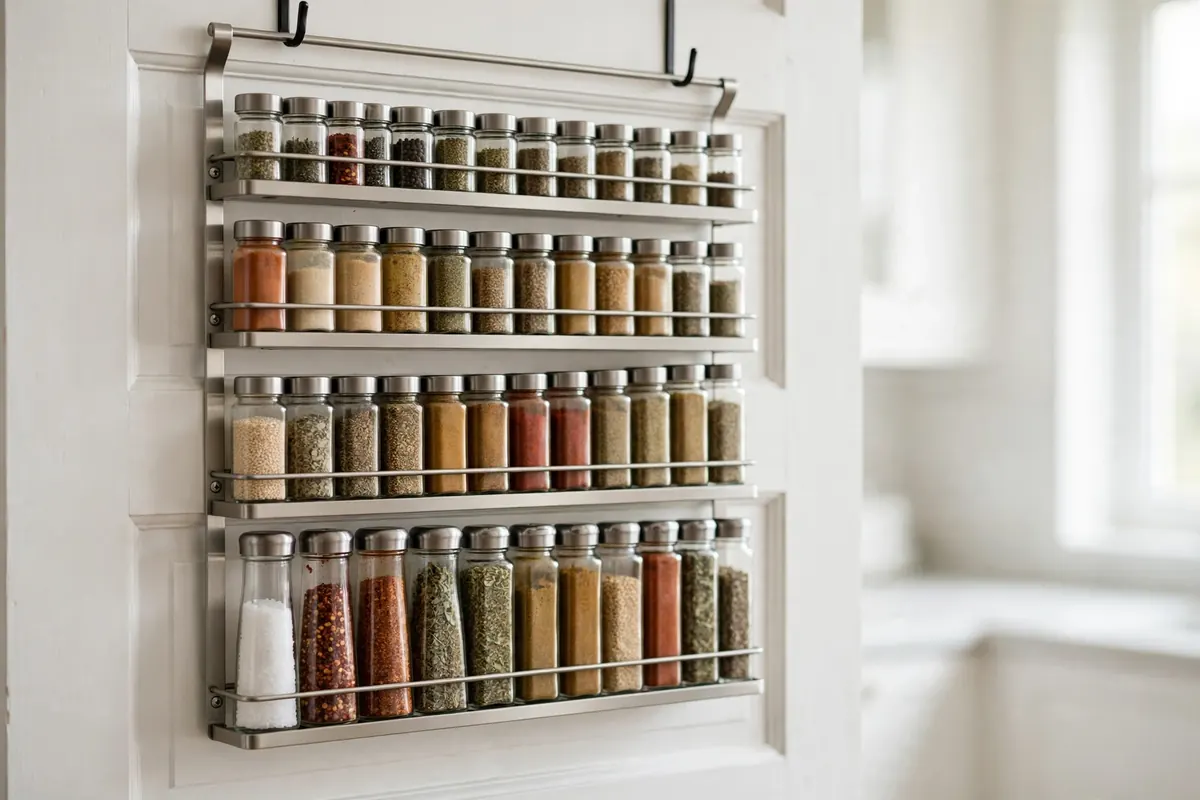
Spices are the natural tenants of a pantry door. They are small, light, needed constantly, and — in most kitchens — crammed into a cabinet where you knock over three jars reaching for one. Moving your core spice collection to the door is one of those changes that feels small and acts big.
The most popular setup is a tiered spice rack designed specifically for doors: shallow shelves with a raised lip so jars cannot slide off when the door swings. Mount it at eye level on the inside of the door, and your most-used spices become the fastest things in the kitchen to grab. No more cabinet Tetris.
A few details that separate a great door spice station from a frustrating one:
- Alphabetize, or at least group. It sounds fussy, but a door rack holds few enough jars that alphabetical order is easy to maintain — and it ends the nightly hunt for the smoked paprika. If alphabetizing feels too rigid, group by cuisine: the taco trio together, the baking spices together, the everyday basics together.
- Decant the oddballs. Door racks work best with uniform jars. If your spice collection is a chaotic mix of brands and sizes, move them into matching small jars first. It is an afternoon project that pays off every single day.
- Leave breathing room. Fill the rack to about 80 percent. That empty space is what keeps the station usable instead of cramped — and it leaves room for the new spice you will absolutely bring home from the specialty store next month.
If your spice situation is bigger than a door can handle, the deep dive in our spice organization guide covers full cabinet systems, drawer inserts, and labeling tricks that pair well with a door station for your everyday jars.
Pantry Door Organization Ideas for Snacks and Grab-and-Go Zones
Now the fun part. Once the practical storage is sorted, the door becomes the perfect home for the stuff your household reaches for constantly — and organizing it into a proper zone saves you from the daily avalanche of half-open boxes.
Think of the door as real estate with different neighborhoods. The top zone is for you: tea, coffee filters, protein bars, the good chocolate you pretend does not exist. The middle zone is for whoever cooks: broths, sauces, marinades, the cans you reach for mid-recipe. And the lower zone — reachable by small hands — is for the kids. This is where door storage quietly becomes parenting help. When the after-school snack options live in one visible row on the door, kids stop standing in front of the open pantry for ten minutes asking what there is to eat.
Practical builds for a grab-and-go door zone:
- Basket rows for snack categories. One basket for sweet snacks, one for savory, one for fruit pouches. When a category empties, the basket empties — and that is your visual cue to restock on the next grocery run instead of discovering an empty shelf on Tuesday night.
- A lunch-packing station on the door. Dedicate two or three tiers to everything lunch needs: sandwich bags, wraps, snack cups, juice pouches. Morning-you will thank evening-you. For the full system, our kids’ snack station guide shows how to build the shelf-side half of this routine.
- A chalkboard or whiteboard panel. The door’s blank space between racks is perfect for a small board. Keep the running grocery list there — when you take the last box of crackers from the door rack, the crackers go on the list immediately. It is the simplest inventory system ever invented.
One caution from experience: do not let the snack zone become the junk zone. Set a loose rule that anything on the door must be something someone actually eats at least weekly. The half-used box of crackers from last spring? Shelf. The mystery protein powder sample? Trash. The door is prime real estate — charge it rent.
The 5-Minute Monthly Reset That Keeps It Working
Here is the unglamorous truth about every organization project: the system is only as good as its maintenance. The good news is that a door organizer needs almost none — five minutes, once a month, is genuinely enough.
Set a timer and run this checklist:
- Toss the expired and the stale. Pull each row quickly and check dates. Door storage gets used often enough that this is rarely dramatic, but the odd expired packet sneaks in.
- Re-home the drifters. Every door collects items that migrated from somewhere else — a random battery, a twist tie collection, a coupon from 2024. Send them back where they belong.
- Tighten and wipe. Check the hooks, tighten any screws, and give the racks a quick wipe. Kitchens are greasy environments; a damp cloth keeps metal racks from getting sticky.
- Restock from the shelves. If you keep back-up supplies on the main shelves — and you should — use the reset to refill the door’s daily rows from your backstock. The door stays full, the shelves stay deep.
And if you are building out a deeper pantry system around your new door storage, our guide to canned food organization shows how to arrange the shelves themselves so the door and the shelves work as one team instead of two separate projects.
That is really the whole secret. Your pantry door has been standing there, quietly offering you an extra wall of storage, the entire time you have owned your kitchen. All it needed was a rack, a plan, and five minutes a month. Start with the tape measure tonight — by the weekend, you will wonder how you ever cooked without that door working for you.
[…] holds tea boxes, pods, and sweeteners without touching a single shelf, exactly the trick that makes pantry door organization a small-space […]
[…] it walkable. The test is simple — walk in, turn around, walk out, without stepping over anything. Don’t forget the door itself: the inside of a walk-in pantry door is prime real estate for spices, small packets, and wraps that […]
[…] your pantry itself needs a broader reset, look at pantry door organization ideas for ways to use the inside of the door for small packets, freeing shelf space for your bigger rice […]