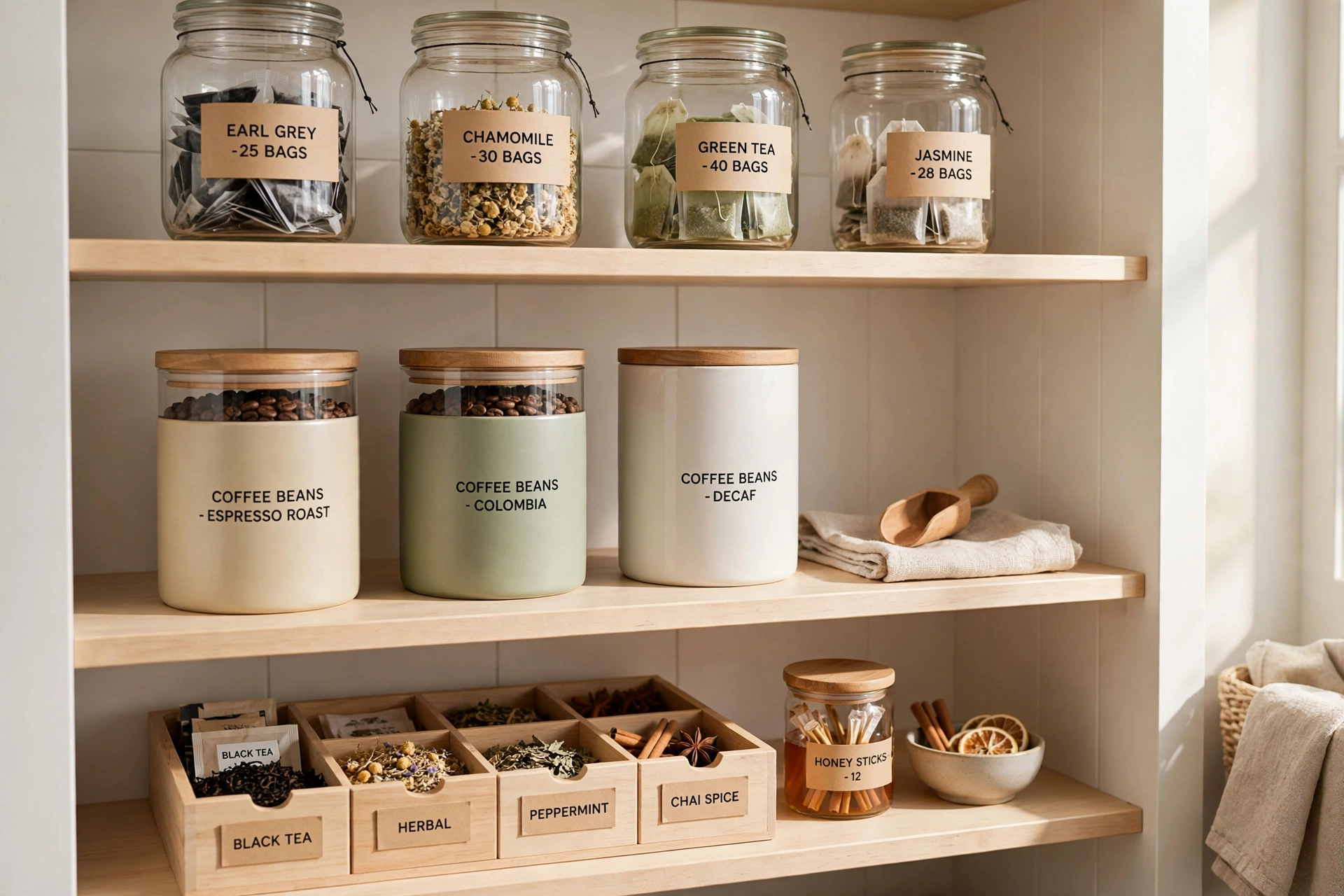

Somewhere in your pantry right now, there’s a graveyard of good intentions. A crushed box of chamomile from last winter. Three bags of coffee — two half-empty, one you’re not sure is coffee or something else. A bag of loose-leaf something your sister brought back from her trip, sitting on a shelf so long it’s basically a souvenir. And every single morning, half awake, you shove past all of it to find the one tea bag you actually wanted.
Here’s the thing: tea and coffee organization isn’t about making your pantry look pretty for strangers. It’s about making your 6 a.m. self function. And this is one of the fastest pantry projects there is — the whole thing fits in a single shelf or drawer, and most people finish in under an hour. Here’s how to do it so it stays that way.
Start with a five-minute audit, not a shopping cart
The number one mistake people make with beverage clutter is buying containers before knowing what they own. Pull every tea, coffee, hot chocolate, matcha, sweetener packet, filter, and pod out of the pantry and line them up on the counter. Yes, all of it — even the dusty tin from the back.
Now sort into four piles: daily drinkers, weekly rotations, seasonal or occasional, and “why do I own this.” That last pile is the most important one. Tea you bought for guests who never drink tea. Coffee that went stale two years ago. Mystery tins with no label. If nobody in the house drinks it and it’s past its best, let it go. Be honest: that free sample from a hotel is not becoming part of anyone’s routine.
Count what remains. Most households land on four to eight daily or weekly teas and one to three coffees. That’s a manageable collection — and knowing the real number tells you exactly how many containers you need, which stops the over-buying habit that caused half the mess in the first place.
Tea and coffee organization works best in zones, not shelves
Here’s the principle that separates tidy beverage corners from re-cluttered ones three months later: organize by the way you actually make drinks, not by alphabetical order or matching aesthetics. Group everything into three zones.
The morning zone is the easy-reach spot — the shelf at eye level, or the front of the drawer. It holds today’s and tomorrow’s choices: your daily tea, the coffee you’re currently drinking, sweetener, and whatever you reach for half asleep. Nothing goes here that requires bending, stretching, or moving something else first.
The variety zone sits behind or below the morning zone and holds the rotation: decaf for evenings, the peppermint for upset stomachs, the fancy single-origin you save for slow weekends. You visit this zone intentionally, so it can sit a little deeper.
The refill zone is where the backups live — the unopened bag of coffee beans, the fresh box of tea bags that restocks the morning zone when the current one runs out. Keep it clearly separate, and you’ll never again open three boxes of Earl Grey.
In a small pantry, these zones can be as simple as front, middle, and back of one shelf, or a single deep drawer: daily tea bags in a divided organizer up front, the coffee canister behind, the refill basket at the back. Drawers beat shelves for beverages anyway, because you see everything from above instead of playing peek-a-boo with the back row. And the inside of the pantry door is prime beverage real estate — a slim over-the-door rack holds tea boxes, pods, and sweeteners without touching a single shelf, exactly the trick that makes pantry door organization a small-space superpower.
Decant the daily stuff, box the backups
Retail packaging is designed to stand out on a store shelf, not to stack neatly in yours. Those flimsy tea boxes get crushed, cardboard absorbs pantry humidity, and coffee bags refuse to stay closed no matter how well you fold them.
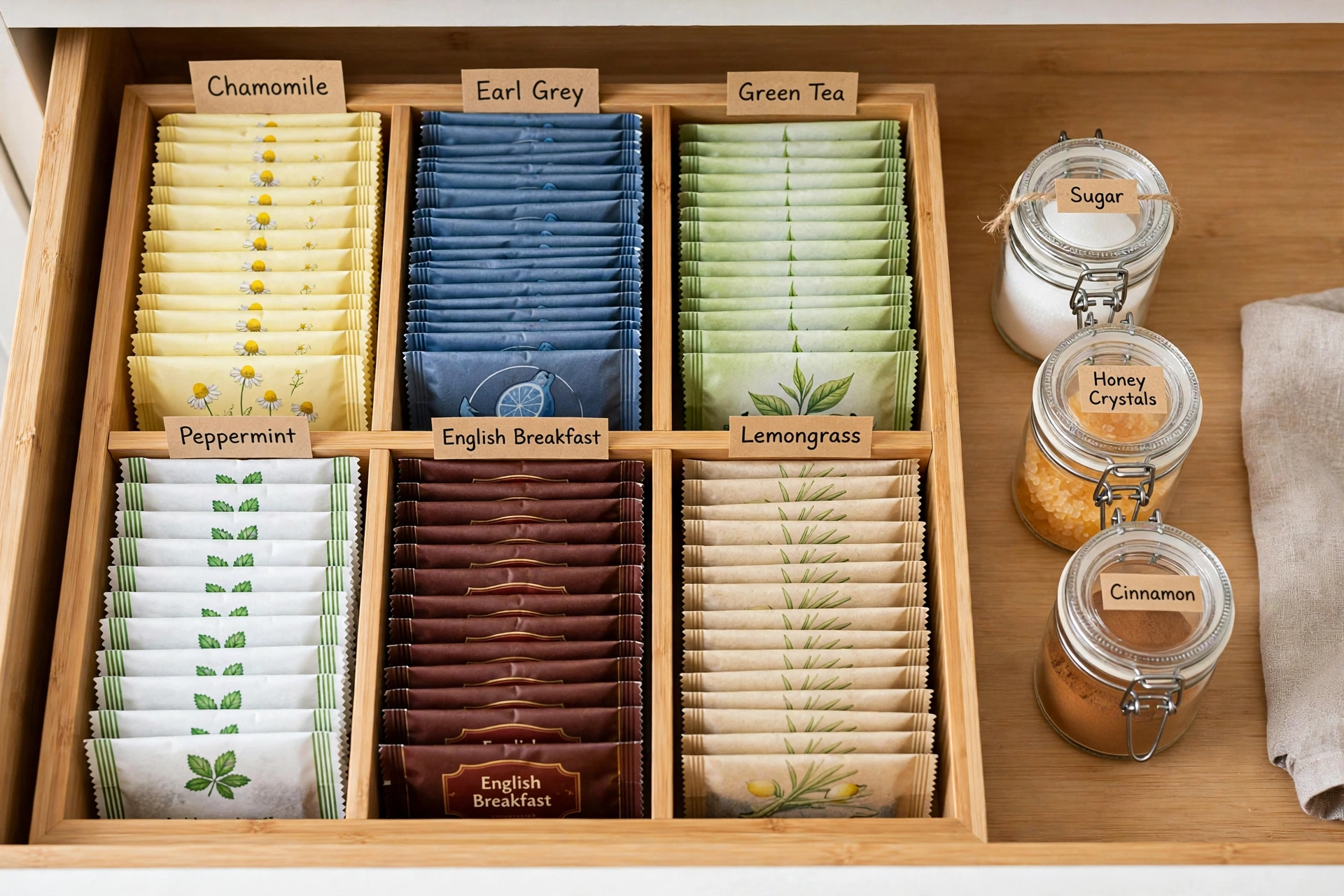
For the morning zone, decant. Tea bags go into small airtight containers or a divided drawer organizer — one compartment per variety, labels facing forward. Loose-leaf tea and ground coffee do best in opaque or dark-tinted airtight canisters, because light degrades flavor faster than most people realize. Whole beans keep noticeably better in a sealed jar than in the bag they came in, especially once opened.
For the refill zone, keep things in their original sealed packaging until you need them. This isn’t laziness — it’s freshness. An unopened bag of coffee stays good far longer than a decanted jar that’s been breathing air for weeks. Just stand the sealed backups upright together in one basket so “the backstock” is visibly one thing, not scattered single bags that each feel like an accident.
Label everything you decant, including the variety and the date you opened it. Tea loses its aroma gradually and coffee goes flat in a matter of weeks once opened — a tiny date sticker turns “is this still good?” from a guessing game into a glance.
Choose containers by the drink, not by the trend
Walk the container aisle and everything looks the same: glass jars with bamboo lids. They’re beautiful, and for some things they’re right. For others, they’re the wrong tool. Here’s the honest breakdown.
- Glass canisters — great for tea bags and sugar packets, where you want to see what’s inside at a glance. Less great for coffee beans and loose-leaf tea, because light speeds up flavor loss. If you love the look, keep them on a shaded shelf, not under a pantry light that stays on all day.
- Opaque ceramic or tinted canisters — the best choice for coffee (whole bean or ground) and loose-leaf tea. They block light, look calm and tidy, and sit in a row without visual noise.
- Divided drawer organizers — perfect for individually wrapped tea bags and pods. Sorted by caffeine level or flavor family, they let you find the right bag in two seconds with one hand while the kettle heats.
- Baskets and trays — use one as the boundary for each zone. When the tray is full, the zone is full — a built-in limit that prevents the slow creep of new purchases. Trays also catch spills, so you clean one tray instead of an entire shelf.
- Tiered pod racks — if your household runs on a pod machine, a vertical rack earns its space. Stacking pods loose in a basket turns every flavor into an unknowable pile.
Match container sizes to your actual collection, not the set you bought. Four tea varieties don’t need an eight-compartment organizer — empty compartments invite clutter to move in.
Build a tiny brew corner inside the pantry
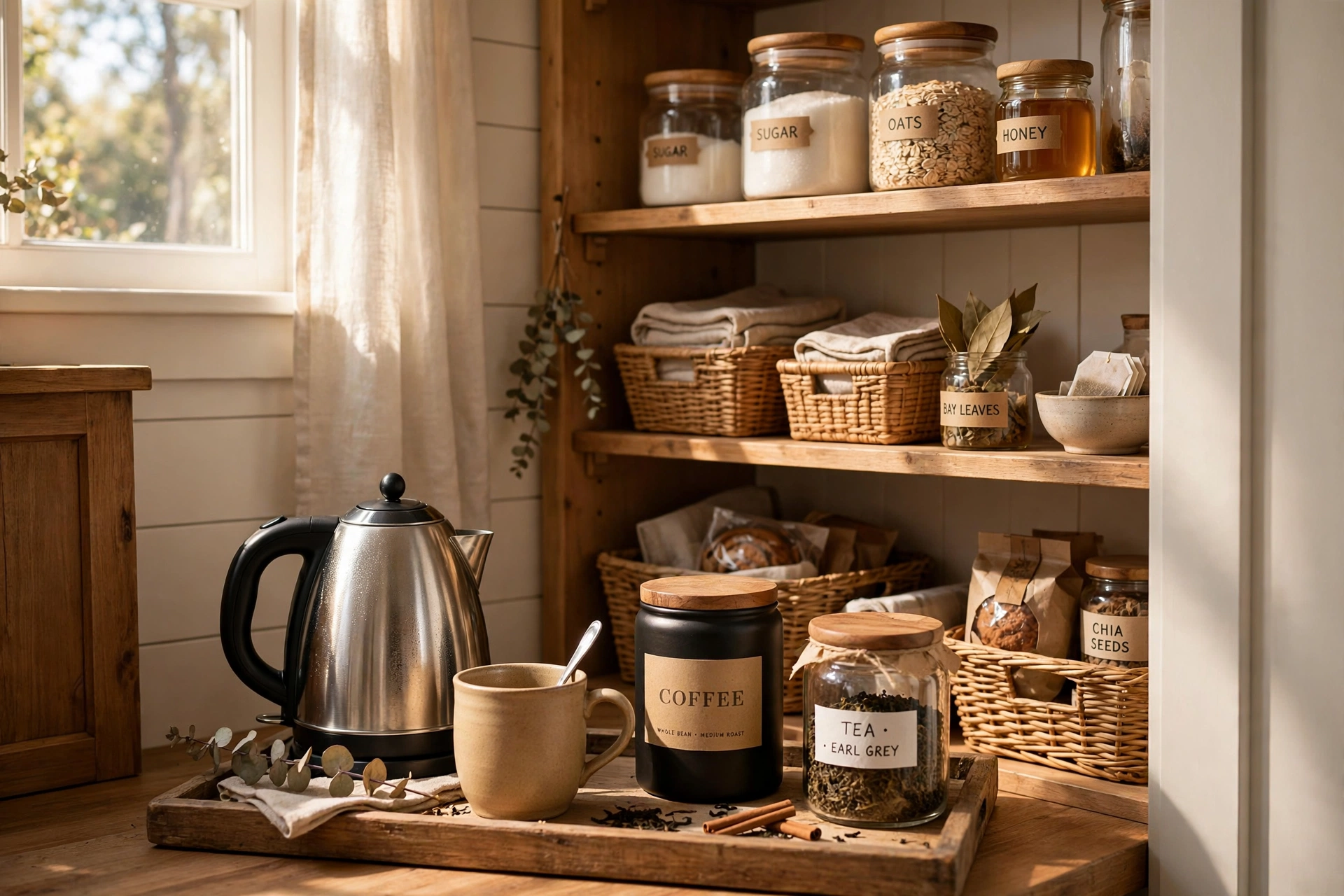
This is the move that turns an organized shelf into something you actually enjoy using. Clear a small footprint — about the size of a cutting board — near your beverage zone, and treat it like a permanent station.
On it goes only what you touch every day: the kettle or your daily brew method, your current tea or coffee canister, your mug, and your sweetener. Everything else lives in its zone, out of the way. If your pantry sits near the coffeemaker, the station lives right beside it. If not, a small tray holding your daily kit can sit on the counter and get refilled from the pantry each morning in about twenty seconds.
Two rules keep the brew corner from becoming clutter again. First, one mug per daily drinker stays at the station; the rest of the mug collection lives in a cabinet, not crowding the work zone. Second, nothing new enters the station without something leaving it. That second bag of specialty coffee your friend brought you is wonderful — it goes in the variety zone, not on the tray.
Households with kids can add a small low basket with hot chocolate packets and decaf options, clearly separate from the caffeinated stuff. It works like a kids’ snack station — their zone, their rules, your peace of mind.
Finally, teach the house the system in one sentence. If other people use the kitchen, the rule has to be simple enough to say out loud: “Morning stuff in the tray, restock goes behind, dates on the tape.” Label the trays themselves — DAILY, VARIETY, REFILLS — big and impossible to misread. It’s the same reason labeling works in spice cabinets: visible labels turn tidiness into the default instead of a chore you’re nagging about.
Keep your tea and coffee organization fresh with a simple rhythm
Most pantry organization advice ends at “buy matching jars.” That’s why most of it fails by spring. Beverages go stale, and a pantry corner full of expired tea is just organized clutter. Build freshness into the system from day one.
- First in, first out. When you restock from the refill zone, the new package goes behind the open one — never in front of it. This one habit prevents the classic problem of three open bags of the same coffee at different stages of staleness.
- Date every decant. A small piece of masking tape with the opening date takes five seconds. As a rough guide: ground coffee is best within two to three weeks of opening, whole beans within a month, and loose-leaf tea holds its character for about six months.
- Two-minute weekly reset. Once a week — while the kettle boils, honestly — straighten the zone. Toss crushed empty boxes, wipe the tray, move the newest item to the back. Two minutes prevents the slow drift that turns every pantry project into a re-do.
- Mind the heat. Never store your beverage zone directly above the stove or dishwasher, where rising heat and steam shorten everything’s life. A shelf a few feet away keeps flavor intact longer.
Let’s be honest about what you’re really buying with this project. Not a magazine photo. You’re buying the thirty seconds every morning when you walk to the pantry half awake and everything is exactly where your hand expects it. The tea you wanted, the coffee that still tastes like coffee, the sweetener without the sticky lid. No shoving, no guessing, no “I’ll deal with it later” that never comes.
Pull it all out. Sort it. Decant the daily, zone the rest, date the tape, label the trays. By the time the kettle boils for the first cup made from your new system, you’ll wonder why the graveyard of good intentions was allowed to live there so long.