
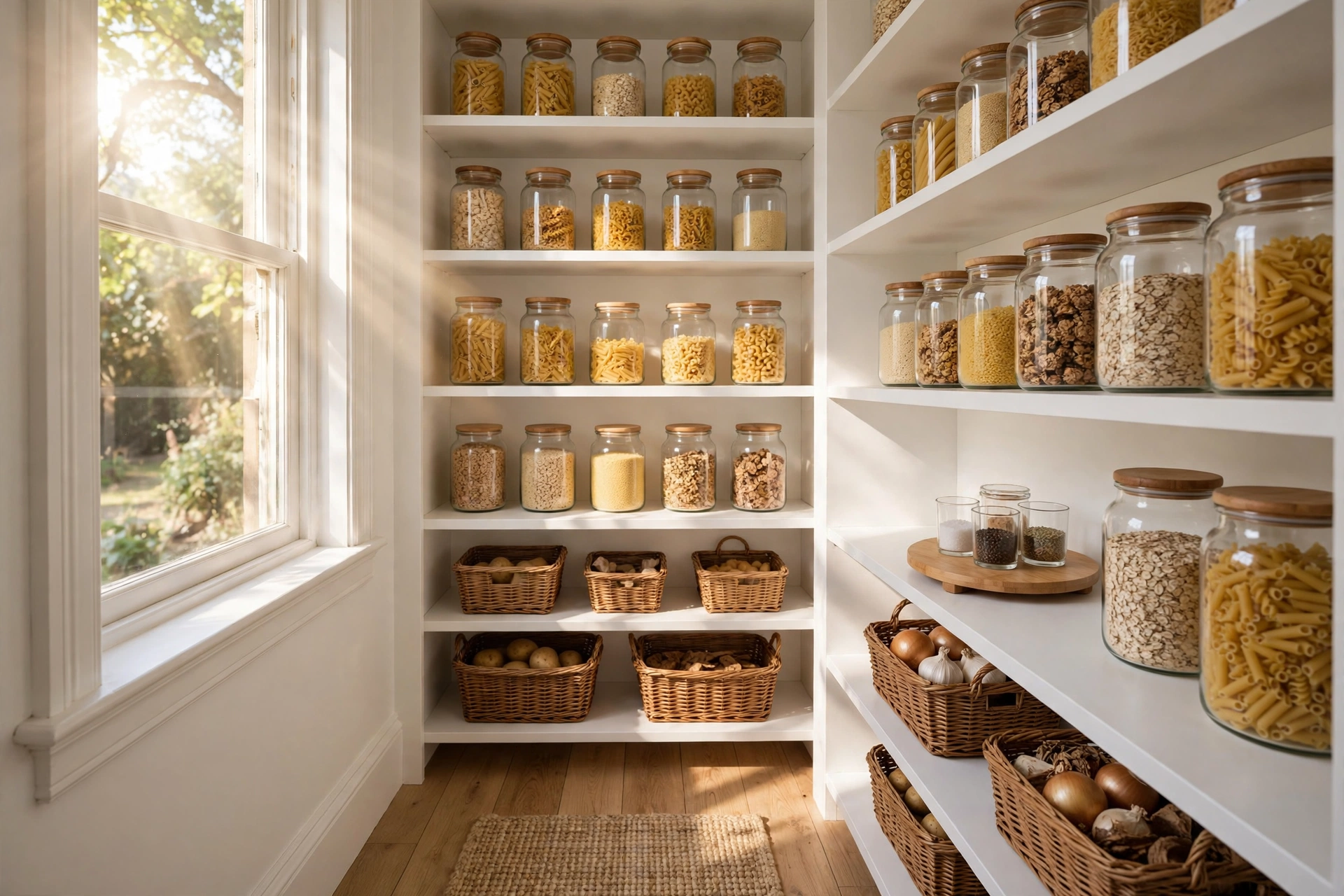

My first apartment kitchen had a “pantry” that was really a cabinet and a half. Every time I opened the doors, something shifted forward like a small avalanche, and I once found three opened bags of rice because I kept buying new ones instead of finding the old ones. If you know that feeling, these small pantry organization ideas are for you. A tiny pantry can actually work harder than a big one, because every inch has to earn its place — no dead corners, no forgotten back rows, no mystery cans from 2022.
The secret is not buying a full matching container set on day one (that is how pantries get cluttered with organizers). It is building a simple system around how you cook: purge first, give every category a zone, use the vertical space you already own, and put the space nobody thinks about — the doors, the walls, the narrow gaps — to work. Here is exactly how to do it, one weekend-friendly step at a time.
Small Pantry Organization Ideas Start With a Hard Reset
Before you spend a single dollar on bins, empty the whole pantry. Every jar, every half-used spice packet, every can you bought for a recipe you never made. Spread it all on the counter or the kitchen table so you can actually see what you own. This feels dramatic, and that is the point — you cannot organize what you cannot see.
Then sort everything into three piles: keep, donate, toss. Be honest about the keep pile. A small pantry has no room for “just in case” ingredients you have not touched in a year. Check dates while you sort, because small pantries hide expired food like nowhere else — that baking powder you bought for one batch of biscuits three years ago is not doing anyone any favors. Combine duplicates into one container (two half bags of lentils become one full one), and move the once-a-year stuff — the turkey baster, the specialty flours for that one holiday loaf — out of the pantry entirely, to a high cabinet or a labeled box in a closet.
Wipe the shelves down while they are empty. You will be amazed at what is lurking back there: sticky sugar dust, a dried lentil, a breadcrumb colony. Ten minutes of cleaning gives you a blank canvas, and it makes the finished result feel brand new even if you change nothing else.
Small Pantry Organization Ideas That Use Vertical Space
Most pantries have 18 to 24 inches of height between shelves, and standard cans and jars use about five. That gap is wasted money in space terms — it is the single biggest reason small pantries feel cramped. The fix is shelf risers: wire or bamboo tiered stands that turn one shelf into two or three steps. Put the tallest items at the back and shortest at the front, and suddenly you can see every can at a glance instead of playing archaeologist every time you need chickpeas.
Under-shelf baskets are the other vertical cheat code. They hook onto the shelf above and hang in the dead air below it, creating a whole new tier for flat things like packets of seasoning, tea boxes, or tortilla wraps. Stackable clear containers do the same thing upward — square and rectangular shapes waste far less space than round ones, and clear walls mean you never buy rice because you forgot you had rice.
Here is a practical rule for deep shelves, which are the bane of small pantries: never stack more than two items deep without a riser or a bin. If you have to move three things to reach one, that item effectively does not exist, and you will buy it again. A pull-out bin or a small turntable fixes this instantly — everything at the back comes to you. If your pantry shelves run uncomfortably deep, the strategies in our guide to deep pantry shelf organization pair perfectly with what you are doing here.
Give Every Category Its Own Zone
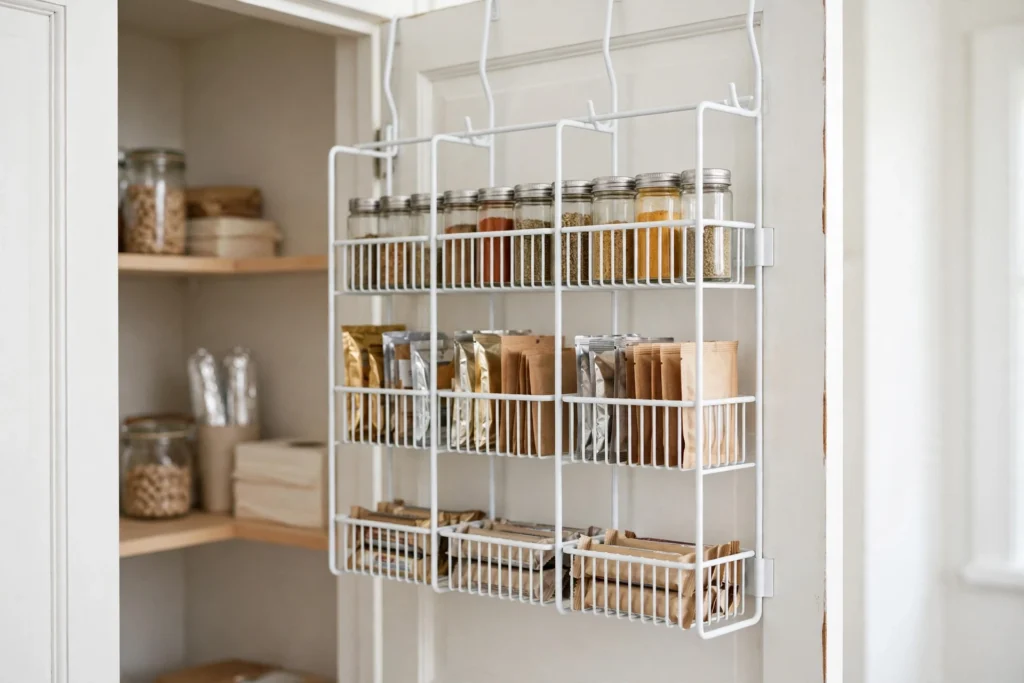
Zoning is the system that makes tiny pantries feel bigger. Instead of shelving items by size or by whatever fit when you unpacked the groceries, you assign each food family a fixed home. Breakfast stuff lives together, baking ingredients live together, dinner ingredients live together. When your eyes know exactly where the “canned goods zone” is, you stop scanning the whole pantry and start reaching.
Here are the zones that work best in small pantries:
- Breakfast zone: cereal, oats, coffee, tea, honey, peanut butter — everything you reach for before your brain is fully awake.
- Baking zone: flour, sugar, baking powder, vanilla, chocolate chips. Keep this tight, especially if you only bake a few times a month.
- Dinner zone: pasta, rice, grains, canned tomatoes, broths, cooking oils — the backbone of weeknight cooking.
- Snack zone: one basket or bin, ideally at kid height if you have little ones. When snacks have a home, they stop colonizing the whole pantry.
- Backup row: duplicates and bulk buys, tucked high or low where they are visible but not in the daily flow.
Use bins to draw the borders between zones — one low-profile basket or turntable per zone, labeled. The bins keep categories from bleeding into each other, which is what causes pantry chaos in the first place. And put each zone where it makes sense for your cooking flow: breakfast at eye level near the front, heavy dinner staples lower where lifting is easy, backup stock on the highest or lowest shelf. If you are starting from scratch on your containers, read our food storage container organization guide first — it will save you from buying three sizes that do not stack.
Decant and Label — But Only Where It Pays
Decanting gets romanticized on social media, but in a small pantry it is genuinely practical — with one caveat. Only decant the things that come in wasteful packaging or that you buy in bulk: flour, sugar, rice, pasta, cereal, snacks. A bulky cereal box holds a lot of cardboard and air; a square airtight container holds the same cereal in half the footprint and keeps it fresher. Oils, vinegars, and most canned goods? Leave them in their original packaging. Decanting those is organizing theater — it eats a Sunday and buys you nothing.
Labels are the thing that makes the whole system survive contact with the rest of your household. Without labels, the beautiful bins drift back to random contents within a week, because your partner, your kids, and your future tired self cannot read your mind. Label the bin, not just the jar — “BREAKFAST,” “BAKING,” “SNACKS.” For decanted containers, put the item name and the expiry date on the label. A grease pencil on the bottom of the jar works too, and it wipes off when you refill. Our full pantry decanting and labels guide walks through the best label types if you want to go deeper, but even a strip of masking tape and a marker will change your pantry life.
Put the Door, the Walls, and the Gaps to Work
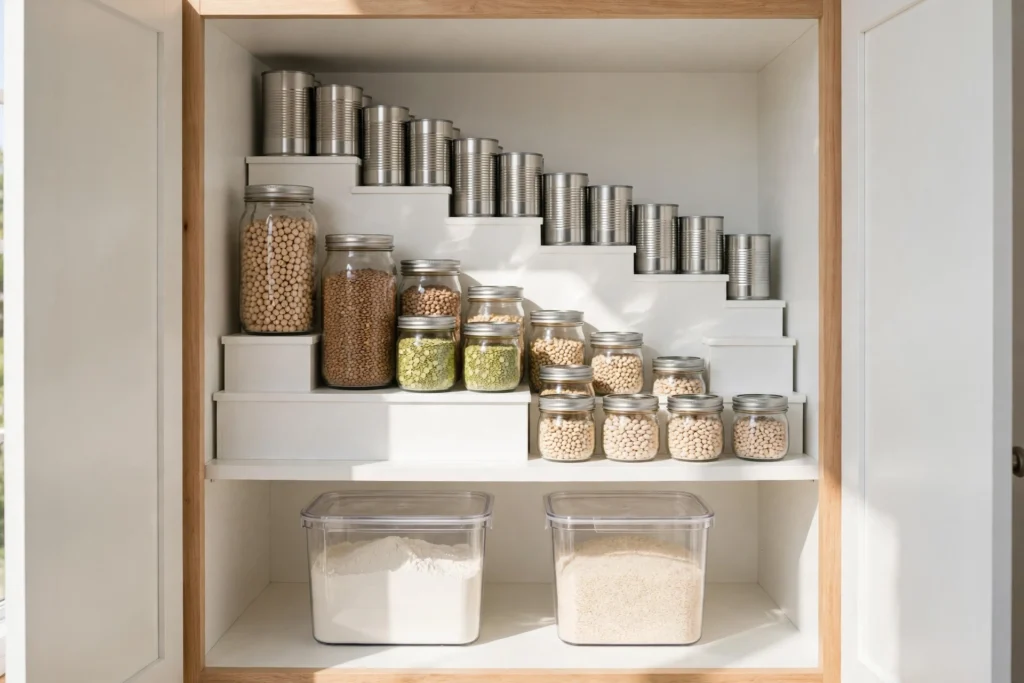
The inside of the pantry door is free real estate, and in a small pantry it might add 20 to 30 percent more storage. A narrow over-the-door rack holds spice jars, seasoning packets, small oils, or snack bars — all the skinny things that get lost on shelves. Renter? No problem: most over-the-door organizers hang on the door with no screws at all. Inside a cabinet pantry, stick-on racks and slim adhesive shelves work the same way without touching your deposit.
Do not forget the narrow gaps either. That three-to-six-inch strip between the pantry and the fridge, or between cabinets, is exactly the width of a slim rolling cart. Slide one in and you have a vertical home for cans, oils, and bottles that would otherwise hog shelf space. Mounting a few adhesive hooks on the side wall of the pantry gives you a spot for measuring cups, reusable grocery bags, or a small whisk. And a tension rod across a low shelf section turns dead space into a vertical divider for cutting boards, baking trays, or serving platters.
One more underused trick: spices do not belong crammed on a pantry shelf where you cannot read the labels. They belong on a small tiered riser, in a drawer next to the stove, or in a door rack where every jar is visible. Getting spices out of the main pantry zone frees a surprising amount of shelf real estate — and you will actually use them instead of forgetting they exist. Our spice organization ideas cover every setup from drawer inserts to wall-mounted racks if yours are still a jumbled row.
Mistakes That Make Small Pantries Feel Even Smaller
Even with good intentions, a few common mistakes undo all the organizing in weeks. Avoid these and your pantry will stay calm on its own:
- Buying containers before purging. You end up organizing clutter instead of removing it. Purge first, measure the shelves, then buy only what fits.
- Over-stocking. Bulk bargains are a trap in small pantries. If it does not fit the system, it becomes the mess — buy what fits between grocery runs, and store true overflow somewhere else.
- Opaque everything. Dark bins hide contents and you forget what you own. Use clear containers for the stuff you use weekly so a glance tells you what is running low.
- Ignoring the back row. Cans and jars pushed to the back die there. Rotate them forward whenever you unpack groceries — first in, first out, every time.
- No maintenance minute. Systems die from drift, not disaster. A thirty-second tidy each time you unpack groceries keeps the zones honest.
If budget is your main constraint, none of this requires a shopping spree. Most of these fixes use risers, baskets, and labels that cost less than a weekly takeaway coffee habit — our roundup of pantry organization ideas on a budget shows exactly how far a few dollars can go.
Your Pantry Is Small. Your System Doesn’t Have To Be.
A small pantry is not a punishment — it is an editor. It forces you to keep only what you cook with, see everything you own, and waste less food, which is honestly a gift. Start with the purge this weekend, add a riser or two and a door rack, give every category its zone, and label the bins. Give it two weeks of real cooking, adjust the zones that are not quite right, and you will open those doors and feel calm instead of dread. Small space, big function — that is the whole game.
[…] space is tight because the whole kitchen is tight, it may be worth borrowing a few ideas from small pantry organization — vertical thinking, ruthless editing, and zones that earn their shelf […]
[…] can be genuinely transformative. If you are working with a tiny pantry to begin with, our guide to small pantry organization ideas pairs beautifully with this upgrade — the door rack handles the small stuff while the shelves […]
[…] a small pantry, these zones can be as simple as front, middle, and back of one shelf, or a single deep drawer: […]
[…] your pantry is tight on space, remember that the small-pantry layout ideas we covered earlier — including using the inside of the pantry door for hanging mesh bags — […]
[…] do not topple when you pull one out. For a full tour of making a tight space work harder, these small pantry organization ideas pair beautifully with a cereal […]
[…] box without a second thought. For a deeper look at making a cramped pantry work harder, see these small pantry organization ideas for big function in a tiny space, which pair beautifully with the tricks in this […]