


My kitchen once had forty-one mugs. I know the exact number because one Saturday I got curious, opened every cabinet, and counted. Forty-one mugs for a household of four people who mostly drink from the same three. Nobody bought them with any malice — they arrived as gifts, conference swag, souvenirs from trips, a cute one from a craft fair. Each arrival felt harmless. But things only ever move in one direction in a home: inward. Nothing leaves on its own. That’s exactly the problem the one in one out rule solves.
The rule is as simple as it sounds: for every new item that enters your home, one existing item must leave. Buy a new pair of shoes, and an old pair gets donated or tossed. Accept a free tote bag, and another tote bag goes. Adopt it honestly for a few months and something remarkable happens — the slow, invisible accumulation that turned your cabinets into a mug museum simply stops. Not because you declutter harder, but because clutter stops outgrowing you.
What Is the One In One Out Rule?
Strip it down and the one-in-one-out rule is an arithmetic promise: net zero. Your home holds a certain number of things right now — let’s call it N. When a new item crosses the threshold, an old one must leave, so the count returns to N. The rule doesn’t ask you to become a minimalist overnight. It doesn’t ask you to empty your house or count your possessions. It just freezes growth.
That freeze is more powerful than it looks, because almost nobody’s clutter comes from one dramatic shopping spree. It comes from the slow drip: the birthday gift you didn’t choose, the kitchen gadget bought on a whim, the “backup” sweater that’s nearly identical to the one you already wear. Each one is individually reasonable. Together, over years, they fill the junk drawer, the spare room, and eventually the garage. The rule interrupts the drip without demanding a heroic purge.
There’s a psychological reason it works so well, too. Big decluttering sessions force dozens of emotional decisions in a row — keep or let go, keep or let go — and decision fatigue sets in fast. That’s why the third hour of a decluttering marathon ends with you keeping a broken toaster “for parts.” The one-in-one-out rule asks for exactly one decision at a time, at the exact moment you’re most capable of making it: when you’re excited about the new thing and the old thing’s flaws are suddenly obvious. New sweater in hand? You’re suddenly very clear that the old one has a stretched collar.
Why This Tiny Habit Beats Marathon Decluttering Sessions
Marathon decluttering has its place — if your home is genuinely overwhelmed, a focused session can reset the baseline. But marathons don’t prevent the next pile. I’ve watched people spend an entire weekend decluttering a room, feel euphoric, and then watch it quietly refill over the next eighteen months. The one-in-one-out rule is the maintenance layer that makes the reset stick.
Think of it like dieting versus eating habits. A crash diet changes your weight for a month; a habit like “vegetables with every dinner” changes it for life. One-in-one-out is the vegetables-with-dinner of home organization. It’s boring, it’s repetitive, and it’s the thing that actually works long-term.
The rule also fixes the biggest lie we tell ourselves about clutter: “I’ll deal with it later.” Later never comes with a natural trigger. But a new item arriving is a perfect natural trigger — it’s specific, it’s immediate, and it hands you a concrete task (find one thing to release) at the exact moment you’re motivated. If you’ve already worked through a full room-by-room declutter, this is the habit that protects all that hard work from quietly undoing itself.
And practically, it’s kinder. Releasing one item is emotionally cheap. Releasing fifty is emotionally expensive. The rule never asks more of you than you can give in two minutes, which is exactly why you might actually keep doing it for years.
How to Apply the One In One Out Rule Room by Room
The principle is universal, but the practice looks different in each part of the house. Here’s how I apply it in the places where clutter actually accumulates:
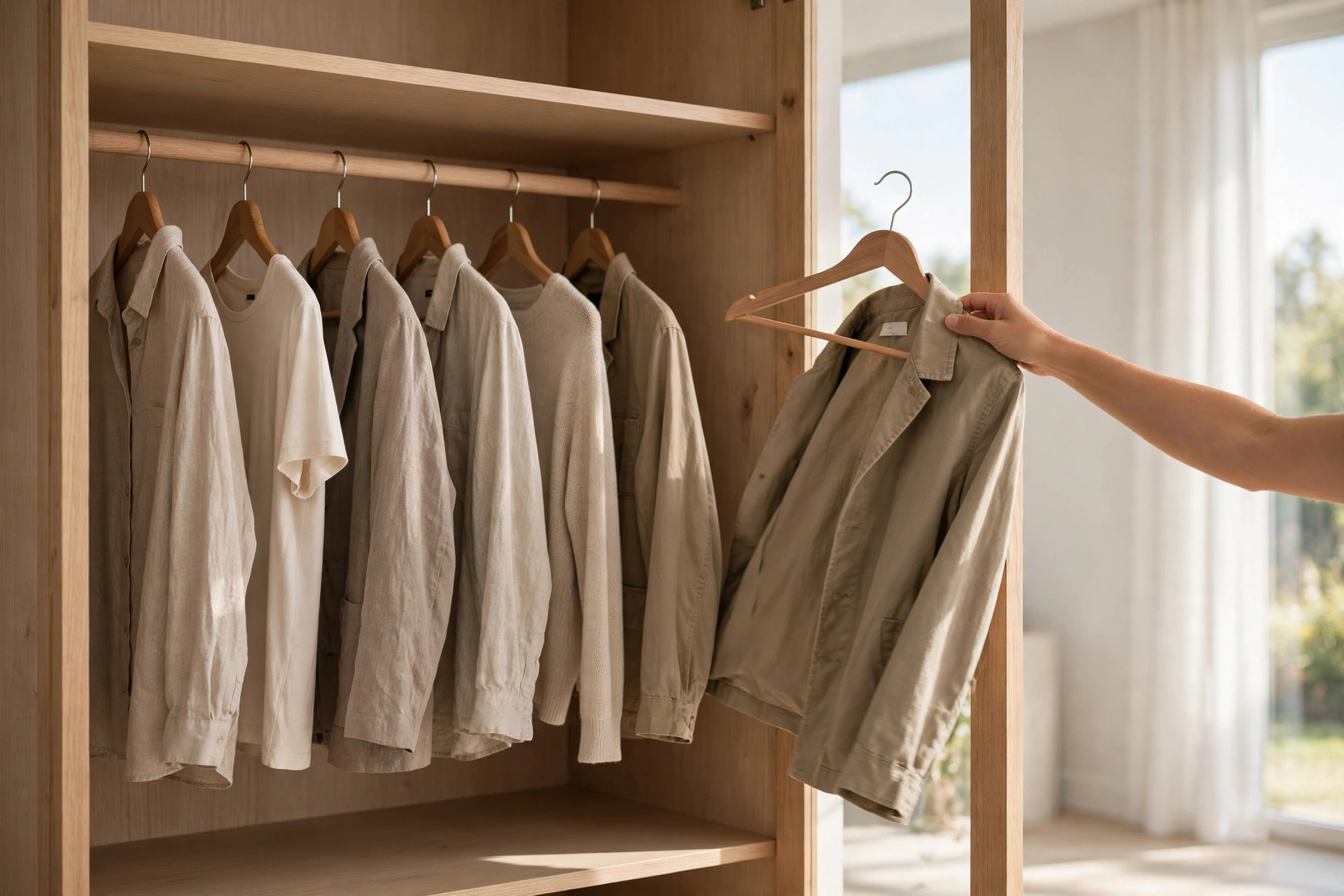
- The wardrobe. This is where the rule earns its reputation. New shirt in, old shirt out — same category, so you can’t weasel out by donating a sock when you bought a coat. The real magic is that the rule makes you notice duplicates. When you buy your third black cardigan and have to choose which of the existing two leaves, you start to realize you never needed three. Pair this with building a capsule wardrobe, where every piece has to earn its limited slot, and your closet transforms from a storage unit into a working system.
- The kitchen. Kitchen clutter is sneaky because so much of it arrives as “useful.” New water bottle? An old one leaves. New baking dish? One of the three you never touch goes. The mug rule from my own kitchen: we agreed on a household limit of twelve mugs, and every new one triggers a farewell. Utensil drawers benefit from the same logic — a new spatula means retiring the one with the melted edge you’ve been tolerating for years.
- The bathroom and linen shelves. Skincare, makeup, and toiletries expire faster than we admit. A new moisturizer should push the half-used one you stopped liking to the bin — yes, the bin, not a donation bag; nobody wants your opened serums. Towels are an easy win: new set arrives, the thinnest oldest towels get demoted to rags or recycled.
- Books, games, and media. Finished a book you’ll never reread? Pass it on before the new one lands on the shelf. The one-in-one-out approach works beautifully for shelves because shelves have a visible capacity — when they’re full, they’re full. Digital clutter counts here too: a new app installed means an old one deleted, a new streaming subscription means an old one cancelled.
- Kids’ toys and gear. This is the hardest category because the influx is constant — birthdays, holidays, grandparents. The version that works for families: when a new toy arrives, the child chooses one toy to donate. Frame it positively (“another kid would love this”) and make it their decision. It teaches generosity and keeps the toy box from staging a takeover. Outgrown clothes and gear are even easier — bag them the same day the next size up comes home.
The “same category” detail matters. Donating a book because you bought a pair of jeans technically follows the letter of the rule but misses the point. The rule works when the outgoing item competes with the incoming one for the same space in your life. Keep it like-for-like and the system stays honest.
The Tricky Parts: Gifts, Upgrades, and Replacements
Every simple rule meets reality eventually. Here are the honest answers to the questions that come up:
Gifts. The rule applies to gifts too, but gently. If your aunt sends a beautiful throw blanket and you already have four, the rule says one blanket leaves — it doesn’t say you must feel guilty about it. The gift served its purpose the moment it was given with love; keeping it forever out of obligation turns a kind gesture into clutter. Thank it, keep it for a while if it earns its place, and let something else go. Nobody’s feelings are hurt by a donation bag they never see.
Replacements versus additions. A true replacement — the old coffee maker died, you buy a new one — isn’t really “one in, one out.” The old one already left via the trash. The rule matters most for additions: the second air fryer, the fifth throw pillow, the backup backpack. When something new arrives that doesn’t replace something broken, that’s when the outgoing item has to be chosen deliberately.
Upgrades. Buying a better version of something you own is the rule’s sweet spot. New winter coat? The old coat goes the same day, not “after one more winter just in case.” The “just in case” closet is where one-in-one-out goes to die. If the upgrade is genuinely better, the old version’s purpose is served. Pass it on while it still has life in it.
Consumables and multi-packs. Don’t overthink it. Nobody is counting how many paper towels cross the threshold. The rule is for durable possessions — things with a permanent address in your home. Food, toilet paper, and birthday candles are exempt. If applying the rule to something feels absurd, it is absurd, and you’re allowed to skip it.
Three Tiny Rituals That Make the Rule Stick
Knowing the rule and living the rule are different things. These three small rituals bridge the gap — none takes more than a few minutes, and together they make one-in-one-out automatic.
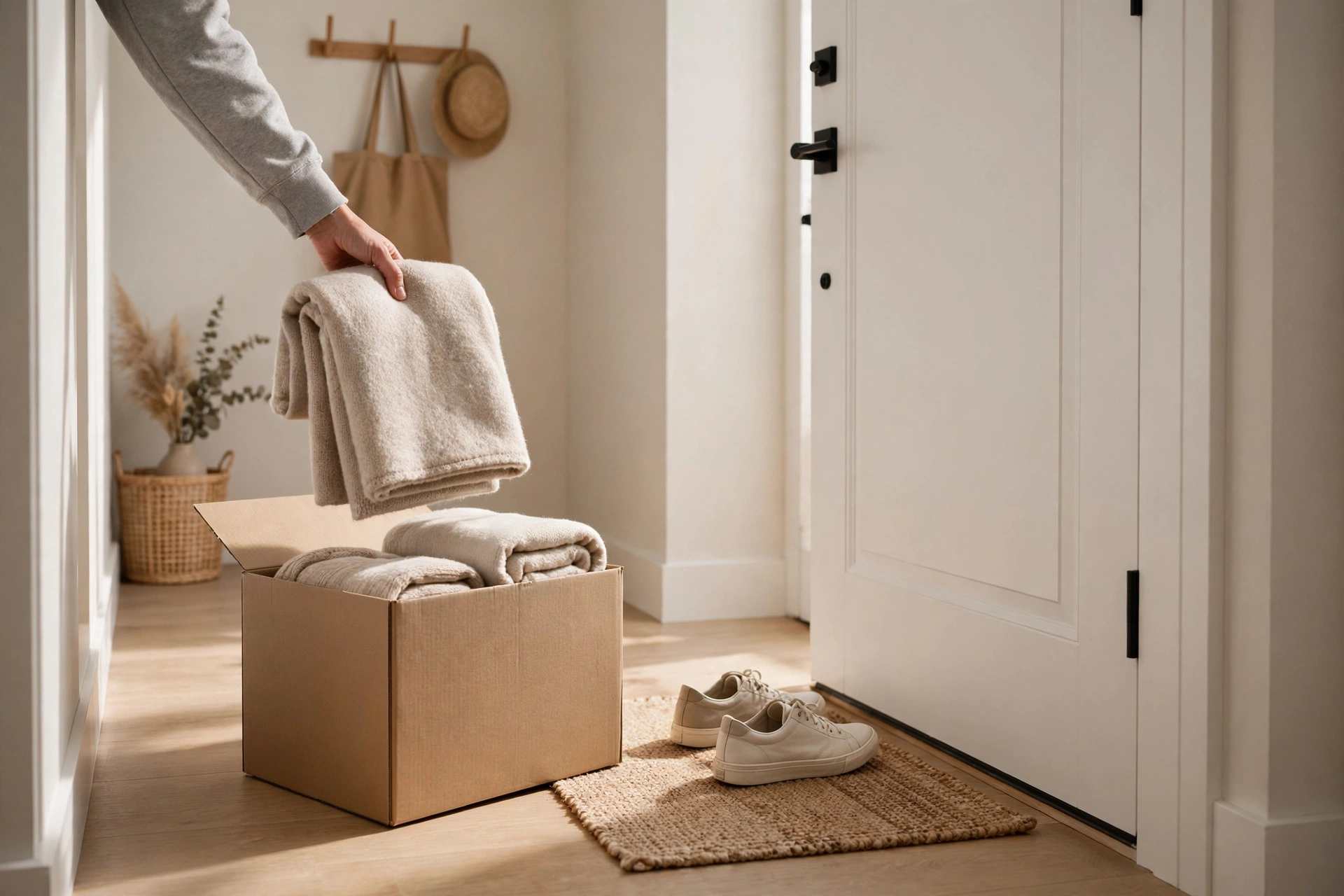
Ritual one: the donation station by the door. Keep a bag or box in a consistent spot — the entryway, the garage, the closet floor — designated for outgoing items. When the rule triggers, the outgoing item goes in the bag immediately, not “somewhere I’ll deal with it later.” When the bag is full, it goes to the donation center on your next errand run. This removes the biggest failure point of the whole system: the outgoing item that sits on a chair for three weeks and slowly migrates back into a drawer. The bag is a one-way door.
Ritual two: the 24-hour shopping pause. The rule works best when fewer items come in to begin with. Before any non-essential purchase, wait 24 hours. Put it in the cart, close the tab, and see if you still want it tomorrow. Roughly half the time, you won’t — the urge was the shopping, not the thing. This pause also makes the outgoing decision easier, because by the time you do buy something, you’re genuinely sure about it. It pairs beautifully with a regular 15-minute declutter session, which keeps your eye trained on what you actually use versus what just occupies space.
Ritual three: the seasonal swap audit. Four times a year, when you’re switching out seasonal clothes or decorations, do a quick pass through that category. Anything you stored away last season and didn’t miss? It doesn’t come back in. Anything worn out, broken, or quietly unloved? It leaves now. Seasonal transitions are natural decision points — your brain is already in “what do I need” mode, and the one-in-one-out rule rides that momentum. For the things with genuine emotional weight, our guide to decluttering sentimental items walks through how to let go without guilt tripping yourself.
The Quiet Freedom of Enough
What surprised me most about living with the one-in-one-out rule wasn’t the tidier shelves, though those are real. It was the change in how shopping feels. When every purchase has a price beyond money — one of your things has to go — you start asking better questions. Do I love this enough to evict something I already own? Usually, honestly, the answer is no. And that “no” feels less like deprivation and more like clarity.
The rule won’t turn you into a minimalist poster child, and it doesn’t try to. It just quietly guarantees that your home never holds more than it holds today. Years from now, your closets will still close, your drawers will still shut, and your kitchen will still have a sensible number of mugs. In a world engineered to make you accumulate, that’s not a small thing. It’s a small habit with the biggest payoff in home organization: a home that stays the size you want it to be.
[…] rule of one also pairs beautifully with maintenance systems you may already use. If you follow the one-in-one-out rule, the rule of one is its stricter older sibling: instead of merely keeping your numbers stable, you […]
[…] is also where simple guardrail rules earn their keep. The one-in-one-out rule — every new item that enters your home means one similar item leaves — is the simplest […]
[…] enough that everything earns its space. If you’re unsure whether something deserves to stay, the one in, one out rule is a brilliant filter: every future purchase means something leaves, so your wardrobe stays at this […]