
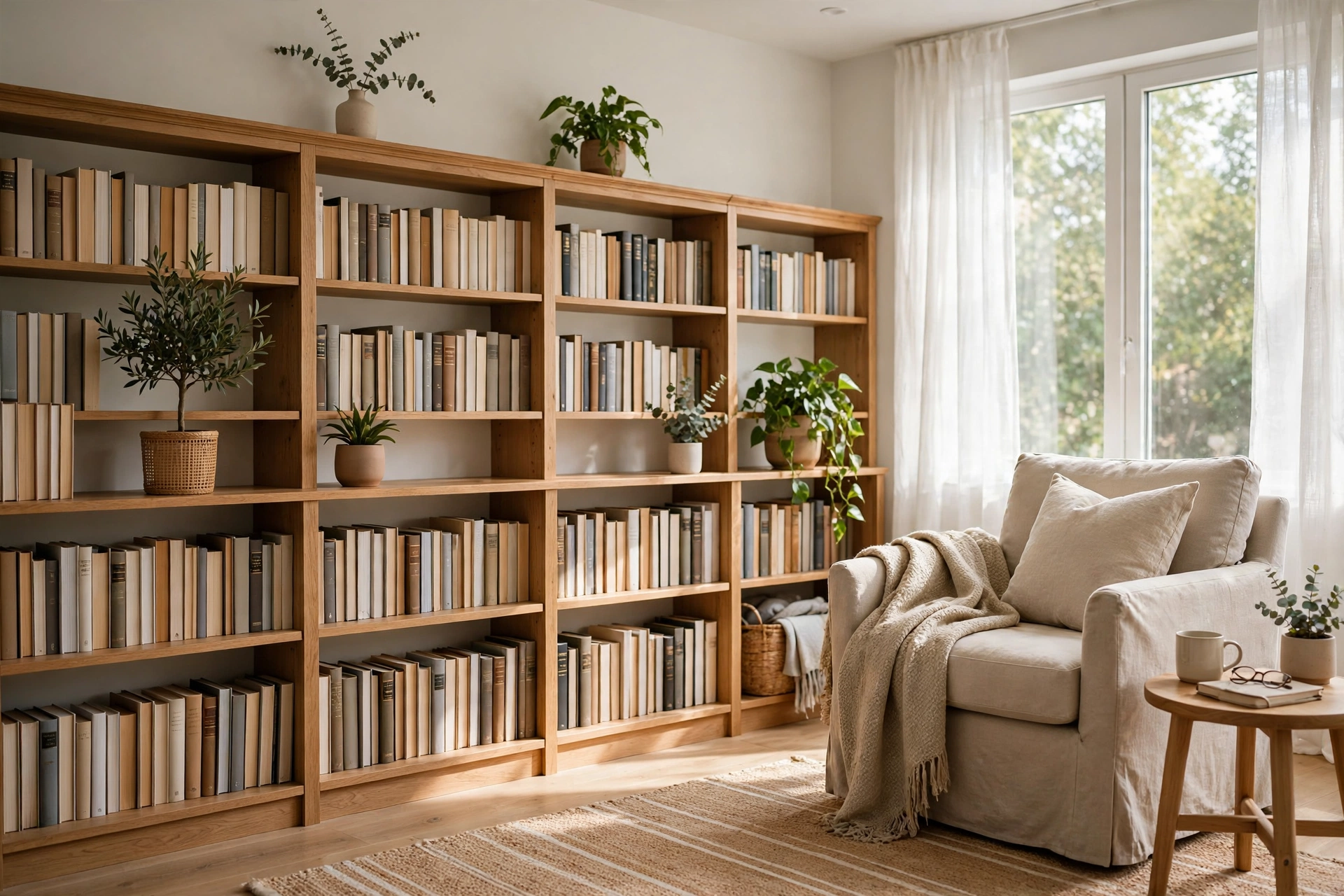

There is a particular kind of guilt that only a bookshelf can give you. You look at the rows of spines, the double-stacked paperbacks, the pile on top that was supposed to be temporary three years ago, and you feel two things at once: love for the books, and a quiet wish that the room felt lighter. If that sounds familiar, learning how to declutter a home library is not about getting rid of books you love. It is about making room for the books you actually reach for, and for the calm that comes with a shelf you can browse without a sigh.
I have decluttered my own shelves more times than I can count, and the first time was the hardest. I stood in front of them with a bin bag, convinced I had to be ruthless, and ended up keeping almost everything out of panic. The approach that finally worked was gentler and more effective: I stopped asking “should I throw this away?” and started asking “does this book earn its place?” That one shift changed everything.
Before we begin, a promise: nothing in this guide asks you to part with a book you truly love. The goal is a library that reflects who you are now, not who you were at eighteen, and a room that invites you to sit down and read.
How to Declutter a Home Library: Start With One Shelf
The biggest mistake people make is trying to do the whole library in one afternoon. You pull everything off, the room looks like a bookshop after an earthquake, and by dinnertime you are shoving things back anywhere they fit. Instead, pick one shelf — just one — and finish it completely before moving on. A single shelf takes twenty to thirty minutes, and the small win builds the momentum to keep going.
Take every book off that shelf and give it a quick wipe. Dust is part of why shelves feel heavy and tired, and a clean shelf makes the books you keep look twice as good. Then sort the pile into four groups:
- Keep and display: books you love, reread, or reach for regularly.
- Keep but store: books worth holding on to that do not need prime shelf space, such as reference books or a complete series you have finished.
- Pass on: books you enjoyed but will not read again, duplicates, and books you bought with good intentions and never opened.
- Recycle: damaged books, outdated guides, and anything falling apart that no charity shop could sell.
Put the “pass on” books straight into a bag or box by the door. If they sit in a pile in the room for a week, half of them will quietly migrate back onto the shelves. Donation is easier when the decision is already made and the box is already packed.
Ask Each Book Four Honest Questions
When you are unsure about a book, run through these four questions. You do not need a yes to all of them — one strong yes is usually enough to keep it.
- Have I read it, and would I read it again or recommend it to a friend?
- Does it hold a real memory — a gift, a trip, a person — rather than just a vague feeling that you should keep it?
- Would I buy it again today, at full price, if I did not already own it?
- Does it fit the life I live now, not the life I imagined when I bought it?
That last question is the one that frees the most shelf space. The bread-making phase, the brief obsession with marathon training, the textbooks from a course you finished a decade ago — those books served a chapter of your life, and letting them go does not erase the chapter. If a book is tied to a person or a memory rather than to reading, that is worth understanding properly, because decluttering sentimental items follows different rules from decluttering ordinary clutter, and being gentle with yourself about it makes the whole process easier.
A practical tip that helps enormously: set a limit before you start. Decide, for example, that each shelf keeps at most one row of books, or that the library as a whole loses twenty books today. A number gives you a target and stops the process drifting into “I kept everything again.”

Sort by How You Actually Use Your Books
Once you know what stays, think about how you use your library. Most home libraries fall apart not because there are too many books, but because the arrangement makes no sense to the person living with it. Grouping by use — rather than by some perfect system you will never maintain — is what keeps shelves tidy long after the declutter is done.
Try one of these arrangements, whichever matches your habits:
- By topic or genre: all the cookbooks together, all the novels together, history on its own shelf. This is the easiest system to maintain and the best choice for most people.
- By frequency: the books you reach for weekly at eye level, the ones you consult occasionally higher up or lower down, and the rarely touched volumes on the top shelf.
- By household member: if you share the library, giving each person a section ends the quiet turf war over shelf space.
Within each group, shelve books upright with a little breathing room — a shelf packed so tightly that pulling one book out brings three more with it will never stay tidy. Leave one small gap on each shelf for new arrivals, and keep styling to about ten percent of the shelf: a small plant or a framed photograph at the end of a row is lovely, but a library is for books first.
If your shelves are shared with a desk or a workspace, the same thinking applies there too. The habits that tame a library — one shelf at a time, honest questions, a home for everything — are exactly the habits in how to declutter a home office, and the two rooms often improve together.
How to Declutter a Home Library Without the Guilt
Let us be honest about the guilt, because it is the real reason most library declutters stall. Books feel different from other objects. Throwing away a broken toaster is easy; parting with a book can feel like betraying the person who gave it to you, or the version of yourself who once loved it.
It helps to remember what a book is for. A book’s job is to be read, enjoyed, or useful. A book sitting unread on a shelf for eight years is not being honoured — it is being stored. Passing it on to a charity shop, a little free library, a school, or a friend gives it a second life with someone who will actually open it. That is a kinder fate than gathering dust.
A few strategies that make letting go genuinely easier:
- Photograph the inscription. If a book carries a message from someone you love, photograph the inscription page before passing the book on. You keep the memory; the book finds a new reader.
- Keep a “maybe” box — with a deadline. Put uncertain books in a box, date it, and store it out of sight for three months. If you do not open the box, donate it unopened. If you do reach for a book, it has earned its place back.
- Start with the easy wins. Duplicates, damaged copies, books you actively disliked, and outdated reference guides are guilt-free departures. Clearing those first often frees a surprising amount of space and builds confidence.
- Let one in, one out. Once the declutter is done, keep it that way: every new book that comes in means one leaves. Your future self will be grateful.
If you find that the books are only part of a bigger paper problem — old magazines, printed articles, manuals, and the general drift of paper that gathers around a reading chair — the same gentle, systematic approach works there as well, and taming paper clutter for good will help you deal with the piles that are not books at all.
What to Do With the Books You Remove
A declutter is only finished when the “pass on” box leaves the house, so decide the destination before you start sorting. Different books suit different destinations, and knowing where they are going makes the decisions faster.
- Charity shops take most fiction and popular non-fiction in good condition, and they sell quickly.
- Little free libraries in your neighbourhood are perfect for a handful of books at a time, especially children’s books and popular novels.
- Schools, shelters, and community centres often welcome children’s books and practical guides — call ahead to check what they need.
- Friends and family are the best destination for a book you loved and want to share; passing a book on with a personal recommendation is a small joy in itself.
- Book swaps and selling apps work well for valuable or collectible editions, and the money can fund the next book you actually want.
- Recycling is the right end for books that are water-damaged, mouldy, or falling apart. Remove any hard covers first if your local recycling asks for it.
One caution: only give books to people who genuinely want them — passing clutter to a friend’s already-full shelves is relocating, not decluttering.
Style the Shelves and Keep Them That Way
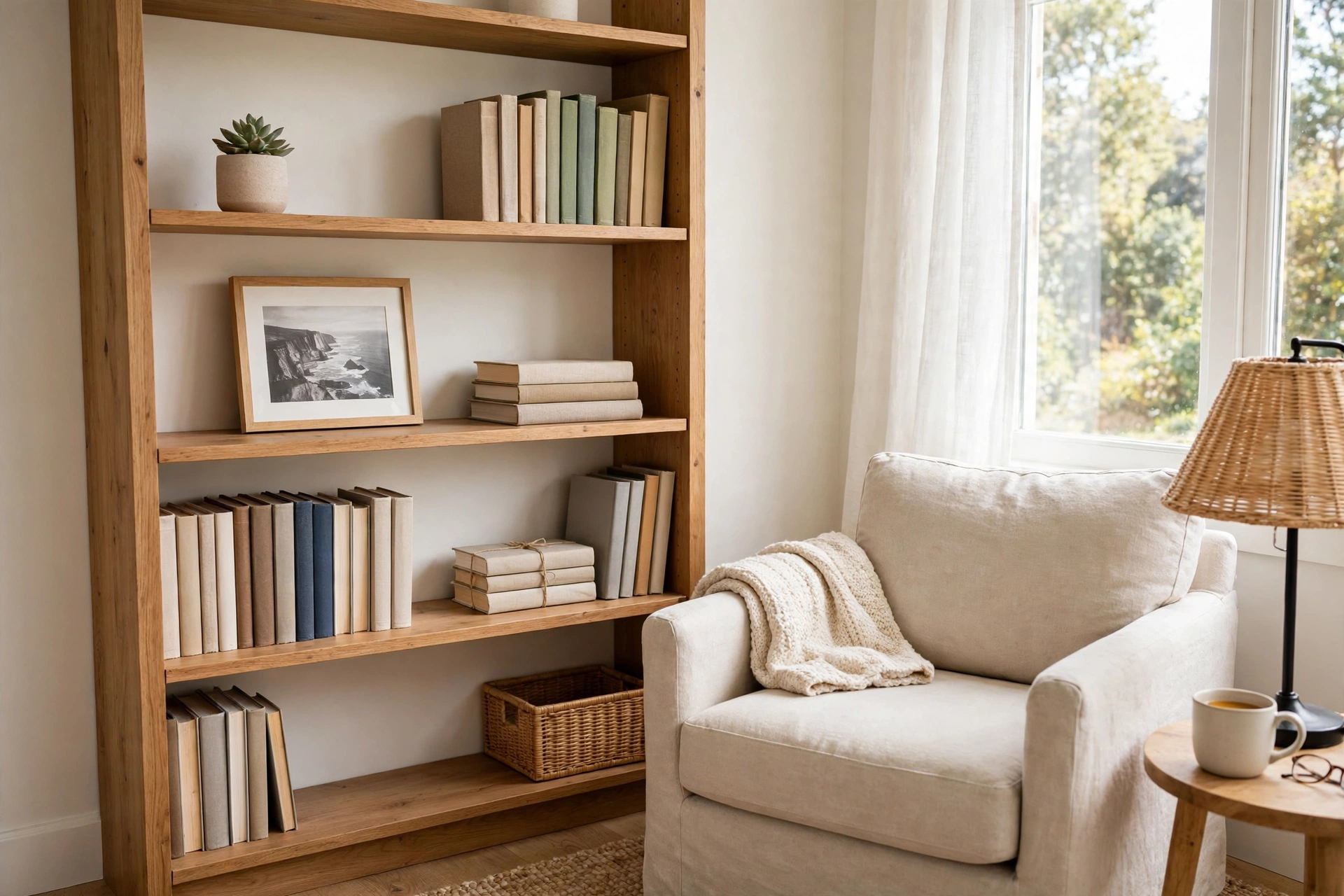
Now comes the rewarding part. With fewer books and a clean shelf, arrange what remains so the library looks as good as it feels. Vary the heights by laying a short stack of books horizontally here and there — a horizontal stack also makes a perfect little platform for a plant or a candle. Face one or two favourite covers outward, like a bookshop display, and keep the tallest books at the ends of rows where they anchor the shelf. Resist the urge to fill every centimetre: empty space is not wasted space; it is what lets your favourite books stand out.
For a truly minimal look, the principles in a minimalist approach to bookshelves fit well here — fewer, carefully chosen books and a little negative space can make a small room feel larger. And think about the reading spot itself: clear the side table, put a bookmark in the book you are currently reading, and leave the next book you want to read where you can see it. A room that invites you in stays tidy far more easily than one that is only looked at.
The hardest part of any declutter is not the day you do it; it is the year after. Libraries grow quietly — a gift here, a bargain there — and a light routine prevents the slow creep:
- One in, one out: keep a small donation bag near the shelves so the departing book leaves the same week the new one arrives.
- A seasonal ten-minute tidy: four times a year, walk the shelves and pull anything that no longer earns its place.
- A visible “to read” shelf: when unread books have their own small section, you can see what you already own before buying more.
- Digital overflow: an ebook or audiobook version keeps the story without the shelf, especially for reference books and rereads.
And if the shelves fill up again despite all this, do not see it as failure. A library that grows is a sign of a reading life, and decluttering it again is simply part of living with books. When you finish, stand in the doorway and look at your shelves: the books that remain are the ones you chose, not the ones that simply accumulated. Put the kettle on, pick up the book at the top of your to-read pile, and enjoy the library you have made. It was worth every decision.