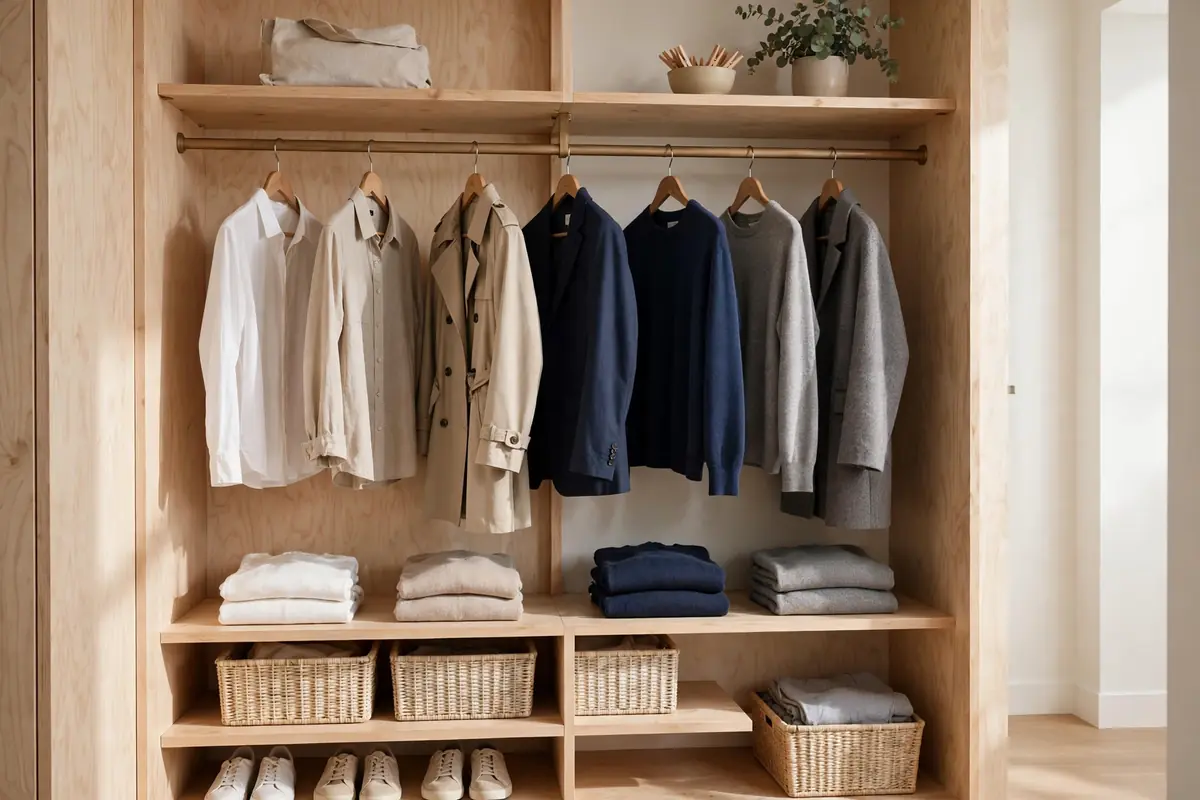

Every morning for about two years, I stood in front of a closet stuffed with clothes and announced to no one in particular that I had nothing to wear. The closet wasn’t empty — it was overflowing. But almost nothing in it worked together, half of it fit only “sort of,” and an embarrassing number of pieces still had the tags on. Learning how to build a capsule wardrobe changed all of that. Not overnight, and not with some dramatic throw-everything-away purge — but by slowly building a smaller collection where everything actually goes with everything else. Here’s the exact process I followed, step by step.
How to Build a Capsule Wardrobe: What It Really Means
A capsule wardrobe is a small, intentional collection of clothing — usually 25 to 40 pieces for a season — where nearly every item works with nearly every other item. The idea goes back to the 1970s, when London boutique owner Susie Faux coined the term, and it resurfaces every few years because the problem it solves never goes away: too many clothes, nothing to wear.
Here’s what it isn’t. It isn’t a uniform — you don’t have to dress like a tech CEO in a black turtleneck. It isn’t about deprivation, and it isn’t about spending a fortune on designer basics either. A good capsule is full of pieces you genuinely like wearing. They’re just chosen on purpose instead of accumulated by accident.
The payoff is practical, not philosophical. Fewer decisions before coffee. A closet you can see into. Less laundry chaos. And the surprise benefit nobody mentions: you start looking more put-together, because everything you own fits well and coordinates.
Step 1: Audit Your Closet Before You Buy a Thing
The biggest mistake people make with a capsule wardrobe is starting at the shops. Don’t. Start with what’s already hanging in your closet.
Pull everything out — yes, everything, including the top-shelf stuff you’ve been pretending doesn’t exist. Then sort each piece into three piles: love and wear regularly, maybe, and no. Be ruthless with the maybe pile; most of it belongs in no. For each item, ask three questions: does it fit me right now, as I am today? Have I worn it in the last twelve months? If I saw it in a shop this weekend, would I buy it again? A no to any of those means it doesn’t earn a spot.
If you want a proper system for these decisions, this guide to decluttering your wardrobe walks through the keep-toss-donate method in detail. And for the pieces with emotional weight — your grandmother’s cardigan, the dress from a trip you’ll never forget — here’s how to handle sentimental clothes without the guilt spiral.
Whatever survives the audit is your foundation. You’ll probably find you already own half your capsule: the jeans that fit perfectly, the white shirt you grab weekly, the boots that go with everything. Write these keepers down — they’re the starting inventory everything else gets built around.
One more trick that saved me from myself: the hanger test. After the audit, turn every hanger in your closet backwards. Each time you wear something, hang it back the normal way. After three months, the backwards hangers are your answer — those are the pieces you’re keeping out of habit, not love. When I did this, six “maybe” items I’d rescued from the donate pile went straight back in. The hanger doesn’t lie.

Step 2: Figure Out How Many Pieces You Actually Need
The question everyone asks: how many pieces should a capsule wardrobe have? There’s no magic number, but most people land between 25 and 40 pieces per season — not counting underwear, workout gear, or occasion-specific items like a formal dress or a heavy parka.
Size yours from your real week, not an ideal one. Five office days means more structured pieces: trousers, blouses, a blazer. Working from home, like I do now, means good knitwear, comfortable trousers, and layers that look respectable on video calls. Then count your laundry rhythm. If you wash weekly, you need about seven days of outfits plus a small buffer.
When in doubt, start small. Adding one perfect piece later is easy; admitting the 34th item was a mistake is not. I began with 30 and within two months could name the three that weren’t earning their keep.
Here’s a worked example. Say you work in an office five days a week and do laundry every Sunday. You need five work outfits, two weekend outfits, and a buffer of two or three pieces for the weeks when laundry day slips to Monday — it will. That’s ten outfits from roughly 30 pieces, because in a capsule one pair of trousers serves three different tops. The maths works because the pieces multiply each other. If an item doesn’t multiply — if that blouse only works with one specific skirt — it’s not a capsule piece, whatever the checklist says.
Step 3: Choose a Color Palette You Won’t Get Bored Of
This is the step that makes the whole system work. A capsule wardrobe runs on color coordination — the “everything goes with everything” magic only happens when your colors get along.
Pick two or three neutrals as your base. Mine are navy, white, and grey, with black for shoes and bags. Yours might be beige, cream, and olive, or black, white, and denim blue. Then add one or two accent colors you genuinely love — the ones that lift your mood when you catch yourself in a mirror. Mine are a deep rust and a soft sage. The rule: every accent has to work with every neutral, so getting dressed stays effortless.
And here’s the shortcut most guides skip: look at your keepers pile from the audit. If eight of your twelve favorite pieces are blue, your palette is already telling you something. Listen to it instead of forcing yourself into beige because a checklist said so.
Before you commit to an accent color, run the swatch test. Wear the color three times in one week — a top, a scarf, whatever you own in it — and notice how you feel by day three. Still reaching for it? It’s a keeper. Slightly tired of it? It was a fling, not a foundation. I nearly built my whole capsule around mustard because it looked wonderful in the shop; by day three of the swatch test I was avoiding the mirror. Rust passed. The test takes a week and saves you a season of regret.
Step 4: Build Your Essentials Checklist
Now the fun part. This framework suits most lifestyles — nudge the numbers to fit your week:
- Tops (6–8): a mix of tees, one or two button-downs, a sweater, and a blouse or shirt that dresses up
- Bottoms (4–5): your best jeans, a tailored trouser, something relaxed for weekends
- Layers (2–3): a cardigan or blazer plus a denim or utility jacket
- Dresses (1–2): one that dresses up, one casual — skip entirely if dresses aren’t your thing
- Shoes (3–4): everyday sneakers or flats, one dressier pair, boots or sandals for the season
- Outerwear (1–2): a coat that actually handles your climate
How you store these pieces matters as much as which ones you choose, especially in a tight space — these closet organization ideas for small closets are designed for exactly that. Shoes deserve their own plan too, because pairs you can’t see are pairs you won’t wear: try these shoe organization ideas for small closets.
Notice what’s missing: trend pieces. If leopard print makes your heart sing, include one — a capsule should feel like you. Just let the trendy stuff be the exception, not the foundation.

Step 5: Shop Smart, Then Maintain It by Season
Only now — after the audit, the numbers, the palette, and the checklist — do you shop. And you shop with a list, like groceries. That’s what stops the impulse buys that built the overstuffed closet in the first place.
Buy in phases if money is tight. Start with whichever category has the biggest gap. When I built mine, I needed proper trousers and a decent coat; everything else waited a month. Try each new piece with at least three things you already own before the tags come off. If it doesn’t play well with the team, back to the shop it goes.
Then the part most guides skip: upkeep. At the start of every season, pull it all out for a fifteen-minute review. Anything you barely reached for gets a hard look. Replace worn-out pieces one-for-one instead of letting substitutes creep in. A capsule wardrobe isn’t a project you finish — it’s a system you run, and the seasonal reset is what keeps it working.
5 Capsule Wardrobe Mistakes Beginners Always Make
I’ve made every one of these, so you don’t have to.
- Buying everything at once. A capsule built in a single shopping trip is just a smaller version of the same impulse closet. Build it in phases — wear what you have, notice the gaps, then fill them deliberately.
- Counting underwear, gym kit, and pyjamas. Don’t. These live outside the capsule. The moment you start counting socks, the system feels like a diet and you’ll quit by March.
- Choosing a palette from an inspiration photo instead of your closet. If your keepers are all blue and you force yourself into beige, you’ll never wear the beige. Your real clothes outvote the mood board every time.
- Keeping the “aspirational” pieces. The jeans that fit “when I lose five pounds,” the heels for a life you don’t live. A capsule is built for the life you have — every piece has to work for today’s body and today’s calendar.
- Skipping the “one in, one out” rule. Without it, the capsule quietly grows back to 60 pieces. Every new purchase should replace something — donate, sell, or retire the outgoing piece the same week it arrives.
How to Transition Your Capsule Between Seasons
Twice a year, your capsule needs a changeover — and this is where most people either overthink it or skip it entirely. Neither works.
Set aside an hour on a weekend when the weather actually turns, not before. Pull out everything, including the off-season box. Try on the returning pieces — bodies change over six months, and last spring’s trousers might not be this spring’s trousers. Anything that doesn’t fit or feel right goes straight to donate; don’t pay storage rent, mental or physical, for maybes.
Then pack the outgoing season properly: clean everything first (moths love a dirty sweater), fold knits rather than hanging them, and use breathable storage bags instead of vacuum-sealing wool. If you’re short on storage space, these storage ideas for small apartments include smart spots for off-season clothes that don’t eat your closet.
Keep a small “bridge box” for the in-between weeks — a light jacket, a cardigan, one pair of closed shoes — because the weather never gets the memo about your schedule. And write down what you missed. Every season I note the one piece I wished I had (“a proper rain jacket,” “warmer socks”), and that note becomes next season’s shopping list. The capsule gets better every year because the list gets smarter.
Two years in, my closet holds 33 pieces and getting dressed takes about four minutes. I wear everything I own and like everything I own, and the morning nothing-to-wear drama is simply gone. Building a capsule wardrobe didn’t turn me into a minimalist — it just handed back the ten frazzled minutes I used to lose every morning, plus the money I used to spend on clothes I never wore. Start with the audit this weekend. The rest follows.