
The box in my closet held my grandmother’s teacups, a stack of birthday cards from people I hadn’t spoken to in a decade, my childhood teddy bear with one eye, and a ticket stub from a concert I barely remembered. Every time I tried to declutter, I’d open that box, feel a wave of guilt, close it, and quit for the day.
Sentimental items are the final boss of decluttering. Clothes are easy — you know what fits. Kitchen gadgets are easy — you know what you use. But the box of memories? That feels like throwing away love itself.
It’s not. And once you understand why it feels that way, letting go gets much, much easier.
Why Sentimental Clutter Feels Impossible
Here’s the psychological trick your brain plays: it confuses the object with the memory, and the memory with the love. So getting rid of your late father’s old sweater feels like getting rid of your father. Keeping a gift you hate feels like loyalty to the giver.
But memories don’t live in objects. They live in you. You can describe your grandmother’s kitchen in perfect detail right now — the smell, the sound of her voice — without owning a single teacup. The object was a trigger, not the memory itself. And love for a person is not measured in cubic feet of stored belongings.
Once you truly absorb that, the guilt loosens. Not vanishes — loosens. And loosened is enough to work with.
The Ground Rules (Read Before You Touch the Box)
Do sentimental items last. This is the golden rule of decluttering. Build your decision-making muscles on easy stuff first — clothes, kitchen duplicates, expired pantry items. By the time you reach the memory box, you’ll trust your judgment. If you’re new to this, start with How to Declutter Your Home Room by Room: A Beginner’s Complete Guide and come back here later.
Don’t do it tired, rushed, or sad. Sentimental sorting requires emotional energy. Pick a calm morning, make tea, give yourself plenty of time. Never do it the week of an anniversary or during a stressful period.
You don’t have to finish in one session. One box per session is plenty. This is delicate work; treat it that way.
Step 1: Gather Everything in One Place
Collect all the sentimental items scattered around the house — the memory boxes, the framed photos in the attic, the inherited items in the garage, the gift drawer. Seeing the full volume is important. Most people are shocked. “I thought it was one box” is the most common sentence in sentimental decluttering.
Seeing it all together also reveals duplicates: three copies of the same school photo, every birthday card from the same person saying basically the same thing. Duplicates are the easiest wins.
Step 2: Sort Into Four Piles
Go through item by item and sort into:
- Display — things you love enough to actually show in your home. A truly displayed item honors the memory; a boxed item just stores it.
- Keep stored — genuinely precious things you’ll keep in a memory box (limited to ONE box — more on that below).
- Photograph and release — items where the memory matters but the object doesn’t. Take a beautiful photo, then let the physical item go.
- Release — things you’re keeping purely from guilt or obligation.
Be honest about pile 4. The gift from your mother-in-law that you never liked. The souvenir from a trip you didn’t enjoy. Keeping something out of obligation isn’t love — it’s a storage tax on your guilt.
Step 3: The One-Box Rule
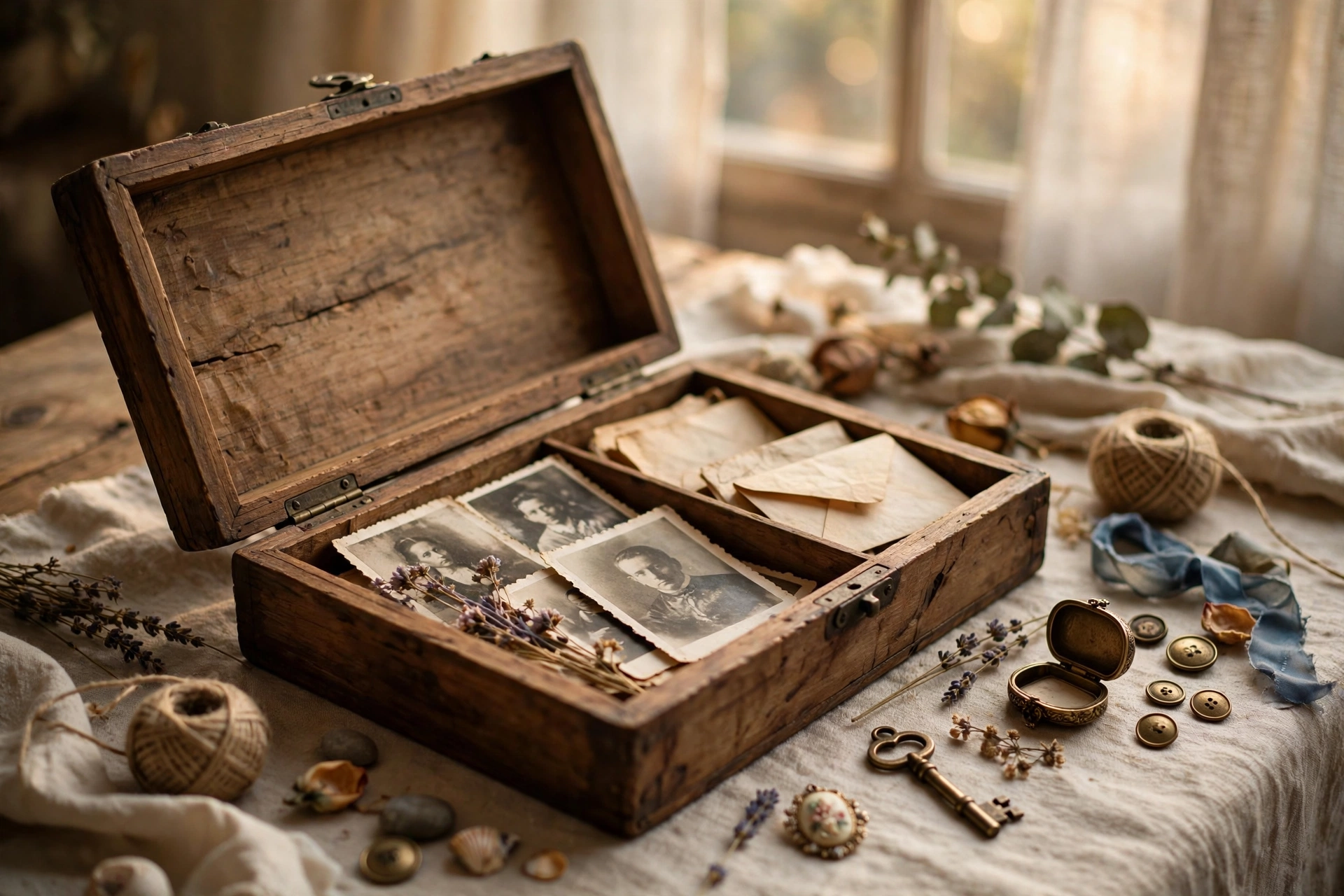
Choose one beautiful box — not a sad cardboard box, a nice one — and that’s your memory box. Everything you keep must fit inside it. This isn’t cruelty; it’s curation. A museum doesn’t display everything in its archives. It chooses the best pieces and honors them properly.
When the box is full and you find something new to keep, something old has to go. This keeps the collection meaningful instead of letting it quietly become ten boxes again.
Step 4: Photograph Before You Release
For items in the “photograph and release” pile, take your time with the photo. Photograph kids’ artwork, old letters, trophies, the teddy bear. Get good light, capture details. Then create a digital memory album — a folder on your phone or computer, or a printed photo book once a year.
Here’s what surprises people: you will look at the photos more than you ever looked at the boxed objects. The digital version is accessible; the box in the attic was not. You’re not losing the memory — you’re finally able to see it.
Handling the Hardest Categories
Inherited items. You are not obligated to become the family warehouse. Keep the pieces you genuinely love and that fit your life. For the rest: offer them to family members first (with a deadline — “let me know by the end of the month”), then donate or sell. Your loved one wanted you to be happy, not burdened.
Gifts you don’t like. The purpose of a gift is the moment of giving — the thought, the connection. That moment already happened and can’t be undone by what you do with the object now. Keeping an unwanted gift doesn’t honor the giver; using the space for something you love honors your home.
Children’s items. Keep a small curated selection: a favorite outfit, a few pieces of art, the meaningful milestones. Photograph the rest. Your kids won’t want 40 boxes of their childhood papers — and neither will you, when you’re the one storing them for decades.
Things from difficult times. Items tied to painful memories — a failed relationship, a hard period — often stay out of inertia, not love. If something makes you feel bad every time you see it, that’s the opposite of a keepsake. You’re allowed to let it go.

The Guilt Toolkit: What to Tell Yourself
When guilt spikes mid-sort (it will), use these:
- “The memory is in me, not in this object.”
- “Keeping this in a box honors no one.”
- “Someone else could actually use and love this.”
- “Letting go of the object is not letting go of the person.”
- “My home is for my present life, not a museum of my past.”
Say them out loud if you need to. It sounds silly. It works anyway.
What to Do With Released Items
Don’t let released sentimental items sit in bags for months — that undoes the emotional work.
- Donate usable items promptly, ideally the same week. Knowing a teacup set will be loved by someone new genuinely eases the parting.
- Offer to family for inherited pieces, with a clear deadline.
- Sell valuable items, but set a time limit — if it doesn’t sell in a month, donate it.
- Trash/recycle what’s broken or truly unusable, without ceremony.
Take the bags out of the house quickly. Out of sight lets the peace settle in.
Frequently Asked Questions
Is it okay to throw away sentimental items?
Yes — when you’ve honored the memory (a photo, a moment of gratitude) and the object no longer serves your life. Discarding the object doesn’t discard the love or the memory.
How do I declutter sentimental items from someone who passed away?
Wait until you’re ready — grief has its own timeline, and there’s no deadline. When you do start, keep what you truly love, photograph the rest, and offer meaningful pieces to family. Consider keeping one special item displayed rather than boxes stored.
What if I regret getting rid of something sentimental?
Regret is rare and usually brief — and the photo you took softens it enormously. In practice, people regret the years of clutter far more than any single released item.
Should I keep my children’s artwork and school papers?
Keep the best pieces — a curated few per year in a portfolio or memory box — and photograph the rest. A photo book of their art gets looked at; a box in the attic doesn’t.
Sentimental decluttering isn’t about having less past. It’s about making room for your present. The memories stay — they’re yours forever, no storage required. Keep the best, photograph the rest, and let your home breathe again.
If guilt around belongings runs deep for you, Swedish Death Cleaning: A Gentle Guide to Decluttering for Good offers a compassionate long-view approach to letting go.
[…] Sentimental pieces. One small box for the truly irreplaceable: the concert tee from the best night of your life, your grandmother’s scarf. Not ten boxes. Photograph the rest if it helps — the memory survives without the fabric. (More on this: How to Declutter Sentimental Items Without the Guilt.) […]