
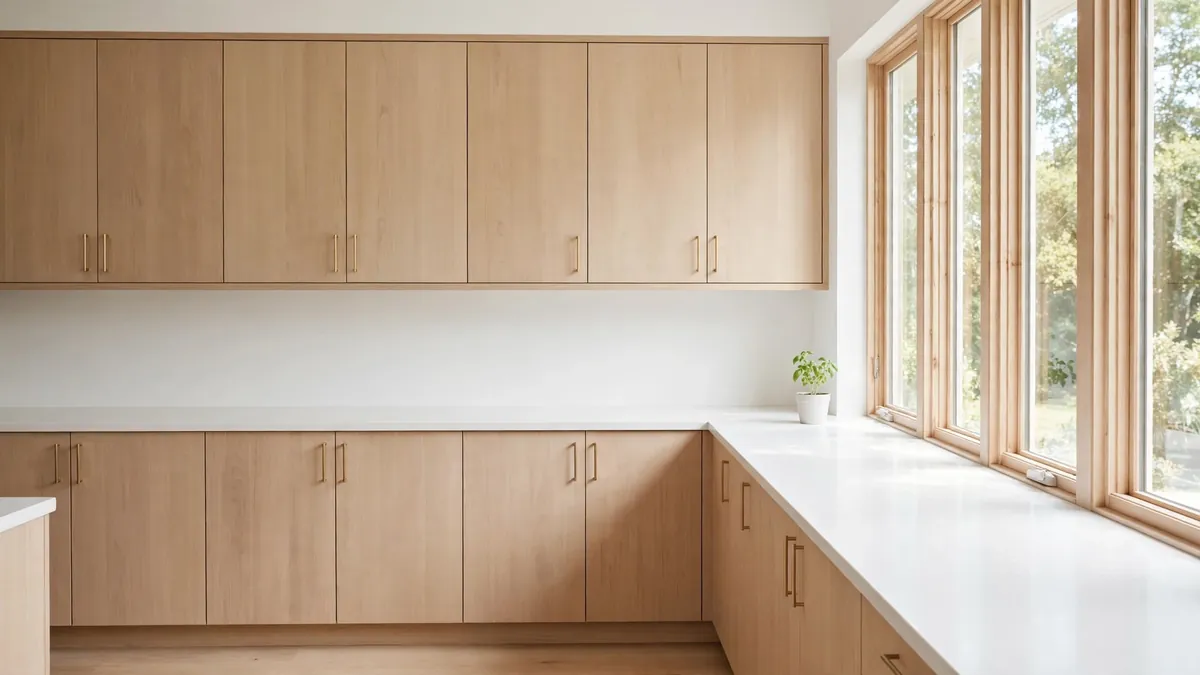

The first time I tried to make coffee in a cluttered kitchen — shoving aside the bread maker nobody uses, the blender, three cutting boards — I understood something important. A minimalist kitchen isn’t about owning nothing. It’s about every single thing in the room earning its place. My friend Sara has maybe forty items in her entire kitchen, and cooking there feels like a deep breath. Mine had four hundred items, and cooking felt like a negotiation.
Here’s the good news: you don’t need a renovation, a big budget, or a personality transplant to get there. You need a clear idea of what a minimalist kitchen actually is, one ruthless afternoon with your cabinets, and a few systems that keep the simplicity alive. This guide covers all three — and no, you don’t have to give up your coffee maker.
What a Minimalist Kitchen Actually Is (and Isn’t)
Forget the showroom photos. A real minimalist kitchen is a functional one: clear counters, tools you actually use, and storage that makes sense. It’s not about white cabinets or hiding everything away — plenty of minimalist kitchens are warm, colourful, and full of life. The difference is intention. Every item has a job and a home.
It’s also not about deprivation. If you bake bread every Sunday, your stand mixer isn’t clutter — it’s essential. Minimalism in the kitchen means your space serves your actual life, not an imaginary one where you suddenly start making fresh juice with that juicer from 2019.
And here’s something the photos never tell you: minimalism has nothing to do with your finishes. Renters can build a minimalist kitchen in a dated rental with oak cabinets and laminate counters, because the philosophy is about your stuff, not your square footage or your renovation budget. Clear surfaces and honest curation work in a galley kitchen just as well as in a showroom.
Step 1: Declutter With the One-Year Rule
Start here, because no organizing system survives a cabinet full of things you don’t use. Pull everything out — yes, everything, one cabinet at a time — and ask the honest question: have I used this in the last year? If the answer is no, it goes. The duplicate spatulas, the fondue set, the third set of measuring cups, the “good” dishes you’re saving for guests who never come.
Sort the rejects into three piles: donate, recycle, bin. Donate anything still useful — someone else’s starter kitchen will love your extras. Be especially honest about single-use gadgets: the avocado slicer, the banana hanger, the electric egg cooker. A good knife does all of those jobs.
This is the hardest step and the most important one. If you want a gentler framework for letting go, the philosophy behind Swedish death cleaning applies beautifully to kitchens: keep what serves your life now, and release the rest with gratitude.
Step 2: Clear the Counters (and Keep Them Clear)
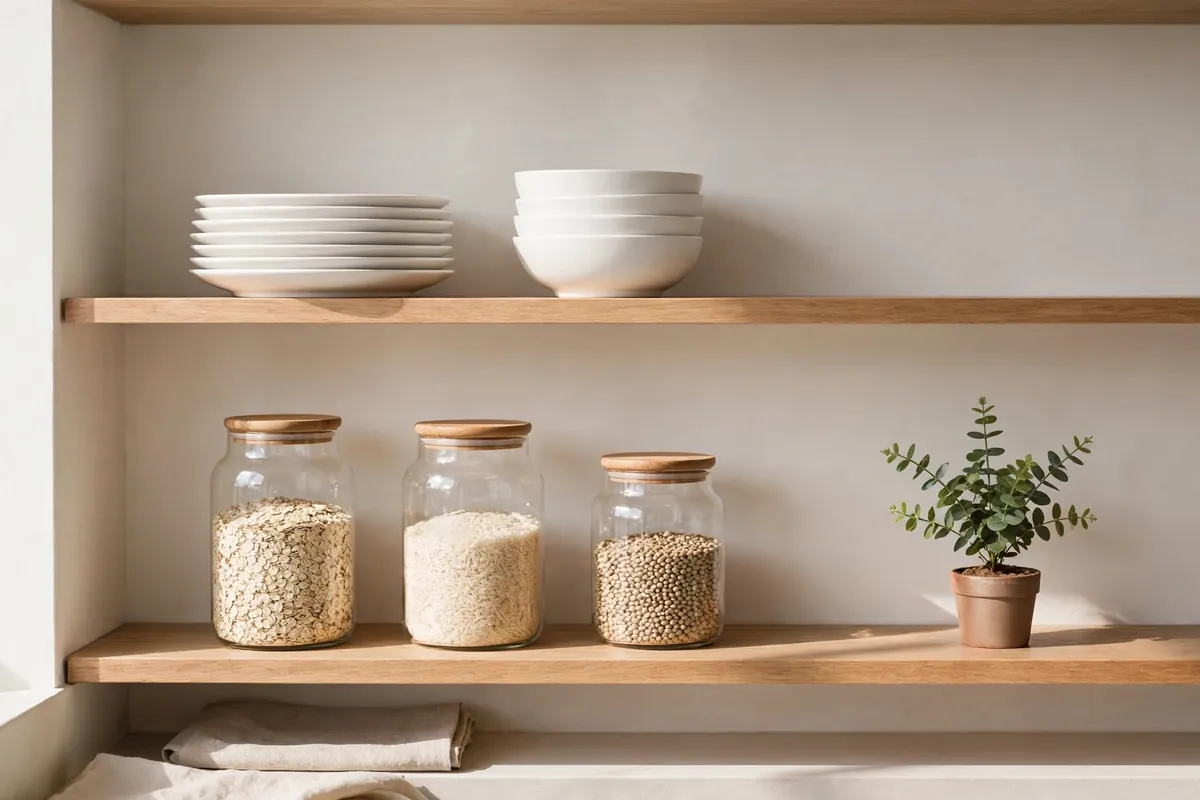
Counters are the soul of a minimalist kitchen. The rule is simple: only daily essentials earn counter space. For most people that’s a coffee maker or kettle, a knife block or magnetic strip, and maybe a small tray that corrals the cooking oil and salt. Everything else — toaster, blender, stand mixer — lives in a cabinet and comes out when needed.
Two tricks make this stick. First, the tray method: group your daily items on one small tray, and the counter instantly looks intentional instead of scattered. Second, the flat-surface test: at the end of each day, everything gets put away so the counters are completely clear. It takes three minutes, and the payoff every morning is enormous.
On my counters today: the kettle, a wooden tray holding olive oil and salt, and a small plant my sister gave me. That’s it. The toaster lives in the cabinet above the stove and comes out for weekend toast; the blender lives under the sink. Nothing about this setup cost money — it just took one honest afternoon of deciding what deserved to stay out.
If your kitchen is short on cabinet space, small kitchen organization ideas like vertical storage and over-the-door racks can absorb the overflow without a single item living on the counters.
Step 3: Choose Multi-Purpose Tools Over Single-Use Gadgets
A minimalist kitchen runs on quality over quantity. One excellent chef’s knife beats a drawer of mediocre ones. A Dutch oven replaces a stockpot, a braiser, and a baking dish. Mixing bowls with lids double as food storage. Every time you’re tempted by a unitasker, ask what you already own that does 90% of the job.
A realistic minimalist kitchen essentials list looks something like this:
- One good chef’s knife, one paring knife, one serrated knife
- One large cutting board and one small one
- A Dutch oven or heavy pot, one skillet, one saucepan, two sheet pans
- Mixing bowls with lids, a colander, a wooden spoon, a spatula, tongs
- Everyday dishes and glasses — one set, enough for your household plus a few guests
- A kettle or coffee maker (your non-negotiable — keep it)
That’s genuinely most of it. When each tool is good at its job, you stop compensating with extras. And storing fewer, better things is easier too — a kitchen cabinet system with zones and dividers keeps the essentials exactly where you reach for them.
And “quality” doesn’t mean expensive. It means buying the version you’ll still be happy with in five years: a knife that holds an edge, pans with real weight to them, containers whose lids actually seal. Thrift stores are full of excellent cast iron and solid wood tools for a few dollars — minimalism and secondhand shopping are natural friends.
One more habit protects all of this: the 30-day wish list. When you want a new kitchen gadget, write it down and wait a month. If you still want it — and you can name the exact job it’ll do that nothing you own does — buy it. Nine times out of ten, the urge fades. My list has saved me from a pasta maker, a milk frother, and an herb stripper I’m still not convinced wasn’t a joke.
Step 4: Give Everything a Zone
Minimalism collapses without organization, because “a place for everything” is what keeps the counters clear. Divide your kitchen into zones: prep (knives, boards, and bowls near the main counter), cooking (pots, pans, and utensils near the stove), cleaning (dish soap and towels under the sink), and storage (containers, wraps, and pantry goods together).
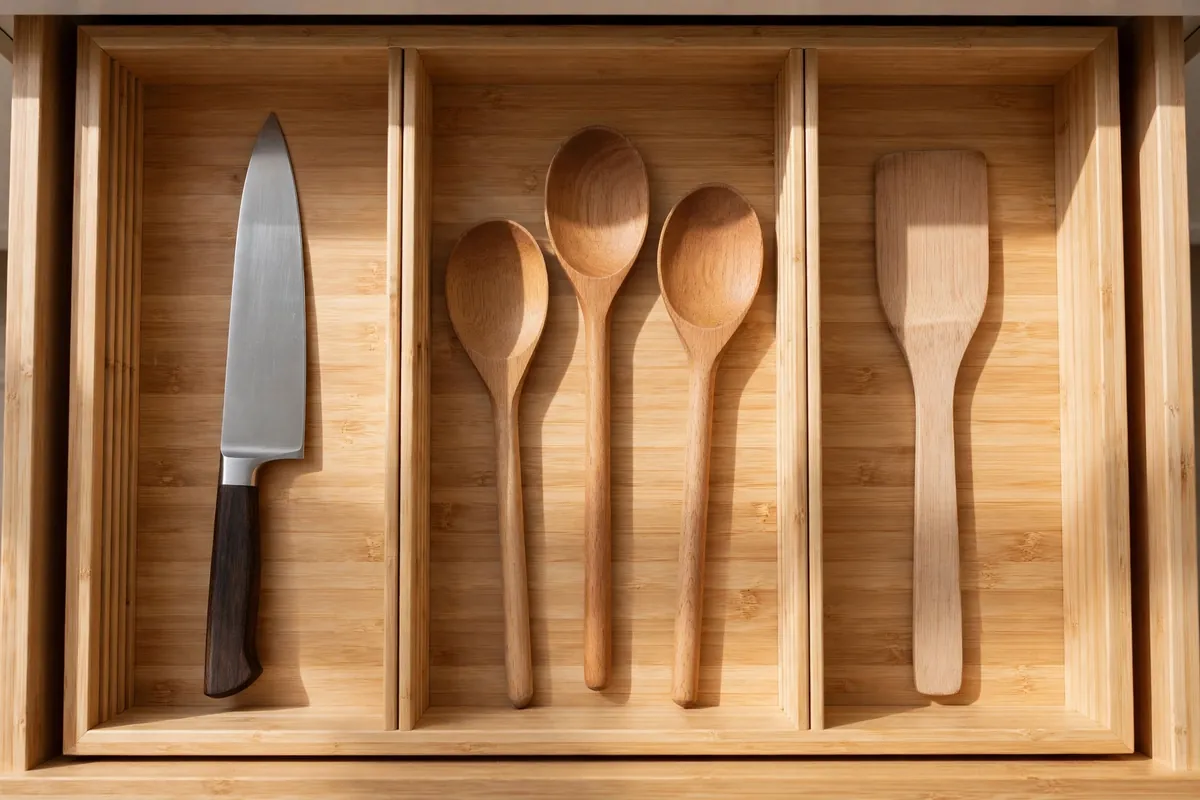
Inside the zones, use drawer dividers so utensils can’t migrate into chaos, and decant dry goods into clear containers so you can see what you have — which quietly stops you buying duplicates. My food storage container system cut my container collection in half, and I haven’t missed a single lid.
If you share the kitchen, get everyone on board with the zones — minimalism dies fast when one person keeps “temporarily” parking things on the clear counter. A five-minute tour (“mugs live here, snacks live here”) works better than nagging, and kids adapt surprisingly quickly when every category has an obvious home.
Minimalist Kitchen Mistakes to Avoid
Most minimalist kitchens fail for predictable reasons — and none of them are about willpower:
- Purging things you actually use. Minimalism isn’t a contest to own the least. If you make smoothies every morning, the blender stays. The goal is a kitchen that fits your life, not someone else’s photo.
- Decluttering too fast. Racing through every cabinet in one frantic afternoon leads to regret donations and rebuying. One zone at a time, with honest decisions, beats a weekend blitz you’ll undo by spring.
- Comparing your kitchen to photos. Showroom kitchens have no groceries, no kids, and no Tuesday-night chaos. Yours is a working room — calm and functional beats camera-ready every time.
- Hiding clutter instead of curating it. Shoving everything into cabinets isn’t minimalism, it’s storage. If the inside of your cabinets is chaos, the calm is an illusion that collapses the first time you actually cook.
How to Keep Your Minimalist Kitchen Minimal
The declutter is the fun part; maintenance is the real skill. Three habits keep the simplicity alive:
- One in, one out. A new mug means an old mug leaves. This single rule prevents 90% of re-clutter.
- The two-minute reset. Every evening, clear the counters and put everything back in its zone. Small daily effort, permanent calm.
- The seasonal scan. Twice a year, open every cabinet and ask the one-year question again. Kitchens accumulate quietly; a quick scan keeps them honest.
One more thing worth planning for: inflow. Kitchens don’t re-clutter by themselves — stuff arrives. Gifts, freebies, the “useful” gadget from a well-meaning relative. Keep a small donation box in a closet where incoming extras go immediately, before they earn a spot in your cabinets. It’s much easier to redirect something at the door than to evict it six months later.
And remember that minimalism is a direction, not a destination. Your kitchen will never look like a showroom, and it shouldn’t — it’s a working room. The goal is a space that feels calm when you walk in and works hard when you cook. The same principles — fewer, better things, each with a home — work in every room of the house once you’ve felt the difference here.
Start this weekend with one drawer. Just one. Pull it out, keep the essentials, and feel the difference when it slides shut. A minimalist kitchen isn’t built in a day — it’s built one honest decision at a time.