
My first apartment kitchen was roughly the size of a parking space. One narrow counter, two cabinets that didn’t fully close, and a drawer that jammed if you looked at it wrong. Cooking in it felt like solving a puzzle where the pieces kept multiplying.
Here’s the good news: small kitchens are not a storage problem. They’re an organization problem. You probably have enough space — it’s just badly used. These are the ideas that actually made a difference in that tiny kitchen, not the fantasy ones from home tours.
Rule Zero: Declutter Before You Organize
I know, I know — you came for organization ideas. But this is the step that makes all the other steps work.
Small kitchens punish duplicates. Pull everything out of one cabinet at a time and count: how many water bottles? How many wooden spoons? How many “just in case” gadgets? In my kitchen, I found four vegetable peelers. Four. I kept one.
Be honest about single-use gadgets too. That avocado slicer, the banana hanger, the garlic press shaped like a garlic bulb — if a regular knife does the job, the gadget is just renting space. Keep the tools you reach for weekly. Everything else can go.
Only after decluttering does organizing make sense. Otherwise you’re just buying pretty containers for clutter.
1. Think Vertical — Your Walls Are Free Real Estate
In a small kitchen, the most underused space is the wall. Counter space is precious; wall space is usually empty.
- Open shelves on one wall can hold everyday dishes and glasses, freeing an entire cabinet. Keep them to things you use daily so nothing gathers dust.
- A pegboard (painted to match your walls) holds pots, pans, measuring cups, and utensils on hooks. Everything visible, everything reachable.
- Magnetic knife strip on the wall replaces a bulky knife block and looks better doing it.
- Hanging rail with S-hooks under a shelf or on a bare wall section — perfect for mugs, small baskets, or cooking utensils.
One honest note: open storage only works if you’re disciplined about what lives there. If a shelf becomes a graveyard for random items, it’s not storage — it’s a display of clutter.
2. Zone Your Kitchen Like a Pro
Professional kitchens run on zones, and the same logic rescues small ones. Divide your kitchen into three zones:
- Prep zone (near the sink): cutting boards, knives, mixing bowls, trash.
- Cook zone (near the stove): pots, pans, oils, spices, cooking utensils.
- Clean zone (sink + dishwasher): dish soap, drying rack, towels.
Store each item in its zone. This sounds obvious, but most small kitchens have spices in three different places and the colander nowhere near the sink. Zoning cuts your steps in half and stops the “where is the thing” dance.
3. Cabinet Doors Are Secret Storage
The inside of a cabinet door is free, hidden storage. Use it:
- Slim racks on the inside of under-sink doors hold spray bottles and sponges.
- A small rack inside a pantry door holds spice jars or packets.
- Command-style hooks inside a cabinet door hold measuring cups and spoons.
- A cutting-board holder mounted inside a lower cabinet door gets boards off the counter.
Just measure your door clearance first — nothing kills the vibe like a door that won’t close because the rack is too deep.
4. Shelf Risers Double Your Cabinet Space
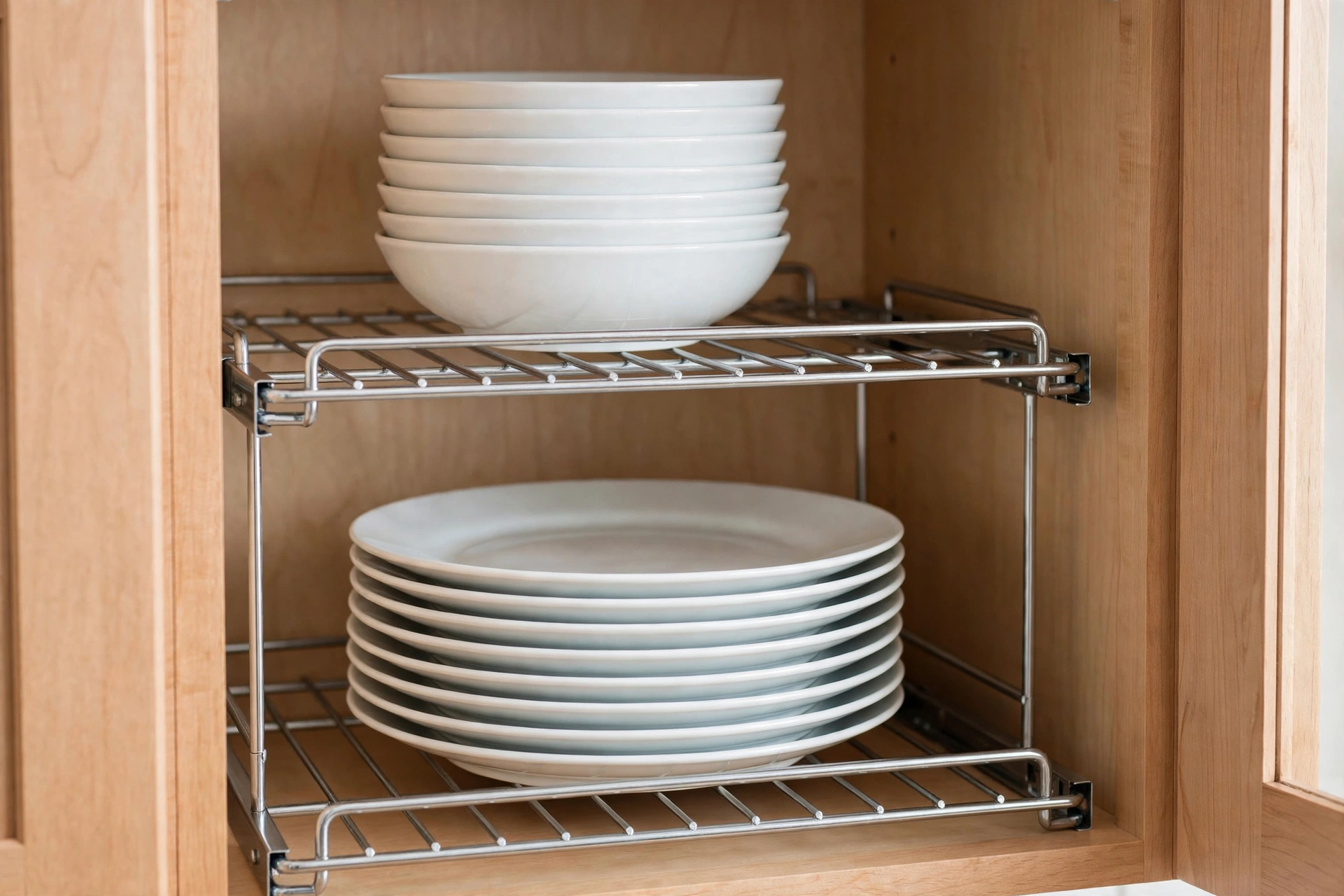
Most cabinets have one tall empty void above the plates. A simple shelf riser — a small raised platform — turns that dead air into a second level. Plates below, bowls above. Mugs below, small bowls above.
They cost very little, need no installation, and honestly, this single item made the biggest difference in my kitchen. Stackable, removable, and they work in pantries too.
5. Drawer Dividers End the Junk Drawer Era
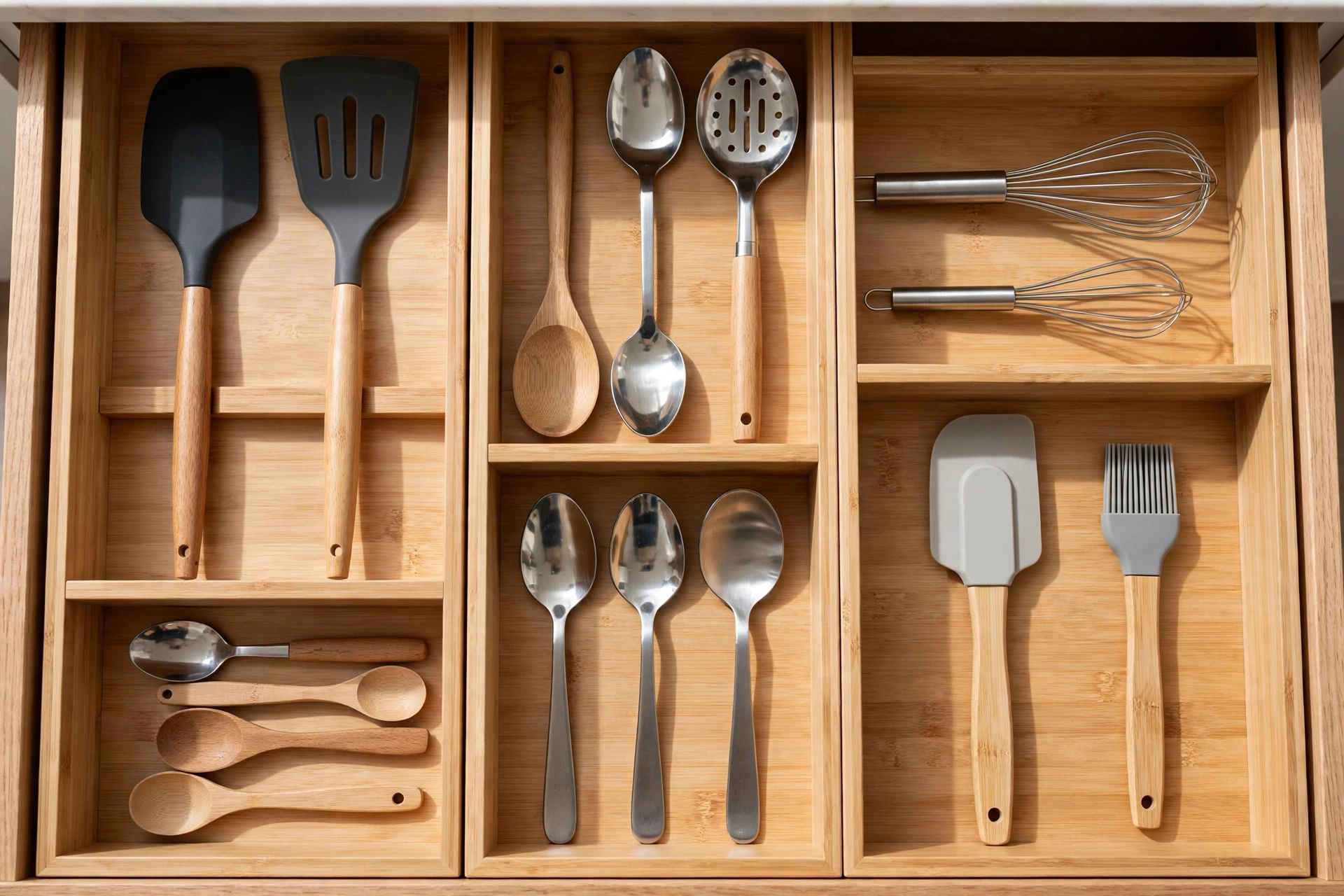
Kitchen drawers without dividers become black holes. Adjustable dividers or a simple organizer tray transform a utensil drawer in five minutes.
Go one level deeper: use the “file fold” for kitchen linens and the vertical trick for lids — store pot lids upright in a divider section instead of stacked. You’ll stop dreading opening that drawer.
If you have one deep drawer, consider a two-tier organizer: everyday utensils on top, lesser-used tools below.
6. Decant — But Only Where It Pays Off
You’ve seen the beautiful pantries with matching glass jars. Here’s the honest version: decanting everything is a hobby, not a necessity. But decanting some things genuinely saves space:
- Flour, sugar, rice, pasta — uniform containers stack neatly and you can see when you’re running low.
- Snacks and cereals — boxes are mostly air; containers are not.
Don’t decant spices into 40 tiny jars unless you enjoy that. Keep spices in a drawer on a tiered insert or on a small turntable in a cabinet. The goal is function, not a photo shoot.
7. Use the Forgotten Spots
Small kitchens have dead zones most people ignore:
- Above the fridge: a basket for rarely-used items (holiday baking gear, the blender you use monthly).
- The gap between fridge and wall: a slim rolling cart fits in 6 inches and holds cans, oils, and spices.
- Under the sink: a tension rod across the cabinet holds spray bottles by their triggers; stackable bins below hold the rest.
- Over the sink: a roll-up dish drying rack that sits over the sink frees counter space when not in use.
- Stove gap: a slim cover over the unused burner area (when cool) becomes extra prep space.
8. Keep Counters 80% Clear
This is the visual trick that makes a small kitchen feel bigger. Aim to keep only true daily essentials on the counter — for most people, that’s the coffee maker and maybe a knife block or utensil crock.
Everything else earns counter space or it doesn’t. The stand mixer you use twice a month? Cabinet. The toaster? If you toast daily, it stays; otherwise, cabinet. A clear counter isn’t just prettier — it’s more usable. You can actually prep food instead of playing Tetris with appliances.
What NOT to Do in a Small Kitchen
- Don’t buy organizers before decluttering. I said it in the decluttering guide and I’ll say it again: measure your actual stuff first, then buy storage that fits it.
- Don’t block natural light with tall items on the windowsill or bulky shelves near the window. Light makes small spaces feel bigger.
- Don’t keep “someday” appliances. The bread maker, the juicer, the fondue set — if you haven’t used it in a year, it’s decoration, not equipment.
- Don’t copy someone else’s kitchen. That influencer’s kitchen is three times your size with a walk-in pantry. Steal the principles, not the shopping list.
A Realistic Weekend Plan
Don’t try to do all of this in one day. Here’s a sane pace:
- Saturday morning: declutter cabinets and drawers (the 15-minute method, one cabinet at a time).
- Saturday afternoon: install one vertical solution — a shelf, a pegboard, or a magnetic strip.
- Sunday: zone your items, add shelf risers and drawer dividers, clear the counters.
One weekend, one transformed kitchen. And unlike a renovation, it costs less than a nice dinner out.
Frequently Asked Questions
How do I organize a very small kitchen with no pantry?
Treat one cabinet as your “pantry cabinet” with shelf risers and clear bins grouped by category. Use wall space and the top of the fridge for overflow. Most small kitchens don’t need a pantry — they need one well-organized cabinet.
What’s the best way to store pots and pans in a small kitchen?
Hang them if you can (pegboard or rail), or nest them with pan protectors in one deep cabinet, lids stored vertically beside them. Avoid stacking heavy pans more than two high.
Should I use open shelves in a small kitchen?
Yes, but only for everyday items you use and wash regularly. Open shelves holding things you touch daily stay clean naturally. Decorative open shelves in a kitchen just collect grease and dust.
How do I keep my small kitchen organized long-term?
The one-in-one-out rule: every new kitchen item means an old one leaves. Plus a two-minute nightly reset — dishes in the dishwasher, counters wiped. Small kitchens stay tidy with tiny daily habits, not big monthly purges.
A small kitchen doesn’t need more space. It needs fewer duplicates, smarter vertical storage, and zones that match how you actually cook. Start with the declutter, add one vertical solution this weekend, and you’ll wonder why it ever felt so cramped.
New to this? Start with our room-by-room decluttering guide — the kitchen section pairs perfectly with this post.
[…] and measuring tools, add a shelf riser to every deep shelf, and be ruthless about duplicates. Our Small Kitchen Organization Ideas That Actually Maximize Space has more small-space-specific tricks that pair perfectly with this […]