
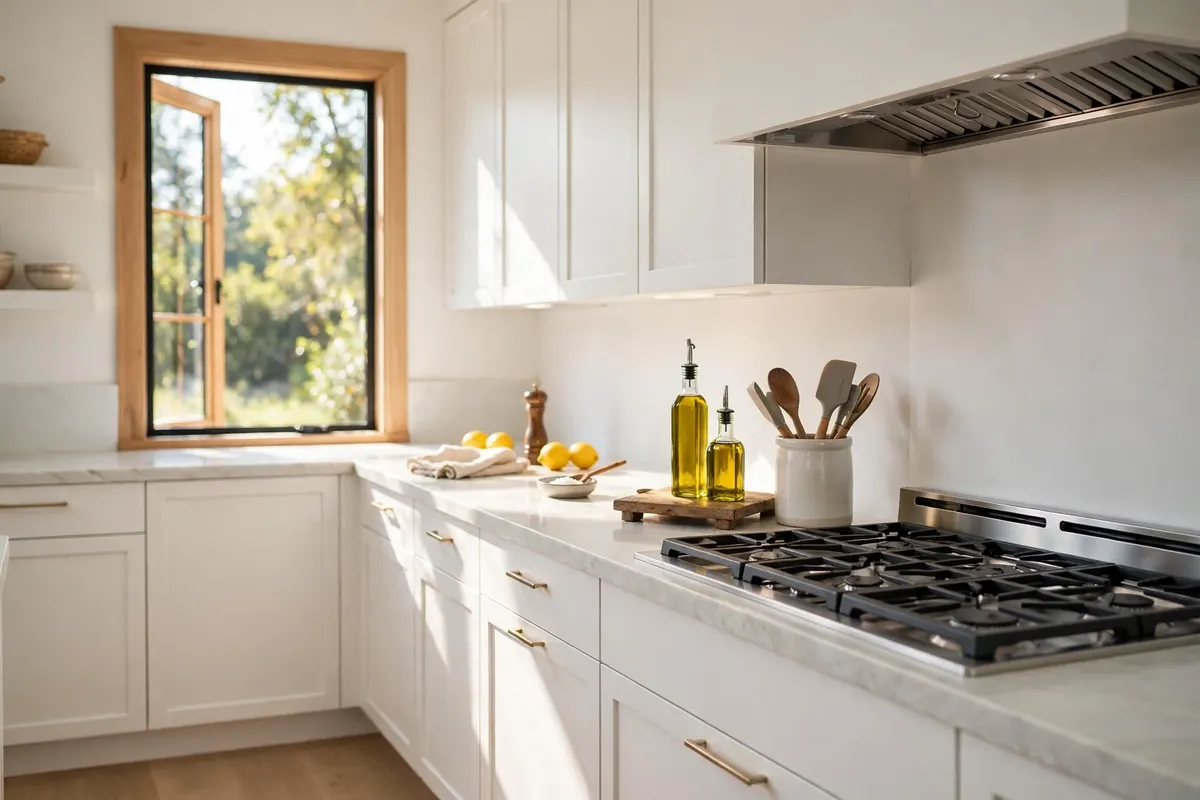

For years, our kitchen counter was where everything went to wait. The mail. School permission slips. A toaster we used twice a month. Three half-empty vitamin bottles and a candle that smelled like a craft store exploded. Cooking dinner meant shoving the whole parade to one end of the counter first — and by the time I’d cleared a cutting-board-sized space, I was already tired of cooking.
Here’s what finally changed it: I stopped waiting for a bigger kitchen and built a simple kitchen counter organization system instead. Decide what earns counter space, give everything else a real home, and add one tiny nightly habit. That’s it. Here’s exactly how to do the whole thing in a single weekend.
First, Decide What Earns a Spot on Your Counter
Before you buy a single tray or turntable, answer one question honestly: what actually lives on your counter? Walk over right now and count. Most of us are shocked — it’s never just the coffee maker. It’s the air fryer, the stand mixer, the paper towel holder, the fruit bowl, the knife block, the dish rack, seventeen spice jars, and a graveyard of reusable water bottles.
Here’s the rule that fixes it: an item earns counter space only if you use it daily or it can’t be stored anywhere else. That’s the whole test. For most households, the keepers are:
- The coffee maker (a genuine daily ritual)
- A knife block or utensil crock
- Dish soap and a sponge
- Maybe a fruit bowl — fruit you actually eat this week
Everything else is on probation. The waffle maker you use on Christmas morning? It belongs in a cabinet. The bulk cereal boxes and the extra paper towels? Those belong in the pantry, not on prime counter real estate. Be ruthless here — this one decision does half the work of the entire project.
The 10-Minute Counter Reset (Your Weekend Starting Point)
Saturday morning, before the house wakes up: set a timer for ten minutes. Take everything off the counters — yes, everything — and put it on the kitchen table. Don’t sort yet, just clear. There’s something almost shocking about seeing your counters completely bare; most of us haven’t seen them in years.
While the counters are empty, wipe them down properly — hot water, dish soap, a microfiber cloth. Crumbs hide in places you’d never expect. Then, with everything laid out on the table, sort into four groups:
- Daily keepers — the short list from the section above
- Relocate — used weekly or monthly; these get a cabinet, drawer, or pantry shelf
- Donate or toss — the duplicate gadgets, the chipped mugs, the expired vitamins
- Doesn’t belong in the kitchen at all — the mail, the sunglasses, your kid’s Lego masterpiece
Small appliances that failed the daily-use test but you still love? They get a proper home inside a cabinet — and if your cabinets are chaotic too, these kitchen cabinet organization ideas will make room for them. Only the daily keepers go back on the counter. Everything else leaves the room.
Kitchen Counter Organization Zones That Do the Work for You
Here’s the part most people skip, and it’s the reason their counters look great on Sunday and chaotic by Thursday: zones. Instead of scattering your keepers randomly, group them by how you actually cook. Things that live where they’re used get put back without thinking — that’s the whole magic.
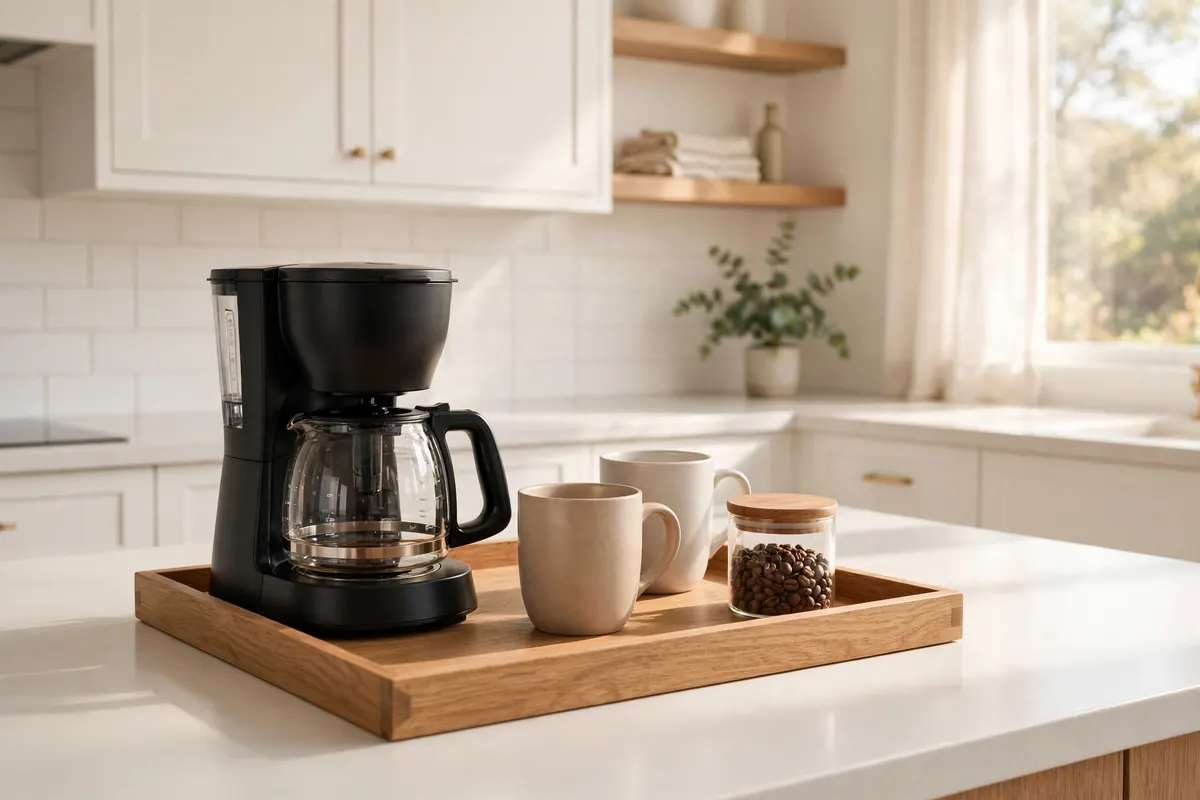
The coffee and breakfast zone. Coffee maker, mugs, sugar, and spoons in one spot — ideally on a tray so the whole station feels intentional instead of scattered. My morning is genuinely calmer since everything I need before 7 a.m. lives in one eighteen-inch square.
The cooking zone. Near the stove: a utensil crock, cooking oils, salt and pepper. A small turntable (lazy Susan) here is worth its weight in gold — oils and vinegars spin into reach, and it catches the drips that used to stain the counter.
The sink zone. Dish soap, sponge, hand soap, and a dish brush — corralled in a simple sink caddy so they read as one tidy unit instead of four random bottles. The sink area works harder than anywhere else in the kitchen; giving it a defined home keeps it from sprawling.
The landing zone. If your kitchen doubles as the family’s entry point, give the daily drop-off items one small tray by the door — keys, wallet, sunglasses. It’s not really a cooking zone, but without it, all that “doesn’t belong in the kitchen” stuff will colonize your newly clear counters within days. Contain the landing, protect the cooking.
Small Kitchen? Steal Space From the Walls
If your counters are small, the answer isn’t fewer keepers — it’s using the square footage you’re ignoring. Walls, the sides of cabinets, and the space under upper cabinets are all free real estate.
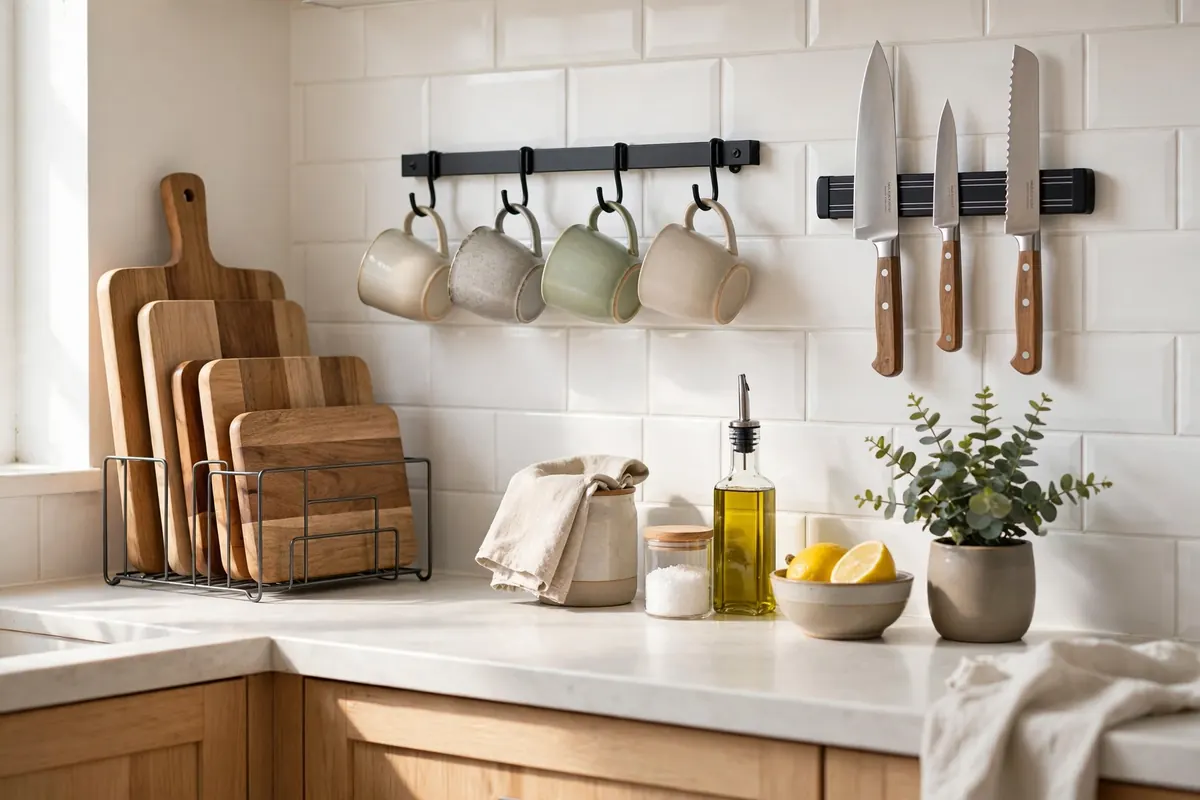
- Store cutting boards upright in a rack or file organizer instead of stacked flat — it halves their footprint and they dry better too.
- Hang mugs on hooks under a shelf or on a wall-mounted rail. Four mugs on hooks free up an entire shelf’s worth of counter.
- Mount a magnetic knife strip on the wall and retire the bulky knife block.
- Move paper towels to a wall-mounted or under-cabinet holder — the standing holder eats a shocking amount of counter.
- Add a small shelf riser in one corner: oils and spices up top, everyday items tucked underneath.
Tiny kitchens reward creativity more than square footage. If you want more ideas in this vein, these small kitchen organization ideas are full of renter-friendly tricks that don’t require a single drilled hole.
Corral the Rest: Trays, Turntables, and Caddies
There’s a reason professional organizers are obsessed with trays: a group of small items on a tray reads as one intentional object, while the same items scattered read as clutter. It’s a visual trick, and it works every time.
A few corrals that earn their keep: a turntable for cooking oils and sauces near the stove; a small tray for salt, pepper, and the olive oil you reach for daily; a sink caddy for dishwashing tools; and — this one changed my life — one small basket for the paper that sneaks in. Mail, receipts, school forms: they land in the basket instead of spreading across the counter, and the basket gets emptied every Sunday. Paper can’t be banished entirely, but it can be contained.
And the utensil situation: if your crock is overflowing, the overflow doesn’t get a second crock — it gets edited. The everyday tools stay; the melon baller and the third spatula move into a drawer. These kitchen drawer organization ideas will give them a proper home with dividers, so you can actually find them when you need them.
The Countertop Appliance Audit: Which Ones Stay and Which Ones Go
Let’s talk about the elephants on the counter: the appliances. Most kitchens I see are hosting at least two appliances that haven’t been touched in months, and they’re the biggest space thieves in the room. The daily-use rule from the first section applies double here, because one air fryer eats as much counter as your entire coffee station.
Do a quick audit. For each appliance, ask: have I used this in the last two weeks? The daily drivers — coffee maker, toaster, kettle — stay. The weekly players — stand mixer, air fryer — get a maybe-spot: fine on the counter if yours are generous, otherwise they move to an easy-access cabinet shelf. The twice-a-year crew — the waffle maker, the bread machine, the juicer from your health phase — they go deep: top of a closet, a basement shelf, or honestly, the donate pile.
The trick that makes this stick: appliances you store must be easy to retrieve. If getting the stand mixer out requires moving twelve things, you’ll either never use it or never put it back. Give stored appliances a dedicated shelf at arm height — that’s where good kitchen cabinet organization pays off again. And here’s the bonus move: when an appliance leaves the counter, its old spot doesn’t get filled. That empty space is the whole point.
The Nightly 5-Minute Habit That Keeps Counters Clear
Here’s the honest truth: the weekend reset means nothing without a maintenance habit. But it doesn’t need to be a big one. Every night — while dinner simmers, or right after the dishes — do a five-minute counter sweep:
- Put the day’s strays back in their zones (the scissors, the vitamins, the random Lego).
- Toss the paper basket’s obvious junk — expired coupons, envelopes, the flyer for a pizza place.
- Wipe the counters and the stovetop.
- Step back and look. It should take about as long as brewing tea.
That’s it. Five minutes. The reason counters spiral isn’t one big mess — it’s thirty tiny “I’ll deal with it later” moments. The nightly sweep deals with them before they compound. Within two weeks it stops feeling like a chore and starts feeling like the best part of winding down the kitchen.
Clear counters change how the whole kitchen feels. I won’t pretend our counters look like a magazine shoot. There’s still a coffee ring I can’t quite get out and a toaster that has earned its spot through daily service. But cooking is easier, cleaning takes minutes instead of half an hour, and the kitchen finally feels like the calm heart of the house instead of its storage unit.
Start tonight with the ten-minute reset — just one section if the whole counter feels like too much. You’ll be amazed what a difference a little bare countertop makes.
[…] aside and turn back into clutter. A quiet corner is perfect: it keeps everything contained while the rest of your counters stay clear and easy to wipe […]
[…] This honest sort is the foundation of every other idea below, and it pairs perfectly with a full kitchen counter organization reset so your counters stay clear for actual […]