
The average person wears 20% of their wardrobe 80% of the time. I know this because I once counted: out of roughly 120 clothing items I owned, I wore about 25 regularly. The other 95 were just… there. Taking up space, making mornings harder, and quietly making me feel like I had “nothing to wear” while standing in front of a stuffed closet.
The keep-toss-donate system fixed it. It’s beautifully simple: every item gets sorted into Keep, Toss, or Donate — no maybe pile, no “decide later” box. Here’s exactly how to run it.
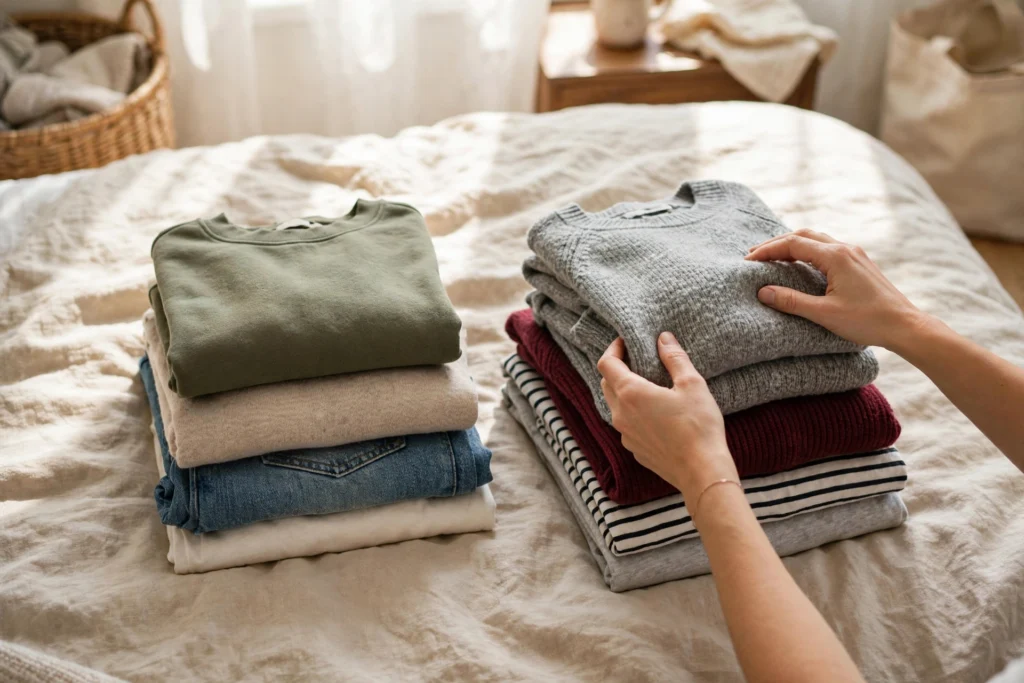
Before You Start: Set Up for Success
Pick the right time. You need 2–3 hours and decent energy. Morning works best — decision fatigue is real, and it’s lowest early in the day. Put on music or a podcast, make coffee, and treat it like a project, not a punishment.
Get your supplies: three large bags or boxes labeled KEEP, TOSS, and DONATE, plus a full-length mirror and good lighting. You’ll be trying things on, so wear something easy to change out of.
Set the ground rules now, while you’re thinking clearly:
- No “maybe” pile. Every item gets a decision today.
- If you wouldn’t buy it again today at full price, it doesn’t stay.
- “Someday” clothes leave. Someday never comes.
- One exception box is allowed for genuine sentimental pieces (wedding outfit, etc.) — but it must be small.
Step 1: Empty the Entire Wardrobe
Take everything out — every hanger, every folded item, every shoe. Yes, it’s dramatic. Yes, it’s necessary. You cannot make good decisions about your wardrobe while half of it is hidden behind the other half.
Pile it all on the bed. Seeing the full volume is the wake-up call most people need. That mountain of clothes is what you’ve been managing every morning. No wonder getting dressed felt hard.
Quick-clean while it’s empty: wipe shelves, vacuum the closet floor, check for moths or damage. This takes ten minutes and you’ll never have a better opportunity.
Step 2: Sort Every Item — Keep, Toss, or Donate
Pick up each item, one at a time, and ask the questions below. Be quick — your first instinct is usually right, and lingering breeds excuses.
KEEP: It earns its place if…
- You wore it in the last 12 months (seasonal exceptions apply — the winter coat stays in summer)
- It fits well right now, not “when I lose weight”
- It’s in good condition — no stains, holes, stretched elastic, or pilling you can’t fix
- You feel good wearing it — genuinely, not “it’s fine”
- It fills a real role: work, casual, exercise, formal, sleep
TOSS: It’s done if…
- It’s stained, torn, or worn out beyond repair
- Underwear and socks are stretched, holey, or ancient
- It’s broken (zippers, elastic) and not worth fixing
- Old promotional t-shirts that have served their time as rags
Toss means trash or textile recycling — don’t donate garbage. Many clothing retailers and charities accept worn-out textiles for recycling.
DONATE: It goes if…
- It’s in good condition but you haven’t worn it in a year
- It doesn’t fit and won’t with realistic alterations
- It was a gift you never liked (the giving already happened; keeping it helps no one)
- It’s a duplicate — you don’t need five black t-shirts
- Your style changed and it’s not coming back
- You keep it “just in case” — for the camping trip, the costume party, the life you don’t live
The 5-second rule for tough calls: Hold the item. If you feel a genuine spark of “I love this,” keep it. If you feel guilt, obligation, or “meh,” it goes. Your gut knows.
Step 3: Handle the Tricky Categories
“Someday” clothes (the aspirational sizes). Keep one aspirational outfit if you must — not ten. A closet full of “when I’m thinner” clothes punishes you every morning. Dress the body you have today; it deserves clothes that fit.
Expensive mistakes. The pricey jacket you never wear. Keeping it doesn’t recover the money — that money is gone either way. Sell it if it’s worth real money (set a one-month deadline; unsold goes to donate), or donate it and let someone else love it. The sunk cost is sunk.
Sentimental pieces. One small box for the truly irreplaceable: the concert tee from the best night of your life, your grandmother’s scarf. Not ten boxes. Photograph the rest if it helps — the memory survives without the fabric. (More on this: How to Declutter Sentimental Items Without the Guilt.)
Work clothes for a life you left. If you changed careers two years ago, those suits are donations now. Keep one interview outfit; release the rest.
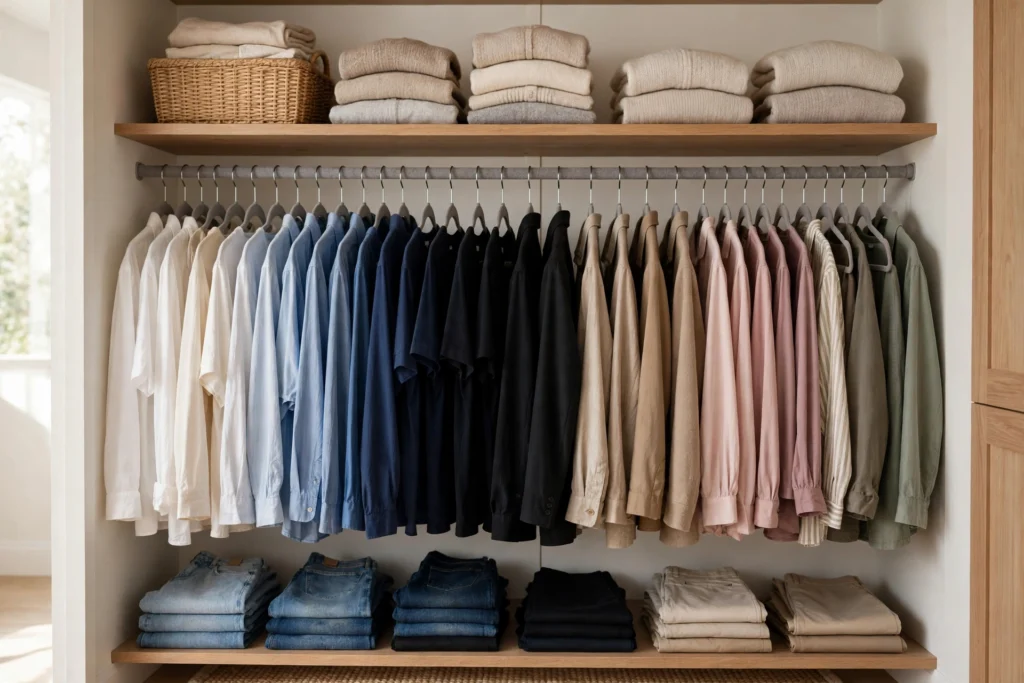
Step 4: Put Back Only the Keeps — Organized
Don’t just shove the keep pile back in. This is your fresh start:
- Hang by category, then color: all shirts together, all pants together, light to dark within each group
- Use slim matching hangers — they save shocking amounts of space and make everything look calmer
- File-fold drawers so you can see every item (no more buried t-shirts)
- Shoes: keep only what you wear; store off-season pairs up high or under the bed
- Accessories: one small organizer for belts, scarves, jewelry — if it overflows, edit
Leave some empty space. A closet at 80% full stays organized; a closet at 100% full collapses within weeks. Empty space isn’t wasted — it’s what makes the system work.
Step 5: Get the Outgoing Items OUT (This Week)
This step is where wardrobe declutters die. The donate bags sit in the corner for two months, then slowly migrate back into the closet.
- Donate: Schedule the drop-off before you start sorting. Put it in your calendar. Most donation runs take 20 minutes.
- Sell: List valuable items this week. Set a firm deadline — whatever doesn’t sell in 30 days goes to donate.
- Toss: Bag it and bin it today. Textile recycling for the worn-out stuff.
Out of the house = done. Until then, it’s just relocated clutter.
Keeping It Lean: The Habits
One in, one out. New shirt in, old shirt out. Non-negotiable. This single rule prevents 90% of wardrobe re-clutter.
The hanger trick. Turn all hangers backward. When you wear something, hang it back normally. In six months, anything still backward hasn’t been worn — donate it without debate.
Seasonal mini-declutter. Twice a year, when you swap seasons, do a 30-minute pass: anything damaged, unworn, or unloved goes. Small, regular edits beat massive annual purges.
The 24-hour rule for shopping. See something you want? Wait a day. Most “must-haves” fade by morning. What survives the wait is usually worth buying — and something else leaves to make room.
Frequently Asked Questions
How many clothes should I own?
There’s no magic number — it depends on your lifestyle, climate, and laundry frequency. A useful test: if you can’t see everything you own at a glance, you own too much to manage. Most people thrive with a leaner wardrobe than they expect.
How do I declutter clothes I have an emotional attachment to?
Keep a small sentimental box for the truly irreplaceable pieces, photograph the rest, and let the physical items go. The memory lives in you, not in the fabric. Be especially strict with “gift guilt” — the gift already served its purpose.
Should I sell or donate unwanted clothes?
Sell items worth real money (designer, nearly new, in-demand brands) with a 30-day deadline. Donate everything else promptly. Don’t let “I should sell this” become a reason bags sit around for months.
What do I do with clothes that don’t fit anymore?
If they don’t fit now, they go — with one small exception for a single aspirational outfit if you genuinely want it. Dress your current body well; it’s the only one you’ve got today.
A decluttered wardrobe changes your mornings. Fewer decisions, everything fits, everything works together, and getting dressed takes five minutes instead of twenty-five. Run the keep-toss-donate system once, protect it with one-in-one-out, and enjoy the calmest closet you’ve ever owned.
For the small-closet storage side of things, read Closet Organization Ideas for Small Closets (No Renovation Needed) next.
[…] this with our wardrobe decluttering system when you’re ready for the deeper […]
[…] (expensive but unwearable) are stealing space from the clothes that actually serve you. (Our How to Declutter Your Wardrobe: The Keep-Toss-Donate System walks you through this […]
[…] — duplicate kitchen tools, excess linens (two sets per bed is plenty), the mug collection. Our Keep-Toss-Donate wardrobe system works perfectly […]