
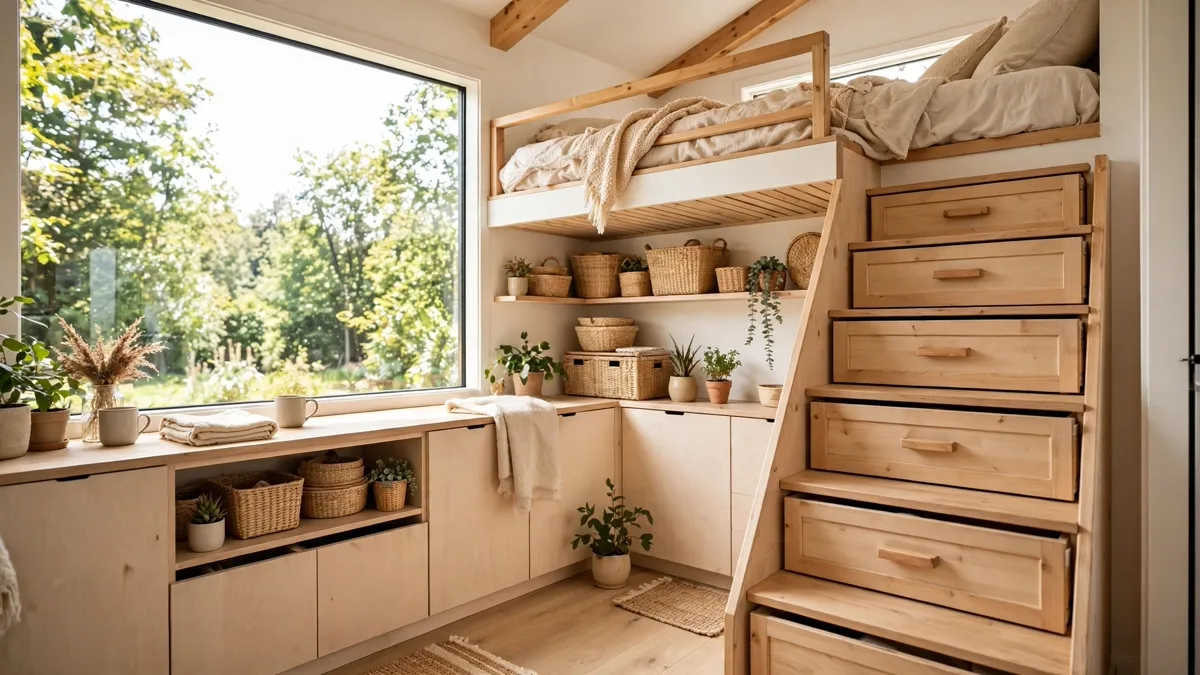

Moving into a tiny house feels a little like joining a club where everybody knows the same secret: tiny house storage ideas are not about cramming more stuff in — they are about making every inch of the home work twice as hard as it does in a regular house. My friend Lena learned this the hard way two summers ago when she parked her 280-square-foot tiny home on a family member’s land in Vermont. She arrived with the same belongings she had kept in a 900-square-foot apartment, confident her new built-ins would swallow them all. By the end of the first weekend, storage totes were lined up on the deck like a yard sale waiting to happen.
Three years later, Lena’s home holds everything she owns without a single tote in sight, and walking through her front door feels calm instead of cramped. What changed was not the size of the house — it was her strategy. She stopped treating storage as furniture and started treating the whole house as storage: stairs that hold the pantry, walls that do the work of closets, a bed that doubles as a dresser. This guide follows the same thinking. Whether you already live tiny or you are simply curious about what these clever homes can teach your apartment, these tiny house storage ideas will help you fit more life into less space.
Start With the Stairs: Tiny House Storage Ideas for Dead Space
In most tiny homes, the staircase to the sleeping loft eats up some of the most valuable square footage in the house. Turning those steps into storage is the single highest-impact change you can make, and it costs less than you might think. Builders and DIY owners routinely replace solid stair boxes with deep pull-out drawers, one per tread, and each drawer holds the equivalent of a full dresser drawer. Lena stores all of her pants, pajamas, and gym clothes in the first three treads of her staircase.
If your tiny home uses a ladder instead of stairs, you can still borrow this idea. Many owners mount a narrow pull-out pantry column beside the ladder — a vertical cabinet barely a foot wide with slide-out shelves that holds spices, cans, and bottles in a space that would otherwise gather dust. Others hang slim hooks on the ladder’s sides for jackets and tote bags. The principle is the same either way: vertical circulation space is not wasted space if you give it a job.
Measure each tread carefully before building drawer boxes — drawers that bind will be drawers you never use — and line each box with non-slip liner so contents stay put during travel.
Make Every Piece of Furniture Pull Double Duty
The first rule of small-footprint living is that no piece of furniture gets to do only one thing. Your couch, your dining table, your bed, even your ottoman — each one should be quietly storing something while it serves its main purpose. The most successful tiny-home owners I have talked to think of furniture as real estate with tenants: the space underneath is always rented out.
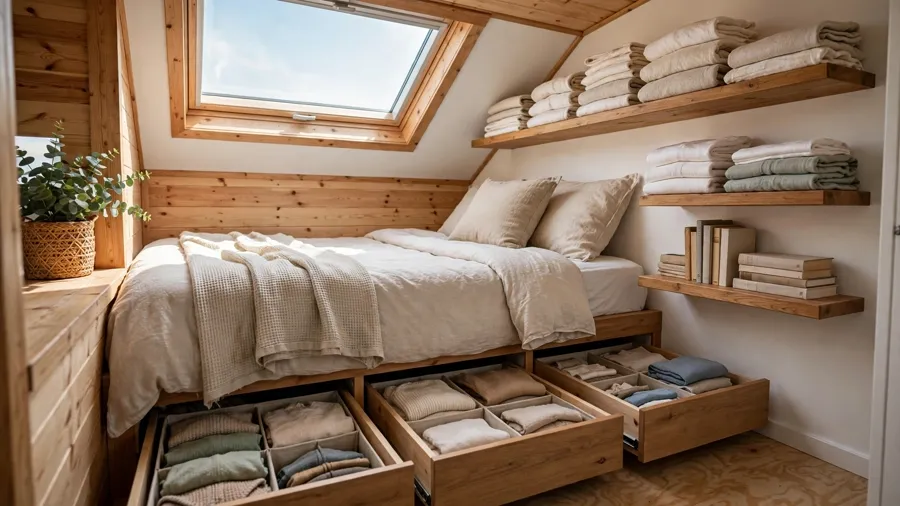
- Storage beds. A bed with a hydraulic lift-up base reveals a cavern of storage underneath — easily the volume of two full dressers. If a lift base is out of budget, a platform bed with deep rolling bins on casters underneath works nearly as well and costs far less.
- Bench seating with cubbies. A window bench with open cubbies underneath handles shoes, pet supplies, and tote bags in the entry zone, and it doubles as extra seating when friends visit.
- Nesting and folding tables. A drop-leaf table mounted to the wall folds flat when it is not mealtime, freeing the center of the house for living. Nested side tables tuck away and pull out only when guests arrive.
- Storage ottomans. They hide throws, board games, and remote controls while giving you a footrest and an extra seat.
- Murphy and fold-down beds. In homes where the sleeping area shares space with the living area, a wall bed that folds away during the day returns a full room of floor space for work and play.
When shopping for double-duty furniture, favor pieces with doors or drawers over open bins — closed fronts keep things looking calm with almost no maintenance.
Go Up: Wall, Door, and Ceiling Storage in a Tiny Home
When floor space is spoken for, the walls are your biggest untapped asset. Tiny-house veterans treat vertical surfaces the way suburban homeowners treat spare closets — as prime storage they are lucky to have.
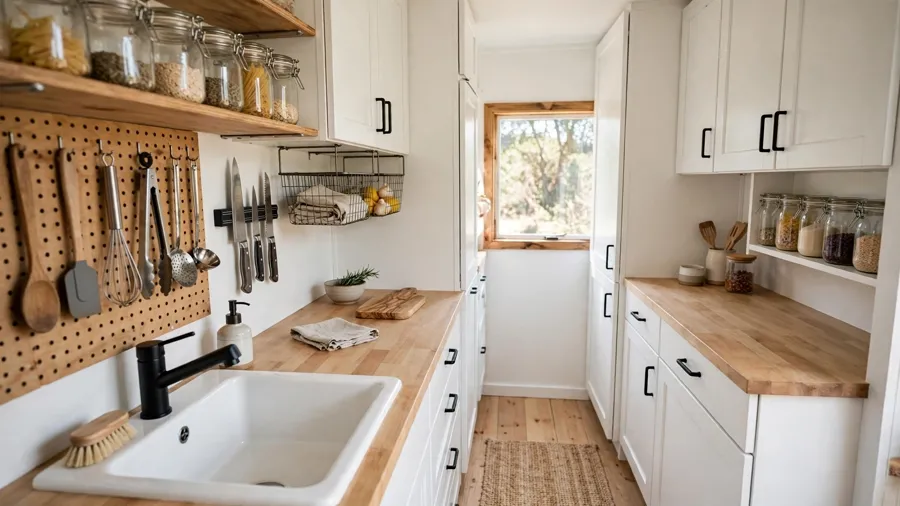
Floating shelves above doorways and windows turn dead air into display and storage space for books, plants, and pretty containers. A pegboard in the galley kitchen — inspired by Julia Child’s famous setup — keeps utensils, pans, and measuring cups visible and within arm’s reach without swallowing a single drawer. Magnetic strips on a metal backsplash hold knives and spice tins; over-the-door organizers on the bathroom door corral toiletries and cleaning supplies.
Ceilings deserve respect too. Shallow overhead lofts above the kitchen or bathroom swallow seasonal items, camping gear, and luggage — one tiny-home owner stores holiday decorations, guest bedding, and canning jars in a loft above her bathroom, a zone most people never think to claim.
If you are building or renovating, ask about toe-kick drawers under your base cabinets. That hidden strip along the floor of a kitchen cabinet is perfect for flat items like baking sheets and serving trays.
Squeeze Storage From a Tiny Kitchen Cabinet System
The kitchen is where tiny living either works or falls apart, because kitchen items are heavy, numerous, and used daily. The good news is that a tiny kitchen responds beautifully to a few well-chosen upgrades.
Start inside the cabinets. Stackable shelf risers double every shelf into two usable layers, instantly ending the era of digging to the back of a dark cabinet for a mixing bowl. Narrow pull-out organizers turn blind corners into accessible storage. Under-shelf hanging baskets clip onto existing shelves and create a new level for mugs, packets, and small produce. If your counters are as short as most tiny kitchens’, you already know how valuable these little small appliance storage and cabinet solutions can be — the same techniques that make a tiny kitchen function also tame cluttered full-size ones.
Next, look at what does not need a cabinet at all. A wall-mounted rail with S-hooks holds pots and pans above the counter. Inside cabinet doors, adhesive hooks and slim racks store measuring spoons, pot lids, and cutting boards flat against surfaces that were doing nothing before. The garbage and recycling question also needs a plan: most tiny kitchens use a tilt-out bin built into a base cabinet or a slim pull-out that keeps smells contained and floors clear.
Finally, be honest about what the kitchen can reasonably hold. Lena keeps a small set of everyday dishes, one pot, one pan, and her favorite knife inside the house, and her rarely used stand mixer and turkey roaster live in an outdoor storage box under the deck. Seasonal rotation is not cheating — it is strategy.
Claim the Nooks Only Tiny Houses Have
Tiny homes are full of odd pockets of space that do not exist in conventional houses: the cavity behind a built-in bench, the inches beside the shower stall, the triangle under the eaves of the loft. The owners who stay organized longest are the ones who go on a treasure hunt for these spots and assign each one a job.
A few favorites worth stealing:
- The wall beside the front door fits a slim coat and shoe cabinet barely eight inches deep — enough for jackets, keys, and daily shoes.
- The gap between the refrigerator and the wall swallows a rolling pantry cart that slides out like a secret drawer.
- The underside of the loft stairs holds a broom closet for a mop, vacuum, and ironing board.
- Cushions on the window seat lift to reveal bins for seasonal clothes or hobby supplies.
- A shallow tray mounted under the dining table holds charging cables, scissors, and the remotes that vanish in every household.
Sketch your floor plan on paper and mark every space deeper than six inches that currently has no purpose. You will be surprised how many there are. Then give each spot one category of items — never “miscellaneous,” because miscellaneous is where clutter breeds.
Tiny House Storage Ideas for Seasonal and Outdoor Gear
Some things simply do not belong inside a tiny home, no matter how clever your drawers are. Camping gear, holiday decorations, sports equipment, and tools all deserve a home that is weatherproof but separate. Most tiny-house owners solve this with an exterior storage box or shed built under the deck or beside the stairs — essentially a garage the size of a closet. Keep these exterior spots for tiny house storage ideas that handle the bulky seasonal cycle: vacuum-sealed bags compress winter bedding and coats to a fraction of their size, labeled totes keep holiday items findable, and a wall-mounted bike rack on the exterior wall keeps wheels off the ground and out of the way.
If your tiny home is on wheels, weight matters as much as space. Store heavy items — tools, canned goods, the cast-iron skillet collection — low and near the trailer axles for safe towing, and reserve the loft for light, soft things like bedding and towels. This is one storage rule that is genuinely about safety, not just tidiness.
For the seasonal wardrobe shuffle, a simple two-bin system works: one bin for the current season lives in the loft or under the bed, the other for the off-season lives in exterior storage. Swap them twice a year. Your closets stay lean, your drawers stay functional, and you never have to excavate a swimsuit from under a winter coat again.
Keep It Calm: The Habits That Protect Your Storage
Here is the part nobody likes to hear: the cleverest storage system in the world cannot survive a steady inflow of new stuff. Every tiny-house owner I interviewed for this article said the same thing in different words — the system works because the inventory stays small, not because the cabinets are magic. The studio apartment dwellers who make the smallest spaces work hard know this too: discipline is the real storage hack.
The habit that works best is a simple one-in-one-out rule. A new book comes in, an old one goes to the donation box. A new sweater arrives, a worn one leaves. In a tiny home this rule is not aspirational — it is enforced by physics, because there is simply nowhere for the extra item to hide.
Schedule a quarterly reset, too. Twice a year is the minimum, but a quick hour each season keeps things honest: pull out the under-bed bins, check the stair drawers, and ask whether everything in there earned its square footage. Homes this small reward regular attention, and an hour of maintenance beats a weekend of chaos every time.
If your small space happens to be a tiny bathroom as well as a tiny house, the same discipline applies to toiletries — the small bathroom storage approach of keeping only what you actually use each week works just as well in a tiny home. And when your sleeping area needs its own system, borrow ideas from small bedroom storage guides: the loft is a bedroom, after all, just one with a shorter ceiling.
Tiny house living is not about owning less for the sake of owning less. It is about owning exactly what fits the life you want, in a home where every drawer, hook, and shelf has been chosen on purpose. Start with the stairs, double up your furniture, claim the walls, and give the seasonal stuff an outdoor address. Your tiny home will thank you with something no amount of square footage can buy: the feeling that everything is right where it belongs.