
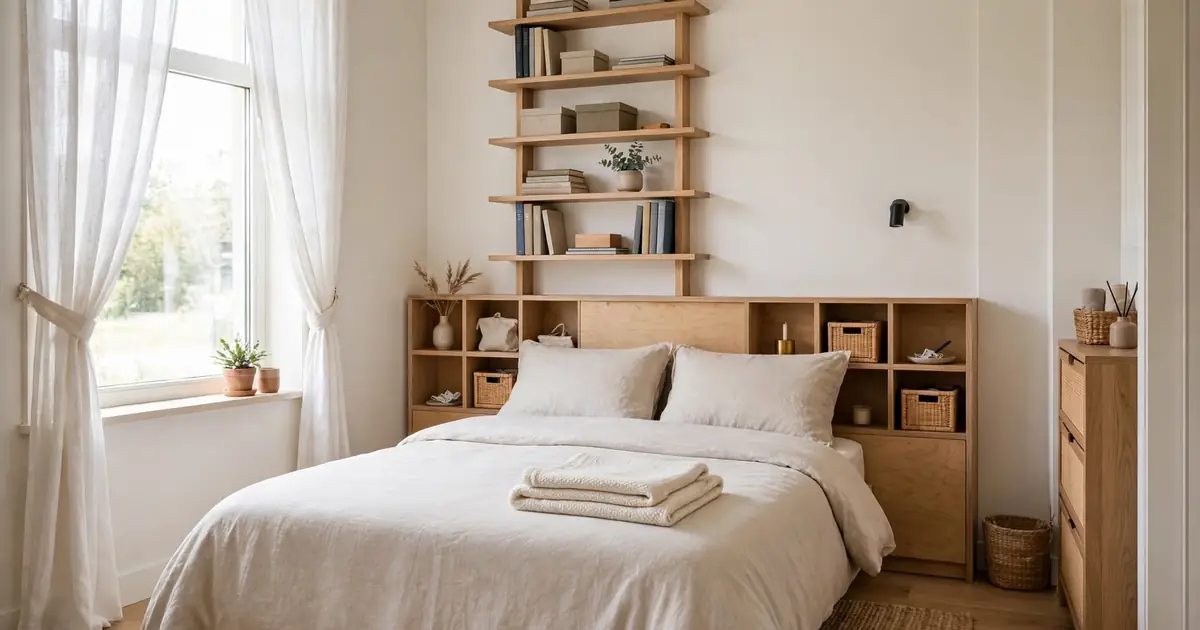

My first apartment bedroom was a rectangle I could almost touch both walls of if I stretched my arms out. The door opened inward and nearly smacked the foot of the bed, so I learned to sidestep it like a dance move. Everything I owned lived in that one room — clothes, books, a guitar I barely played, and the infamous chair that had quietly become a second closet. If that sounds familiar, you are exactly who these small bedroom storage ideas are for. They come from years of living in rooms where every inch had to work, plus a lot of trial, error, and one disastrous “organization” attempt involving tension rods that is still a sore subject.
The thing nobody tells you about small bedrooms is that they don’t need less stuff so much as they need smarter decisions. A tiny room punishes clutter, yes, but it rewards creativity. Every strategy below has survived contact with a real bedroom — mine, friends’, and a few rental rooms that looked impossible until they weren’t.
Small Bedroom Storage Ideas That Start at the Walls
When floor space runs out, the only direction left is up, and most people barely use it. I once measured the wall above a friend’s bed and found nearly eight feet of completely empty vertical space — while her floor was so crowded she had to climb into bed from the foot. The walls were the answer all along.
Floating shelves mounted high — around six to seven feet — are the fastest win in a small room. They hold books, small boxes, and things you grab weekly rather than daily, without stealing a single square inch of floor. I keep mine deliberately sparse: a row of books, one small plant, a basket for the odds and ends. The trick is restraint. A few neatly arranged items look intentional; a crowded shelf reads as clutter even though you technically “stored” everything.
Three wall-based moves have saved more small bedrooms than anything else:
- Over-door hooks and organizers: The back of your bedroom door is free real estate. A fabric over-door organizer holds scarves, belts, handbags, or even rolled T-shirts. I once reclaimed an entire dresser drawer this way in a studio apartment — the organizer cost less than a takeaway dinner.
- High perimeter shelving: One long shelf running around the room at ceiling height is perfect for things you use seasonally — the heavy winter duvet in summer, the box of Christmas decorations, the suitcase. It’s out of your daily sightline but still inside your room.
- Pegboards and wall grids: A pegboard beside your desk or dresser turns vertical dead space into a customizable organizer for jewelry, headphones, stationery, and small bags. It looks good and changes with your needs.
If you rent, none of this has to mean drilling holes. Command-strip shelves, tension-rod nooks, and removable adhesive hooks are genuinely strong these days — my renter-friendly shelves have survived two moves and three landlords. Speaking of renting, everything on this list was chosen with lease agreements in mind: no permanent damage required.
Under the Bed: Small Bedroom Storage Ideas That Hide in Plain Sight
The space under your bed is the largest storage zone in a small bedroom, and most people treat it like a graveyard for dust and forgotten gym bags. A standard bed frame hides somewhere between seven and fourteen inches of clearance — that’s a whole dresser’s worth of volume sitting under your mattress, doing nothing.
My own under-bed system has gone through three evolutions. First: chaos — bags shoved under there like a crime scene. Second: open bins, which looked tidy for exactly one day and then collected dust and visible clutter. Third, the one that stuck: shallow lidded bins on two sides only, so I can reach everything without crawling. One side holds off-season clothes in vacuum bags (winter coats in July, linen dresses in January), the other holds extra bedding and the guest pillow. Everything has a lid, because open storage under a bed just looks like more mess from the doorway.
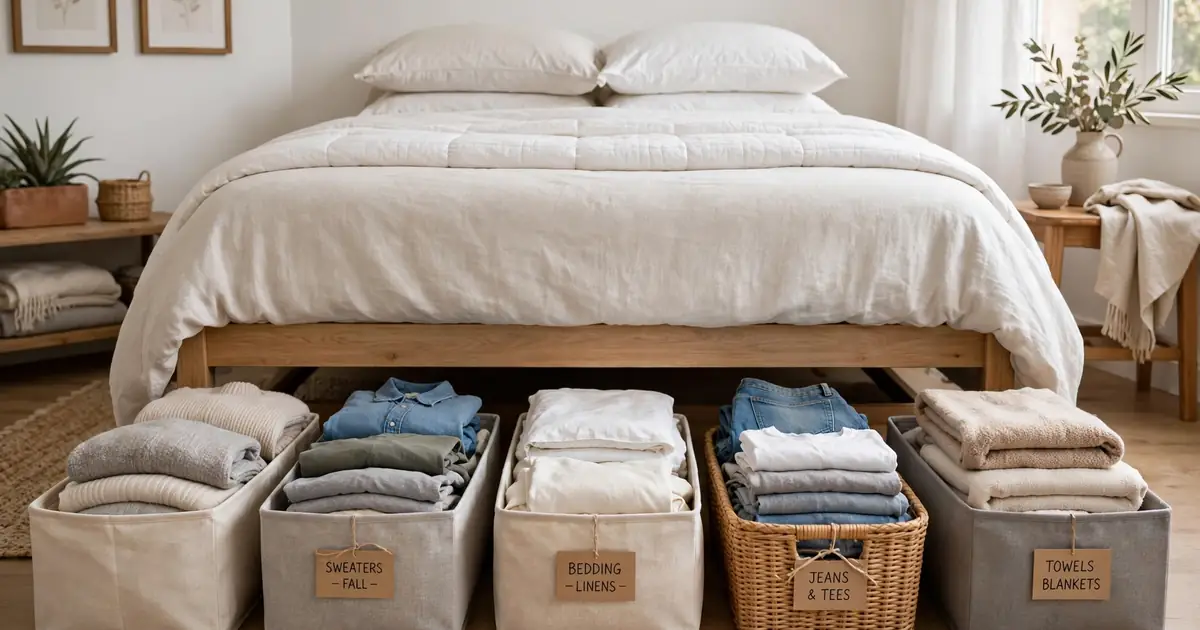
A few things worth knowing before you buy bins:
- Measure the clearance first. Most rolling bins are built around six inches tall, and a half-inch overshoot means the bin never slides under. Measure before you order — I have the scar tissue from this mistake.
- Bed risers buy you real inches. If your frame sits low, sturdy risers can add three to five inches of clearance. They made my old dorm-room bed dramatically more useful.
- Zipped fabric cases work for low beds. When there isn’t room for rigid bins, flat zippered storage bags for blankets and linens slide under beds with only a few inches of space.
Under-bed storage deserves its own deep dive, honestly — I’ve written a whole separate guide on under-bed storage ideas that covers what to store (and what to never store) down there, bin-by-bin.
Closet Overflow: When Your Wardrobe Won’t Fit
In a lot of small bedrooms, the closet is less a closet and more a cruel joke — a single rod, one shelf, and a door that won’t stay shut if you hang anything heavier than a windbreaker. My college rental had a closet so shallow that shirts on hangers stuck out past the frame — so we learn to cheat.
The highest-impact closet trick is the double rod. One inexpensive tension or drop-down rod hung below your main rod instantly doubles hanging space for shirts, blouses, and anything that doesn’t need full length. In a small closet this single change can feel like adding a second wardrobe. Above the rod, stack labeled boxes on the top shelf — out-of-season items up high, everyday things at eye level.
But the real overflow plan lives outside the closet, because in a truly small bedroom the closet will never hold everything:
- Slim rolling cart as a “satellite dresser”: A narrow three-tier rolling cart tucked into the gap between the bed and the wall holds folded basics — T-shirts, jeans, workout clothes. It rolls out when you need it and vanishes when you don’t.
- Shoes get their own system: Shoes are the sneakiest floor-space thieves in a small bedroom. I use a slim tilted shoe rack behind the door — it holds a week’s worth of shoes in about six inches of depth. If your collection has outgrown the room, my guide on shoe organization for small closets walks through options for collections of every size.
- An over-door mirror with hidden storage: Some slim over-door units combine a full-length mirror with shallow jewelry and accessory shelves inside. Two jobs, one door, zero floor space.
And a small truth I’ve had to learn the hard way: in a tiny bedroom, “overflow” often just means “things I haven’t decided about.” If a pile of clothes has lived on the chair for a month, that’s not a storage problem — that’s an editing problem. The chair is not a closet, no matter how much we wish it were.
Furniture That Earns Its Floor Space
In a small bedroom, every piece of furniture has to pass a ruthless test: if it only does one job, it might be fired. A nightstand that is just a table? Replaced with one that has drawers. A bed that’s just a bed? A platform bed with drawers or a hydraulic-lift storage bed quietly doubles as the room’s biggest cupboard.
My favorite small-bedroom furniture swaps:
- Storage bench at the foot of the bed: It holds spare bedding, doubles as seating when getting dressed, and in a pinch becomes a luggage stand when guests arrive. The one I have now is a flat-top bench with a hinged lid — three jobs, one footprint.
- Headboard with built-in shelves: A headboard with cubbies or a ledge replaces the need for a nightstand entirely. Your book, glasses, phone, and a glass of water all live right there, and the floor on both sides of the bed stays clear. In a room where the door barely opens, that saved square footage matters.
- Ottoman with hidden storage: A storage ottoman does triple duty as a seat, a footrest, and a bin for blankets or the laundry that used to live on the chair.
- Fold-down desk for work-from-bedroom people: If your bedroom doubles as an office, a wall-mounted fold-down desk disappears when work ends — and mentally, the room becomes a bedroom again. I’ve written more about small home office storage ideas that actually work for exactly this kind of shared space.
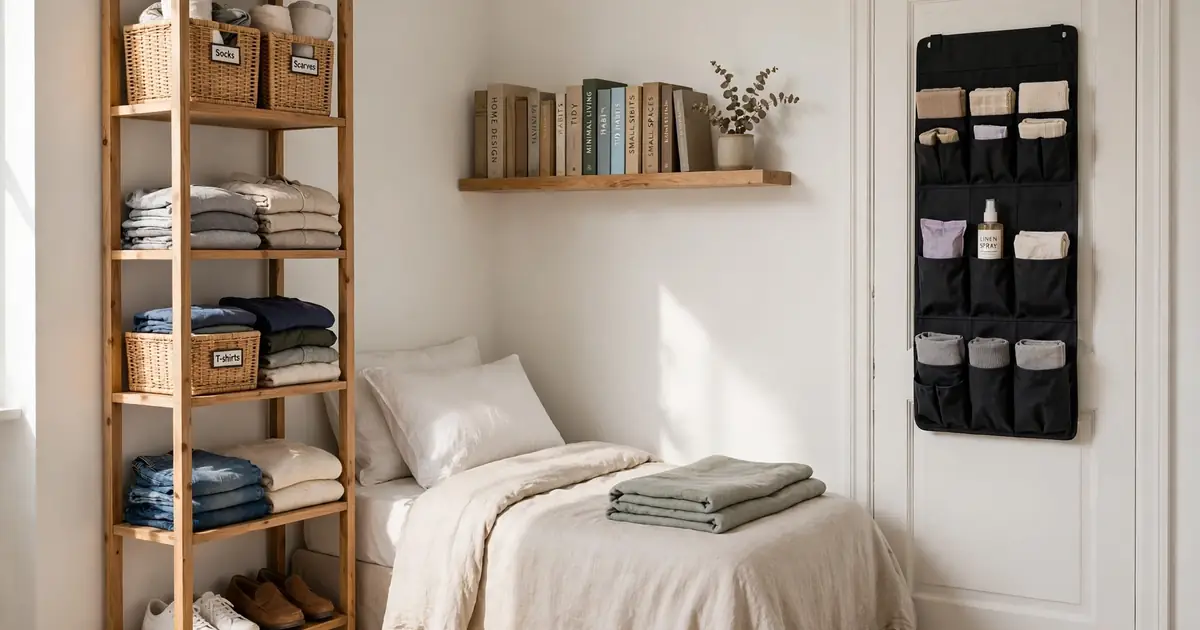
The loft bed deserves an honorable mention, too. In rooms with decent ceiling height, raising the bed creates an entire second zone underneath — desk, dresser, or a cozy reading nook in the footprint of the mattress. It won’t suit everyone, but in a kids’ room and studio apartments it can be one of the most transformative moves you can make.
Rethink the Nightstand and the Layout
Here’s the thing about tiny bedroom layouts: the standard arrangement — bed centered, nightstands on both sides — assumes a room size you probably don’t have. In my first apartment, there was room for exactly one nightstand, and even that had to be a wall-mounted shelf because a table would have blocked the closet door. Letting go of the “matching nightstand” idea was oddly freeing.
Nightstand alternatives that actually work in tight spaces:
- A wall-mounted shelf beside the bed — takes up zero floor space and holds everything a table would.
- A narrow stool or a tall plant stand — narrower than any proper nightstand, but still gives you a landing spot for the phone and the novel.
- A clip-on bedside caddy — slides under the mattress edge and holds glasses, chargers, and a book. Not glamorous, but in a room where every inch counts, it’s brilliant.
A few layout rules that have saved my small bedrooms more than once. Leave the path clear. You need one uninterrupted walking lane from the door to the bed — if you’re shuffling sideways past furniture, something is in the wrong place. Keep the center of the room open, even if it means pushing furniture harder against the walls than feels natural; a small patch of visible floor makes the whole room feel twice its size. And face the bed’s long side to the door if you can — walking in and seeing the made bed rather than its side makes the room feel intentional instead of cramped.
Light matters enormously in small rooms. A dark corner reads as smaller than it is, so a small lamp or wall sconce in the dimmest corner can visually “open” the room. Mirrors do the same work: one large mirror opposite a window bounces daylight around and tricks the eye into seeing more space. These aren’t storage tricks, exactly — but a room that feels bigger is easier to keep organized, because you stop cramming things into it in a panic.
I’ll be honest about the emotional side, too. Small bedrooms test your relationship with your stuff in a way big rooms never do. There were months when I felt like my room was winning — piles migrating, surfaces filling up, that chair slowly re-becoming a closet. What finally turned it around wasn’t a new product. It was a ten-minute Sunday reset: everything back to its home, surfaces cleared, floor visible. Small rooms forgive clutter if you reset them regularly; they only rebel when you give up. For keeping that habit alive, my piece on how to maintain a clutter-free home has the realistic routines that actually stuck for me.
Start with one change this weekend — the under-bed bins, the double rod, the shelf above the door. You don’t need all of these ideas. You need the three or four that fit your room, your lease, and your life. And if your bedroom has a chair slowly turning into a second closet? You and I both know exactly where to begin.
[…] to the thickness of a textbook. Similar small-bedroom logic applies everywhere — our guide to small bedroom storage ideas that really work covers the same “keep less, store smarter” mindset for tiny rooms of any […]
[…] the location is wrong. And if you’re working with a very small room, take inspiration from small bedroom storage ideas — vertical solutions like wall shelves pull double duty by freeing floor space […]
[…] desks and antique tables — don’t worry. The same system works; your “drawers” will just be small storage solutions that live underneath or beside the table instead of inside […]
[…] storage without losing floor space. If your nursery shares a room with something else, our guide to small bedroom storage ideas that really work shows how to carve storage out of rooms that serve two purposes at […]