


When I first heard the phrase simple living on a budget, I pictured a life stripped down to the bare minimum: no takeaways, no treats, no fun. It sounded like a punishment dressed up as a philosophy. Then my own bank balance forced the experiment, and I discovered something nobody had told me: living simply on less money is not about giving everything up. It is about choosing carefully, so the money you do spend actually buys you the life you want.
That shift changed everything. Instead of a long list of things I was no longer allowed to enjoy, I built a quieter, calmer daily life that happened to cost less. My home felt tidier, my weeks felt less frantic, and my savings account slowly started to grow. If you want the same — a home and a routine that feel good without draining your wallet — this guide will show you how, one practical step at a time.
Simple Living on a Budget Starts With What You Value
Most budgets fail for the same reason most diets fail: they start with restriction instead of direction. Before you cut a single expense, sit down with a cup of tea and answer one honest question: what actually makes your life feel good? For most of us, the answer is surprisingly short. A comfortable home, good food, time with people we love, a little rest, and maybe one hobby that genuinely lights us up.
Write those things down. They are your protected list — the spending you keep on purpose, without guilt. Everything else becomes a candidate for a swap, a cut, or a pause. This is the heart of simple living on a budget: you are not spending less on everything, you are spending almost nothing on the things you barely notice, so there is room for the things you truly enjoy.
Try this simple exercise this week. Look at last month’s bank statement and highlight every expense that made you think, “Yes, that was worth it.” Then circle the ones you had completely forgotten about. The forgotten ones — the duplicate streaming service, the snack runs, the subscription you meant to cancel — are your easiest wins. Cancelling them does not feel like deprivation, because you were not enjoying them in the first place.
It also helps to give yourself a small, guilt-free allowance every week or month. Call it fun money, pocket money, whatever you like. When it is gone, it is gone — but while you have it, you can spend it on anything without tracking or justifying it.
The Swap Mindset: Change How, Not Whether, You Enjoy Things
The most sustainable way to spend less is to swap, not stop. You keep the pleasure and change the price tag. A coffee at home on weekdays with one proper café coffee at the weekend tastes better than a daily takeaway coffee you barely notice. A film night at home with popcorn, blankets, and friends can be more memorable than an expensive night out, and it costs a fraction of the price.
Here are swaps that real households use every week:
- Library instead of bookshop: borrow books, audiobooks, and films for free, including e-books you can download at home.
- Home cooking instead of takeaway: cook the meals you would normally order, and save takeaway for the nights you truly cannot face the kitchen.
- Secondhand instead of new: check charity shops, resale sites, and local swap groups for clothes, furniture, and children’s gear first.
- Hosting instead of going out: invite friends for a simple supper or a walk, rather than meeting at a pricey restaurant.
- Free fun instead of paid fun: parks, trails, community events, and game nights at home cost little and often feel better.
The trick is to make the cheaper option the default, not a daily battle of willpower. Keep your library card in your wallet. Keep a few go-to recipes you actually look forward to cooking. When the easy choice is also the cheap choice, you stop feeling like you are missing out. If you want a bigger reset, a no-buy month can be a surprisingly gentle way to discover which purchases you never missed at all.
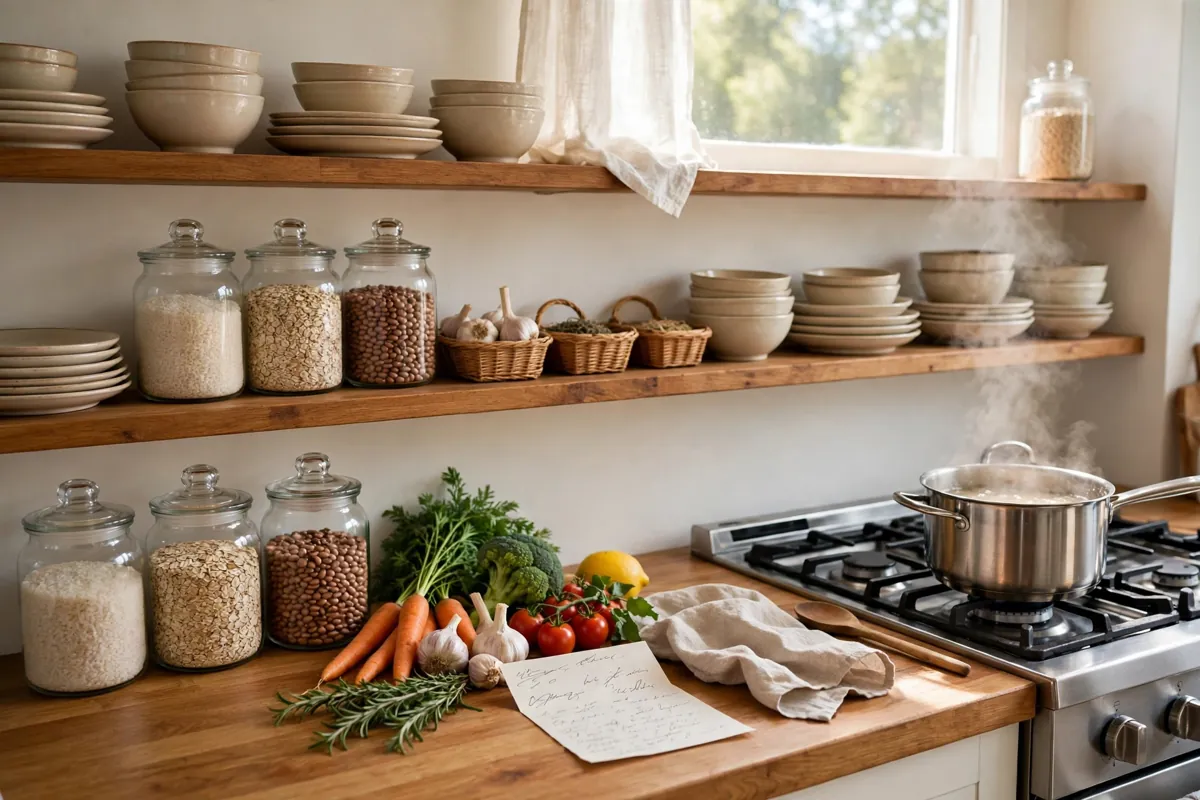
A Calmer Kitchen That Costs Less
The kitchen is where simple living and saving money meet most naturally. A calm, organised kitchen makes cooking at home easy, and cooking at home is one of the biggest single savings most households can make. You do not need fancy equipment or a pantry worthy of a magazine. You need a short list of meals you like, a stocked shelf of basics, and a plan that survives a busy week.
Start with five to seven meals your household genuinely enjoys and can cook without a recipe hunt. Rotate them across the month. In practice it is a relief: fewer decisions, fewer impulse buys, and less food quietly going off in the fridge. Add one new recipe a month if you like variety, and drop anything nobody asks for again.
Then build the habit of cooking from what you already have. Before you write a shopping list, check the cupboards, the fridge, and the freezer. Half-used jars, a bag of lentils, a tin of tomatoes — these are meals waiting to happen. A weekly “use it up” night, where dinner comes entirely from leftovers and pantry odds and ends, can save a surprising amount over a year and stops good food from being wasted.
A few more kitchen habits that quietly protect your budget:
- Buy staples like rice, oats, beans, and flour in larger quantities when they are on offer, and store them properly.
- Stretch meat with beans, lentils, or extra vegetables — the meal stays filling and costs far less.
- Batch-cook soups, stews, and casseroles, and freeze portions for the nights when takeaway usually wins.
- Shop with a list and stick to it, especially when you are hungry or in a hurry.
- Wait 48 hours before buying any kitchen gadget — most of them gather dust while a good knife and one solid pan do the real work.
None of this requires perfection. If takeaway happens on a hard Friday, enjoy it and move on.
A Capsule Wardrobe and a Lighter Closet
Clothing is another quiet drain on the budget, and a simpler closet is the fix that pays you back twice: less money spent, and less time lost deciding what to wear. A capsule wardrobe — a small collection of versatile pieces that all work together — removes the morning decision fatigue and stops the cycle of buying something new because nothing in a full wardrobe seems to go together.
Start by pulling out the pieces you actually reach for week after week. These are your core. Then notice the gaps: usually one good pair of jeans, a warm coat, and shoes you can walk in cover most of life. Buy quality over quantity for those core pieces, because one well-made coat that lasts five winters is cheaper than three cheap ones that fall apart. For everything else, secondhand is your friend — charity shops and resale apps are full of barely worn clothes at a fraction of retail.
The same principle applies to the rest of the house. Before buying anything new, ask whether you already own something that does the job, whether you can borrow it, or whether a friend or neighbour has one gathering dust. This is where a one-in-one-out rule earns its keep: every new item in means one old item out, which keeps both your home and your spending in check. And if you sell what you no longer use, you turn clutter into a small windfall — a tidy home that pays for its own treats.
Mending matters too. A button sewn back on, a seam repaired, a favourite jumper darned — these tiny fixes cost almost nothing and can add years to a garment’s life.
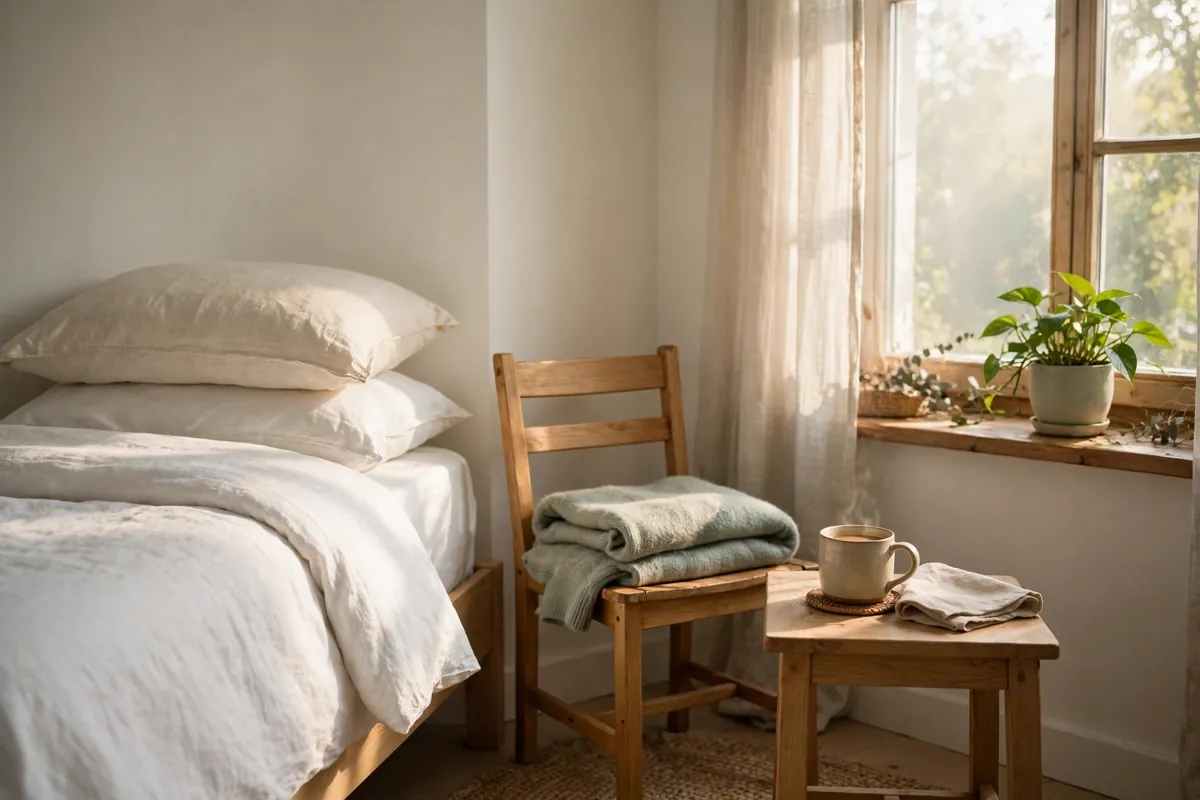
Low-Cost Daily Routines That Keep a Simple Home Running
Simple living is not a single big decision; it is a handful of small routines repeated until they feel like nothing at all. The routines below cost almost nothing, yet they are the ones that keep a home calm and a budget steady.
First, a ten-minute evening reset. Before bed, walk through the main rooms, put things back where they belong, and set up tomorrow: bags by the door, lunchboxes ready, keys in their spot. A home that starts the day tidy is a home that does not send you out the door stressed and reaching for expensive convenience fixes.
Second, a weekly money check-in that takes five minutes, not an hour of anxiety. Glance at your spending, move a small amount to savings right after payday if you can, and note anything surprising. Automating that transfer is even better — money you never see is money you never miss, and it quietly builds a cushion for the unexpected.
Third, a regular “use it up” sweep of one area at a time: the bathroom cabinet, the craft box, the freezer. Most households discover weeks’ worth of supplies they assumed they needed to buy. And fourth, a screen-time boundary. Less scrolling means less exposure to adverts and influencer hauls telling you that you need things you were perfectly happy without yesterday.
These habits overlap beautifully with the gentle routines in our guide to simple living habits that keep a minimalist home effortless, and with the slower rhythms described in our slow living habits for a calmer home. You do not need to adopt them all at once. Pick two, live with them for a fortnight, and add another only when the first two feel automatic.
When Money Is Tight, Protect the Joy First
There will be months when the budget is genuinely tight — an unexpected bill, a quiet spell at work, a car repair that eats the savings. In those months, simple living on a budget is not a lifestyle project; it is a lifeline. And the rule stays the same: protect the joy first, then trim around it.
Keep the Saturday morning walk with a friend. Keep the family film night. Keep the one small ritual that makes your week feel like yours, even if it costs a little. Cut the background spending instead: the subscriptions nobody watches, the brand-name staples where the store brand tastes the same, the delivery fees you can dodge by collecting. A life that still contains pleasure is a life you can sustain; a life stripped of every pleasure is a plan that collapses within weeks.
It also helps to lower the temperature of your home’s running costs without making it uncomfortable. A degree or two lower on the thermostat with a warm jumper, washing clothes in cold water, air-drying the heavier items like towels and jeans — none of these feel like hardship, but together they trim the bills month after month.
Finally, remember that borrowing and sharing are part of simple living, not a failure of it. Tool libraries, neighbours who lend a ladder, friends who swap children’s clothes — these are how communities have always lived well on less. Asking for help, and offering it back, builds the kind of wealth no bank balance measures.
Simple living on a budget is not about becoming a different person. It is about noticing what already makes your life good, and quietly removing the expensive noise around it. Swap instead of stopping. Cook the food you love at home. Wear the clothes you actually reach for. Keep the rituals that matter and let the rest go.
Start small this week: pick one swap, one protected joy, and one forgotten subscription to cancel. That is enough. Over months, those small choices compound into a calmer home, a steadier budget, and a life that feels like yours again — not smaller, but simpler, warmer, and genuinely easier to afford.