
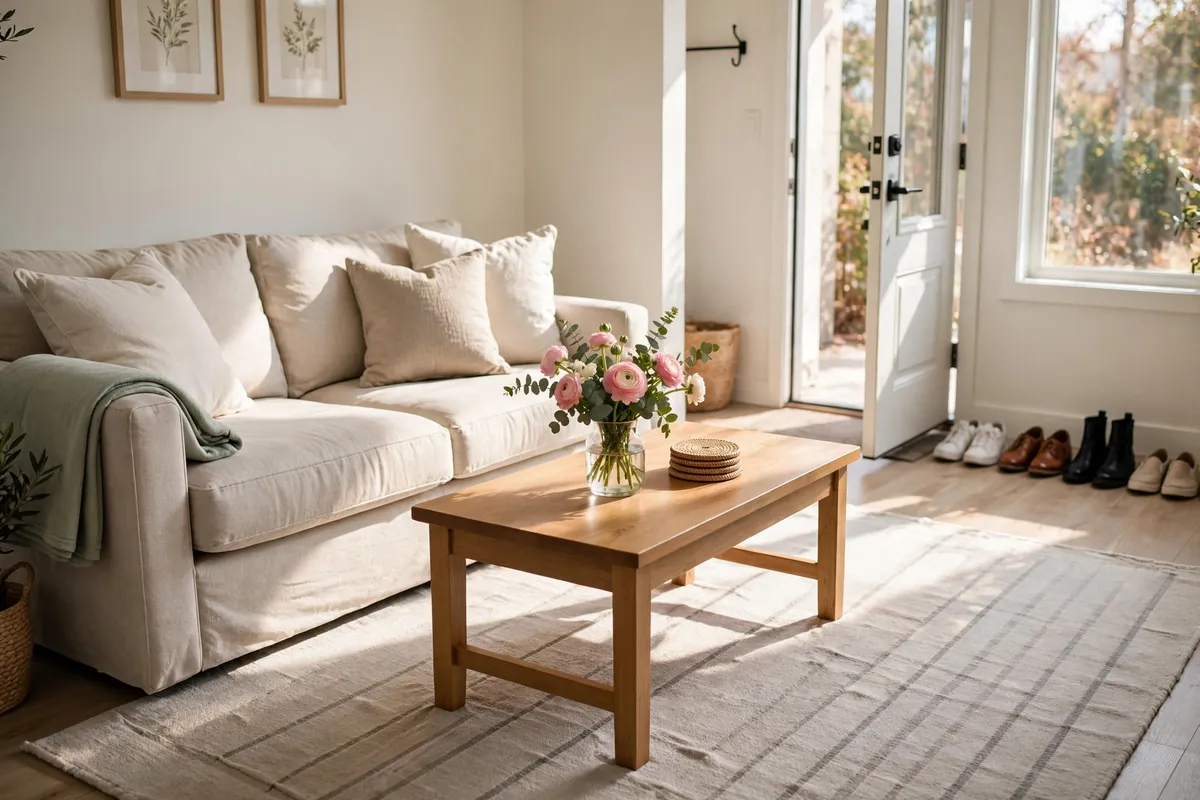

There is a particular kind of letdown that hits around Wednesday. Last weekend you decluttered the kitchen junk drawer, bagged up three boxes for donation, and stood in the hallway feeling like someone who had finally figured it out. By Wednesday the counter is buried again — a permission slip, a cereal box nobody put away, keys in a bowl you do not remember buying. The purge worked. It just did not last. That is exactly the gap simple living habits are built to close.
A minimalist home does not stay calm because its owner is unusually disciplined or owns a label maker. It stays calm because a handful of small daily habits quietly put everything back in its place faster than life can scatter it. Not one-time purges. Not weekend overhauls. Just a few minutes, repeated, until the house starts to feel like it takes care of itself. Below are the habits that actually do that — the small, unglamorous routines that make an effortless minimalist home feel less like a project and more like simply how your house is.
What Simple Living Habits Actually Look Like
When most people hear the phrase simple living habits, they picture someone serenely folding socks or meditating beside an empty room. The real version is far more ordinary, which is why it works. A habit is just a trigger plus a tiny action: the kettle boils, so you wipe the counter while you wait. You walk in the door, so your shoes land by the rack instead of the middle of the floor. No motivation required, no willpower summoned.
It helps to stop thinking of clutter as stuff and start thinking of it as a pile of unmade decisions. Every object without a home demands a tiny decision every time your eyes land on it — where does this go, will I deal with it later, is it trash? A cluttered house is really just a house full of postponed decisions, and researchers at UCLA have even found that people who describe their homes as cluttered show higher levels of the stress hormone cortisol during the day. A good habit removes the decision entirely.
Effortless, in other words, does not mean you never lift a finger. It means the effort is so small and so routine that you barely notice it. The ten habits below look like almost nothing. Together, they keep the whole house in order:
- Make the bed before the kettle boils.
- Clear one key surface every morning.
- Set up a launch pad by the door for tomorrow.
- Run a ten-minute evening reset before bed.
- Touch everything once — never set things down “for now.”
- Give incoming mail a landing zone the moment it arrives.
- Pause 48 hours before any non-essential purchase.
- Keep the one-in-one-out rule running in the background.
- Filter out freebies before they enter the house.
- Never miss twice — always recover the very next day.
The Morning Landing: Two Minutes That Set the Tone
The first ten minutes of your day shape how the whole house feels at 7 p.m. And here is the secret: you do not need a morning routine with twelve steps. You need a morning landing — two minutes of tiny actions done before the coffee finishes brewing.
Mine looks like this. Bed made — not hotel-cornered, just pulled smooth, pillows fluffed. Blinds opened, because daylight makes every room look calmer and bigger. Then one surface: the kitchen counter gets a quick wipe, or the entryway table gets cleared of whatever landed there overnight. That is it. Two minutes, three actions, and the house is already cooperating.
The other half of the morning landing is the launch pad: one spot by the front door where tonight’s keys, wallet, bag, and tomorrow’s lunch bag already wait. When everything you need for leaving the house lives in one place, you stop scattering it across counters and chairs. This is also the habit that quietly rescues the school run. A ten-year-old who puts their backpack on the launch pad the night before is a ten-year-old who is not screaming for lost shoes at 8:12 a.m.
Start ridiculously small if this feels like a lot. One morning habit, done every day for a week, beats five habits abandoned by Thursday. Once the bed-and-counter loop feels automatic, add the launch pad. Layer the habits the way you would layer blankets — one at a time, only adding when the first feels like nothing.
The Evening Reset: Ten Calm Minutes Before Bed
If the morning landing sets the tone, the evening reset keeps it. This is the single highest-leverage habit on the list, and it takes about ten minutes — less time than scrolling through one more batch of videos.
Set a timer, grab a laundry basket, and walk the house in one loop. Kitchen: dishes into the dishwasher, counters wiped, anything perishable put away. Living room: blankets folded over the sofa arm, remotes corralled, stray mugs collected. Entryway: shoes by the rack, bags on hooks. Bathroom: products lined up, towel hung straight. Laundry lands in the hamper instead of the famous chair. Anything that does not belong in the room you are standing in goes in the basket, and the basket gets emptied on the second lap.
What makes the reset work is not speed — it is that it prevents disorder from compounding overnight. Clutter has a way of multiplying while you sleep. A tidy-ish house at midnight becomes a chaotic house by morning only if you let it, because nobody started the night with a baseline. Ten minutes gives you that baseline. If you would like a minute-by-minute version of this walkthrough, try our 10-minute evening reset cleaning routine, which breaks the whole loop into a checklist you can follow until it becomes second nature.
Families make this easier by turning it into a group habit. Put on music, hand everyone a room, and race the timer.
Touch It Once: The Habit That Stops Clutter at the Door
Most clutter is not created by big decisions. It is created by small postponements. You open the mail and set it on the counter “for now.” You take off your coat and drape it on a chair “for now.” The dishes land in the sink “for now.” Every “for now” becomes a pile, and every pile becomes a weekend project.
The one-touch rule ends that cycle: when you pick something up, handle it fully before your hand lets go. Open the mail standing over the recycling bin — junk goes straight in, bills go to one slim action tray, and only genuinely important papers get filed. Take off your coat and it goes on the hook, not the chair. Dishes go from the table directly into the dishwasher, not into the sink to be re-handled later. Packages get broken down the moment they are opened, and the boxes go out that same day.
This is where a landing zone earns its keep. Incoming paper is the fastest-spreading clutter in most homes because it looks harmless and arrives daily. For a deeper system for the paper that does pile up, see our guide to taming mail, bills, and paper piles for good.
Watch your hot spots, too. Every house has one or two: the chair that quietly becomes a closet, the stair landing that collects objects waiting to go upstairs, the end of the counter nearest the front door. Put the one-touch rule on autopilot at those spots first, and make sure each has what the habit needs nearby — a hook, a tray, a bin.
Slow the Inflow: Make Buying Slower Than Bringing Home
Here is the uncomfortable truth about maintaining a minimalist home: no amount of tidying can outrun a fast inflow. If new things enter your house faster than old things leave, you are bailing water with a sieve. The habits that matter most long-term are the ones that slow what comes through the door.
The simplest is the 48-hour pause. Anything non-essential goes on a list instead of in the cart, and you revisit it two days later. Most of the time you will wonder why you wanted it at all. The pause works because desire is loudest in the moment — give it two days of silence and it usually disappears. For bigger purchases, try the replacement question: “Would I buy the one I already own again today?” If the answer is no, you do not need a second one.
Then keep the one-in-one-out rule running quietly in the background. New sweater? An old one leaves. New kitchen gadget? An old one gets donated. This is the mechanism that keeps your home at equilibrium instead of slowly filling up again between purges. Our full breakdown of the rule of one for decluttering duplicates shows exactly how to run it for clothes, kitchen tools, and everything in between.
Finally, filter the free stuff. Conference tote bags, promotional mugs, the fifth water bottle from a school fundraiser — free is not a reason to keep something you would never buy. If you would not spend your own money on it, let it stay at the event. And if spending in general has been creeping up, a structured break can reset your instincts: our no-buy month declutter guide walks you through thirty days of buying only essentials, and most people report that the habit of pausing sticks long after the month ends.
Small Simple Living Habits That Survive Busy Weeks
All of this works beautifully in a calm week. The real test is the week with the flu, the deadline, the houseguests, and the birthday party. This is where most systems die — not because they were bad, but because they demanded perfection. Simple living habits survive busy weeks by being forgiving.
The rule that saves everything else is never miss twice. Miss the evening reset once? Fine, life happened. Miss it twice and you have a new habit called “not resetting.” The recovery is always small: when you are exhausted, run a two-minute version instead of the full ten. Put the dishes in the dishwasher and call it done. Two minutes still protects the baseline; zero minutes lets the pile grow.
Anchor each habit to something you already do. Wipe the bathroom sink after brushing your teeth. Process the mail tray while the kettle boils. Run the reset right after locking the front door for the night. Habits glued to existing routines need almost no reminding — the old habit becomes the alarm clock for the new one.
And when it all falls apart anyway — because sometimes it does — do not restart the whole project. Just pick up the next habit on the list and go. A calm house is not a house that is never messy. It is a house that returns to calm quickly. For the bigger picture on keeping that recovery loop going month after month, our guide on how to maintain a clutter-free home ties these daily habits into a longer-term rhythm.
Start tonight, not next weekend. Set a timer for ten minutes, walk the house once, and wake up tomorrow to a home that feels a little more like the calm place you have been picturing. That feeling is not the reward at the end of some grand organizing project. It is simply what happens when small simple living habits do their quiet work, one day at a time.
[…] isn’t another guide about owning fewer things, though having less certainly helps (our guide to simple living habits for a minimalist home covers that side beautifully). This is about rhythm. The way you move through your rooms, the order […]