


You know the moment. You open the kitchen towel drawer for one clean towel and the whole pile sighs, shifts, and slides toward you like a small, soft landslide. You grab the one on top, the rest tumble, and by the time you have closed the drawer again, it looks exactly the way it did before you ever tried to tidy it. Good kitchen towel organization is not about owning prettier towels or buying a fancy organizer. It is about giving a small, hard-working pile of cloth a system that survives real life: wet hands, rushed weeknight cooking, and laundry day arriving two days late.
Here is the reassuring truth: towels are one of the easiest things in the kitchen to fix, because the problem is almost never the towels themselves. It is the storage method. A flat stack in a deep drawer is designed to fail, since every towel you pull out disturbs the ones underneath it. A drawer crammed with twenty towels when your household only ever uses eight is designed to fail too. Change the method, trim the stash to what you actually use, and the drawer stops fighting you.
This guide walks through the whole fix. You will work out how many towels you really need, learn the fold that keeps them standing in tidy rows, find a hanging spot for the towel in use right now, and set up a two-minute weekly reset. No new furniture required, and most of it costs nothing at all.
Why Your Towel Drawer Always Explodes
It helps to understand what is going wrong before you try to fix it, because most towel chaos comes down to three small, fixable causes. The first is the stack. Flat stacks look tidy for about ten seconds. You always reach for the top towel, the ones below get compressed, and sooner or later someone shoves a fresh towel onto a leaning pile and the whole thing topples sideways. The second cause is sheer quantity. Towels multiply quietly: sale sets, Christmas gifts, holiday novelties, thin ones nobody likes but nobody throws away. A drawer holding thirty towels cannot stay organized, no matter how neatly you fold them.
The third cause is that towels have two very different jobs, and most kitchens store them as if they had one. There is the towel in active use right now, damp from drying hands, which needs air and a hook. And there is the clean supply in the drawer, which needs to be folded and easy to grab. Stuff the damp towel back in with the clean ones and everything comes out smelling faintly musty. Solve these three things, and the drawer avalanche stops.
Step One: Cut the Stash Before You Organize It
Before you buy a single bin or learn a single fold, empty the towel drawer completely and take stock. Lay every kitchen towel you own on the bed or the dining table, including the ones draped over the oven handle, hanging on the fridge, and hiding in the laundry basket. Most people are surprised: twenty-five or thirty is common in a household that rotates through eight or ten.
Now sort them honestly into three piles:
- Keep and use daily: absorbent towels in good shape that you genuinely reach for — your working stash.
- Keep for messy jobs: older or stained towels still useful for spills, muddy boots, or the car. Store these outside the kitchen drawer so they never creep back in.
- Let go: thin, threadbare, scratchy, or permanently smelly towels, plus duplicates you never liked. Cut the worst into rags or recycle them; donate any still decent.
How many should stay in the kitchen? For most households, eight to twelve is the sweet spot: ten to twelve for a couple who cooks most nights and does laundry weekly, six to eight if the washing machine runs every few days, twelve to fourteen for a large family. The test is simple: if the drawer closes easily with room to spare, the number is right. If you have to press the pile down to shut it, you still own too many.
While you are at it, give the empty drawer a quick wipe. A clean drawer makes the fresh start feel real. If your drawers in general are a war zone, the same declutter-first approach works there too, and our guide to kitchen drawer organization ideas that end the junk drawer chaos walks through the full drawer-by-drawer method.
Kitchen Towel Organization That Holds: The File Fold
Here is the single change that makes the biggest difference: stop stacking towels flat and start filing them upright, like books on a shelf. You can see every towel at a glance, pull out the exact one you want without disturbing its neighbors, and the drawer looks as neat after a week as it did on folding day. It works in a drawer, a basket, or a deep bin, and takes about thirty seconds to learn.
To file-fold a standard kitchen towel, lay it flat on the counter and smooth out the wrinkles. Fold it in half lengthwise so it becomes a long, narrow rectangle. Then fold that rectangle in half across the middle, and once more into thirds, until you have a small, firm rectangle that stands on its edge. If it will not stand on its own, fold it once more, a little tighter. That stand test is the whole secret: a towel that stands stays put.
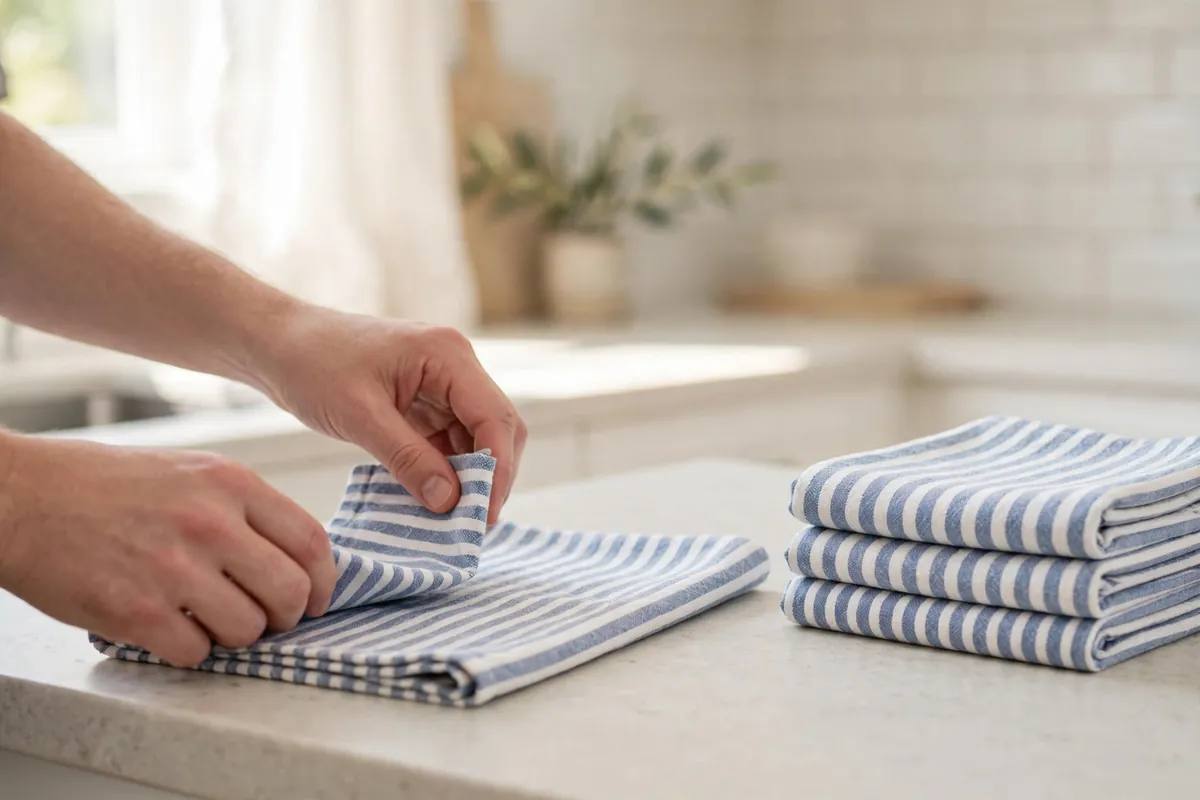
Once every towel is folded the same way, stand them in the drawer in rows with the folded edge facing up. Everyday towels go at the front, dish-drying towels together, hand towels together, and the two or three prettiest guest towels at the back where they stay clean. If the rows slide when you open and close the drawer, a small divider, a shallow box, or even a cut-down cereal box will hold them upright. You do not need matching organizers; you need something that stops sideways drift.
For very shallow drawers, a flat fold works better. Fold the towel into thirds lengthwise, then in half widthwise into a compact rectangle, and stack these in neat rows. The stack stays stable because every towel is the same size and shape, and with the stash trimmed, it never grows tall enough to topple. Whichever fold you choose, consistency is what keeps it tidy: towels folded five different ways will never sit neatly together, so pick one method and fold them all the same way.
Give Every Active Towel a Hanging Home
The file fold fixes the clean supply, but not the towel you are using right now — the one that usually ends up draped over a chair, balled up on the counter, or stuffed damp into the drawer. Give active towels their own hanging spots, separate from storage, and make those spots so convenient that using them is easier than not using them.
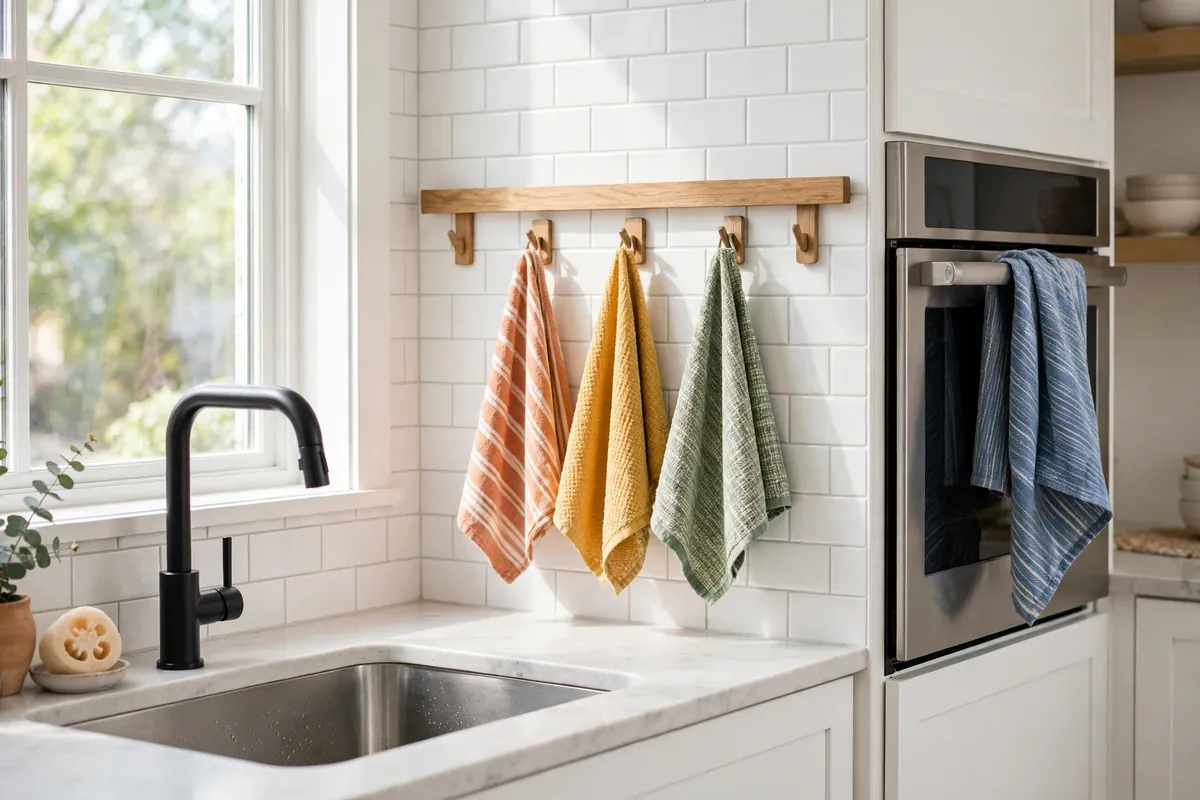
The oven handle is the classic for a reason: it is right where you cook, and the oven’s warmth helps a damp towel dry between uses. Swap it for a fresh one as soon as it gets properly damp. A towel ring or small bar beside the sink is ideal for a hand towel, keeping it separate from the dish towels so nobody dries their hands on the one you just wiped the counter with.
Short on wall space? Put a pair of adhesive hooks inside the cabinet door nearest the sink, or on the under-sink door itself — a hidden hanging spot that costs almost nothing and needs no drilling. If the area under your sink is itself a jumble, our under-sink kitchen organization ideas will help you sort that space out first so the hooks have a clean door to stick to.
One rule matters more than any hanging gadget: damp towels need air. A towel folded over a hook in a tight bunch, pressed flat against a cabinet wall, or piled on top of another damp towel will start to smell within hours, no matter how often you wash it. Hang towels so air reaches both sides, leave a gap between neighbors on a bar, and never put a damp towel back with the clean ones. If a towel smells sour even after washing, run a hot wash with half a cup of white vinegar and skip fabric softener, which coats fibers and traps odor.
Kitchen Towel Organization for Tiny Kitchens
Not every kitchen has a spare drawer for towels. Small kitchens just need a different home for the stash, and some of the best solutions do not use a drawer at all. A basket on the counter or an open shelf holds four to six rolled towels beautifully: you can pull one out without disturbing the rest, and the rolls look cheerful and intentional. Keep the count small, though. Two or three towels on display is practical; ten on the counter is a pile that happens to be in a basket.
Open shelving turns folded towels into part of the kitchen’s look: a neat stack in one color family, or a row of file-folded towels, reads as styling rather than storage. A slim rolling cart fits the gap between fridge and wall and tucks away when guests arrive. And a magazine file holder tipped on its side inside a deep cabinet makes a surprisingly good vertical organizer: rolled towels slide in one by one, and you grab the top one without touching the rest.
Towel storage rarely fails on its own. Towels often share a drawer with pot lids or gadgets, and every extra category in that drawer makes them harder to keep neat. Moving lids to their own spot, for example with the methods in our guide to pot and lid storage ideas that actually work in real kitchens, can free up an entire drawer. The same goes for cabinets: if your towel drawer is overflowing because a cabinet is holding things that belong elsewhere, our kitchen cabinet organization ideas will help you rebalance the whole room so towels end up with a proper home of their own.
The Two-Minute Weekly Reset That Keeps It Working
Even the best system drifts, so build in a reset so small you will actually do it. Once a week, as you put clean laundry away, take thirty seconds to straighten the rows: push leaning towels upright, pull the front row forward, and move any damp or stray towel to its hook or the laundry basket. That is the whole job most weeks.
Once a month, do a slightly deeper pass. Move any towel gone thin, stained, or scratchy to the messy-jobs pile, and check the hanging spots: adhesive hooks lose grip over time in steamy kitchens, so replace any peeling ones before a towel ends up on the floor. If the drawer has crept full again, be ruthless. One in, one out keeps the count honest.
Laundry habits matter too. Wash towels every couple of days if they wipe surfaces or dry dishes, and every three to four days for hand-drying only. Use warm water, skip fabric softener, and make sure towels are fully dry before they go back in the drawer — one folded while still damp is a mildew problem waiting to happen.
Kitchen towel organization is a small project with an outsized payoff. You touch these towels a dozen times a day, and each moment is either a tiny frustration or a tiny satisfaction. Trim the stash, fold them all the same way, give the towel in use a hook with room to breathe, and spend two minutes a week keeping it that way. The next time you open that drawer, nothing will slide toward you, nothing will topple, and the towel you want will be right where you left it. That is a small daily win, and kitchens run on those.