
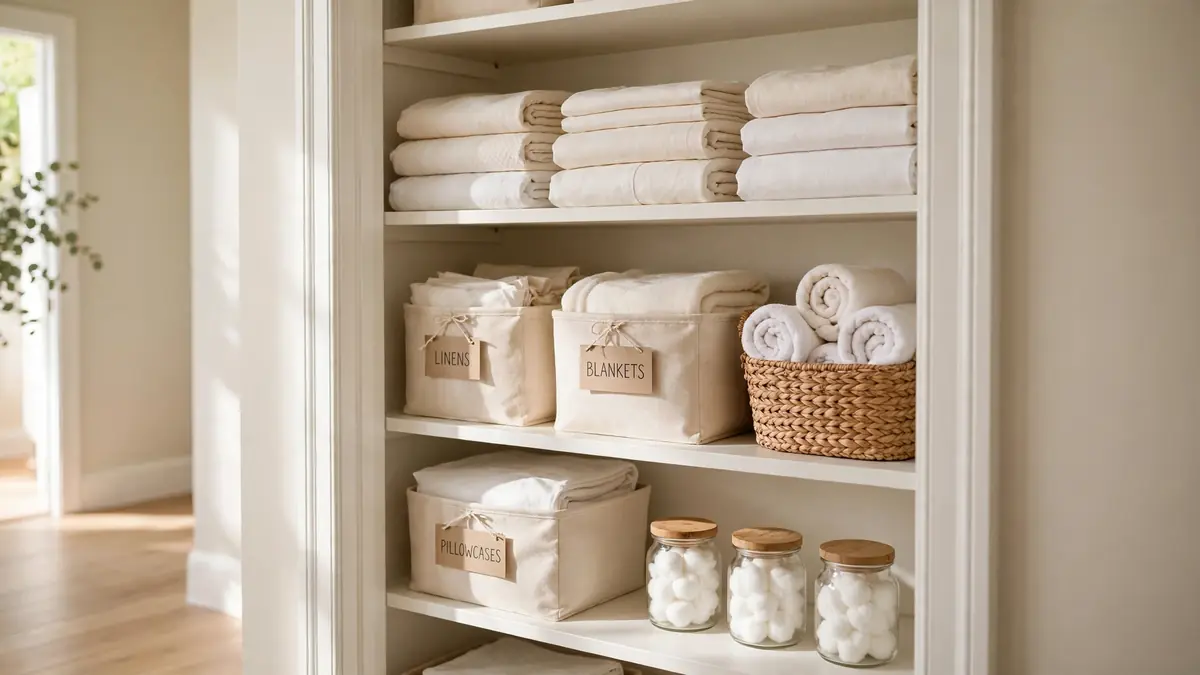

You know the exact moment I’m talking about. You open the hallway closet to grab a fresh set of sheets, and a small avalanche of washcloths, pillowcases, and one very suspicious flat sheet slides toward you like the closet is tired of its job. You grab what you need, shove the rest back in, and close the door a little too fast — as if the mess won’t notice. I’ve lived with that closet for years. Here’s what I finally learned: linen closet organization isn’t about buying prettier baskets. It’s about building a system simple enough that your whole household — including the family member who folds a fitted sheet by wadding it into a ball — can keep it working.
This guide walks you through the exact process I used to turn our chaotic hallway closet into a space I can actually navigate at 6 a.m. with one eye open. No special tools required, no weekend-killing project. Just honest steps that stick.
Step One: Take Everything Out (Yes, All of It)
Before you reorganize a single towel, pull every item out of the closet and put it on the bed or the hallway floor. All of it. This is the step most people skip, and it’s the step that matters most. You cannot make smart keep-or-donate decisions while half your sheets are still stacked on the top shelf, quietly judging you.
While the shelves are bare, wipe them down. Linen closets collect a surprising film of dust, especially on the higher shelves where the air barely moves. A quick damp-cloth wipe takes three minutes and gives you a genuinely fresh start. If you want to go deeper while you’re at it, our bathroom deep cleaning checklist covers this kind of reset in detail, since the linen closet usually serves the bathroom anyway.
Now look at your pile. Sort it into three groups: keep, donate, toss. The donate pile is for linens that are still perfectly usable but surplus to your needs. The toss pile is for the threadbare towel that’s developed the texture of a fishing net, the pillowcases gone grey at the edges, the washcloth with a stain that survived every wash cycle since 2022. Old towels make excellent cleaning rags before they make excellent trash, so keep a few for that job — but be honest about how many cleaning rags one household needs.
The Two-Sets-Per-Bed Rule (Your New Declutter Superpower)
Here’s the rule that changed everything for me: two sheet sets per bed, plus one guest set. That’s it. One set on the bed, one set in the closet. When you strip the bed, the clean set goes straight on — laundry day becomes a swap, not a project. The third, guest-room set lives at the back of the closet or on the highest shelf, waiting for visitors.
Towels work the same way. Two bath towels per person is genuinely enough for most households, plus a couple of hand towels and four to six washcloths in regular rotation. Anything beyond that is just fabric taking up rent in your closet. I know it feels wrong to let go of perfectly good towels, but count them: if you have eleven bath towels for two people, eight of them are decoration. This is the same kind of honest math that makes minimalist bedroom design feel so calm — fewer things, each one earning its place.
Beach towels and specialty blankets get one simple test: did you use it last year? If not, it doesn’t need prime closet real estate. Seasonal items like heavy flannel sheets or beach towels can live in an under-bed bin or the top of a bedroom closet instead of clogging the daily-use shelves.
Linen Closet Organization Zones That Make Sense
Once you’ve decluttered, it’s time to assign every shelf a job. A zoned closet is a closet you can navigate half-asleep, and it means nothing lands “just anywhere” when you’re putting laundry away.
Here’s the zone layout that works in almost every standard hallway linen closet, from top to bottom:
- Top shelf (the archive): guest linens, seasonal blankets, the spare duvet. Things you touch a few times a year. If your top shelf is deep, put these items in a labeled bin so they don’t slide back and vanish.
- Upper-middle shelves (eye level to shoulder height): sheet sets for the beds you use daily. This is the zone your hands reach for most, so it deserves the best position.
- Lower-middle shelves: bath towels, hand towels, and washcloths — grouped together, folded the same way.
- Bottom shelf and floor: heavier items: spare blankets, the humidifier you only use in winter, cleaning supplies if this closet doubles as a utility space.
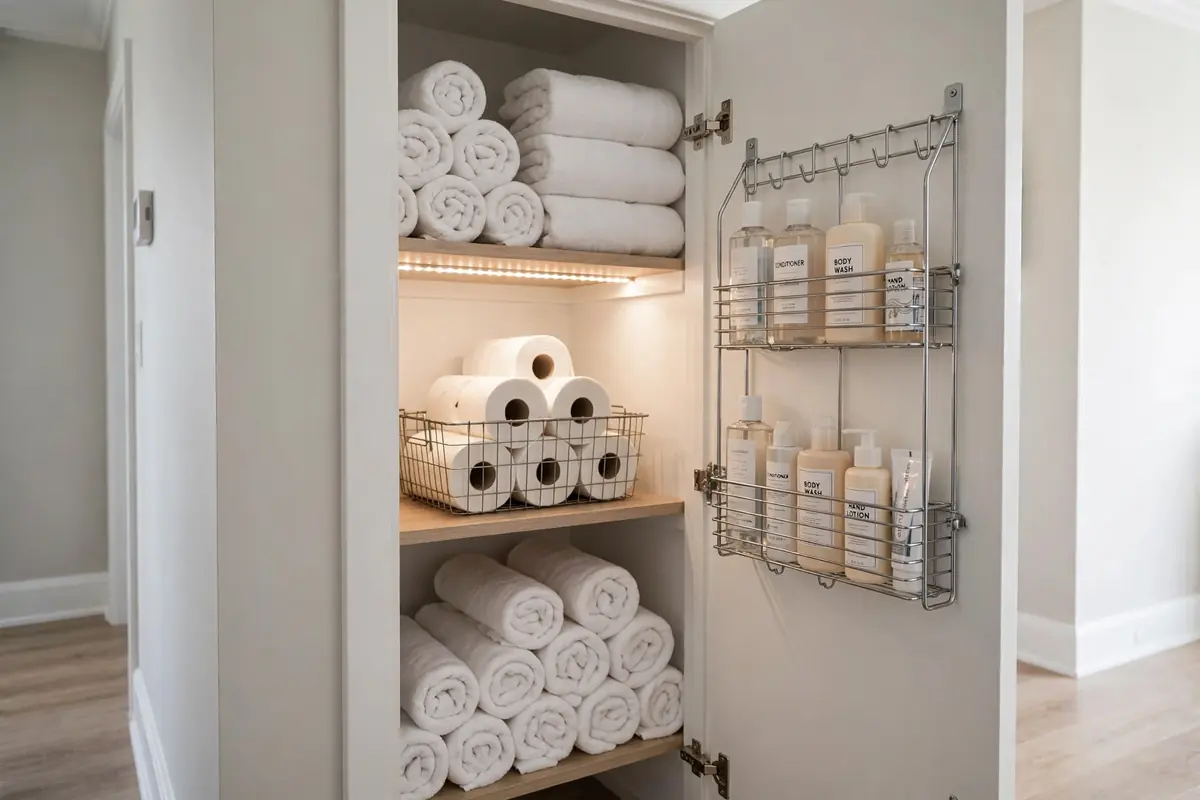
- The door (bonus zone): an over-the-door wire rack for spare toiletries, a small lint roller, a sachet of lavender. Dead space turned useful.
The one principle behind all of this: store things where you use them. Bath towels near the bathroom end of the hallway, guest bedding near the guest room. If your linen closet is far from where things get used, that’s why nothing stays put — every put-away trip is a chore instead of a two-step task. For overflow bathroom items like extra shampoo bottles and backup soap, consider letting your under-sink bathroom storage handle those, and keep the linen closet for linens.
Folding Tricks That Save Serious Space
You don’t need to fold like a department store. You need to fold the same way every time, because consistency is what makes stacks stay upright instead of sliding sideways the moment you pull one item out.
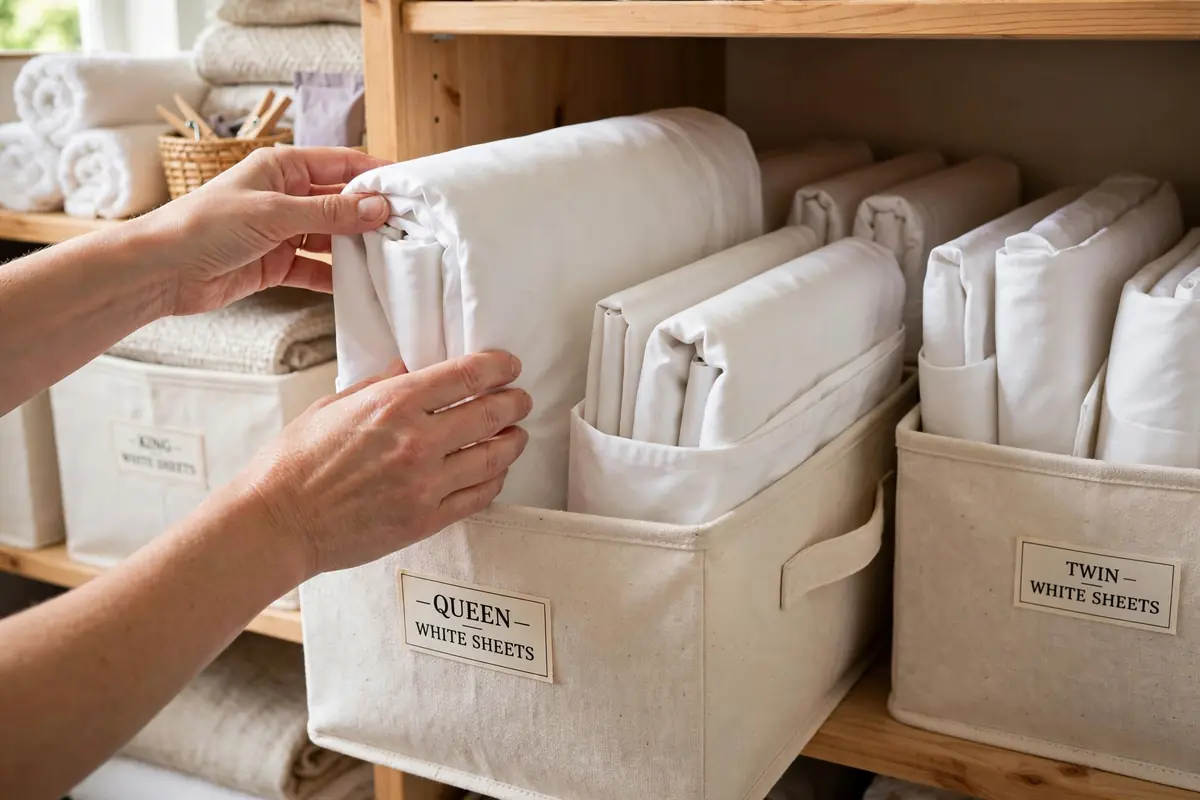
The pillowcase trick for sheet sets: fold the fitted sheet, flat sheet, and one pillowcase into a neat rectangle, then slide the whole stack inside the second pillowcase. Now every sheet set is a self-contained package — no more hunting for the matching pillowcase at 10 p.m. on a school night. It takes about ninety seconds per set once you’ve done it twice, and it eliminates the single most annoying part of linen storage.
The tri-fold for bath towels: fold a bath towel in thirds lengthwise, then in half or thirds again depending on your shelf depth. The goal is a uniform rectangle roughly 12 inches wide. When every towel is the same width, stacks line up like books and don’t lean. File-folding — standing towels upright in a bin like files in a drawer — is another excellent option for deep shelves, because you can see every towel at a glance instead of lifting a stack to find the one you want.
Rolling for hand towels and washcloths: small items are the ones that migrate and tangle. Rolling hand towels tightly and standing them in a basket or bin keeps them compact, visible, and oddly satisfying to look at. Washcloths roll down to the size of a cinnamon roll and fit anywhere.
One more practical note: don’t fold your fitted sheets while standing at the bed making faces at them. Sit down at a table. It takes the wrestling out of it. There are plenty of fitted-sheet folding videos worth exactly one watch — after that, muscle memory does the rest.
Bins, Baskets, and Labels: Your Linen Closet Organization Kit
Good linen closet organization depends on a small, cheap kit of containers. You don’t need a matching designer set — you need the right tool for each zone. Here’s the honest shopping list:
- Labeled bins for sheet sets: one bin per bed size (queen, twin, guest). File-folded or pillowcase-bundled sets stand upright inside. A simple label — “QUEEN SHEETS,” “GUEST” — means anyone in the house can put laundry away correctly.
- A basket for hand towels and washcloths: rolled items live here. A woven or wire basket works fine as long as it’s not so deep that items get lost at the bottom.
- Small clear jars for tiny things: cotton balls, spare soap bars, travel shampoo bottles, mesh laundry bags. Glass jars keep small items from scattering across a shelf and make it easy to see when you’re running low.
- One bin for “first aid and medicines”: if your linen closet holds the thermometer, bandages, and backup toiletries, give them their own clearly labeled home so a midnight nosebleed doesn’t turn into a shelf search.
- Shelf dividers or bookends: if your shelves are tall, stacks lean. A couple of dividers hold towel piles upright without any fancy system.
Labels are the unsung hero here. They take five minutes with a label maker or a marker and masking tape, and they’re the difference between a system only you understand and a system the whole household maintains. This is the same principle that makes smart towel storage in real bathrooms actually work — the system has to survive contact with real life.
One honest warning: leave some breathing room. The temptation is to fill every inch, but a closet packed edge-to-edge becomes impossible to maintain. An 80-percent-full closet with a little air between zones stays tidy for months. A 100-percent-full closet slides back into chaos the first time someone shoves a beach towel in sideways.
Keep It Fresh: Smell, Moisture, and Light
Linen closets have three natural enemies: mustiness, moisture, and darkness. All three are fixable.
Musty smells usually mean poor airflow. If your closet has a solid door, leaving it cracked occasionally helps — or add a small gap under the door if you can. A sachet of dried lavender or a cedar block on each shelf keeps stored linens smelling clean, and they’re cheap enough to replace once a year. Avoid cramming damp-feeling items into bins with lids; breathable fabric bins are better than sealed plastic for anything you don’t wash weekly.
Moisture is worth taking seriously, especially in humid climates or if the closet sits near a bathroom. Make sure towels are fully dry before they go back on the shelf — a slightly damp towel folded into a stack will sour the whole pile. If humidity is a recurring problem, a small rechargeable dehumidifier on the bottom shelf costs very little and protects everything above it.
Darkness makes every closet feel bigger and messier than it is, because you can’t see what you have. A battery-powered motion-sensor LED strip under the top shelf is a five-minute, five-dollar upgrade that makes an absurd difference. You’ll stop pulling out the wrong sheet set because you can actually read the labels now.
The 10-Minute Seasonal Reset
Here’s the maintenance plan that keeps the whole system alive: twice a year — when you switch to summer sheets and when you switch back to winter bedding — spend ten minutes on the closet.
Pull out anything you haven’t touched in six months and ask the two-sets question again. Refold any stack that’s started to slump (it takes less time than you’d think once everything already has a home). Check that the lavender sachets still smell like something, and toss any that have gone faint. Look at the bottom shelf: is it becoming a dumping ground for “I’ll deal with this later” items? Deal with them now, while it’s just one shelf.
That’s it. Ten minutes, twice a year. Compare that to the forty-five-minute avalanche cleanup you used to do every few months, and the math speaks for itself.
A well-organized linen closet won’t change your life. It will do something better: it will stop interrupting it. Grabbing clean sheets becomes a ten-second task instead of a small excavation. Putting laundry away becomes obvious instead of puzzling. And the next time a guest asks for a spare blanket, you’ll know exactly where it is — and you’ll reach for it with total confidence. That’s what a good system gives you: not perfection, just one less thing to think about.
[…] a guest asks for another pillow. Speaking of which, if your own linens are in chaos, our guide on how to organize a linen closet will save you that late-night scramble, and these under-bed storage ideas work just as well in a […]
[…] you are also clearing out spare sheets or towels, my guide on how to organize a linen closet will find them a proper home instead of cramming them into a clothes […]