
The cabinet under your bathroom sink is probably the most dishonest storage space in your entire house. It looks manageable from the outside — a closed door, a quiet promise of order — but open it up and it’s usually a graveyard of half-empty shampoo bottles, mystery cleaning sprays, and that hairdryer you swore you’d use more often. Good under-sink bathroom storage isn’t about buying the prettiest organizer on the internet. It’s about designing a system that survives real life: the pipes in the middle, the damp air, the 6 a.m. scramble when you can’t find the contact lens solution.
I spent a full Saturday fixing my own under-sink cabinet earlier this year, and the difference is embarrassing in retrospect. Everything I needed was suddenly within reach — and it has stayed that way for months. Here’s exactly how to do it, without buying anything you’ll regret.
Start With an Empty Cabinet (Yes, the Whole Thing)
You can’t organize around a mess. Pull everything out, wipe the cabinet floor, and lay it all on a towel so you can actually see what you’re working with. This unglamorous part does about 70 percent of the work.
Now, sort with brutal honesty into four piles:
- Daily essentials — things you touch every single day: toothpaste, face wash, deodorant, your contact case, the moisturizer that’s already on your skin by 7 a.m.
- Weekly or occasional items — hair masks, exfoliating scrubs, the fancy lotion guests get, backup bars of soap.
- Cleaning supplies — toilet bowl cleaner, all-purpose spray, spare sponges, gloves. Yes, these live here too, but they deserve their own zone.
- Get it out — anything expired, anything you haven’t touched in six months, anything you can’t identify. Old sunscreen from two summers ago isn’t protecting anyone. Nearly empty bottles with one pump left? Commit to finishing them this week or toss them now.
The “get it out” pile is usually bigger than expected. Mine filled half a trash bag: expired contact solution, three near-identical hand creams, a prescription tube I couldn’t date. Most bathroom products quietly expire long before we finish them, and anything past its date is stealing space from products that work. If you’re unsure what to toss, our bathroom deep cleaning checklist covers how to audit bathroom products while you’re at it.
Under-Sink Bathroom Storage Starts With Working Around the Pipes
Here’s why under-sink cabinets defeat most people: the plumbing. The drain and supply lines run right through the middle, so a normal shelf or box simply doesn’t fit. Whatever you buy has to be designed around that obstacle.
Before you spend a dollar, grab a tape measure and note three numbers: the cabinet opening width, the depth to the back wall, and the vertical clearance on each side of the pipes. Keep these on your phone — checking every organizer against them first prevents about 90 percent of “it doesn’t fit” returns.
Once you know your measurements, you have three approaches that actually work with plumbing rather than against it:
- Under-sink shelf organizers with a U-shape or cutout — these are built to straddle the pipes, giving you a real shelf layer above the cabinet floor on both sides. They’re the closest thing to a magic fix this space has.
- Two short stacks flanking the pipes — place a stackable bin or small drawer tower on the left of the drain and another on the right. Simple, cheap, and you can pull one side out to reach the other.
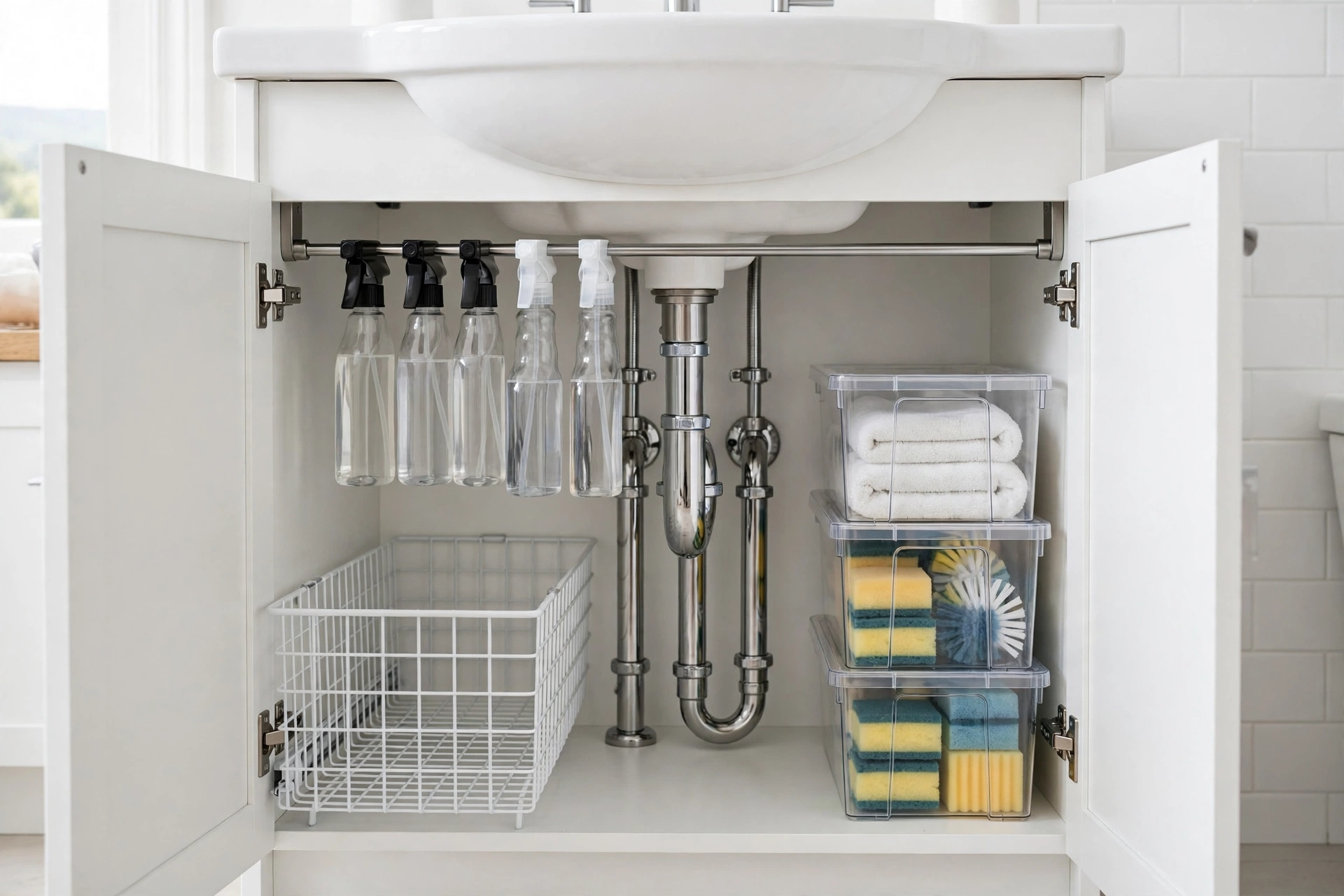
- Ignore the floor entirely — hook things to the door, hang spray bottles from a tension rod across the top, and mount adhesive hooks on the side walls. Sometimes the best under-sink bathroom storage uses zero floor space.
One practical note: bathrooms are humid, and under-sink cabinets catch the worst of it. Skip cardboard boxes — they go soft and musty within months. Plastic, coated wire, or sealed bamboo organizers survive; plain cardboard doesn’t.
Storage Tools That Actually Earn Their Space
Walk into any home store and you’ll find an entire aisle of under-sink gadgets. Most are shelf decoration in disguise. Here’s what genuinely earns its place.
Pull-out drawers and sliding trays
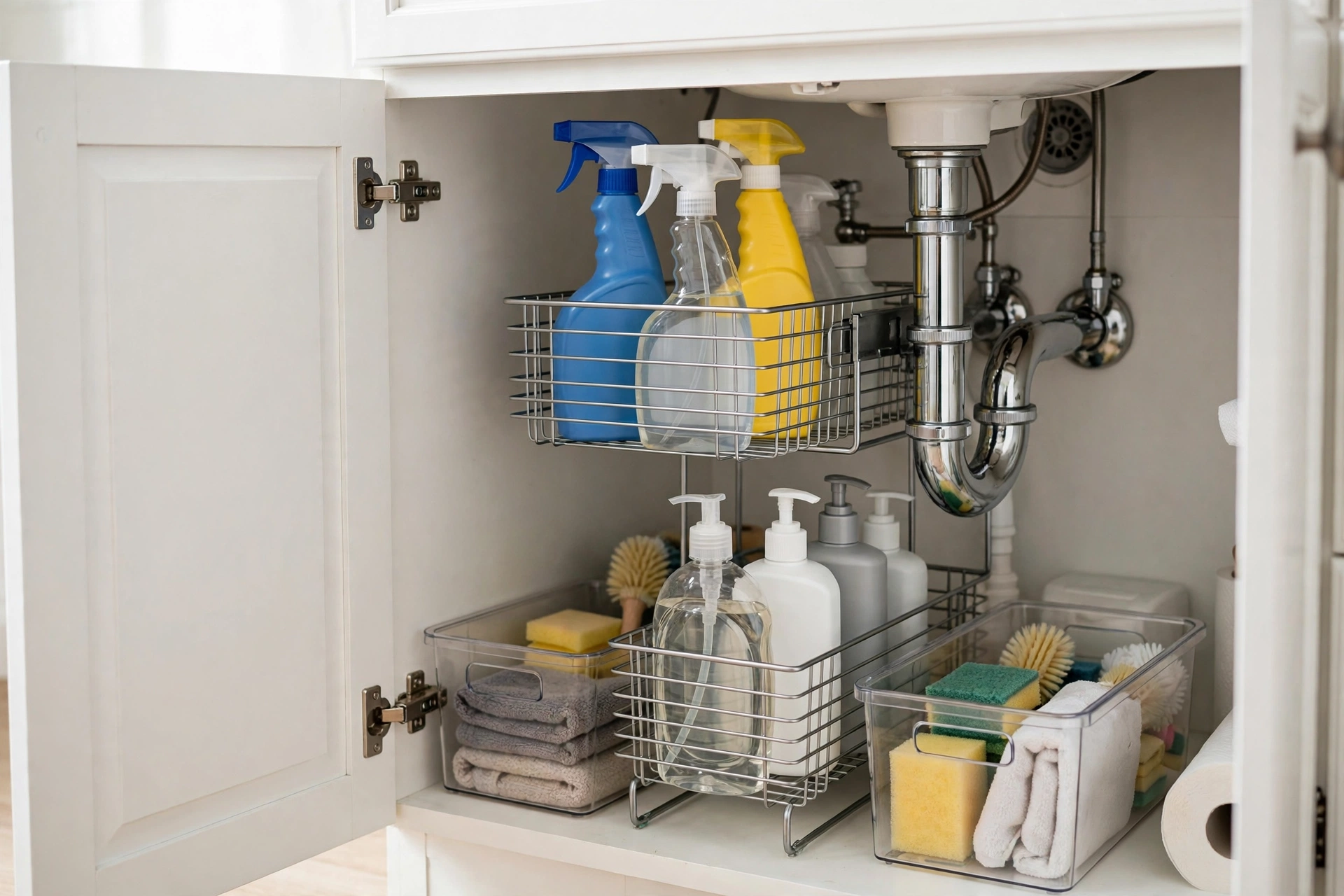
This is the single biggest upgrade you can make. A pull-out drawer brings the back of the cabinet to you — no more lying on the bathroom floor to reach the vitamins behind the Windex. Pick a tray with raised edges so bottles don’t slide off.
A tension rod for spray bottles
One of the cheapest tricks in the book: install a small tension rod across the upper cabinet and hang spray bottles by their trigger handles. Cleaning supplies hover above the floor, freeing the whole cabinet bottom for everything else. Five minutes, less than the cost of a coffee.
Stackable bins with a purpose
Not every bin helps — but short, wide, clear bins that stack two high absolutely do. The key is that each bin holds ONE category: “hair stuff,” “cleaning,” “first aid,” “backups.” When a bin becomes a junk drawer, it fails. When it holds one thing, it works. Clear bins matter because you can see what’s inside without pulling them out; if you prefer opaque bins for a calmer look, add a label to the front.
The cabinet door: your secret second cabinet
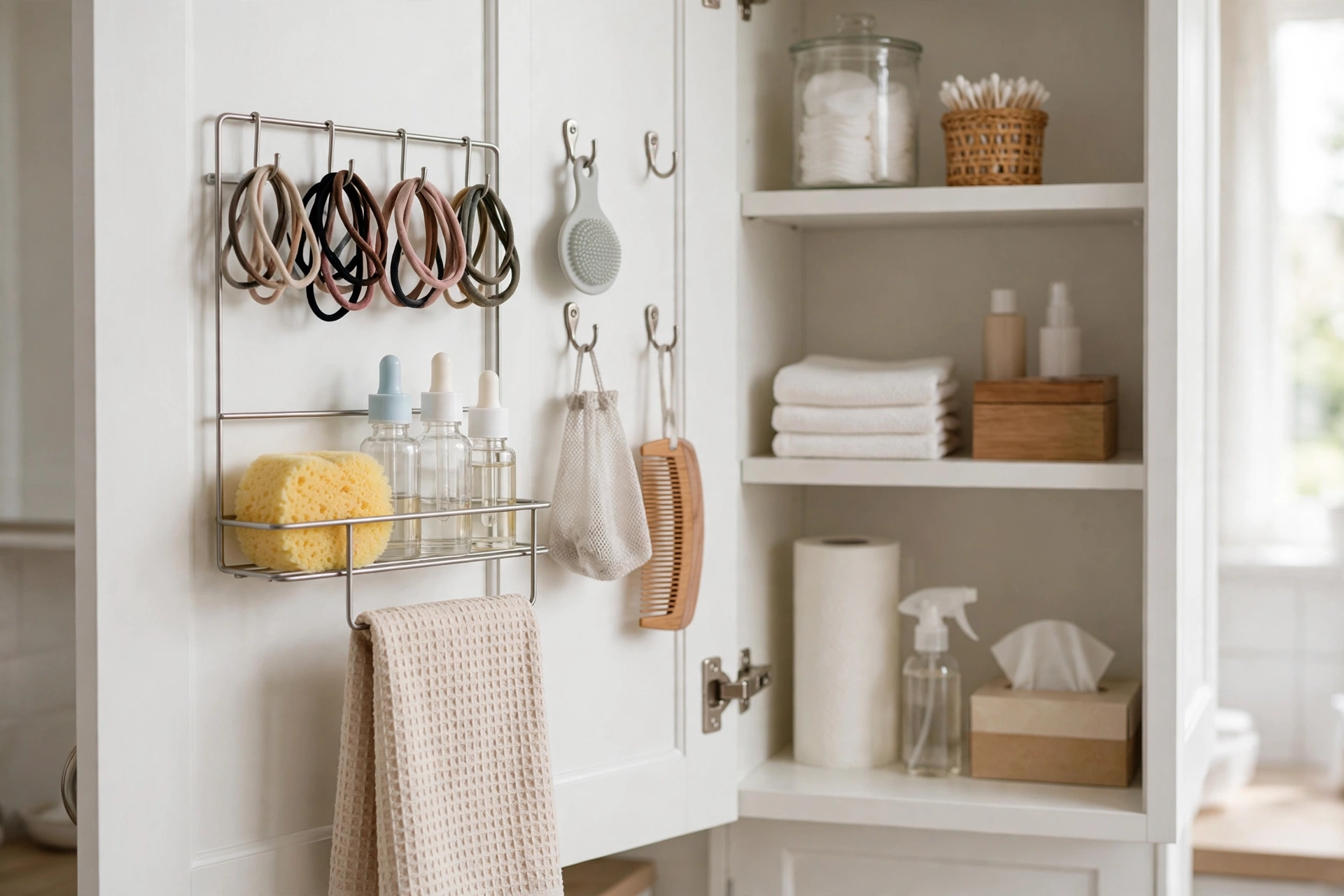
The inside of the cabinet doors is free real estate most people ignore. A slim door-mounted rack or a row of adhesive hooks can hold hair ties, a small brush, spare sponges, or a hanging pouch for medicines. This alone can clear a whole shelf — just make sure nothing collides with the pipes when the door closes.
Lazy Susan for the deep corners
For wide cabinets with a dead corner, a two-tier lazy Susan earns its keep — spin it and everything rotates into view. Get one with raised edges so small bottles don’t topple. Especially useful when several people share one bathroom.
Zone Your Cabinet Like a Pro
Organizers are just tools; the system is what keeps things tidy. Professional organizers divide the space into zones, and it’s why their clients’ cabinets still look good months later.
Zone 1: Daily essentials, front and center. Your toothpaste, skincare, deodorant — the things you grab half-asleep — belong in the most accessible spot, ideally in a pull-out tray or a bin you can grab with one hand. If you share the bathroom, give each person their own bin. Two bins, two people, zero morning arguments about whose moisturizer is whose.
Zone 2: Cleaning supplies, grouped and contained. Keep all cleaning products together, ideally in one caddy or bin you can lift out when it’s cleaning day. This is also a safety win: if you have small children, this zone is where a child-safe latch matters most. One caddy, one latch, and the whole category is secured.
Zone 3: Backups and bulky items, back and high. The economy pack of toilet paper, the refill shampoo, the box of cotton pads — these go toward the back or on the highest usable shelf, because you reach for them once a week, not once a day. They’re the “warehouse,” not the “shop floor.”
Zone 4: The door, for the small and slippery. Anything tiny that vanishes into bins — tweezers, nail clippers, hair ties, spare razor heads — gets a home on the door or in a small labeled pouch. Small things need small containers, or they’ll migrate everywhere.
One more habit that makes the zones stick: put things back immediately after use. Most under-sink chaos comes from “I’ll put it back later.” If every item has a visible, labeled home, returning it takes three seconds — and that three-second rule is the entire maintenance plan.
Under-Sink Bathroom Storage for Small Bathrooms
Everything above still applies in a tiny bathroom — it just gets compressed. When the cabinet itself is barely wider than the sink, every inch has to work harder. Here’s how to adapt.
First, accept that a small under-sink cabinet can’t hold everything, and that’s fine. Let the cabinet handle the daily essentials and move the rest outward — cleaning supplies might live in a slim rolling cart or the hallway closet instead. That’s not a failure of your under-sink bathroom storage; that’s the system working. Pair this with a calmer bathroom counter and the whole bathroom breathes easier.
Second, go vertical inside the cabinet. A two-tier organizer that straddles the pipes doubles your usable surface without taking a single extra inch of floor space. Door-mounted storage becomes even more important in small cabinets, since the door area is proportionally larger relative to the tiny interior.
Third, decant ruthlessly. In a small bathroom, you do not need the family-size shampoo under the sink — keep a smaller bottle in the cabinet and the bulk refill elsewhere. Same goes for cleaning products: one all-purpose spray beats four specialty cleaners you’ll use twice a year. And if your morning routine products are fighting for space, consider whether some of them belong on the counter in a tidy tray or in a dedicated makeup organizer instead of crammed under the sink.
- Use a slim pull-out caddy no wider than your cabinet minus the pipes.
- Hang a small hook rack inside the door for daily grab-and-go items.
- Store only current-use products here; backstock lives in the linen closet.
- Choose one multi-purpose cleaner instead of a shelf of specialists.
Keep It Organized Without Thinking About It
Here’s the honest truth about under-sink bathroom storage: the system you set up on Saturday only survives if maintaining it is nearly effortless. I’ve seen (and built) plenty of beautiful cabinets that were a mess again by month two. The ones that last share a few boring little habits.
Do a two-minute reset once a week — usually on cleaning day. Open the cabinet, toss anything obviously empty or expired, and return anything that’s drifted to the wrong zone. Two minutes, once a week, is genuinely all it takes once the zones exist. Pair it with your regular routine, like the one in this weekend reset guide, and it just becomes part of the rhythm.
Every three to four months, do the full pull-out again — everything out, wipe down, check expiry dates. Products expire faster than we think in bathroom humidity, and a quarterly audit keeps the cabinet honest. Mark it on your calendar like anything else worth keeping.
And live by one-in, one-out. A new bottle comes in, an old bottle goes out or gets used up first. This single rule prevents the slow creep that turns organized cabinets into cluttered ones, because it caps the total volume. Under-sink cabinets don’t get messy from one big event; they get messy from ten small additions nobody removed.
A Cabinet That Actually Works for You
The cabinet under your bathroom sink will never be glamorous, and it doesn’t need to be. What it needs to be is honest: every item earns its place, everything has a zone, and you can find what you need with one hand and your eyes half closed. That’s the real standard of good under-sink bathroom storage — not a photo-perfect shelf, but a system that keeps working on a tired Tuesday morning.
Start with the empty-cabinet reset this weekend. Measure your space, pick one or two tools that fit around your pipes, set up your zones, and give yourself the two-minute weekly reset. By next week, you’ll wonder why you ever crawled around on the bathroom floor looking for the contact solution. Your future self — the one running ten minutes late — will thank you.
[…] items: Extra bottles, bulk boxes, and backup supplies don’t live here. They go in the storage under your bathroom sink or the linen […]
[…] permanently. Everything else needs a real home, whether that is the space under your sink (our under-sink bathroom storage ideas will help you claim that neglected space) or a medicine cabinet with actual order to it instead of […]
[…] deodorant. Be honest: if it won’t fit comfortably, it belongs under the sink. That’s what under-sink bathroom storage is for, and keeping backstock out of the drawer is half the […]
[…] that touches your skin. If that under-sink zone is currently the worst offender in your bathroom, these under-sink bathroom storage ideas go deeper on layouts that work around pipes instead of fighting […]
[…] is doing double duty for cleaning supplies and styling tools, it is worth separating the two. Our under-sink bathroom storage ideas show how to zone that awkward space so hair tools never end up wedged behind a bottle of […]