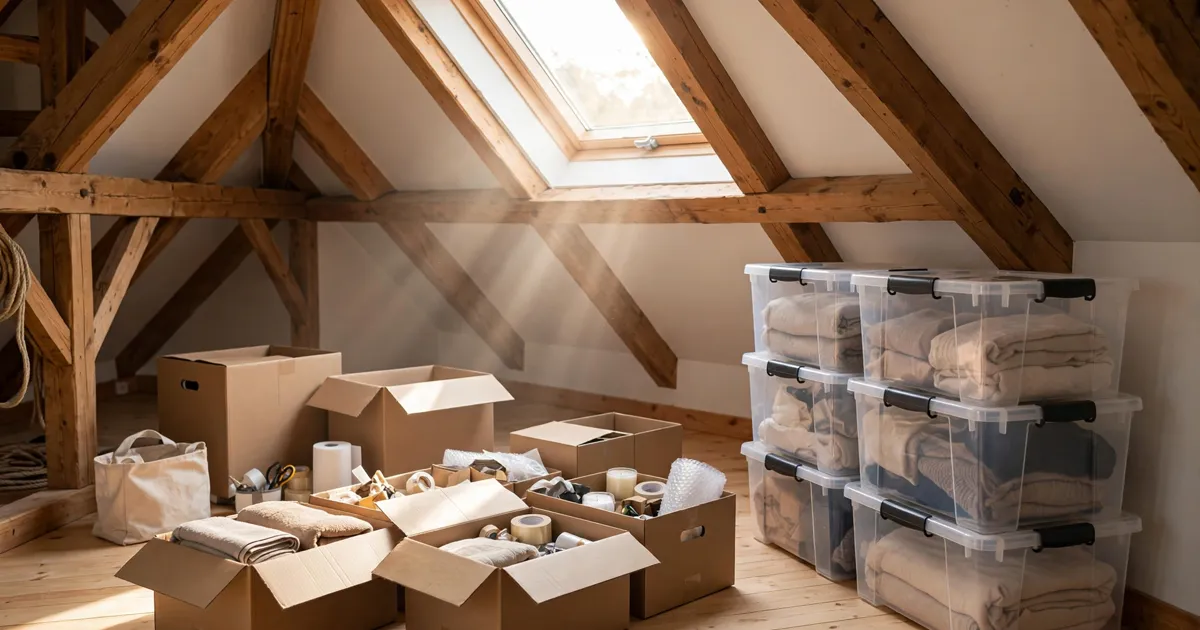

Every house has one: the room above the rooms, where good intentions go to gather dust. If you are wondering how to declutter your attic without losing an entire month of weekends, you are in the right place. Attics become accidental museums — a broken lamp from your first apartment, your kids’ preschool artwork, a treadmill you swore you would use. This guide gives you a realistic weekend plan to sort it all, make confident decisions, and set up attic storage that stays tidy for years.
Here is the truth nobody tells you: attic clutter feels overwhelming because it is usually a decade of postponed decisions stacked in cardboard. The method below works because it breaks the job into small, finishable zones and gives you clear rules for the hardest categories — sentimental boxes, ancient electronics, and the holiday decorations that multiply every December. Bring water, put on music you love, and treat this like a satisfying deep-dive rather than a chore.
How to Declutter Your Attic in One Weekend: The Plan
Before you haul a single box, decide your goal. Are you reclaiming storage space, making room for a renovation, or just finally facing the boxes you inherited from your parents? Write your goal on a sticky note and tape it to the attic door. When decision fatigue hits on Sunday afternoon — and it will — that note keeps you honest.
Next, divide the attic into zones. Most attics naturally split into three or four areas: holiday decorations, clothing and linens, sentimental boxes and paperwork, and the “everything else” pile of furniture, sports gear, and mystery boxes. Tackle one zone per half-day. Finishing a complete zone gives you a visible win and prevents the common mistake of half-sorting the entire attic and quitting exhausted.
Book a donation pickup or plan a donation-center run for Monday morning before you start. Having a hard deadline for the donate piles stops them from migrating back upstairs. Also line up your disposal plan: check your town’s bulk pickup schedule for big furniture, and find your nearest e-waste drop-off for old electronics. Knowing where things will go makes it dramatically easier to let them go.
Safety First: Gear Up Before You Climb Up
Attics are dusty, dim, and full of tripping hazards — so a little preparation goes a long way. Gather these supplies and stage them at the bottom of the attic stairs:
- Dust mask or respirator — old insulation and decades of dust are no joke for your lungs.
- Work gloves — protects against splinters, staples, and mystery sticky things.
- Headlamp or clip-on work light — most attics have one sad bulb; you need real light to read labels and spot damage.
- Knee pads — if your attic has low clearance, your knees will thank you by hour two.
- Heavy-duty trash bags, a box cutter, a marker, and painter’s tape — your entire sorting toolkit.
- A step stool — for reaching rafter storage without balancing on joists.
Check the floor before you load it up. Walk only on joists or laid boards, never on bare drywall or insulation, which will not hold your weight. In summer, work early in the morning — attics can reach dangerous temperatures by midday. If you spot signs of pests, mold, or water damage, deal with that first (or call a professional) before you start sorting around it.
The Four-Pile Sorting System
Pull everything from one zone into an open area — the garage, a spare room, or the driveway on a dry day — and sort every single item into four piles. No “maybe” pile. The maybe pile is where decluttering goes to die.
- Keep — you use it, it is seasonal and you will use it this year, or it has genuine sentimental value.
- Donate or sell — works fine, but has no place in your life anymore.
- Recycle — broken electronics, scrap metal, cardboard, anything your local program accepts.
- Trash — broken beyond repair, stained, moldy, or missing essential parts.
As you sort, ask three questions about each item: Have I used this in the past two years? Would I buy it again today? If my house burned down, would I replace it? Two or three “no” answers means it leaves the attic. Be especially firm with duplicates — you do not need four slow cookers or three sets of curtains for windows you no longer have. One of the most common decluttering mistakes to avoid is sorting without deciding, so commit to a pile for every item before you pick up the next one.
What to Keep, Toss, Donate, or Recycle: Attic Edition
Certain attic regulars deserve specific call-outs, because they are the items people agonize over most. Here is how to handle each one decisively.
Holiday decorations
Keep only the decorations you actually put up. If a box of ornaments has sat unopened for two Christmases in a row, donate it as a complete set — someone decorating on a budget will love it. Test every string of lights before you store it again; a tangled ball of dead lights is not a family heirloom. Toss broken ornaments and faded plastic garlands without guilt.
Old electronics and cables
That VCR, the tube TV, the flip phone in a drawer — they are not vintage, they are e-waste. Unless something is a genuine collectible in working condition, recycle it at an e-waste facility. The same goes for the box of tangled chargers: if you cannot name the device a cable belongs to, you will never need it. Keep at most one universal charger and one spare HDMI cable.
Clothing, linens, and luggage
Seasonal clothes you wear every year earn their spot. But the suitcase full of clothes that do not fit, the baby blankets from kids now in college, the curtains from three houses ago — those are donation bags waiting to happen. Old mattresses and pillows stored in attics absorb moisture and dust mites; if nobody will ever sleep on them, schedule a bulk pickup.
Baby gear and kids’ items
Keep one small memory box per child — first shoes, a favorite blanket, the hospital bracelet. The rest of the outgrown gear (strollers, high chairs, boxes of plastic toys) should be donated while it is still useful to another family. If you are done having kids, the bulky gear is the easiest win in the whole attic.
Paperwork and old files
Tax records older than seven years, ancient utility bills, and manuals for appliances you no longer own can be shredded or recycled. Keep only active documents — property deeds, birth certificates, current insurance — and consider scanning them. A simple paper clutter organization system with one small fireproof box replaces five mildewed file boxes.
Furniture
The chair with the broken leg you meant to fix in 2019? It is not getting fixed. Donate solid furniture in usable condition the same week you sort it, and haul broken pieces straight to bulk pickup. Empty floor space in an attic is worth more than “maybe someday” furniture.
Handle Sentimental Attic Boxes Without Stalling
Sentimental items are where attic decluttering sessions go to die. You open a box of your grandmother’s letters, and suddenly it is dinnertime and you have sorted three boxes. The trick is to separate the emotion from the session: set a timer for 20 minutes, and when it rings, seal the memory box and move on.
Give yourself a firm limit — one keepsake box per family member, or one shelf of memory bins total. Within that limit, keep the items that truly carry a story: the handwritten recipe card, not all forty cookbooks. Photograph bulky sentimental objects (your kid’s giant papier-mâché volcano, the rocking chair that will not fit anywhere) and let the physical item go; the photo preserves the memory in a fraction of the space. If you need a deeper framework for the emotional side, our guide to decluttering sentimental items walks through exactly how to decide what earns a place in your limited keepsake space.
For boxes you inherited and never opened: you are allowed to open them, skim for genuine treasures, and release the rest. Keeping a sealed box out of guilt is not honoring anyone’s memory. Choose the two or three items that feel most like the person, display or store those properly, and let the rest find new homes.

How to Declutter Your Attic Storage So It Stays Tidy
Once the keep pile is all that remains, resist the urge to shove it back upstairs in the same old cardboard. How you store things now determines whether you repeat this whole project in five years.
Swap cardboard for clear plastic bins
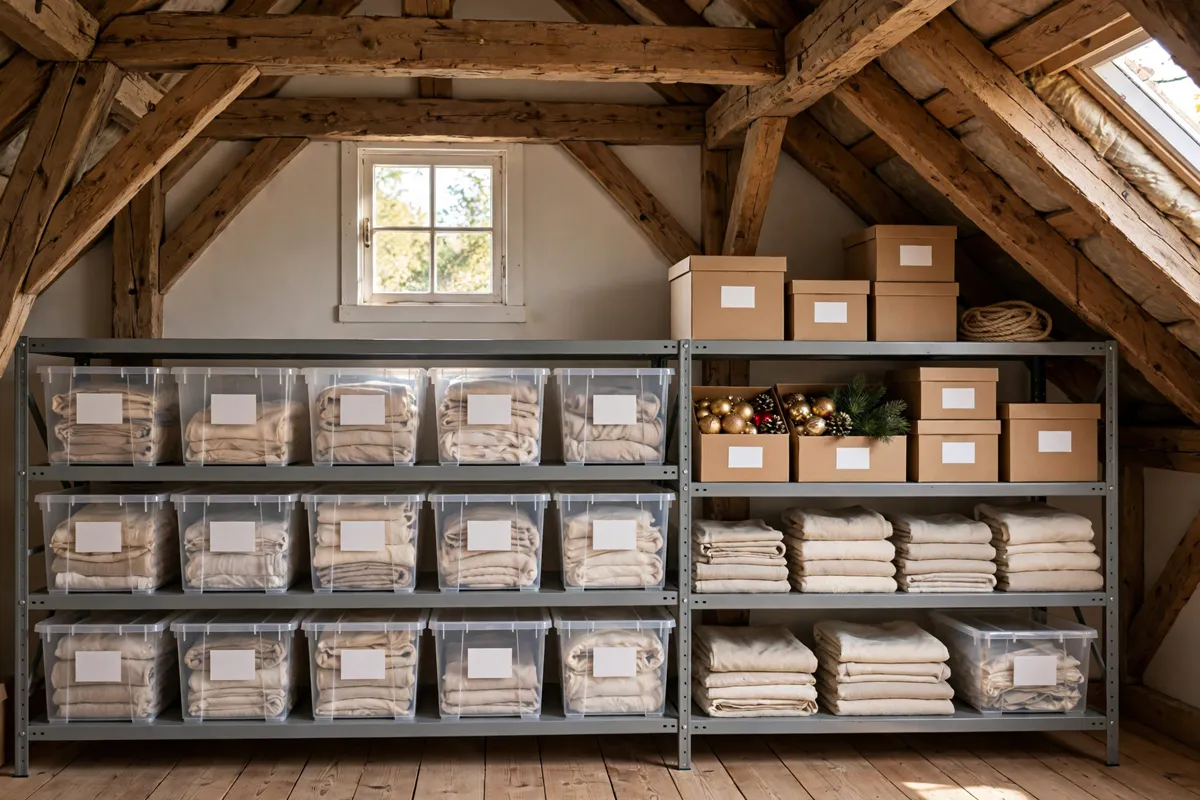
Cardboard attracts moisture, silverfish, and dust — exactly what attics have in abundance. Clear, lidded plastic bins let you see contents at a glance and stack safely. Buy one size so they stack neatly, and do not overfill them; a bin you cannot lift without help is a bin you will dread moving.
Create zones with breathing room
Give every category a defined home: holiday decor near the entrance (you visit it yearly), off-season clothing along one wall, keepsakes in the driest corner. Leave a clear walkway down the middle so you can reach everything without climbing over bins. Label every bin on two sides with a marker or printed labels — “Halloween Decor,” “Winter Coats 2026,” “Tax Records 2020–2026.” Future you will be grateful.
Use the walls and rafters
Install simple shelving along the knee walls for smaller bins, and hang lightweight seasonal items — wreaths, garlands, sleeping bags in compression sacks — from sturdy hooks on the rafters. Getting things off the floor instantly makes the attic feel twice as big and keeps bins away from any damp spots.
Set an attic boundary rule
Adopt a simple gatekeeper rule for everything that comes upstairs from now on: every new box stored means one old box gets reviewed. And once a year, ideally when you pull down holiday decorations, do a 30-minute attic sweep: anything you did not touch all year gets questioned. If you want a longer-term philosophy for keeping only what truly matters, Swedish death cleaning offers a thoughtful framework for gradually lightening the load you leave behind.
A Calmer House Starts Above Your Head
There is a particular kind of peace that comes from knowing exactly what is in your attic — and knowing it is all there on purpose. No more mystery boxes, no more guilt every time you pull down the stairs. Just clear bins, honest labels, and space to breathe. This weekend, pick your zone, set your timer, and start with the easiest pile. Your future self, climbing those stairs next December with a clear path and a labeled bin in reach, will be so glad you did.