

For years, my paper clutter organization strategy was a drawer. One kitchen drawer, stuffed with envelopes, receipts, school forms, insurance letters I was “definitely going to read,” and three menus for a pizza place that closed down two years ago. Every time I opened it, a faint dread settled over me — because I knew there were at least two bills in there I’d already paid and one letter I’d been meaning to answer for months. If this sounds familiar, you’re in the right place. This is the simple paper clutter organization system I built after finally emptying that drawer, and it’s the reason my kitchen counter has stayed paper-free for two years.
Paper is the sneakiest kind of clutter. It arrives quietly — one envelope at a time — and it looks innocent sitting on the counter. But it carries something no other clutter does: guilt. Every unopened envelope whispers that you’re behind on something. That’s why tackling it feels so good. The moment you build a real system, the low-grade anxiety just… lifts.
Why Paper Piles Grow So Fast (It’s Not Laziness)
Before we fix anything, let’s drop the shame. Paper accumulates because it requires decisions, and decisions are exhausting. Every piece of mail asks you something: keep or toss? Pay or file? Act now or later? When you’re tired after work, the easiest thing is to set the envelope down “for now.” And “for now” becomes a pile.
Researchers call this decision fatigue, and it’s completely normal. The problem isn’t you — it’s that you never had a system that makes the decision for you. That’s what we’re building today: a simple setup where every piece of paper has exactly one place to land, so you never have to think about it again.
The whole system rests on one rule: every piece of paper gets sorted within 24 hours. Not filed, not dealt with — just sorted. Sorting is easy. Dealing with it comes later, in batches. This single distinction is what makes the system stick.
Step 1: Do One Big Paper Roundup
You can’t organize chaos without seeing it first. So grab a laundry basket and do a full sweep: kitchen counters, the dining table, your desk, the junk drawer, the hallway table, the top of the fridge, your car, your bag. Every scrap of paper in the house goes in the basket. Yes, it will look worse before it looks better. That’s the point.
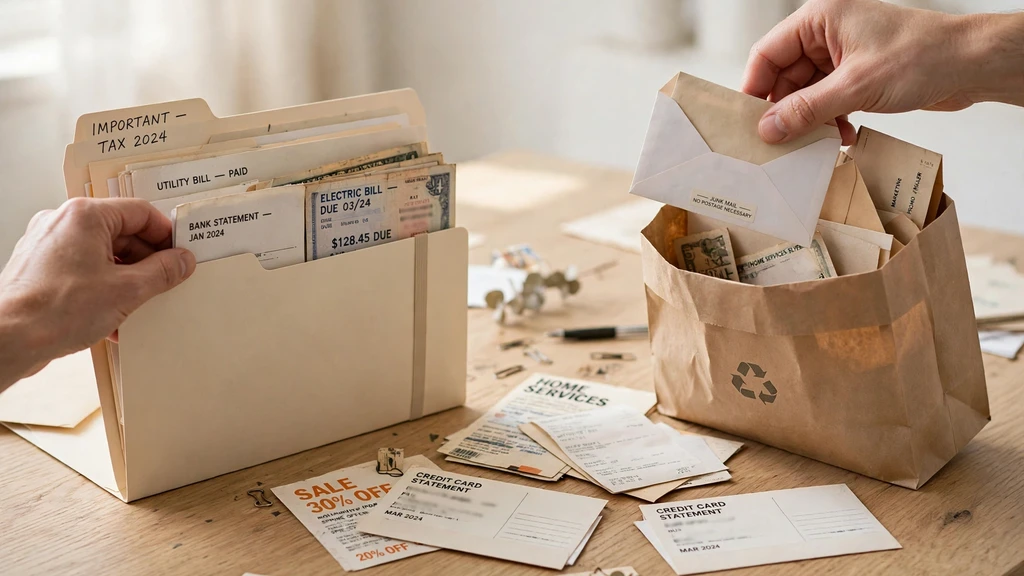
Now sit down with a cup of coffee and sort the whole basket into four piles:
- Action — bills to pay, forms to fill out, invitations to answer, anything that needs you to do something.
- File — insurance policies, tax documents, medical records, warranties — things you need to keep but don’t need to act on.
- Shred — anything with personal info you don’t need: old bank statements, expired cards, pre-approved credit offers.
- Recycle — junk mail, flyers, catalogs, old receipts you truly don’t need.
Be ruthless with the Shred and Recycle piles. A good test I learned the hard way: if you haven’t looked at it in a year and it’s not a tax document or legal record, you probably don’t need it. Most utility bills and bank statements live online now — if you can pull it up in an app, the paper copy is a duplicate. Let it go.
For the big roundup, work in 15-minute declutter bursts if the pile feels overwhelming. Set a timer, blast some music, and stop when the timer rings. A huge backlog didn’t arrive in one day; it doesn’t have to leave in one day either.
The Simple Paper Clutter Organization System: Four Baskets, Zero Stress
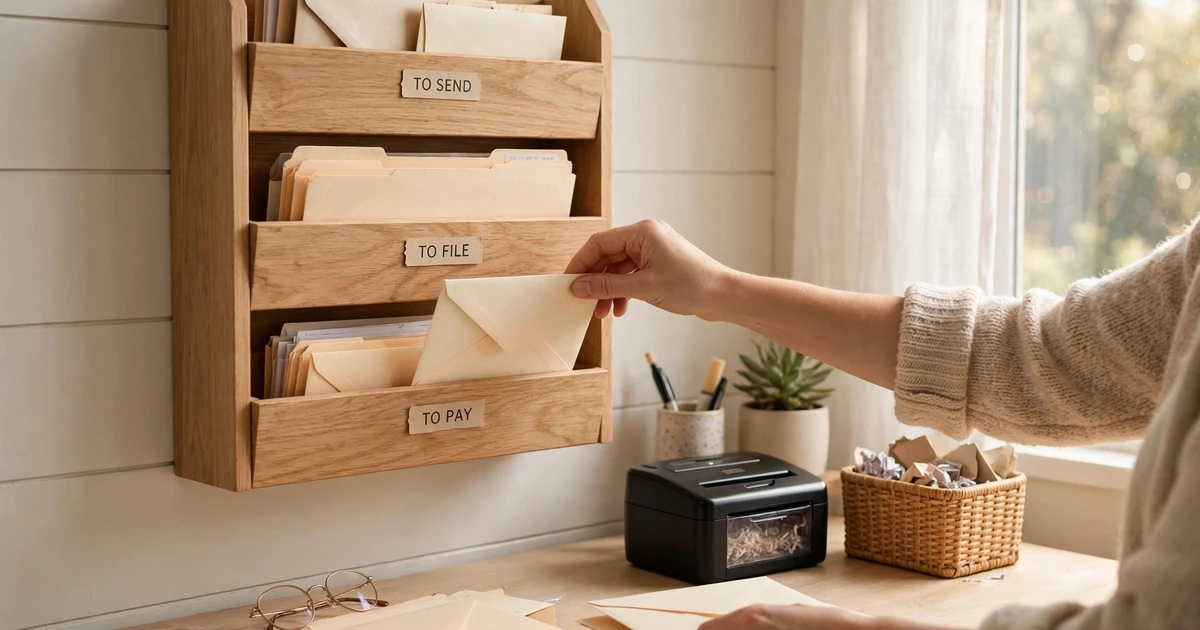
Once the backlog is gone, you need a daily landing zone — what I call my mail drop zone. It lives right by my front door, and it took me about ten minutes and five dollars to set up. You’ll need:
- A small tray or basket for incoming mail — one spot, and only one, where new paper is allowed to land.
- Four labeled slots or folders: Action, File, Read Later, Shred/Recycle. I use a cheap desktop file sorter, but a few labeled envelopes pinned to the wall work just as well.
- A shredder or a “shred bag” nearby. If you don’t own a shredder, a paper bag labeled “to shred” works — empty it at a library or office store shredding day, or just tear things by hand once a week.
Here’s the daily routine, and it takes about three minutes: when you bring the mail inside, you stand at the drop zone and sort it immediately. Junk goes straight to recycling. Anything with your name and account numbers goes in the shred pile. Bills and forms go in Action. Everything else worth keeping goes in File. The recycling bin should be within arm’s reach of your mail spot — that one placement change did more for me than any fancy organizer ever could.
The magic is that sorting is not the same as handling. You’re not paying the bill right now. You’re just putting the bill where future-you can find it in seconds. This is the paper clutter organization system that survives real life, because it asks almost nothing of you on a tired Tuesday evening.
Tame the Flow: Stop Paper at the Source
Organizing incoming paper is only half the battle. The other half is making less of it arrive. This part takes one afternoon and pays you back every single day:
- Switch to paperless billing for every utility, bank, and credit card account you can. Log in to each one once, check the “paperless” box, and watch your mail shrink by half within a billing cycle.
- Opt out of pre-approved credit offers. In the US, you can opt out of these mailings for five years (or permanently) — they’re the single biggest source of junk mail for most households.
- Unsubscribe from catalogs you never open. Keep a little list by the drop zone; every time a catalog arrives that you flip straight through to recycling, take two minutes to unsubscribe online that day.
- Say no to paper receipts when offered, and use your phone’s notes app or a scanning app for the ones you need to keep.
I was skeptical about this step — it felt like admin work I’d never finish. But here’s the truth: I did it in one Saturday morning, mostly while waiting for laundry. Within two months, my daily mail went from a thick stack to three or four envelopes. The less that arrives, the less your system has to handle.
Build a Filing System You’ll Actually Use
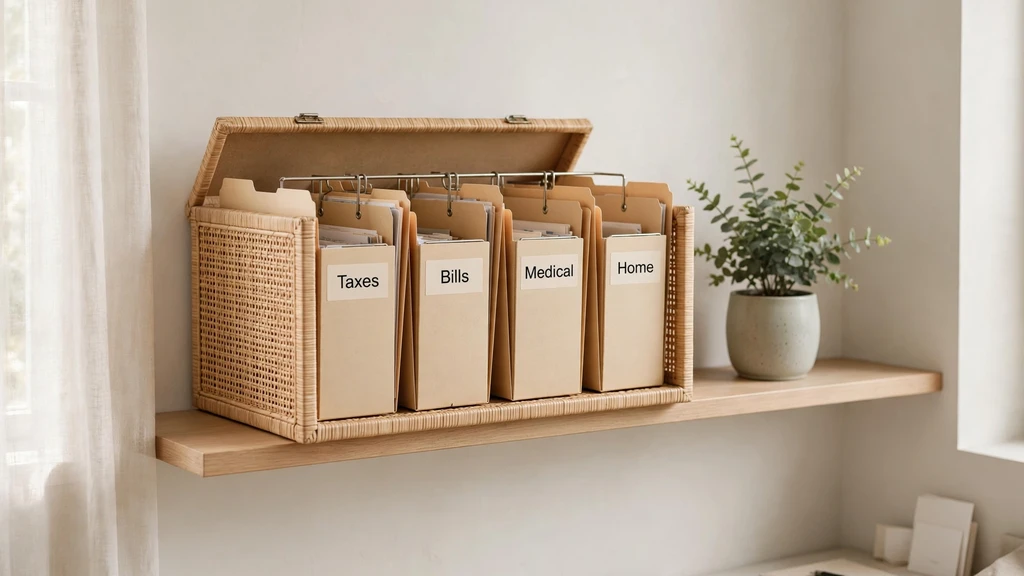
Your File pile needs a home that isn’t a mystery drawer. The simplest filing system that works is one small box or drawer with hanging folders. Label them with plain, obvious names — future-you will not remember what “Misc Important” meant:
- Taxes — current year’s documents (keep tax records at least seven years)
- Home — lease or mortgage, insurance, repair receipts
- Medical — one folder per family member
- Car — registration, insurance, service records
- Kids/School — report cards, medical forms, activity registrations
- Vital records — birth certificates, passports, social security cards (keep these somewhere fire-safe)
Don’t overthink the categories. You can always add a folder, but start small — six to eight folders is the sweet spot. And here’s my biggest lesson: file immediately during your weekly reset (more on that below), or the File folder becomes its own little pile. Filing one paper takes four seconds. Filing thirty papers feels like a chore.
If paper filing feels like too much maintenance, a hybrid approach works beautifully: snap a photo of every receipt and important document with your phone and save it to a clearly labeled folder in cloud storage. Keep the physical originals only for legal documents — birth certificates, property deeds, wills. For everything else, the digital copy is enough, and it’s searchable, which paper will never be. The goal is fewer papers to babysit, not a perfect archive.
The 15-Minute Weekly Paper Reset
This is the maintenance routine that keeps the whole thing alive. Pick one day a week — Sunday evening works for me, because bills due Monday are top of mind — and spend fifteen minutes at your drop zone:
- Empty the Action folder: pay the bills (or schedule them), fill out the forms, answer the invitations. Anything that takes under two minutes, do it right now.
- File the File folder: slip each paper into its hanging folder. Four seconds each.
- Empty the shred and recycling: shred what needs shredding, bag the rest.
- Glance at Read Later: if you haven’t touched it in two weeks, you never will — recycle it.
That’s it. Fifteen minutes, once a week, and paper clutter never gets a foothold. I fold this into my weekly cleaning routine so it happens on autopilot — same day, same time, no decision required. If your home runs on a daily 20-minute routine, treat the mail sort as part of the evening wind-down: three minutes while dinner heats up.
Once a year, do a deeper pass: shred tax documents older than seven years, toss expired insurance policies, and recycle manuals for appliances you no longer own. An annual purge keeps your files lean instead of letting them quietly swell back into chaos. If the idea of decluttering a whole category at once appeals to you, our room-by-room decluttering checklist pairs perfectly with this system — paper is just one room’s worth of the same mindset.
You’ve got this. Two years after emptying that kitchen drawer, I can honestly say paper clutter is the decluttering win I’m proudest of — not because it was the biggest pile, but because it was the one draining me silently every day. The system isn’t fancy. It’s a tray, four folders, three minutes a day, and fifteen minutes a week. Start with the roundup this weekend, set up your drop zone, and watch what happens to that little background hum of guilt. You’ll wonder why you waited so long.
[…] seconds and saves you the twenty-minute treasure hunt later. If you’ve been working through a paper clutter organization system for your physical documents, mirror that logic digitally; the same brain that can find things in a […]