
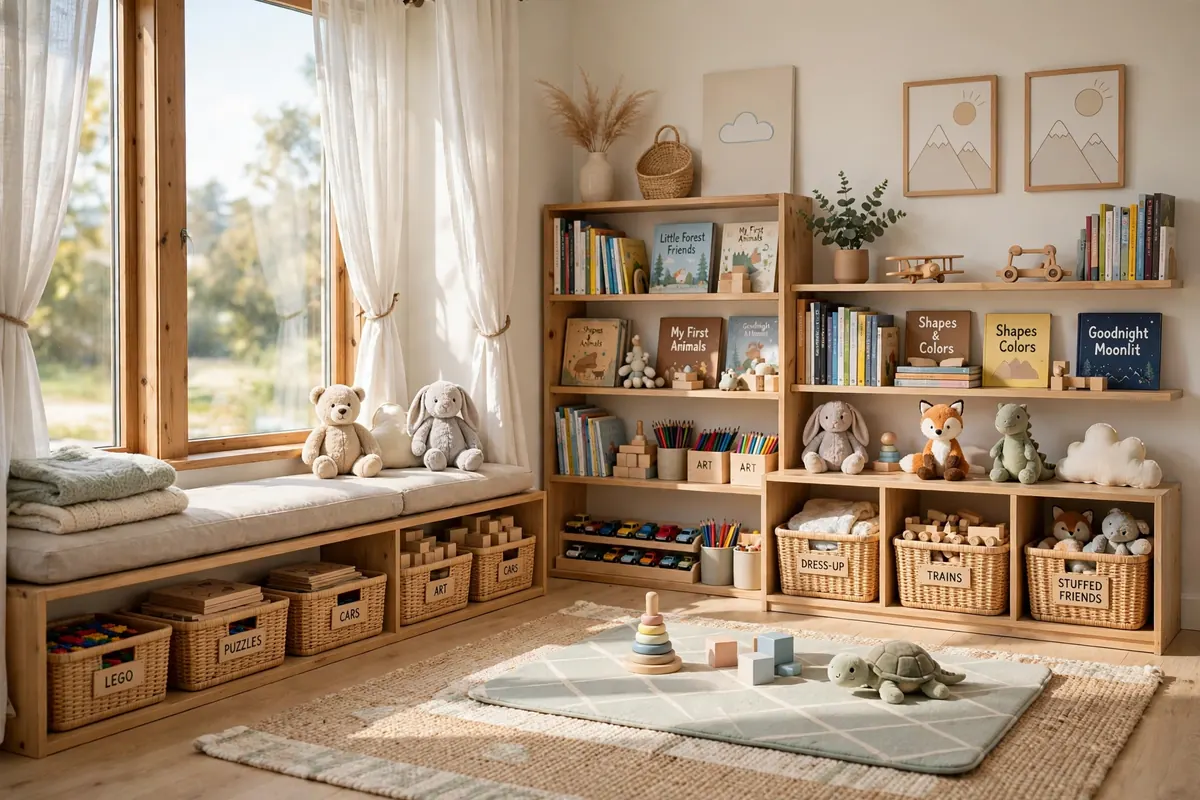

If you have ever stood in the doorway of a playroom and felt your shoulders drop, you are not alone. The floor is a carpet of plastic, there is a puzzle with three missing pieces under the sofa, and somewhere in the chaos is a toy your child has not touched since last Christmas. Learning how to declutter a playroom without turning it into a battleground is one of the kindest things you can do for your family, because the goal is not a showroom. The goal is a room your kids actually enjoy playing in, and that you can walk through without stepping on a rogue building block.
Here is the truth most organizing advice skips: a playroom gets messy because children are using it. That is a good sign. The problem is when the sheer volume of stuff makes play harder instead of easier. Too many toys means nothing gets played with properly, clean-up feels impossible, and every tidy-up ends in tears — sometimes yours. This guide walks you through a calmer way: sort first, involve the kids second, and set up systems they can actually maintain.
Why Playrooms Explode (and Why That Is Normal)
Playrooms rarely get out of hand in a single afternoon. They fill up gradually: birthday gifts, holiday presents, party bags, hand-me-downs from cousins, and craft kits that seemed like a wonderful idea at the time. Each item arrives with good intentions, but nobody ever removes anything to make space. Before long, the room holds twice what it can comfortably contain.
Children also play differently from adults. An adult sees a shelf of toys and thinks in categories. A child sees raw material for a story: the dinosaur belongs in the castle, and the castle needs the tea set. That is wonderful imaginative play — but it also means tidying by strict category alone will never stick. The systems in this guide work with how children play, not against it.
Before you begin, give yourself a realistic window. For an average playroom, plan two to three hours, ideally while younger children are napping or happily occupied elsewhere. You will do the heavy sorting first, then invite the kids in for the decisions that matter to them.
How to Declutter a Playroom by Play Style
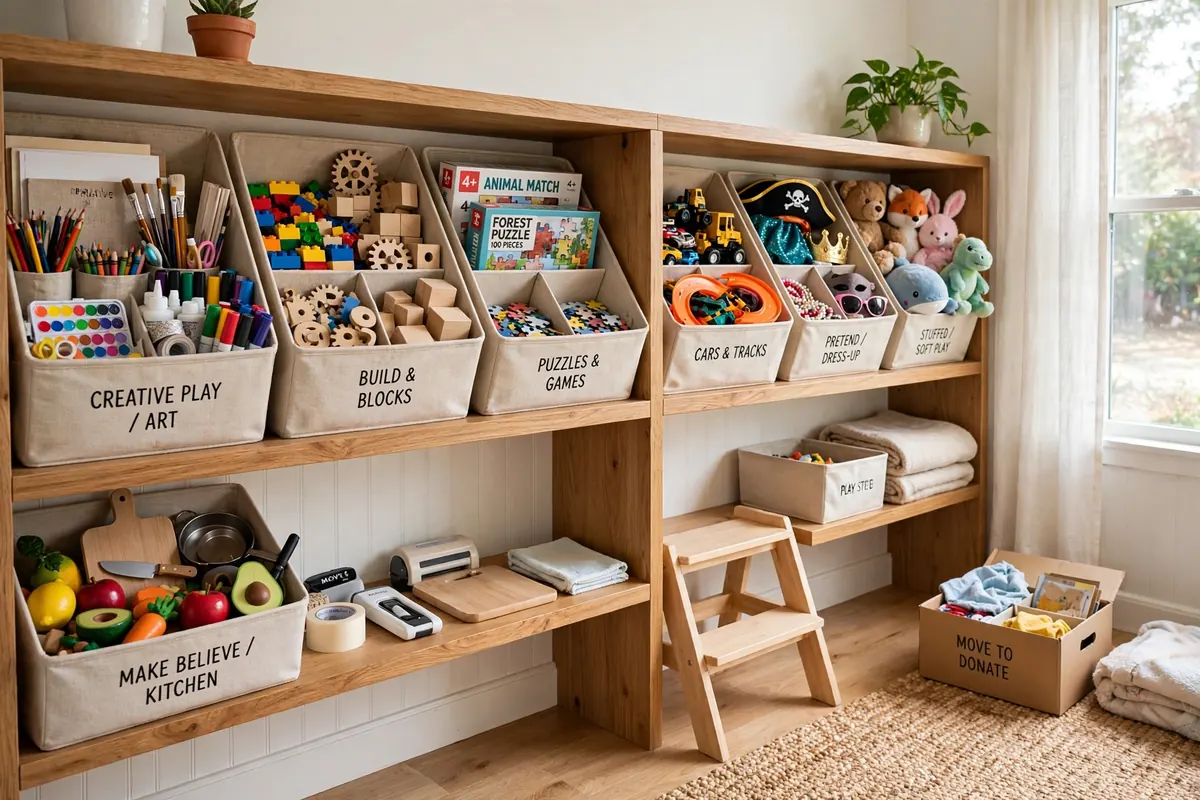
Forget sorting by colour or by brand. The most useful way to sort a playroom is by how your children actually play. Pull everything out and group it by activity — chaotic for twenty minutes, then strangely satisfying.
- Building and construction: blocks, magnetic tiles, train tracks, stacking toys.
- Pretend play: dolls, action figures, play kitchens, dress-up costumes, playhouses.
- Creative play: crayons, paints, craft kits, modelling clay, sticker books.
- Games and puzzles: board games, jigsaws, card games, memory games.
- Active play: balls, ride-ons, skipping ropes, balance boards, sports gear.
- Reading and quiet play: books, audio stories, colouring books, soft toys for bedtime.
As you sort, set aside anything broken, missing essential pieces, or outgrown. A puzzle with half its pieces gone is not a toy, it is clutter wearing a disguise. Be honest about duplicates too: three near-identical craft sets and four water pistols do not make play four times better. Keep the best of each type and let the rest go.
Let Kids Decide — Without the Meltdown
Here is where most playroom declutters fall apart. A parent, armed with a bin bag and good intentions, removes toys while the child is at school, and the child comes home to a room that feels stolen from. Even if they never played with half of it, the loss feels real. Involving children in the decisions is slower, but it is what makes the result last.
Give them real choices within boundaries you control:
- The favourites box: each child picks their ten absolute favourites first. Those are safe, no questions asked. Everything else is negotiable.
- The maybe box: toys they are unsure about go into a box in the garage or a high cupboard for two weeks. If nobody asks for anything in it, the whole box goes to donation without a second debate.
- One in, one out: for every new toy that arrives, one old toy leaves. Frame it as making space for the new favourite, not as punishment.
- Donation with dignity: let children choose where donations go — a younger cousin, a nursery, a charity shop. Knowing a toy will be loved by another child makes letting go feel generous rather than sad.
Expect some wobbling. A child who swore they did not care about the old shape sorter may suddenly clutch it like a long-lost friend. That is normal. Let them keep one or two sentimental rescues without a fuss; the goal is progress, not perfection. If tears do come, pause — a ten-minute break with a snack beats pushing through and turning the whole afternoon into a memory everyone dreads repeating.
If you have already tackled the toy mountain once before, a gentler follow-up approach helps. Our guide to decluttering kids’ toys without tears covers the same keep-or-donate conversation in more depth, including what to do when siblings disagree about shared toys.
The Stuffed Animals and the Artwork Mountain
Every family has two categories that resist all logic: stuffed animals and children’s artwork. Stuffed animals multiply, and each one apparently has a name and a personality. Artwork arrives daily from school and nursery, and throwing any of it away can feel like throwing away childhood itself.
For stuffed animals, try the bed test: if the animal sleeps on the bed, it stays. If it lives in a pile on the floor, it is a candidate for the maybe box. Most children, given a limit — say, the ones that fit in one basket — will choose their true favourites surprisingly quickly. Wash the keepers before they go back; a freshly laundered favourite feels like a new toy.
For artwork and school papers, set up a simple system rather than a shrine. Keep one display spot — a string with clips or a magnetic board — and one keepsake box per child per school year. When the box is full, something old comes out before anything new goes in. Photograph the rest before recycling it: a photo album of artwork takes up no shelf space and is far easier to enjoy years later than a sagging folder of crumpled paintings. The same principle works beyond the playroom; a seasonal rotation habit for clothes and belongings keeps the whole house from creeping back into chaos.
Toy Rotation That Actually Works
Toy rotation is the single best trick for keeping a decluttered playroom decluttered, and it is much simpler than the internet makes it sound. You do not need a spreadsheet or a labelling machine — just two or three boxes and a little discipline.
Split the kept toys into two or three groups, keeping a balanced mix in each: something to build with, something to pretend with, something creative, and a couple of favourites. One group lives in the playroom; the others live in a cupboard or on top of a wardrobe, anywhere out of sight. Every two to three weeks, swap the groups. The toys that come back feel brand new, and the playroom never holds more than it can handle.
A few rotation rules that keep it painless:
- Keep absolute favourites out of rotation. A beloved teddy or the daily building set stays put.
- Rotate on a day you already tidy — Sunday evening works well for many families.
- Let the kids help choose what goes away and what comes back; it builds anticipation instead of resentment.
- If a rotated toy comes back and still gets ignored for a full cycle, it is ready to leave the house.
Rotation also solves the birthday problem. When new toys arrive, they join the next rotation group rather than exploding onto already-full shelves. And if your children share a bedroom as well as a playroom, the same less-is-more logic applies there — these small bedroom storage ideas that really work show how to keep shared sleeping spaces calm without stripping them of personality.
Storage Kids Can Actually Maintain
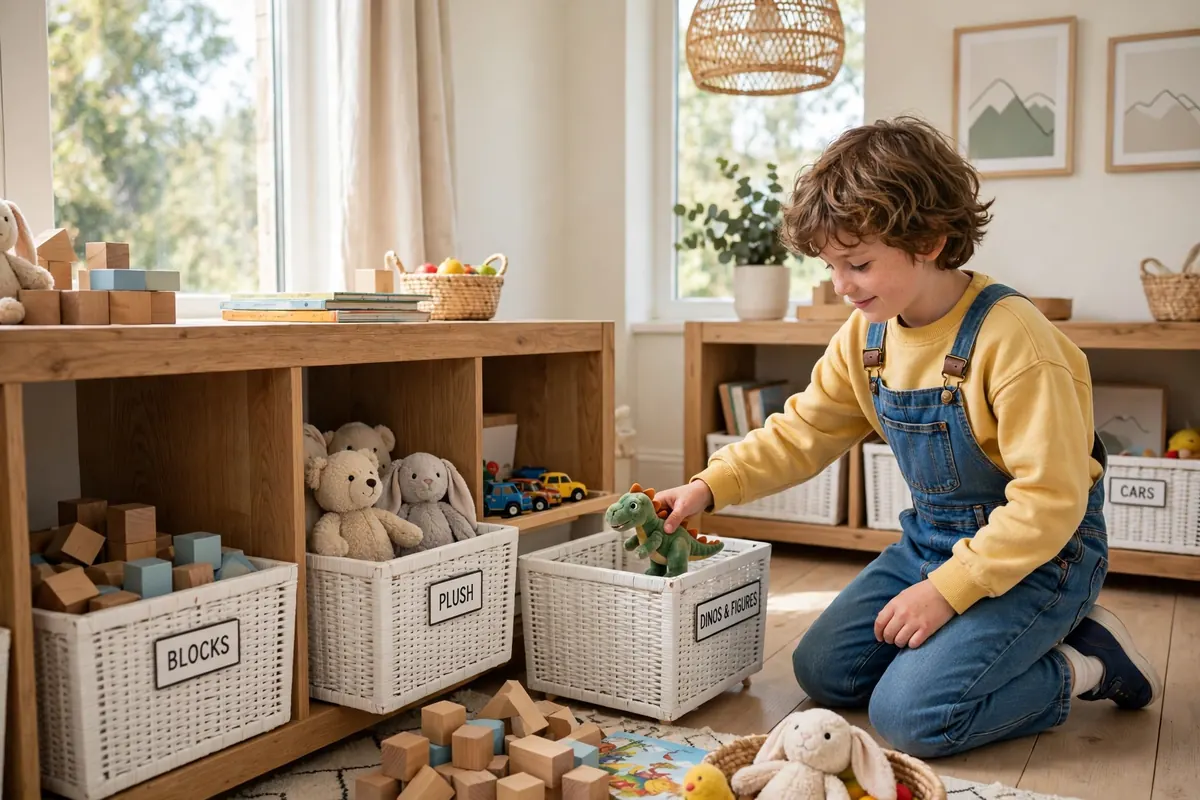
The storage in the room has to be usable by a six-year-old. Open bins beat lidded boxes, low shelves beat tall ones, and labels with pictures beat labels with words for younger children. If putting something away takes more than two steps, it will end up on the floor. Design for laziness; it is the only system children reliably follow.
Zone the room loosely by play style, matching the groups you sorted earlier: building toys near a flat surface, dress-up near a hook rail, art supplies near a wipeable table. A rug can mark the building zone, a small table the art zone — a rough geography helps children remember where things live, and that is half of tidying.
Watch out for the deep-bin trap. A giant toy box where everything gets tossed in together looks tidy for about a day, then becomes a pit nobody can find anything in. Smaller, shallower bins — one per category — mean a child can see what is inside and grab what they want without emptying the whole container.
The 10-Minute Daily Reset
A decluttered playroom will not stay that way on its own, but keeping it tidy does not require a daily deep clean. The 10-minute reset is the habit that makes everything else stick. Pick a consistent time — after dinner, before bath time, or at the end of the school day — and make it part of the routine, not a punishment.
Set a timer for ten minutes and make it a game. Race the clock, play a favourite song, or challenge everyone to find ten things that do not belong. Children who would groan at “tidy your room” will happily compete to beat yesterday’s time. The rules are simple: everything goes back to its zone, rubbish goes in the bin, and anything broken goes in a small “fix or toss” basket by the door.
Once a week, spend five minutes scanning for strays — the odd sock, the library book, the craft supply that migrated from the kitchen table. Small, regular attention beats heroic quarterly purges every single time.
Do not forget the rest of the house. Playroom clutter leaks into bedrooms and hallways, especially when children outgrow clothes faster than you can sort them. Keeping their clothing storage in order — our kids’ closet organization ideas are a good starting point — means one less avalanche waiting to happen.
Decluttering a playroom is not really about the room. It is about giving your children fewer, better choices and giving yourself back an evening that is not spent tripping over toys in the dark. The room will get messy again — that is what rooms for children do — but messy in a room with the right amount of stuff is a ten-minute reset, not a weekend project.
Start small if the whole room feels overwhelming. One shelf today, one bin tomorrow, the stuffed animal mountain on Saturday. Every bag that leaves the house makes the next tidy-up easier, and every time your child chooses to donate a toy themselves, they learn a skill that will serve them far beyond the playroom walls. The tears, yours or theirs, are optional. The calmer, more playable room is not.