
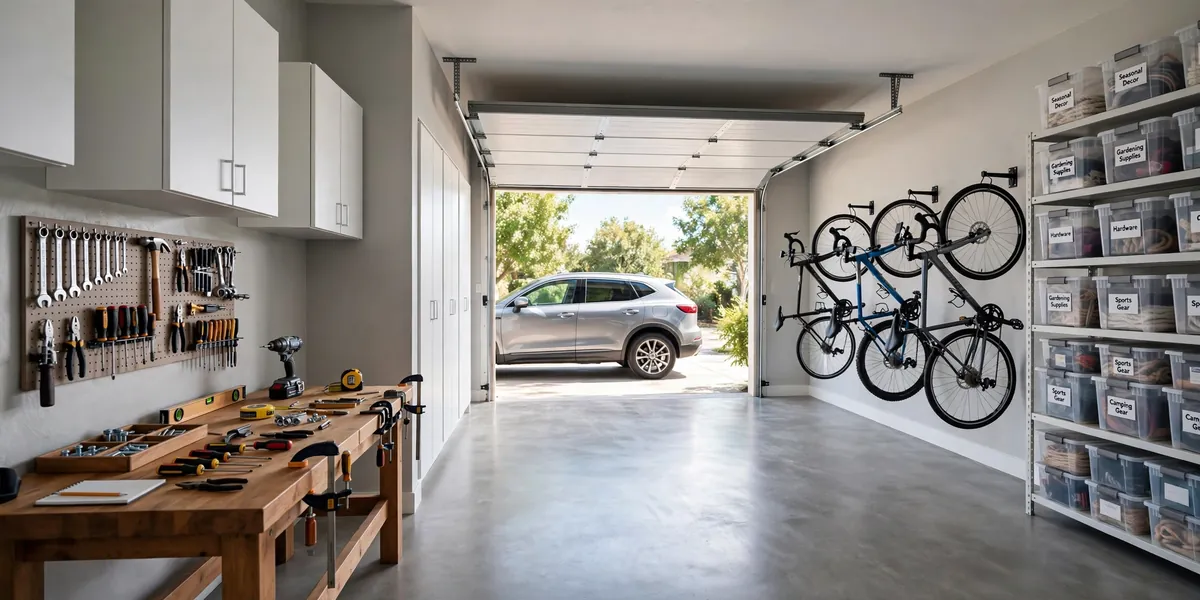

Here’s a question most of us avoid asking: when was the last time you could actually park your car in your garage? If you’re learning how to declutter a garage because yours has slowly turned into a storage unit with a door, you’re in very good company. Garages are where good intentions go to hibernate — the broken treadmill, the paint cans from the nursery you painted in 2019, the box of cables you might need “someday.”
The good news? A garage is one of the most satisfying rooms to declutter. Unlike a closet, where progress hides behind a door, a clean garage is dramatic. You can stand at the end of the driveway on Sunday evening, look at two empty parking spots, and feel like a genuinely different person. This weekend plan gets you there — no marathon suffering, no rented dumpster (unless you need one), just a clear sequence that works.
How to Declutter a Garage in One Weekend: The Game Plan
Before you touch a single box, spend Friday evening on prep. Ten minutes of planning on Friday saves you three hours of standing around on Saturday wondering what to do first.
Gather your supplies
You probably own most of this already. Grab a marker and painter’s tape for labels, a stack of large trash bags, a few empty bins or laundry baskets for sorting, and a broom. If you have a pop-up canopy or tarp, pull it out too — it buys you weather insurance for anything staged on the driveway. Put your phone on a charger and queue up a podcast or playlist; decluttering a garage is physical work, and good audio makes it about 40% more pleasant.
Pick the right weekend
Choose a dry-weather weekend, because half of this project happens on your driveway. Start early on Saturday — 8 or 9 a.m. — when the light is good and your energy is fresh. Tell the household the garage is a construction zone for two days so nobody starts “putting things back” mid-project. If you have a partner or teenager you can recruit, bribe them with lunch. An extra pair of hands turns a two-day project into something closer to a day and a half.
Line up your exits
Nothing kills momentum like a pile of donation bags sitting in the garage for three weeks. On Friday, look up your local donation drop-off hours and a textile recycling point, and schedule any bulky-waste pickup your city offers. And if a move is on the horizon, skim our guide to decluttering before a move — hauling junk to a new house is the most expensive way to store it.
Saturday Morning: Pull Everything Out
Yes, everything. This is the step everyone wants to skip, and it’s the whole secret. You cannot organize a garage by shuffling boxes around inside it — you need to see the full inventory, ideally all at once. Pull the cars onto the street or the end of the driveway, open the garage door wide, and start pulling things out.
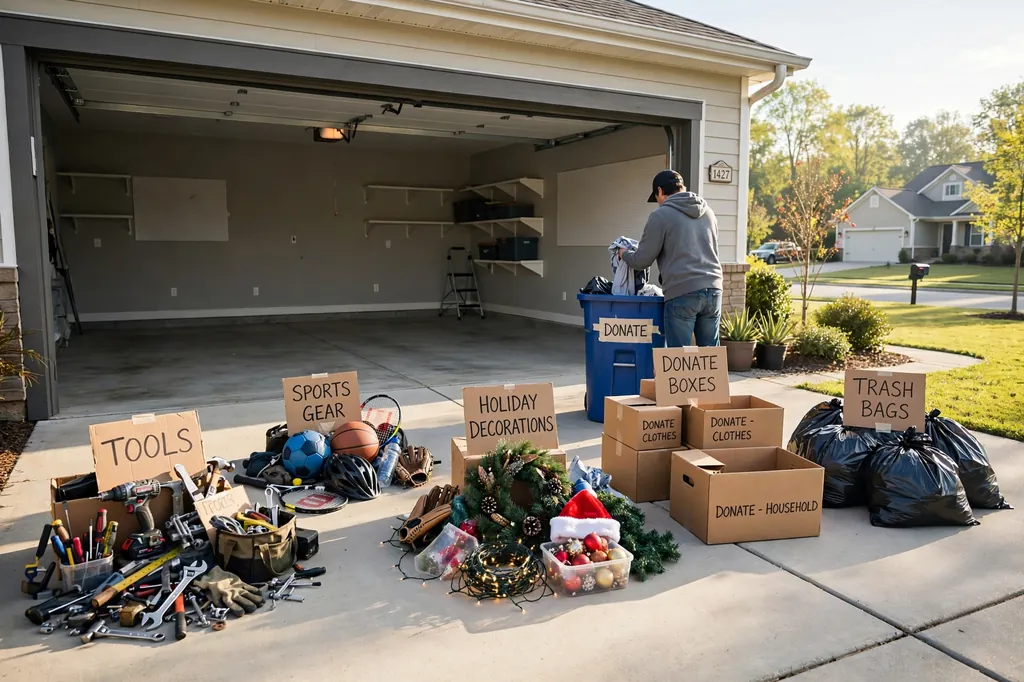
Set up driveway zones
As items come out, group them into rough zones right there on the driveway. Don’t overthink the categories; you can refine them later. Most garages break down into these groups:
- Tools and hardware — hand tools, power tools, screws, nails, the drill you bought for one project
- Yard and garden — rakes, hoses, planters, the lawn mower, bags of soil
- Sports and outdoor gear — bikes, skis, camping equipment, the kids’ scooters
- Car supplies — washer fluid, jumper cables, roof box, cleaning products
- Holiday and seasonal decor — the tree, wreaths, the inflatable reindeer
- Household overflow — this is the danger pile: boxes that drifted out here “temporarily” in 2021
Seeing it all spread out is genuinely shocking the first time. That’s the point. When the driveway looks like a yard sale exploded, you finally understand the scale of what you’re dealing with — and the sorting becomes much easier because you’re comparing things side by side instead of discovering them one dusty box at a time.
The “does it live here?” sweep
Before lunch, do one ruthless pass: pull out everything that doesn’t belong in a garage at all. Garages are terrible storage for paper, photos, mattresses, upholstered furniture, and anything that hates humidity or temperature swings. Old tax paperwork and birthday cards don’t belong next to the lawn chemicals — move those boxes of documents inside and run them through a proper paper filing system instead. Clothes the kids outgrew go to the donation pile, not back on a garage shelf.
Saturday Afternoon: Sort and Purge Like You Mean It
This is the hard part, and there’s no way around it: you have to make decisions. The reason the garage got this way isn’t lack of storage — it’s a backlog of unmade decisions. Every “I might need this someday” box is a decision you deferred. Saturday afternoon is when you make them all.
The four-pile method
For each item, it goes into exactly one of four piles:
- Keep — you use it, it works, and it genuinely belongs in the garage
- Donate or sell — it works, but you don’t use it (the second leaf blower, the bike the kids outgrew two summers ago)
- Trash or recycle — dried-out paint, dead batteries, broken tools, anything expired
- Relocate — it belongs somewhere else in the house
Be honest with yourself about the broken stuff. That weed whacker you’ve been meaning to fix since 2022? It’s not a project, it’s a paperweight. Old paint, pesticides, and chemicals often can’t go in regular trash — most areas have a household hazardous waste drop-off, so bag those separately and check your city’s schedule. Dead batteries go to the auto parts store, not the bin.
Questions that cut through the fog
When you get stuck on an item, ask three questions: Have I used this in the last year? Would I buy it again today? Am I keeping it out of guilt or usefulness? Guilt is a terrible storage strategy. Your dad’s ancient toolbox can stay if the tools work and you use them — not because throwing it away feels disloyal. Keep the memory, donate the rust.
Handle the exits immediately
Load the donation pile into your car the same afternoon and drop it off, or at least schedule the pickup. Tie up the trash bags and get them to the curb or the dump. The goal is to have only two piles left by Saturday evening: keep and relocate. Anything destined for elsewhere in the house gets carried inside tonight — don’t let a “relocate” pile become a new garage fixture.
Sunday Morning: Build Your Zones and Storage
With the purge done, sweep the garage floor. Seriously — sweep it, maybe hose it out, and wipe down the shelves. Putting organized things into a filthy space just feels wrong, and starting from a clean floor makes the whole project feel real. Then it’s time to design the new layout.
Map zones to how you actually live
Forget the Pinterest-perfect garage; design for your habits. Put the things you grab most often near the door to the house — sports gear, reusable shopping bags, the umbrella stand. Car supplies go near where you park. Gardening tools belong near the garage door or the side gate closest to the yard. Holiday decor can live in the least convenient spot because you touch it twice a year. Walk the path you’d take on a normal Saturday and place zones along it.
Go vertical before you buy anything
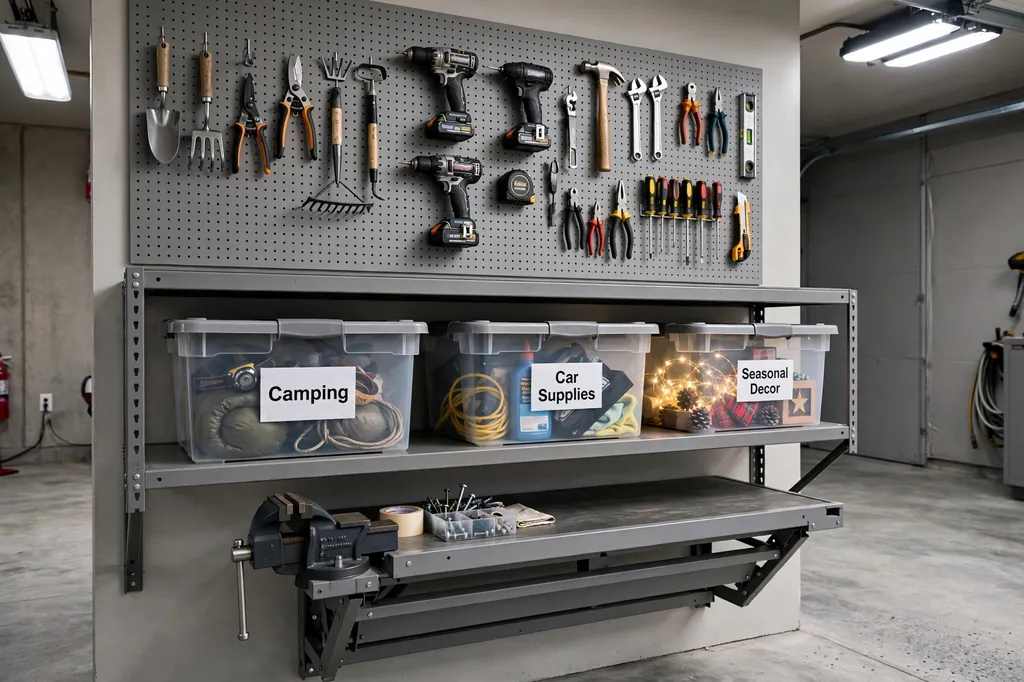
Garages waste an enormous amount of wall and ceiling space while the floor drowns. Before spending a penny, hang what you can: bikes on wall hooks, shovels and rakes on a wall-mounted rack, hand tools on a pegboard above the workbench. Heavy items go at waist height on shelves (never overhead — you’ll thank yourself later), everyday items low and reachable, seasonal stuff up high. Overhead ceiling racks are brilliant for camping bins and the roof box. Only after the walls are working should you buy storage — and then, clear bins with real labels beat pretty opaque ones every time, because you can see what’s inside without opening six boxes.
Contain the small stuff
Screws, batteries, lightbulbs, bungee cords, garden twine — small items are what make a garage feel chaotic even when the big stuff is tidy. Corral them into labeled bins or a small parts organizer on the workbench. The ten minutes this takes pays for itself the first time you need a AA battery and find it in four seconds instead of tearing through a junk drawer.
How to Declutter a Garage and Keep It That Way
Here’s the uncomfortable truth: the garage will fill up again. It always does. Every household generates drift — the box from the delivery you haven’t broken down, the tool you borrowed, the thing that “just needs a spot for now.” Keeping a garage decluttered isn’t about willpower; it’s about systems that make the right choice the easy choice.
The one-in, one-out rule
Every new item that enters the garage should trigger one item leaving. New drill? The old one gets donated or recycled. New set of golf clubs? The ancient set goes. This single habit does more long-term good than any storage system, because it caps the total volume. Put a small donation box or bag in a corner of the garage permanently — when it’s full, it goes to the charity shop. No drama, no second-guessing.
A weekly two-minute reset
Once a week — Sunday evening works well — spend two minutes putting strays back in their zones. That’s it. Two minutes. A rake leaning against the wrong wall, a bin lid left off, a bag that never made it to the car. Catching these while they’re small is the whole game; a garage that’s reset weekly never needs another full weekend purge. If you want to build the habit more broadly, a weekly 15-minute declutter session works wonders across the whole house too.
Seasonal check-ins
Twice a year — spring and autumn are natural moments — do a thirty-minute review. Rotate what’s accessible: bring the garden tools forward in spring, the snow gear in autumn (or the reverse, depending on your climate). Check for anything that expired, broke, or got duplicated over the year. This keeps the garage matched to your actual life instead of slowly fossilizing around last year’s needs.
Your Turn This Weekend
A decluttered garage is genuinely life-changing in the most mundane, wonderful way. You’ll find the screwdriver in seconds. The bikes will be rideable instead of buried. And on some ordinary Tuesday, you’ll pull into your own garage — into a parking spot that didn’t exist a week ago — and wonder why you waited so long. Start Saturday morning, trust the process, and don’t aim for perfect. Aim for better. If the momentum carries you indoors, our room-by-room decluttering guide is waiting. But first: the garage. You’ve got this.
[…] a treadmill parked in the garage for a year is just gym clutter with a different address. Our garage decluttering guide is a good companion if things have already migrated out […]
[…] leave. The same honest questions work at home, too; if you want practice before the big day, our garage decluttering guide walks through the same kind of keep-or-let-go decisions in a smaller […]
[…] not been used in a year and has no clear job ahead, it is a candidate for the donation pile. Our garage decluttering guide walks through this first clear-out step by step, and it is worth doing properly before you spend a […]