
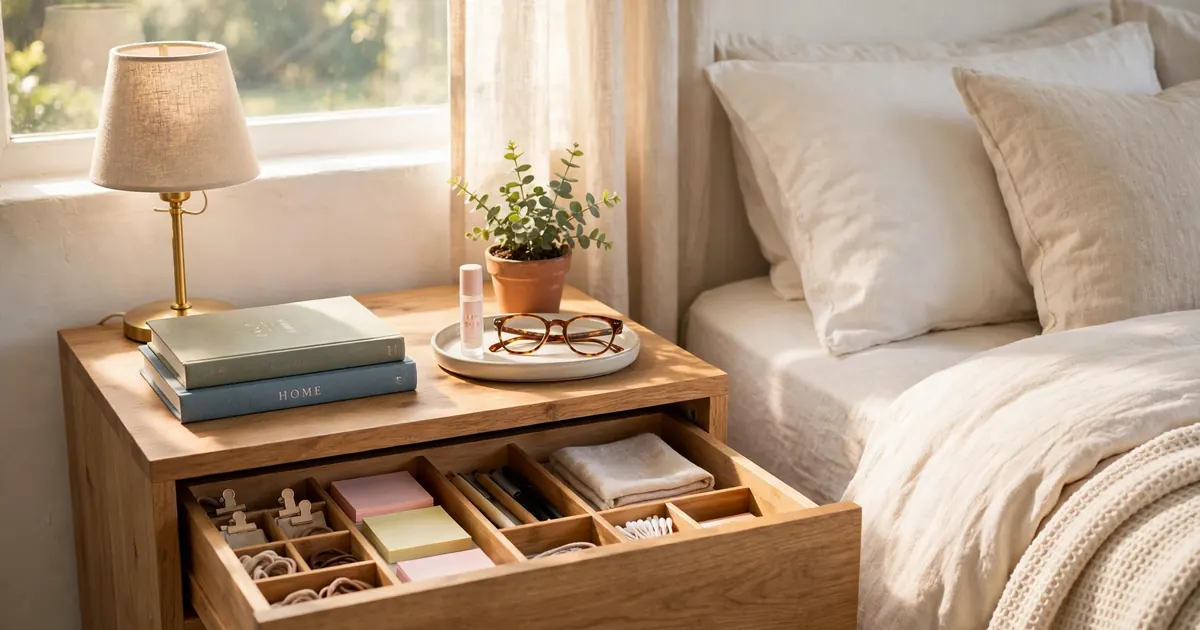

It’s 11:47 at night. You’re half asleep, throat dry, and you reach for the water glass on your nightstand — and instead your hand lands on a cold phone screen, a tangled charger cable, three half-read books, yesterday’s receipts, and something sticky you don’t want to identify. You fumble the lamp on. Light hits a small mountain of clutter sitting roughly twelve inches from where you lay your head every single night — and that is exactly why good nightstand organization ideas matter more than most people realize.
Here’s the thing nobody tells you: the nightstand is the most-used piece of furniture in your bedroom. You touch it more than your wardrobe, more than your dresser. And yet most of us treat it like a junk drawer that happens to be visible. These nightstand organization ideas will change that — not with a shopping spree or a picture-perfect makeover, but with small, realistic systems that survive real life: kids who leave toys on your side, a partner who charges five devices at once, and that one drawer where everything currently goes to disappear.
Start With the Honest 10-Minute Audit
Before you buy a single organizer, empty the whole thing. Both the top and the drawer — everything, onto the bed. I mean everything: the dead pens, the three lip balms (one in each stage of use), the expired cough drops, the book you finished in March but kept “just in case.” This is the only way to see what your nightstand has actually become versus what you think it is.
Once it’s all spread out, sort into four piles. Be fast; don’t overthink it.
- Nightly essentials: things you genuinely use after lights-out — phone, water, lip balm, medication, glasses, the current book.
- Daily-adjacent items: used every day but not at night — earrings you take off before bed, watch, notebook, hand cream.
- Storage-worthy: spare earplugs, the flashlight for power cuts, birthday cards you haven’t filed, backup chargers.
- Doesn’t belong here at all: mail, loose coins, kids’ homework, tools, takeout menus. This pile always surprises people.
Now clean the empty nightstand — a damp cloth, inside the drawer too. You’ll be shocked how dusty it gets behind the lamp. Then only put back piles one and two on the surface or in the top drawer, and give pile three a proper home elsewhere in the bedroom. Pile four goes back to its real homes tonight, not tomorrow. If you’re in a whole-room rut, this little project pairs beautifully with a bigger refresh — our guide on how to declutter a bedroom walks through the same honest-pile method for the entire space.
Nightstand Organization Ideas That Make the Drawer Work Hard
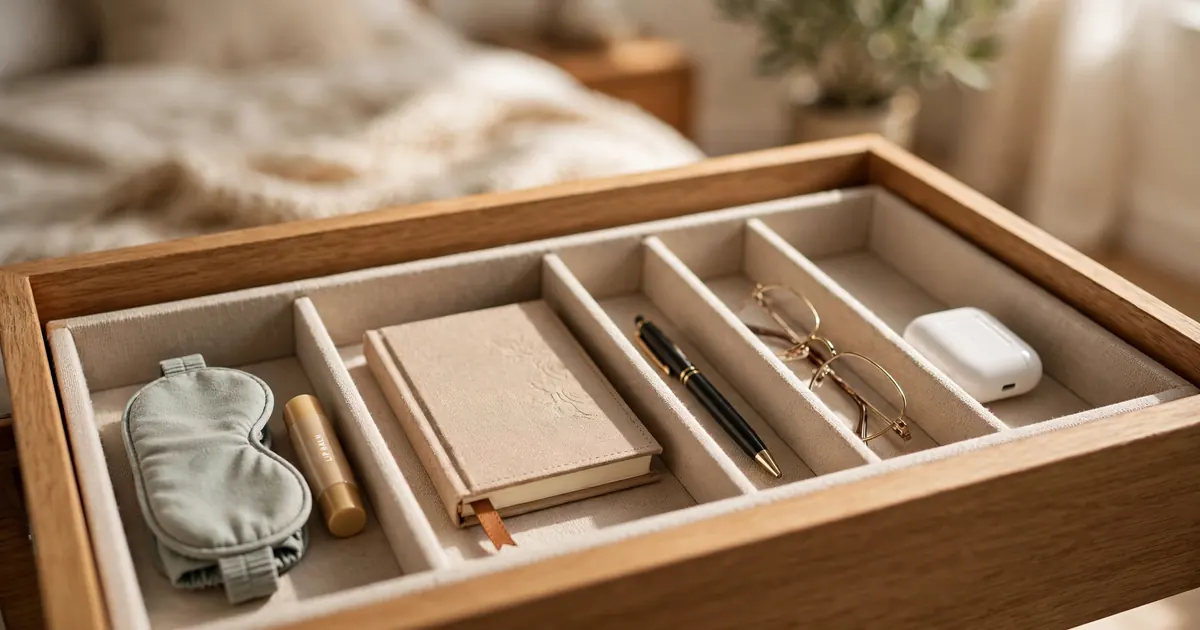
The top drawer of a nightstand is prime real estate, roughly the size of a shoebox, and it deserves better than being a graveyard of tangled cables. The secret is simple: compartments. A drawer without dividers will always become chaos, because small items migrate. A £8 set of bamboo dividers or a couple of small fabric trays changes everything.
Divide your drawer into four zones and assign each one a job:
- Sleep zone: sleep mask, earplugs, melatonin or any nighttime medication, nasal strips — the things that help you actually rest.
- Reading zone: the current book or e-reader, reading glasses, a pen, sticky tabs or a bookmark. Nothing past or future — one book, one pair of glasses.
- Care zone: lip balm, hand cream, a nail file, tissues. The little self-care things you reach for in the dark.
- Tech zone: spare charging cable, earbuds case, a small power bank. This zone is the one most people need most urgently.
One rule that keeps it all working: the drawer holds what you need between dinner and breakfast, and nothing more. The moment you stash a receipt or a random screwdriver in there, you’re one week away from the junk-drawer relapse. When you catch yourself opening it and thinking “I’ll just put this here for now,” pause — “for now” is how drawers die. And if your nightstand has a deep lower drawer or shelf instead, that’s perfect for overflow: spare pillowcases, a backup blanket, or the journal you’re between.
The Surface Rule: Five Things, Maximum
A nightstand surface should hold five things. Count them right now — most people are at eleven. Five is the magic number because it leaves breathing room: you can see every item, wipe the surface in seconds, and nothing hides behind anything else.
The five that earn their place:
- A lamp (or sconce, if you’re freeing up surface — more on that below)
- Water — but not a precarious open glass. A spillproof tumbler or bottle with a lid. Every pro organizer says the same thing: open glasses on nightstands are an accident waiting to happen, and dust settles into them overnight anyway.
- The current book — one. Not a stack of four “maybes.” When you finish it, the next one comes up from the shelf.
- A catch-all dish or tray — a small ceramic dish, a pretty tray, even a saucer. This is where glasses, earrings, hair ties, and the ring go. Without a tray, these scatter; with one, they have an address.
- One beautiful thing — a small plant, a framed photo, a candle. Not clutter. The one thing that makes the corner feel like yours.
Everything else — the phone dock, the alarm clock, the diffuser — goes on the wall, inside the drawer, or to another surface. If you’re thinking “but I need my phone on the surface,” you probably don’t; you need it nearby, which the bedside caddy in the next section handles. Be honest about which items you’re keeping out of habit versus need. The remote you haven’t used since you got streaming? That lives in the living room now.
End the Charging Cable Spaghetti for Good
Let’s talk about the mess that ruins every nightstand: cables. The average bedside has a phone charger, maybe a smartwatch cable, earbud charging, and a lamp cord all converging into one outlet behind the table. It looks like a bird’s nest and it acts like one — every morning you’re untangling something.
The fix depends on how handy you are:
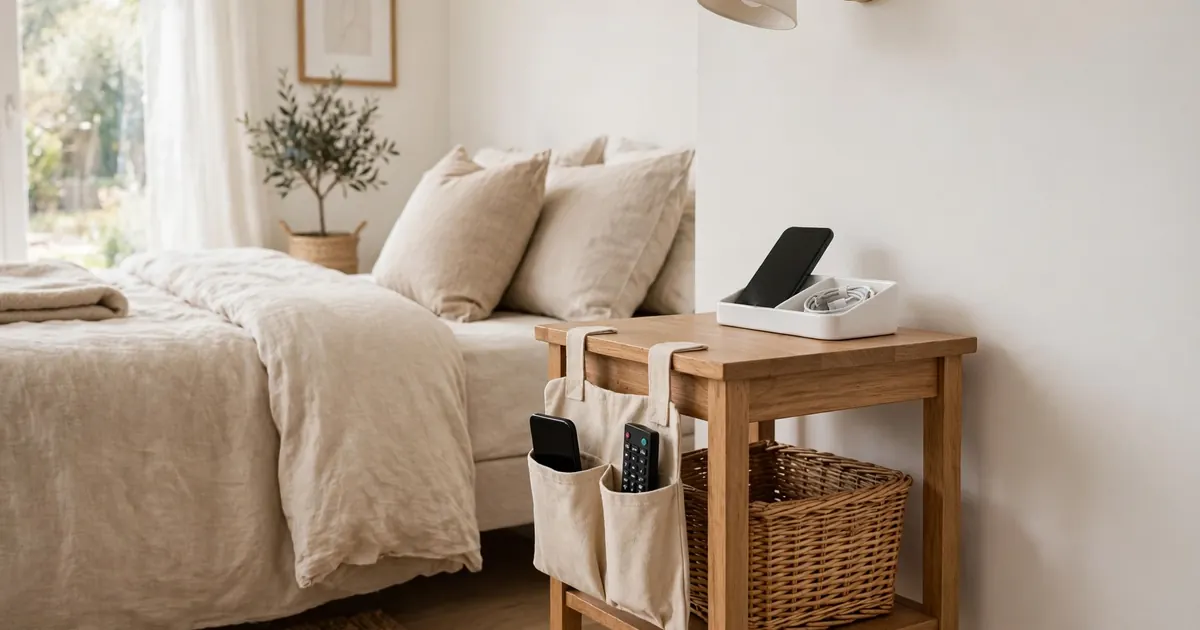
- The five-minute fix: a small charging tray or dock on the surface. One dock that holds phone, watch, and earbuds replaces three loose cables. Corral the cords with a short cable clip stuck to the back of the nightstand.
- The weekend project: a charging drawer. Drill or cut a small hole in the back of the top drawer, run a short power strip or in-drawer outlet kit through it, and charge everything inside with the drawer closed. Measure first — most kits need about two inches of clearance behind the drawer box.
- The renter-friendly move: a bedside caddy that tucks between the mattress and the nightstand. Phone, remote, and book slide into its pockets; cables run down the back. No drilling, no damage, and it costs less than a takeaway.
And here’s a sleep-hygiene bonus worth mentioning: once your phone has a proper home in the drawer or caddy, you’re far less likely to scroll in bed. Several of these nightstand organization ideas do double duty — they tidy the mess and they make the last thing you see at night something calm instead of a glowing screen. If your phone is your alarm, a simple sunrise alarm clock takes over that job beautifully and lets the phone stay parked until morning.
Not everyone has room for a proper nightstand. Studio flats, box rooms, guest beds squeezed into corners — the same principles work, they just need smaller hardware. This is where clever substitutes earn their keep.
Floating shelves are the single best small-space upgrade. A single shelf at mattress height, screwed into a stud, gives you a surface without a single inch of floor space. Add a small basket on it for the drawer-equivalent storage, and you’ve got a nightstand that takes up zero footprint. Renters: heavy-duty adhesive hooks and a narrow wall-mounted basket can approximate this without a single hole.
Wall sconces instead of table lamps. Moving the light to the wall is the fastest way to double your usable surface. A plug-in sconce with a cord cover costs little and installs in minutes — no electrician needed. Suddenly your tiny surface has room for water, book, and the tray.
Sharing one nightstand with a partner? Divide it like a treaty. Each person gets one side of the surface (masking-tape the line for the first week if you must) and one drawer or shelf. The middle holds the lamp and water only. It sounds fussy, but couples who do this report far fewer “who left this here” conversations — and honestly, the visual calm of a shared, bounded surface does something nice for the whole relationship with the room. For more ways to make a compact sleep space pull its weight, our small bedroom storage ideas guide goes far beyond the bedside.
Kids’ rooms count too. A child’s nightstand has different residents — a water bottle, the current library book, a comfort toy, maybe a nightlight — but the same rules apply: one surface tray, one drawer zone, five things max. Giving a child their own tiny organized bedside actually teaches the habit better than any lecture. Our kids bedroom organization ideas cover the whole room if bedtime clutter is a family-wide project.
The Two-Minute Nightly Reset
Here’s the uncomfortable truth about every organization system ever written: it only works if you maintain it, and maintenance only happens if it takes under two minutes. So here is the entire nightly reset routine. Do it while your phone charges, right before you get into bed.
- Return the strays: anything on the nightstand that isn’t one of your five surface items goes back to its home — the book you abandoned, the snack wrapper, the hairbrush.
- Close the loop: drawer shut, charging cables tucked, water tumbler refilled if needed.
- Wipe and scan: once a week, a quick wipe of the surface. Dust gathers fast in bedrooms — it’s mostly fabric fibers and, frankly, skin cells, so a damp microfiber cloth every Sunday keeps it from building up.
That’s it. Two minutes, and you wake up to a clear surface instead of a to-do list in furniture form. This tiny ritual slots neatly into a broader evening wind-down — if you like routines that actually stick, our morning reset cleaning routine pairs with it on the other end of the night, fifteen minutes that make the whole house feel handled before the day starts.
A calmer corner, one drawer at a time.
You don’t need a new nightstand. You don’t need a haul of organizers or a weekend project that takes over your life. You need an honest ten minutes with four piles, a drawer with dividers, five things on the surface, and a two-minute habit at night. That’s the whole system.
The payoff is disproportionate to the effort. There’s something deeply settling about reaching for water in the dark and finding water — not a tangle of cables and yesterday’s mail. Your nightstand is the last thing you see at night and the first thing you see in the morning. Make it calm, and the rest of the room — and honestly, the rest of the day — follows a little more easily.