


You know that feeling when you walk into your bedroom at night, exhausted, and instead of winding down, your brain starts cataloging everything wrong with the room? The laundry pile on the dresser. The book tower wobbling on the nightstand. The armchair that quietly became a second closet. If you have been searching for how to declutter a bedroom without spending three weekends on it, this plan was written for you: one Friday evening of quiet prep, one Saturday of focused work in two manageable sessions, and one slow Sunday morning of finishing touches. No marathon sessions, no guilt trips, and no black bags that never leave the house.
This is a plan for real bedrooms — the kind with a nightstand drawer full of random chargers, a closet floor you have not seen in months, and a laundry chair. It is built around the way tired people actually work: in short blocks, with breaks, and with rules simple enough to follow when motivation is running on fumes. By Sunday lunch, you will fall asleep in a room that feels calm instead of demanding.
Why Your Bedroom Collects Clutter Faster Than Any Other Room
The bedroom is the only room in the house where clutter is invisible to everyone but you, which is exactly why it accumulates. Guests see the living room, the kitchen, the hallway — so those get the emergency tidy-ups. The bedroom door closes, and inside, the slow pile-up begins: mail that wandered in, clothes that are clean but not put away, books you meant to return, receipts you meant to file, that gift bag from your sister’s birthday that never got recycled.
There is also a sneaky middle category that causes most bedroom mess: transition clothing. These are the garments not dirty enough for the hamper but not clean enough for the closet. They end up on the chair, the floor, or the foot of the bed, and within a week there is a soft, chaotic mountain of them. One small hook or valet stand defeats this category entirely.
The good news is that bedrooms are actually the easiest rooms to declutter. It is mostly clothes, books, bedding, and surfaces — categories with straightforward keep-or-let-go rules. That is why a single weekend, done deliberately, is genuinely enough.
Friday Evening: The 45-Minute Setup (No Actual Decluttering Yet)
Do not touch a single item on Friday. The whole point of tonight is to make tomorrow effortless, because the number one reason bedroom declutters fail is that people start Saturday morning by wandering around the room wondering where to begin. You will not do that. Here is your Friday checklist:
- Gather supplies: two sturdy donation bags or boxes, one trash bag, one laundry basket for items that belong in other rooms, a box or bin labeled “relocate,” and cleaning basics — a dust cloth, an all-purpose spray, and the vacuum.
- Clear a staging area just outside your bedroom door — a hallway corner or landing works perfectly. This is where donation bags and the relocate bin will wait, so nothing piles up inside the room again.
- Plug your phone charger in another room. It breaks the habit of scrolling in bed and forces you to decide what actually belongs on the nightstand.
- Strip the bed and start a load of laundry with the sheets. Saturday afternoon you will remake the bed with fresh bedding, and that one change alone transforms the room’s mood.
- Write your Saturday plan on a sticky note and put it on the door: “Saturday 9–12: closet and dresser. Saturday 2–4: surfaces and floors. Sunday 10–12: finishing touches.” Seeing it in writing turns a vague intention into an appointment.
Eat something comforting and go to bed at a decent hour. Saturday goes much better when you are not already exhausted.
Saturday Morning: How to Declutter a Bedroom Closet and Dresser in Three Hours
Start with the closet, the biggest storage zone and the most visible win. Set a timer for three hours and work one section at a time — hanging clothes, shelves, then the closet floor — taking everything out before you decide anything. The shock of seeing the full volume laid out on the bed is the feature, not a bug: it makes the letting-go decisions honest.
For every single item, ask three questions and accept the first honest answer: Have I worn this in the last twelve months? Would I buy it again today at full price? Does it fit the way I want to feel getting dressed? If an item fails all three, it goes into donation — no “maybe” pile, no second chances drawer. If you are genuinely unsure about something, use the two-week rule: put it in a dated box in the staging area, and if you have not thought about it in fourteen days, it goes to donation unopened. It helps to know the common decluttering mistakes that trip people up right at this stage.
What goes back in gets organized by category, not by color — all tops together, all trousers together, sleepwear in one drawer zone. File-fold t-shirts and knitwear so you can see every piece at a glance instead of digging through stacks. Move off-season clothes into under-bed boxes or the top shelf in labeled bags, which frees an astonishing amount of prime closet real estate. If your closet is genuinely tiny even after the purge, a few targeted small bedroom storage ideas can buy you real breathing room without a single piece of new furniture.
When the timer goes off, stop, even if you are mid-drawer. Close the closet doors, eat lunch away from the room, and do something unrelated for an hour. Decision fatigue is what leads to shoving things back “for now” — which is how the clutter started in the first place.

Saturday Afternoon: Surfaces, Nightstands, and That Chair
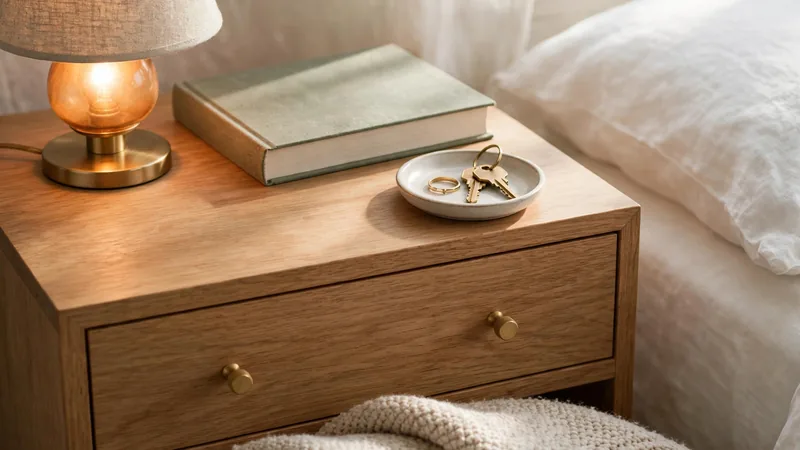
Surfaces are where a bedroom either feels calm or feels chaotic, so this session is about giving every flat area a ruthless edit. Start with the nightstand, because it is the first thing you see in the morning and the last thing you see at night. Take everything off it. Now choose the three to five items that earn the right to live there: a lamp, your current book, a glass of water, maybe a small dish for a ring and lip balm. The dead batteries, the receipts, the three half-used hand creams, the mystery cables — they go. If your nightstand has a drawer, it gets one category only (sleep essentials, for example), not a junk drawer with a bedside view. A little dedicated nightstand organization — a small tray to corral the keepers, drawer dividers inside — keeps it from sliding back into chaos within a month.
Move to the dresser top, the desk, and any shelves with the same rule: three to five intentional items per surface, everything else either gets a home inside a drawer or leaves the room. The chair is next. Sort the pile honestly: clean items get hung or folded immediately, worn-once items go on the new hook or valet stand you set up for transition clothing, and genuinely dirty items go straight in the hamper. No fourth option exists. Then clear the floor completely — shoes into the closet, the laundry basket emptied, stray socks reunited with partners or retired.
Finally, deal with the “relocate” items: everything in the room that belongs somewhere else. Carry the basket through the house and put each item in its actual home right now. Bedrooms become clutter magnets because they are where displaced objects hide — evicting them breaks the cycle.
Sunday: The Slow Finish — How to Declutter a Bedroom When You Are Already Tired
Sunday morning is deliberately gentle. You have done the heavy lifting; today is about finishing with fresh eyes. Walk the room slowly with a trash bag — Saturday-you missed things, and that is fine. The gift bag, the expired coupons on the dresser, the cracked phone case, the single earring whose partner vanished two apartments ago. This last sweep is what makes the room feel finished rather than just “better.”
Remake the bed with Friday’s fresh sheets: pillows upright, the throw folded across the foot. Three minutes, and it signals to your brain that this room is done. Vacuum under the bed and behind the nightstands while the floor is clear. Then carry the donation bags to your car immediately — trunk, not backseat — so the next errand run takes them away. Donation bags that stay in the house have a remarkable ability to migrate back inside.
Before you close the door on this project, set one rule — just one, because ten collapse by Wednesday. The one-in-one-out rule is the perfect candidate: every new item that enters the bedroom retires an old one. New pajamas in, worn-out pair out. It is small, it is automatic, and it quietly prevents the slow re-accumulation that undoes most weekend declutters.
Five Habits That Keep the Bedroom Calm After the Weekend
These five habits take minutes combined, and they are the difference between a room that stays serene and one that needs another weekend in six months:
- The two-minute nightly reset. Before bed, set a timer for two minutes and return every stray item to its home — clothes on hooks or in the hamper, book on the nightstand, glass to the kitchen. It prevents the nightly creep that starts every clutter avalanche.
- Make the bed every morning. It takes ninety seconds, and it does something psychological: a made bed makes the rest of the room look tidier, which makes you more likely to keep it that way. It is the highest-return habit in the entire house.
- No flat-surface parking. Mail, bags, and random objects enter the bedroom only if they have a designated home. The moment the dresser becomes a mail tray, surfaces start inviting more clutter.
- A weekly five-minute closet check. Every Sunday, glance through the hanging clothes and rescue anything that migrated to the floor or got shoved back on a hanger wrong. Catching it weekly means you never need another three-hour closet session.
- The seasonal swap. Twice a year, when you rotate seasonal clothes, do a mini-declutter at the same time. Items that sat untouched for a whole season are telling you something — listen, and let them go.
In a small apartment where the bedroom doubles as an office and a reading nook, these habits matter even more — small rooms show clutter faster, but they also respond faster. A two-minute reset is genuinely enough to keep the whole space calm.
Here is the part nobody tells you about how to declutter a bedroom: the real payoff is not the tidy closet. It is what happens at night, when you walk in exhausted and your brain finds nothing to catalog. No laundry mountain to process, no chair-pile to feel guilty about, no buzzing sense that you should be doing something. Just a made bed, a clear surface, and a lamp. Your nervous system reads visual chaos as unfinished business, and unfinished business is the enemy of rest.
You did not just organize a room this weekend. You gave yourself a place where the day actually ends. Protect it with the two-minute reset, respect the one-in-one-out rule, and the next time you come home tired, the room will do its real job: letting you rest.
[…] in a whole-room rut, this little project pairs beautifully with a bigger refresh — our guide on how to declutter a bedroom walks through the same honest-pile method for the entire […]
[…] room feels like a bigger project than the floor, that’s a different job with its own rhythm; this guide to decluttering a bedroom walks through the full room-by-room approach. But for most of us, the floor was never a whole-room […]
[…] you’ve ever thought about decluttering your whole bedroom, the charging station is an excellent place to start. It’s a small, contained project you can […]