

There is a special kind of tiredness that comes from working at a desk that is also, somehow, a dumping ground. The charger tangle next to your coffee. The notebook under the notebook. The stack of mail you moved from the kitchen counter to the desk, where it promptly stayed for three weeks. If you work from a small apartment, a studio, or a corner of your bedroom, you know this exact feeling. And that is exactly why small home office storage ideas matter so much more than they seem to at first glance — because in a tiny workspace, every object either earns its place or steals your focus.
Here is the honest truth I have learned from years of working in tight quarters: you do not need a bigger desk. You need a desk that stops asking you to store everything on top of it. A good small-space setup pushes things up the walls, tucks them under the surface, and hides the ugly stuff so your eyes can rest. This guide walks through exactly how to do that — from the audit you do before buying a single organizer, to furniture choices that earn their square footage, to renter-friendly tricks that do not touch the walls.
If your office is a spare wall in the living room, a closet you converted, or the three feet between your bed and the window, these ideas are built for real square footage, not showroom square footage.
Start with a storage audit, not a shopping trip
Before you buy anything — before you even browse — pull everything out of your work area and sort it into four piles on the floor. Yes, on the floor. You need to see it all.
- Daily tools: laptop, charger, notebook, pen, water bottle, headphones. These stay within arm’s reach.
- Weekly items: a folder of current paperwork, the camera you use for video calls, your planner. These live close, but not on the desk.
- Occasional things: tax folders, reference books, the good pens, spare cables. These belong in closed storage.
- Not yours / not work: the candle you were gifted, last week’s grocery receipt, your partner’s sunglasses. Return them where they belong.
For most people working in small apartments, the desk becomes a catch-all because nothing else in the home has a defined landing spot. Giving the whole apartment a bit more structure — not just the desk — makes the office corner easier to keep clean. If the rest of the home feels chaotic too, start with the broader playbook in our storage ideas for small apartments and watch how much lighter the desk feels once the apartment stops leaking stuff onto it.
Small home office storage ideas that use your walls instead of your floor
Floor space is the currency of small homes. The single most effective small home office storage ideas share one trait: they move storage onto the wall, above the desk line, where it costs you zero floor space.
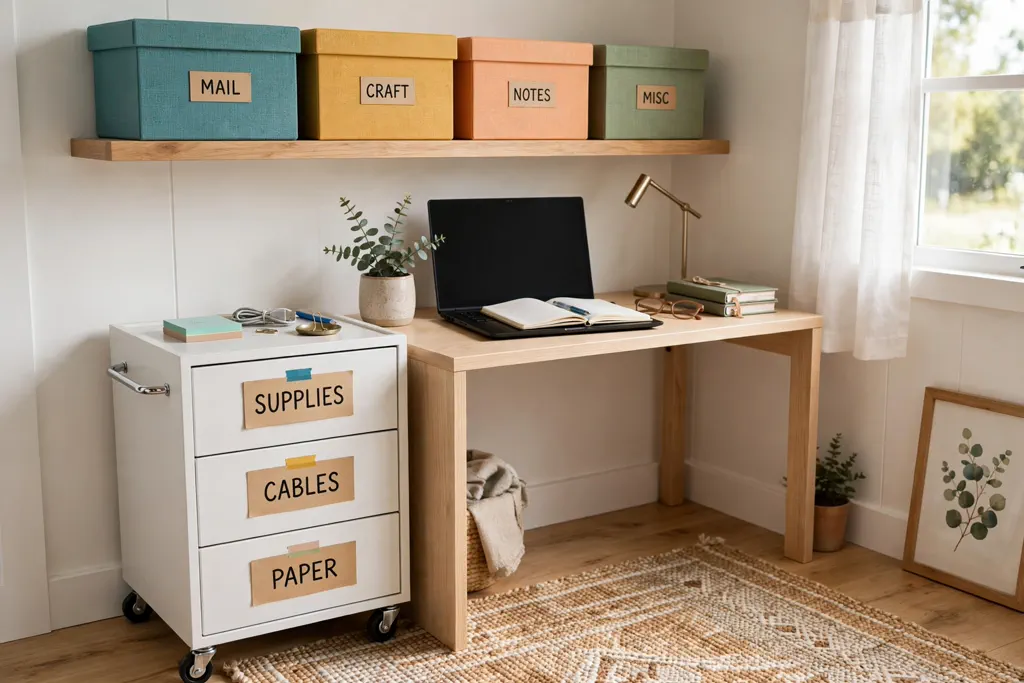
Floating shelves above the desk. Two shallow shelves — eight to ten inches deep is plenty — hold binders, reference books, and a couple of labeled boxes. Keep the closest shelf for things you grab daily, and push rarely used stuff to the top.
A pegboard as a command center. A pegboard over the desk is the hardest-working square footage in a small office. Small bins hold pens and sticky notes, hooks hold headphones and cables, a tiny shelf holds a plant. Everything stays visible and off the desk surface.
Wall-mounted drop-leaf desks. If your desk only needs to exist during work hours, a drop-leaf or fold-down wall desk is a beautiful answer. Open it in the morning, close it at five, and your bedroom or living room gets its space back for the evening. Pair it with a slim wall cabinet or a hanging file holder mounted at the same height, and the whole workstation becomes nearly invisible when folded.
Think in vertical zones. Organize the wall from the desk upward in three bands: the reach band (desk to about 20 inches up) for daily supplies, the eye band (20 to 50 inches) for reference and décor, and the high band (above 50 inches) for archives and rarely used supplies. This simple framework stops you from stacking things randomly. For more on working the full height of a room, see our guide to vertical storage ideas for small spaces — nearly every trick there applies directly to a home office corner.
Choose furniture that does double duty
In a small home office, every piece of furniture has to justify itself twice. A chair is a chair. But a desk with storage, a stool with a lid, or a bookshelf that divides the room — those are doing real work.
- Rolling drawer units. A slim three-drawer unit on casters tucks under or beside a desk and holds an entire office: drawer one for supplies, drawer two for cables and chargers, drawer three for paper and envelopes. When you need legroom, roll it into the closet. When the workday starts, roll it back out.
- Storage ottomans and benches. If your office shares space with a living room or bedroom, an ottoman that holds spare cables, notebooks, and the laptop bag doubles as extra seating. Nobody walking into the room sees “office clutter” — they see furniture.
- A bookshelf as a room divider. In a studio, a low bookshelf placed perpendicular to the wall creates a psychological boundary between “work” and “home.” The side facing the living area holds books and décor; the side facing the desk holds office supplies and files. Two zones, one piece of furniture.
- Corner desks. Corners are dead space in most rooms, and an L-shaped or triangular corner desk turns that dead space into the most productive square feet in the house. Corner setups also naturally create a little “alcove” feeling, which helps the space read as an office rather than a desk that wandered into the bedroom.
A deep, heavy desk in a smaller room leaves no room to breathe. Narrower is better — a 20-inch-deep surface fits a laptop, a notebook, and a mug with room to spare, and it leaves floor space for your chair to actually roll.
If your workspace sits in an awkward corner of a larger room, you will also find useful angles in our corner storage ideas for small rooms, which covers the shelves, racks, and furniture shapes that make dead corners pull their weight.
Tame the paper, cables, and small stuff that multiplies
Paper and cables are the two things that turn a tidy desk into a disaster in under a week. Neither one is dramatic on its own; they win by volume and invisibility. The fix is a system, not willpower.
For paper: give every piece of paper exactly one of three destinations the moment it enters the workspace. An inbox tray for anything that needs action this week, a slim wall-mounted file holder for the current project, and a single archive box on a high shelf for anything you must keep but rarely touch. Scan what you can. The people who drown in paper are rarely the ones who get a lot of it — they are the ones who never decided where it goes.
For cables: mount a small power strip under the back edge of the desk with adhesive clips, and coil the excess length of each cable with a Velcro tie. One cable channel running down the desk leg hides everything that drops to the floor. Label each charger with a tiny piece of washi tape so you are not unplugging the wrong brick in a panic.
For the small stuff: pens, sticky notes, USB drives, the spare batteries — corral them in one shallow tray or drawer organizer. The rule is simple: small items never live loose on a surface. The moment a paperclip lands on bare desk, it has started a colony. Give it a home before it invites friends.
Renter-friendly ways to add storage without drilling holes
Renters get the trickiest version of this problem. The walls are not yours, the lease says no holes, and your landlord considers a shelf bracket a personal betrayal. None of that means you are stuck with a cluttered desk.
- Over-the-door organizers. The back of any door near your workspace is free real estate. A clear-pocket organizer holds office supplies, notebooks, cables, and chargers, and it comes down in seconds on moving day. Our full breakdown of over-door storage ideas covers the pocket types that work best for office supplies versus heavier items.
- Tension rods and spring-loaded shelves. A tension rod inside a closet or alcove creates an instant second shelf for boxes. Spring-loaded shower-style shelves wedge between walls and hold surprisingly heavy loads.
- Adhesive hooks and strips. Modern adhesive strips hold a real amount of weight — enough for a small whiteboard, a hanging file holder, or a charging station. Use them for lightweight wall storage and keep the heavy stuff on the floor.
- Freestanding everything. A narrow rolling cart, a leaning ladder shelf, or a tall thin bookcase needs no wall attachment at all. Ladder shelves are especially kind to renters: they lean, they hold a lot, and they leave no trace.
- Furniture-mounted add-ons. Clip-on desk shelves, under-desk drawer units that screw into the desk (not the wall), and monitor risers with built-in storage add capacity to furniture you already own.
When your lease eventually ends, every one of these solutions packs into a box in minutes — which, honestly, is another argument in their favor.
A simple weekend plan to reset a cramped workspace
You do not need a full renovation. You need one focused weekend and a trip to the hardware store. Here is the order that works:
Saturday morning: the purge. Do the four-pile audit from the first section. Be honest about the “occasional” pile — if you have not touched it in six months, it belongs in a closet or on a high shelf, not in your work zone. Take the donation bag out the same day.
Saturday afternoon: the wall. Install your vertical layer — one floating shelf, one pegboard, or one over-the-door organizer, whichever fits your situation. This is the step that creates the biggest visible change for the smallest amount of work, because it instantly clears the desk surface.
Sunday morning: the systems. Set up the paper flow (inbox, current-project file, archive box), mount the power strip under the desk, and corral the small items into one tray or drawer. Label everything.
Sunday afternoon: the styling. This is not vanity — it is maintenance. Add the plant, the decent lamp, the one framed print. A workspace that looks intentional is a workspace you will protect from clutter.
Then live with it for two weeks and adjust. Maybe the pegboard bins are too small, maybe the drawer unit works better on the other side of the desk. The perfect layout is the one you tune after living in it, not the one you planned on paper.
Small spaces reward intention, not square footage
A calm, capable home office in a small space is not about owning less or buying more — it is about deciding where things live and defending those decisions. Put the walls to work, choose furniture that earns its footprint twice over, give paper and cables their systems, and work around the rental rules instead of fighting them. Most of these ideas need an afternoon and a little honesty about what your workday actually looks like.
The payoff is bigger than a tidy desk. When your workspace holds only what the day needs, your brain stops cataloging the mess every time you sit down. The corner of the bedroom stops feeling like a compromise and starts feeling like a place where real work gets done.
[…] where everything goes, start under the bed — it has been waiting. For more, see our guides on small home office storage and corner storage […]
[…] come back there. If you’re also carving a workspace into your studio, the ideas in our guide to small home office storage ideas pair perfectly with the zoning approach […]
[…] Within the current size, sort by type rather than by colour or cuteness: all the sleepsuits together, all the vests together, all the daytime outfits together. Drawer dividers or small fabric boxes will do the job — the container matters far less than the consistency. When anyone else looks after the baby, they should be able to find a clean outfit without asking you where things live. If they cannot, the system needs simplifying, not more containers. The same discipline runs through our guide to small home office storage ideas that actually work. […]