
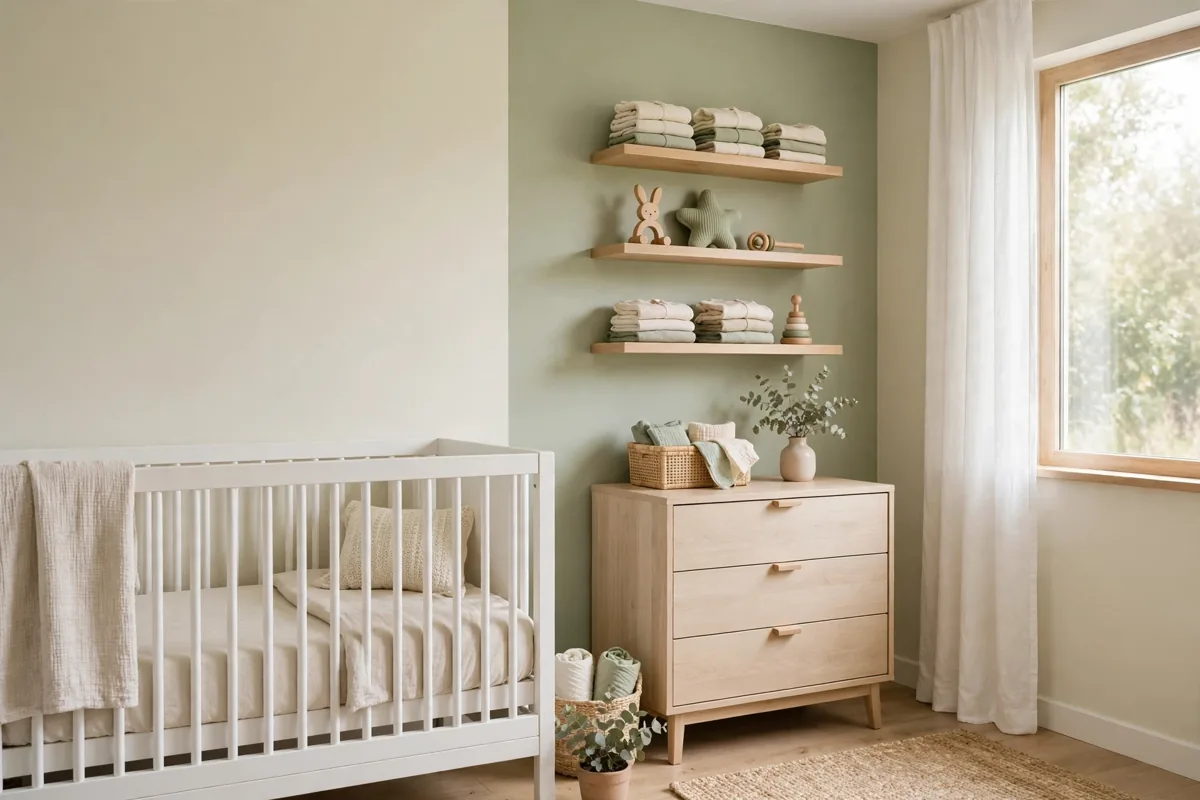

If you are setting up a nursery in a spare bedroom, a box room, or a corner of your own bedroom, you already know the truth: babies are tiny, but their stuff is not. These small nursery storage ideas are built for exactly that problem — a room where every inch has to earn its place, and where you need to find a clean sleepsuit at 3 a.m. without turning on every light in the house. The good news is that a tiny nursery can work beautifully. It just needs a different approach from a big one: furniture that does two jobs, walls that carry their weight, a closet planned like a proper storage system, and a firm habit of keeping only the current size within reach.
The nurseries that stay calm are rarely the ones with the most storage furniture. They are the ones where each thing has one obvious home, and where the changing supplies live within arm’s reach of the changing pad.
Before You Buy Anything, Measure and Map the Room
It is tempting to start with shopping. Resist it for one evening. Instead, grab a tape measure and sketch the room properly: door swing, window position, radiator or vent, plug sockets, and the spot where the crib must go. In a small nursery, the crib usually decides everything else, because it is the largest item and the one with the strictest safety rules around it. Place it first, on paper, and fit everything else around it.
Measure the gaps that matter, not just the walls. How much space is under the crib? How deep is the closet? How wide is the wall beside the changing area? Keep these numbers on your phone when you shop. So many mistakes come from buying a basket or cart two centimetres too wide for its gap. While you are measuring, notice the dead zones: the wall above the dresser, the back of the door, the top shelf of the closet. These are where a small room quietly gains storage without losing floor space. If your nursery shares a room with something else, our guide to small bedroom storage ideas that really work shows how to carve storage out of rooms that serve two purposes at once.
Small Nursery Storage Ideas That Start With Double-Duty Furniture
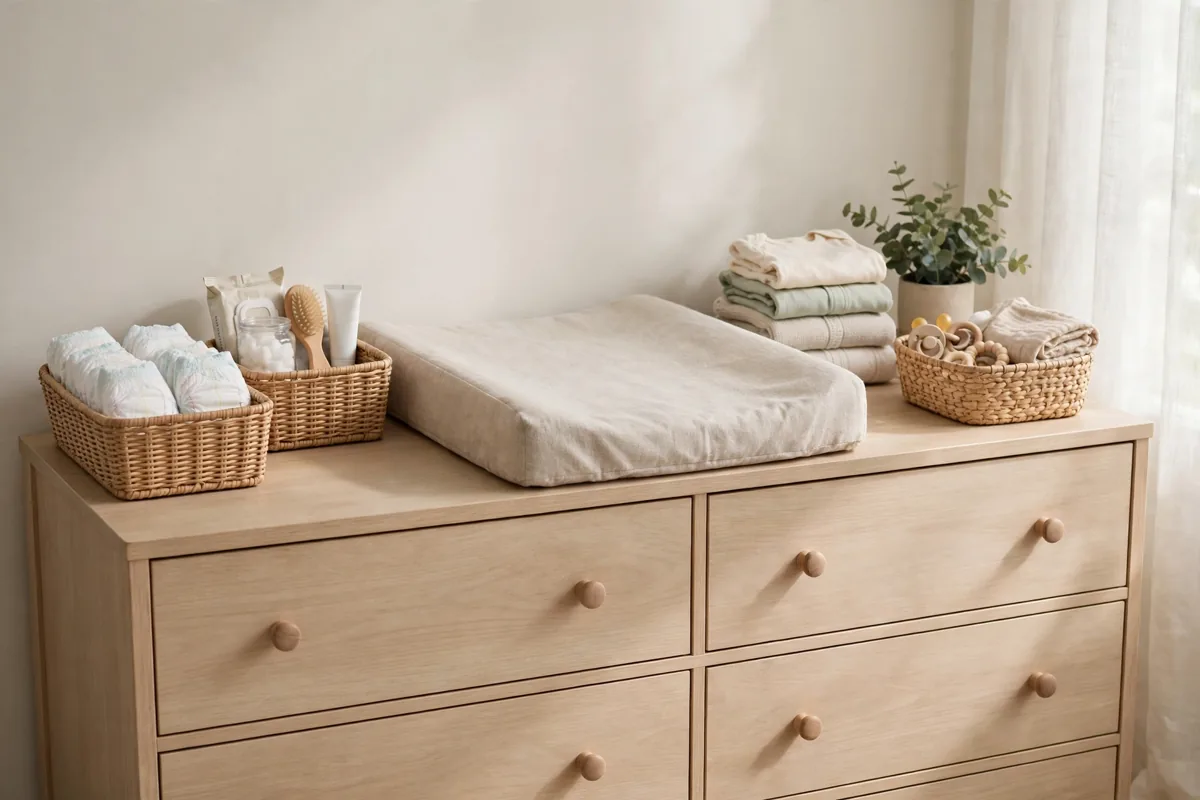
In a tiny nursery, every piece of furniture should justify its footprint twice over. The classic example is the dresser that doubles as a changing station. A sturdy, standard-height dresser with a contoured changing pad secured on top gives you a changing table and a full chest of drawers in the space of one item — and unlike a dedicated changing table, it stays useful long after nappy changes end. Keep the top organised with baskets for nappies, wipes and creams, and spare muslins.
The crib is the second big decision. If the room is genuinely tight, a mini crib can be a sensible choice for the first months: it takes up noticeably less floor space and can often be wheeled between rooms for daytime naps. Be honest about the trade-off, though — your baby will outgrow it sooner, so it only saves space if you have a plan for what comes next. A standard crib with clear space below for flat bins gives you storage without adding a single extra piece of furniture.
Look for the same double-duty logic everywhere else. A rocking chair with a small side table beside it becomes your night-feed station if the table holds a water bottle, a muslin, and a dim lamp. A bookshelf with baskets on its lower shelves stores toys now and books later. An ottoman with a lift-off lid hides blankets and doubles as a footrest during long evening feeds. And do not overlook slim, movable storage: a narrow rolling cart, barely wider than a nappy pack, slides into the gap between the dresser and the wall and becomes a mobile changing station, wheeled to wherever you need it and slid away again.
Use the Walls First, Before You Buy Another Bin
When the floor is full, the walls are your next room. Floating shelves above the dresser or beside the crib (never directly above it — more on safety below) hold the things you reach for daily: a few board books, the nappy cream, a framed print. Keep shelves shallow, no deeper than about 15 centimetres, so they hold essentials without jutting into the room or tempting you to pile them high.
Book ledges are a particular favourite in small nurseries, and for good reason. A slim picture ledge mounted at your eye level displays books with their covers facing out, which means a toddler can choose a story by its picture long before they can read a spine. Two or three ledges on one wall hold a surprising number of books, cost very little, and look intentional rather than cluttered. Rotate the books every few weeks and the same ledges feel fresh again.
Do not forget the back of the door. An over-the-door organiser with clear pockets holds shoes, small toys, and the endless little items that otherwise colonise every flat surface. Hooks at adult height hold the nappy bag, ready to grab on the way out, and a row of pegs near the door gives coats and cardigans a home that is not the rocking chair. Wall storage works best when each hook and shelf has a named job; a hook that holds “miscellaneous” quickly becomes a dumping ground.
Turn the Closet Into the Hardest-Working Spot in the Room
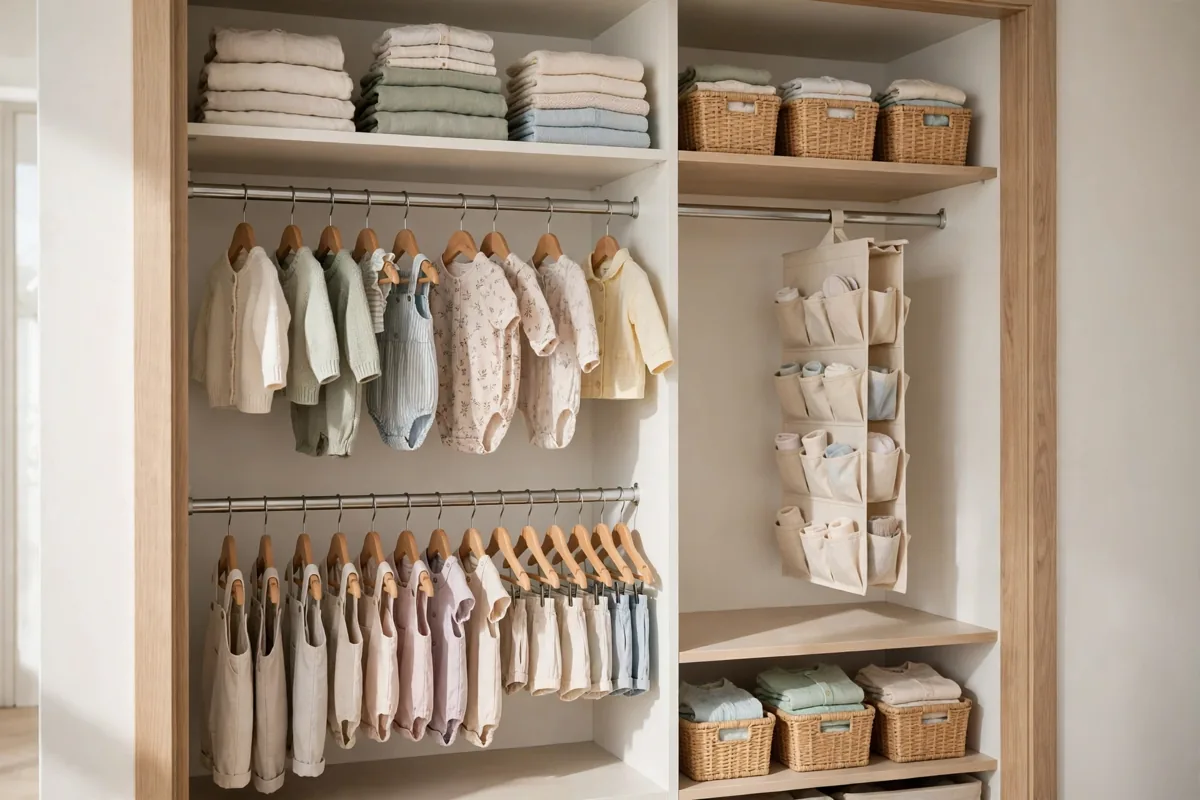
If your nursery has a closet, it is probably the most underused space in the room — and the easiest win. Most closets come with a single rod and one high shelf, which wastes the lower half entirely, especially when the clothes hanging there are only forty centimetres long. Baby clothes are short, and that is your advantage. Fit a second rod below the first and you instantly double the hanging space without changing the closet at all.
Work the closet in zones, from top to bottom. The high shelf is for the things you need rarely: the next-size-up clothes in labelled bins, the keepsake box, the out-of-season blankets. The rods hold the current size only. The floor takes a small bin for shoes and another for laundry. If closet doors swing into the room and eat floor space, consider a curtain instead — it never blocks a walkway and lets you see everything at a glance.
Hanging organisers earn their place here too. A fabric shelf unit that hangs from the rod gives you instant cubbies for folded items — vests in one, leggings in another, bibs in a third — without any drilling or building. Label each cubby, even if the labels feel overly tidy at first. At 2 a.m., a label is the difference between grabbing the right thing in ten seconds and emptying three cubbies onto the floor. The same zone-and-label discipline works beyond the nursery: our under-bed storage ideas show how to use another overlooked space the same way. And one habit makes the whole system last: when a new bag of clothes arrives, sort it for five minutes first — current size in, next size up into the labelled bin, everything else out.
Sort Clothes by Size, and Keep the Next Size Ready
Babies outgrow clothes at a speed that genuinely surprises first-time parents. One month a sleepsuit fits perfectly; three weeks later it will not fasten. That is why sorting by size is not just an organising preference in a nursery — it is the system that stops the room from overflowing. Keep only the current size in the drawers, on the rods, and in the changing area. Everything else lives elsewhere, in clearly labelled bins, out of the daily path.
A simple three-bin system works for most families. Bin one is the current size, and it lives in the nursery. Bin two is the next size up, stored on the high closet shelf or under the bed, ready to be swapped in the moment the current clothes get snug. Bin three is outgrown — clothes to pass on, donate, or keep as mementoes — and it leaves the nursery as soon as it is full. Once a fortnight, spend ten minutes checking what still fits, moving the too-small items out, and pulling the next size down. It is the kind of job that is easy to postpone and miserable to do three months late.
Within the current size, sort by type rather than by colour or cuteness: all the sleepsuits together, all the vests together, all the daytime outfits together. Drawer dividers or small fabric boxes will do the job — the container matters far less than the consistency. When anyone else looks after the baby, they should be able to find a clean outfit without asking you where things live. If they cannot, the system needs simplifying, not more containers. The same discipline runs through our guide to small home office storage ideas that actually work.
- Current size only in drawers and on rods — nothing else in the daily path.
- Next size up in one labelled bin on a high shelf or under the bed.
- Outgrown clothes in a separate bin that leaves the room when full.
- A ten-minute size check every fortnight keeps the system honest.
Safety Rules That Come Before Any Storage Hack
None of this matters if the room is not safe, and in a small nursery the storage itself can become the hazard. So before you admire your new shelves, run through these rules — they outrank every idea in this article. First, anchor it: every dresser, bookshelf, and tall unit must be fixed to the wall with proper furniture straps. Babies pull up, climb, and yank drawers open far earlier than you expect, and a tipping dresser is one of the most serious risks in any nursery.
Second, keep the crib zone clear. Nothing heavy should hang above the crib — no shelves, no frames, no mobiles fixed to the wall above it — and nothing with cords, strings, or ribbons should be within reach of it. That includes blind cords, monitor cables, and the cord of a wall-mounted lamp. Route cables behind furniture, and keep the monitor on a wall bracket well out of reach.
Third, think about what little hands can reach once your baby is standing. Small items, button batteries, creams, medicines, and anything that could be a choking hazard belong in a high drawer or a latched box, not in an open basket at toddler height. Heavy items go low in storage units so the furniture stays bottom-heavy and stable. If a storage idea puts something heavy above your baby’s head, or something small within their grasp, change the idea — no matter how tidy it looks. The same principle runs through our studio apartment storage ideas that make a small space work hard, where a small space has to stay safe as well as organised.
Finally, leave room to breathe. A nursery does not need to hold everything a baby owns. A couple of labelled boxes elsewhere in the house are a legitimate part of the nursery system. Keeping the overflow out of the nursery is not a failure of storage — it is the decision that keeps the room calm, safe, and usable. Start with the measurements, let one piece of furniture do two jobs, use the walls and the closet before you buy anything new, sort by size without mercy, and keep the safety rules above every clever idea. Do that, and the smallest room in the house will quietly become one of the hardest-working — and one of the happiest — rooms you have.