
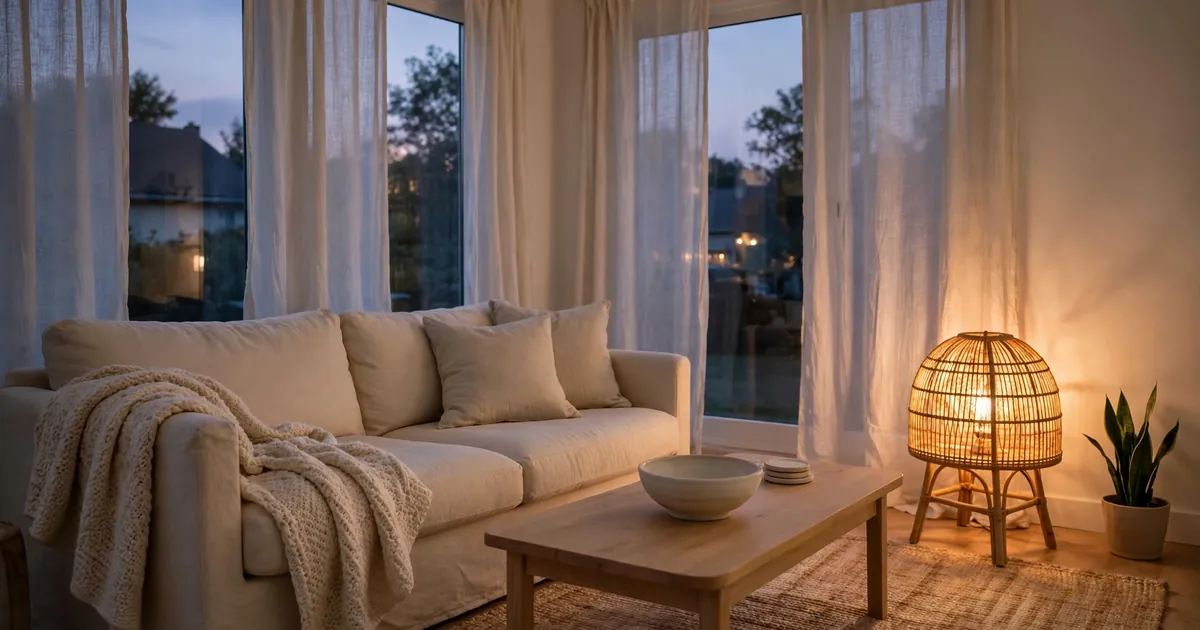

Here’s a confession: I used to think cozy minimalist decor was impossible. Every time I decluttered my living room and painted everything the same bright white, the place looked clean — and completely soulless. It felt like a waiting room. Somewhere between the flat-pack furniture and the empty surfaces, the room had lost its personality, and I’d stand in the doorway wondering where the warmth went.
The breakthrough came the day I stopped blaming minimalism and started blaming starkness. Minimalism was never the problem. The problem was that I’d confused “simple” with “bare.” A truly cozy minimalist room isn’t cold at all — it’s calm, soft, and quietly inviting. The trick isn’t adding more stuff. It’s choosing pieces that do more: a throw that begs to be touched, a lamp that turns the whole room gold at 8pm, one warm wood shelf that keeps everything from floating away.
These are the ideas that finally made my home feel like a hug instead of a showroom — and not one of them required me to own more than I wanted to keep. If you’ve been trying out minimalist living room ideas but something still feels off, this is the missing layer.
The Secret to Cozy Minimalist Decor Is Texture, Not More Stuff
When a minimalist room feels cold, it’s almost never the emptiness that’s the problem. It’s that everything is smooth. Smooth white walls, smooth sofa, smooth floor, smooth table — there’s nothing for your eyes to land on, so the room slides right past you. Texture fixes that without adding a single object.
Think of texture as the way a minimalist room “speaks” without raising its voice. A chunky knit throw folded over the arm of a plain linen sofa. A jute rug softening the floor under a simple wooden coffee table. Woven baskets that hold your extra blankets and look like decor while doing it. Ceramic bowls, a stone tray, a rattan lampshade — each one catches the light differently, and that variation is what makes a spare room feel layered instead of empty.
My practical rule: pick two or three textures and repeat them around the room. Linen, wood, and wool. Or rattan, cotton, and ceramic. Repeating them keeps everything calm, but the variety keeps it interesting. The moment I swapped my slick microfiber sofa cushions for linen ones in a warm oatmeal color — same sofa, same room — the whole space exhaled. It looked the same in a photo. It felt completely different in person.
This is also the best cozy trick for renters. You can’t always paint the walls or change the flooring, but nobody can stop you from layering a great rug and draping a real throw blanket. Textures are the rent-friendly renovation.
Build a Warm Neutral Palette First
Not all neutrals are warm, and this is where most cold-feeling minimalist rooms go wrong. A bright, blue-white wall looks crisp in daylight and clinical by evening. Warm whites — the kind with a hint of cream or peach in them — bounce light around just as well but make everyone in the room look like they’re glowing.
The cozy minimalist palette lives in warm territory: warm white, cream, oat, camel, soft taupe, warm greige, sand, and the natural tones of oak and pine. If you want a touch of color, keep it in the same family: terracotta, sage, muted olive, soft clay. These colors sit next to each other without competing, so a room stays calm even when it’s fully dressed.
The easiest formula I’ve found is one main neutral, one warm wood tone, and one soft accent. Paint the walls warm white, bring in oak furniture, and let your accent be a muted terracotta throw or a sage cushion. That’s it. Everything coordinates because you only ever gave yourself three colors to work with.
If you’re redoing a bedroom, the same rule transforms it overnight: swapping cool grey bedding for cream or oat linen changes how the whole room feels at bedtime. It works the same way as good bedroom organization — when the colors are settled, the whole room feels settled.

Light It Like You Actually Live There
Lighting is the difference between a minimalist room that feels serene and one that feels like a gallery after closing time. Harsh overhead lighting flattens everything. Warm, layered lighting gives a spare room depth and mood — it’s the closest thing to a cheat code this style has.
You want three layers, even in a simple room:
- Ambient light: a soft ceiling glow or dimmable recessed lights for general brightness.
- Task light: a floor lamp by your reading chair, a table lamp where you pay bills.
- Glow light: the fun one — a candle, a string of fairy lights, a small lamp on a shelf. Purely for atmosphere.
Choose warm bulbs — around 2700K, the cozy end of the spectrum — and put the main lamps on dimmers if you can. I put a dimmer on my living room floor lamp for about twelve pounds and it changed my evenings more than any piece of furniture ever has. Bright for cleaning, low and golden for everything after dinner.
Daylight matters just as much. Sheer linen curtains let light pour in without the glare, and a mirror placed opposite a window doubles whatever light you get. A bright room in the morning and a golden one at night — that’s the rhythm cozy minimalism lives in.
Bring In Wood, Woven, and Living Things
Natural materials are minimalism’s best friend because they add warmth without adding visual noise. A light oak coffee table, a single rattan chair, a wooden tray on the ottoman — each piece has grain and character, so it holds your attention gently instead of demanding it.
Wicker and rattan baskets are the quiet heroes here: they corral the throw blankets, the kids’ toys, the remote controls, and they look like they were always part of the plan. And if you’re in a small space, smart storage that blends into the room keeps the minimalist calm while the coziness does its work.
Then add one living thing. Just one is enough — a trailing pothos on the shelf, a snake plant in the corner, a small olive tree by the window. Greenery is the warmest neutral there is: it brings a soft, organic shape into rooms full of straight lines, and it makes a space feel cared for. Low-maintenance plants like snake plants and ZZ plants thrive on neglect, so even if you’ve killed every plant you’ve ever owned, you’ve got a second chance here.
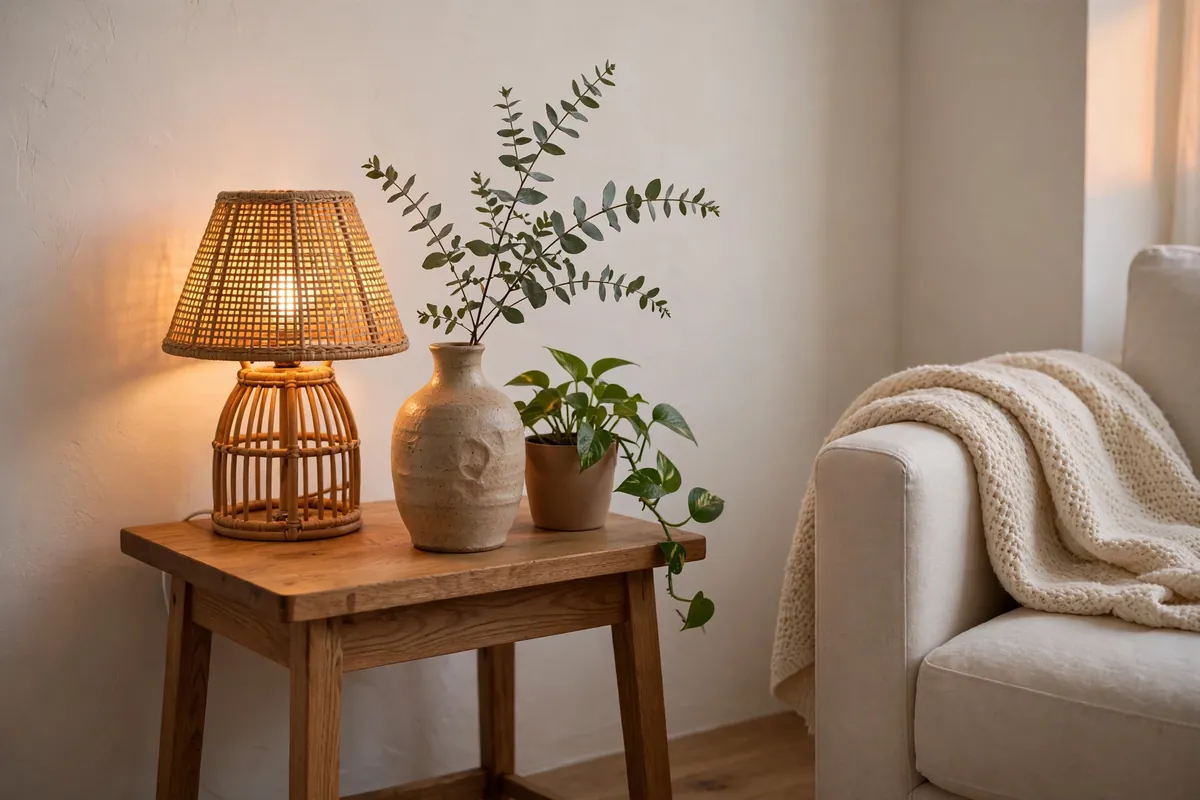
Finish with ceramics — a handmade-feeling mug collection, a simple vase with one stem of eucalyptus, a bowl of lemons on the kitchen counter. Artisan touches add the human hand that factory-perfect minimalism sometimes lacks.
The Cozy–Cluttered Line: How to Tell You’ve Gone Too Far
This is the question every cozy minimalist eventually asks: how do I know when all this layering has turned into clutter? Fair question. There’s a line, and it’s easy to cross without noticing.
My tests are simple. First, the photo test: take a photo of the room on your phone. Cameras are ruthless — anything that’s visual noise will jump out at you in a photo before your eyes register it in person. Second, the evening glance: when you walk through the room at night with the lamps on, does it feel calm or busy? Trust the first feeling. Third, the hotel test: would a really good hotel have this out? Hotels are cozy minimalism done professionally, and they never leave the mail on the console table.
A few habits keep the line clear:
- Corral, don’t scatter. Group small items on a tray or in a bowl so they read as one intentional moment, not five random objects.
- Keep one surface in every room completely clear. It gives the eye a place to rest and keeps the room breathing.
- Favor closed storage for the messy stuff. Baskets with lids, drawers, an ottoman that opens. Out of sight, out of visual clutter.
- Edit seasonally. When the chunky knit throws come out, the light cotton ones go into storage. One season’s cozy is another season’s clutter.
If the whole house has drifted past cozy into chaotic, that’s a decluttering job, not a decorating one — and a structured pass like the one in our Swedish death cleaning guide will clear the decks so your cozy layers actually show.
One Personal Touch Per Room (Not Ten)
The reason some minimalist rooms feel like nobody lives there is simple: nobody’s fingerprints are on them. Cozy doesn’t come from a catalog. It comes from the framed photo from the trip you still talk about, your grandmother’s quilt folded at the foot of the bed, the weird little vase you picked up at a market and have loved for years.
Give each room one or two genuinely personal pieces — and only one or two. Five sentimental objects on a shelf is a curated story. Fifty is a junk drawer with good intentions. When every personal item has breathing room around it, each one actually gets noticed, which is the whole point.
This is where cozy minimalism quietly overlaps with letting go: keep the objects that carry real memories, and give the guilt-objects the goodbye they deserve. If you’re not sure which is which, our guide to decluttering sentimental items walks through the decisions without the guilt spiral.
A home that shows who lives there — warm textures, golden lamplight, and the evidence of a real life — never feels stark, no matter how few things it holds.
Cozy minimalist decor isn’t a contradiction; it’s just minimalism with its guard down. Warm neutrals instead of stark white. Texture instead of flatness. Layered light instead of a single overhead glare. One plant, one wood table, one honest personal touch per room. Nothing on this list is expensive, and most of it can be done in an afternoon — which is the real beauty of it. Your home doesn’t need more. It needs the right few things, chosen well, layered with intention. Start with the lamp and the throw blanket. The rest will follow.