
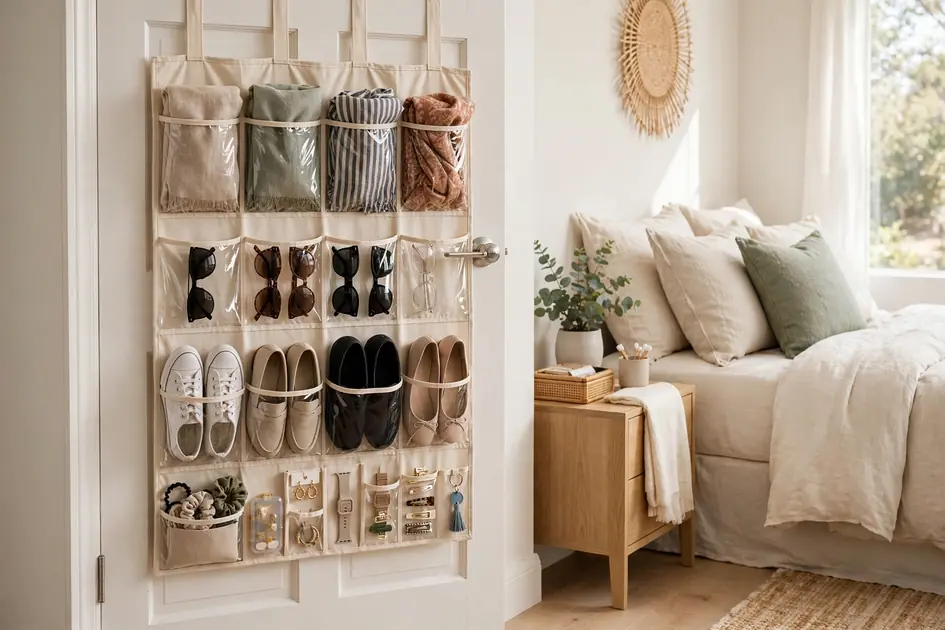

Every home has a surface that almost everyone forgets about: the back of the door. It’s roughly twenty square feet of blank space, hanging there doing nothing, while the rest of the house overflows with shoes, toiletries, snacks, and random clutter. Over door storage ideas are the simplest way I know to turn that wasted space into real, usable storage — no drilling, no damage, and usually no more than twenty dollars spent.
I discovered this in my first tiny rental, where the closets were more decorative than functional. A friend hung a fabric pocket organizer over my bedroom door in about thirty seconds, and suddenly I had twenty-four new pockets of storage. That was the day I stopped thinking of doors as just doors.
This guide walks you through over-the-door storage for every room — what actually works, what to avoid, and how to pick the right style for the stuff you need to store.
Why Over-the-Door Storage Works So Well
Most storage solutions ask you to sacrifice something: floor space, shelf space, or your security deposit. Over-the-door storage asks for none of that. The reasons it has become such a go-to, especially for renters and small-home dwellers, are pretty convincing:
- Zero floor space required. The organizer lives entirely on the back of a door, so your walking paths and floor area stay completely clear.
- Truly renter-friendly. Hooks slide over the top of the door — no screws, no adhesive, no holes to patch when you move out.
- Instant and tool-free. Most organizers go up in under five minutes, and they come down just as fast when you need to rearrange.
- Surprisingly strong. A quality pocket organizer can hold forty pounds or more, and metal hook racks handle coats, bags, and robes with ease.
- Cheap for what you get. Twenty-four pockets for fifteen to twenty-five dollars works out to less than a dollar per pocket. Try beating that with any other furniture.
Before you buy anything, grab a tape measure. Standard interior doors in the US are about 1-3/8 inches thick, and most organizers are designed for exactly that. If your doors are unusually thick or thin, check the hook width before ordering. And while you’re at it, note whether the door needs to close snugly against a frame — bulky hooks can prevent a door from latching, which is a real problem for bathroom and bedroom doors. A quick measurement now saves you an annoying return later.
The Main Types of Over-the-Door Organizers
Not every door needs the same kind of organizer. Matching the style to the items makes all the difference. Here are the main categories:
- Clear pocket organizers. Rows of transparent vinyl or mesh pockets — the classic shoe organizer, now used for everything from snacks to craft supplies. The big advantage is visibility: you see everything at a glance. Great for items you grab daily.
- Fabric or canvas organizers. Opaque pockets in linen, canvas, or non-woven fabric. They look tidier than clear vinyl (nothing screams “dorm room” less), and they’re gentler on door paint. Perfect for bedrooms and entryways where you want things to look calm.
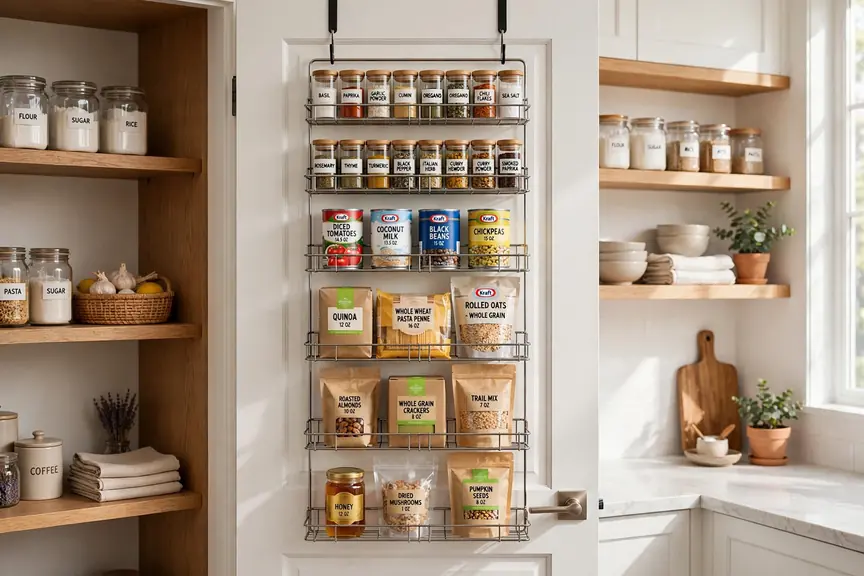
- Wire shelf racks. Flat metal shelves rather than pockets, which work better for cans, jars, bottles, and books. They’re the most pantry-friendly option and usually the sturdiest.
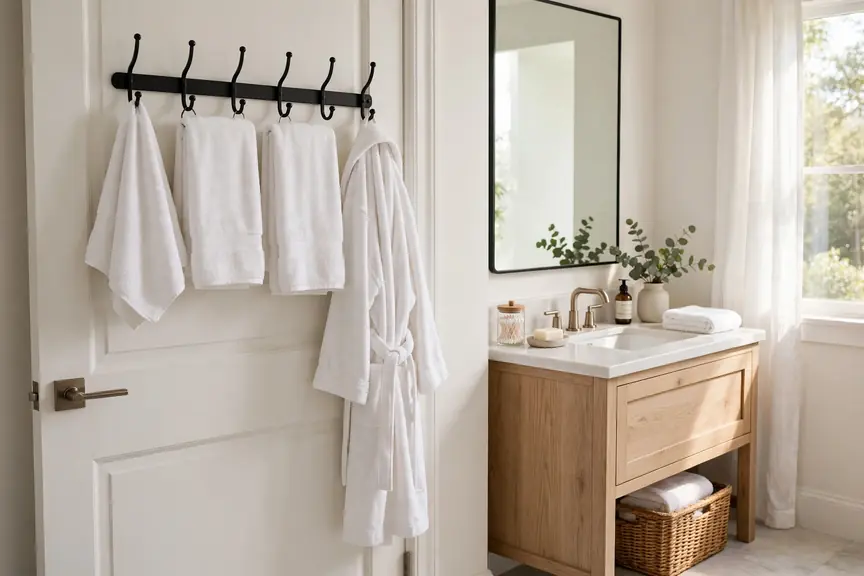
- Hook racks. A row of five to nine hooks on a slim metal bar — for coats, towels, robes, bags, dog leashes. Choose ones with rubber or foam tips so the hooks don’t scratch the door.
- Mirror cabinets and combination units. Full-length mirrors with hidden jewelry storage or shelves behind them. Pricier, but they do double duty where floor space is precious.
Here’s a practical rule I follow: pockets for small items, shelves for heavy or stackable items, hooks for things you hang. It sounds obvious, but matching the tool to the job is what makes the difference between something you’ll use every day and something that becomes its own kind of clutter.
Over-the-Door Storage Ideas for the Bedroom and Closet
The bedroom is where over-the-door organizers earn their reputation. It’s the room where the most “homeless” items live — the things too clean for the laundry hamper but too worn for the closet, the shoes that don’t fit on the closet floor, the accessories that end up in a drawer tangled beyond recognition.
If you’re working on organizing a packed closet, pairing a door organizer with a good closet system multiplies what the space can hold — take a look at these closet organization ideas for small closets for the full setup.
Behind the bedroom door itself (rather than the closet door), a hook rack is hard to beat. Tomorrow’s outfit, the bathrobe, the gym bag — all of it lives one reach away, off the floor and off the chair that was becoming a second wardrobe. If your bedroom is pulling double duty as your dressing area, you might also like these bedroom organization ideas for keeping the whole room calm.
Bathroom Over-the-Door Storage Ideas
Bathrooms are the smallest rooms in most homes and somehow hold the most tiny, fiddly items: bottles, tubes, brushes, bands, razors, medicines. The vanity is never big enough, the medicine cabinet fills up in a month, and counter space is a luxury. This is exactly where over-the-door storage shines.
The inside of the bathroom door is prime territory for a clear pocket organizer stocked with the daily routine: toothpaste, deodorant, contact lens supplies, hair ties, cotton pads, sunscreen. Clear pockets matter here more than anywhere else — when you’re half-awake at 6:30 a.m., you need to see everything without thinking.
For towels and robes, a hook rack is the classic move. Look for a rack with at least six hooks and rubber-tipped ends — the rubber coating protects the door’s paint, and quality matters here because bathroom doors get slammed more than any other door in the house.
If your bathroom suffers from the dreaded under-sink avalanche — you know the one, where you reach for the plunger and fourteen bottles tumble out — an over-door organizer can absorb a surprising amount of the overflow. Combine it with these under-bathroom-sink organization ideas and even the smallest bathroom starts to feel manageable.
What to watch out for in bathrooms
- Moisture is the enemy of fabric organizers — prefer vinyl, mesh, or wire in humid bathrooms, or make sure your fan actually runs.
- Keep anything with batteries (electric razors, trimmers) away from the steamy zone if possible; the door is often drier than the counter, which is a point in its favor.
- Check the weight rating. A dozen full-size shampoo bottles adds up fast, and bathroom items are dense.
Kitchen and Pantry Over-the-Door Storage Ideas
The pantry door might be the single best door in the house for storage. It’s usually large, it opens into the kitchen where you need things at hand, and pantries are chronically short on shelf space.
Here’s how I’d organize a pantry door, top to bottom: spices and small jars up top where they’re visible, canned goods and sauces in the middle, and wraps and foil at the bottom. The door becomes a grab-and-go station that saves you from digging through deep pantry shelves. If you’re rethinking your pantry setup entirely, these budget pantry organization ideas pair beautifully with a door rack.
Don’t stop at the pantry. The inside of a broom-closet door is ideal for a slim rack with cleaning supplies — broom closets are narrow, and a door rack uses space that would otherwise be dead air. If your counters are the real problem area, these kitchen counter organization ideas will help you clear the decks.
One caution for the kitchen: respect the weight limits — a full set of canned tomatoes is genuinely heavy. Distribute the heaviest items low and toward the hinge side of the door, which handles weight better than the handle side.
Entryway, Laundry, and the Rooms You Forget
The entryway closet door can hold a pocket organizer that becomes your family’s launch pad: keys in one pocket, sunglasses in another, dog leash on a hook, reusable shopping bags in the deep bottom pockets. If your entryway needs a broader overhaul, these small entryway organization ideas cover the rest.
The laundry room door (or the door of whatever closet holds the washer and dryer) is perfect for a pocket organizer with supplies: dryer sheets, stain remover pens, delicates bags, clothespins. I keep a small mesh bag hooked on one of the organizer’s hooks specifically for single socks — it has reunited more pairs than I can count.
The home office door deserves a mention too. A pocket organizer behind the office door holds notebooks, chargers, pens, and sticky notes — sweep the clutter into the door pockets and the room looks serene again for video calls.
Renter-Friendly Tips: Choosing Without Damaging Anything
Since so many of us rent, let’s talk about keeping your doors (and your security deposit) intact:
- Pick hooks that fit your door thickness. Hooks sized for a 1-3/8-inch door that are too tight will gouge paint; too loose and the organizer wobbles. Many better organizers now come with foam or rubber padding on the hooks — worth seeking out.
- Avoid adhesive strips on doors. Command-style strips are brilliant on walls, but on doors the constant swinging loosens them, and the residue left behind can genuinely violate a lease. Hooks over the top are safer.
- Respect the weight limit. This is the number one cause of door damage and organizer failure alike. If a fabric organizer is rated for 25 pounds, don’t load it with 40 pounds of books. Distribute weight evenly rather than loading one side.
- Protect against swinging. If your door swings hard (kids, pets, drafts), a small felt pad or bumper where the organizer meets the door stops paint scuffs.
- Mind the latch. Test that the door still closes and latches with the organizer on. If the hooks are too thick, the door won’t catch — annoying on a bathroom door, a real problem on a bedroom door at night.
One more practical note: measure twice if you have non-standard doors. Older homes sometimes have thicker doors, and some modern apartment doors are thinner hollow-core. Most organizers list the door thickness they fit, so a thirty-second measurement while you’re shopping saves the hassle of a return.
How to Keep Your Door Organizers Tidy (Not Just Full)
Here’s the honest truth nobody puts on the packaging: an over-door organizer is only as good as your willingness to maintain it. Every pocket is a tiny temptation to stash something “for now.” Left unchecked, the organizer becomes a vertical junk drawer.
The system that works for me is simple: every pocket has a job. Not a vague category — a job. The top-left pocket isn’t “random small stuff,” it’s “sunglasses and reading glasses.” When something doesn’t have an assigned pocket, it doesn’t go on the door; it goes back where it belongs. This takes about ten minutes to set up and almost no time to maintain, because putting things away becomes automatic.
Do a quick monthly reset: pull everything out, wipe down the pockets (they collect dust faster than you’d think), toss what’s expired or broken, and reassign anything that’s drifted. Ten minutes, once a month, and the system keeps working. And resist the urge to buy the biggest organizer for every door — a well-used 12-pocket organizer serves you better than a half-empty 24-pocket one inviting filler. Start with the room that’s bothering you most, live with it for a couple of weeks, and then decide which door is next.
The back of the door is one of those rare storage wins: free space, no installation, no damage, and genuinely useful every single day. Pick one door this weekend, hang one organizer, and see how much calmer that room feels. Then come back and tell me you didn’t immediately start eyeing every other door in the house — I certainly did.
[…] shelves, all instantly visible. I’ve got a shortlist of setups that work in tiny closets in our over-the-door storage ideas guide, because door-mounted storage behaves differently in a 24-inch closet than in a walk-in. And […]