
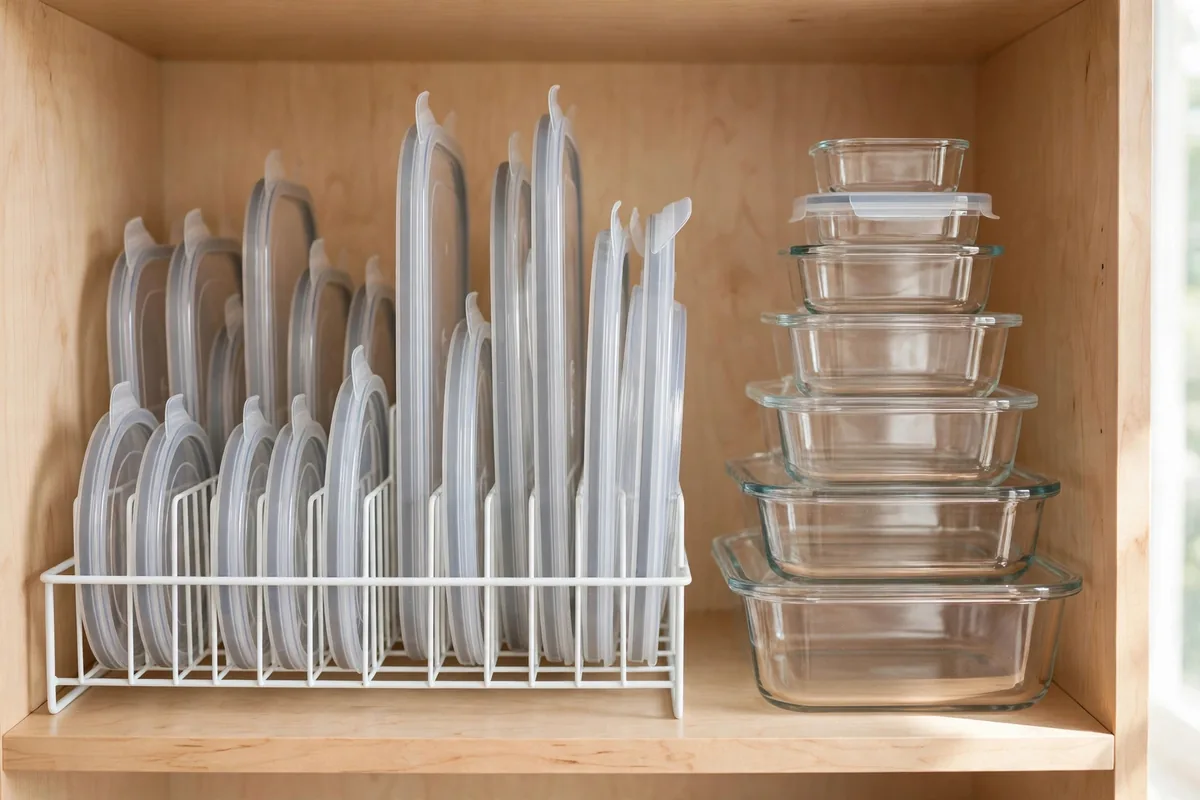

You know the sound — that hollow plastic rattle that means somewhere in your kitchen, lids are avalanching again. You open the cabinet for one small container to pack a lunch, and three round lids, a square one you don’t recognize, and something that might belong to a bowl you threw away in 2023 all tumble out like they’re trying to escape. If that moment makes you want to close the door slowly and order takeout instead, you’re not alone — and these tupperware organization ideas were written exactly for you.
Here’s the reassuring part: the problem is almost never that you have too many containers. It’s that lids and containers are stored like strangers in the same house, with no system at all. A container with no visible lid is a mystery; a lid with no container is a grievance. Put a simple system in place — not a perfect one, just a consistent one — and the whole corner of your kitchen stays calm for months. You can do it in a single afternoon with nothing fancier than a couple of baskets, a lid organizer, and one honest hour on the kitchen floor.
Why Your Container Cabinet Always Descends Into Chaos
Most of us accumulate food containers the way we accumulate stray pens: one by one, accidentally. A set arrives as a housewarming gift. Another comes free with a takeout order. Your mother sends you home with soup in a container and says “don’t worry about returning it,” and now it lives with you. Within two years you own forty-something pieces from at least four different brands, and none of the lids quite fit anything else.
That mismatch is the root of the chaos. When a lid doesn’t obviously belong to the container in your hand, you toss them back in the cabinet separately — lids in one drift, bases in another. Soon you have a floating population of orphans: lids whose containers cracked and went in the trash, containers whose lids warped in the microwave. Every time you need to pack leftovers, you stand in front of the cabinet playing what organizers call the matching game, stacking and restacking until something roughly fits. Dinner gets cold. Patience gets thin.
Add the staining problem and it gets worse. Plastic containers that have held tomato sauce for five years carry a permanent orange tint that makes leftovers look suspicious before you’ve even reheated them. You keep those stained ones “for non-food use,” and suddenly half your collection is doing double duty as junk-drawer overflow, which is no duty at all.
None of this means you’re a messy person. It means containers are designed to be bought in sets and stored in systems, and most kitchens have neither the full set nor the system. Both are fixable, and neither requires spending real money.
Step One: The Great Tupperware Purge (Yes, the Floor Exercise)
Every good system starts with less stuff. Pull every container and lid out of wherever they live — the cabinet, the drawer, that shelf above the fridge — and spread them across the kitchen floor. All of them. This looks dramatic, which is the point: you can finally see what you’re dealing with.
Now play the matching game, but with rules. Pick up each container, find its lid, and check both against this short test:
- Does the lid seal? Warped, cracked, or loose-fitting lids go. A lid that doesn’t seal is a spill waiting to happen in a lunchbox or fridge.
- Is the container stained, scratched, or smelly? Plastic is porous — tomato sauce, curry, and turmeric leave permanent color and sometimes odor. If it looks permanently dirty, it isn’t pulling its weight. (This is also the moment many people switch their daily rotation to glass, which doesn’t stain and doesn’t hold smells.)
- Has it been used in the last three months? Be honest. That giant rectangular container you bought for a party in 2022 and never touched again is occupying prime real estate.
- Does it have a match at all? Orphans — lids without containers, containers without lids — go straight into a bag. Give them one week in the bag (in case a missing partner turns up in the dishwasher), then recycle or toss them.
Most people cut their collection by a third here, and it feels like magic. What’s left is a crew of containers that all seal, all fit, and all earn their space. Keep the pieces you actually reach for — for most households that’s a surprising small number: four or five medium containers for leftovers, a few small ones for snacks and sauces, and one or two large ones for batch cooking.
A note on stained-but-functional pieces: if you can’t bear to toss them, demote them. Keep two or three for non-food jobs — garage screws, craft supplies, the junk drawer — and move them out of the kitchen entirely. A stained container kept “just in case” in the kitchen is still occupying the same space and creating the same visual noise.
Tupperware Organization Ideas for Lids That Actually Stay Put
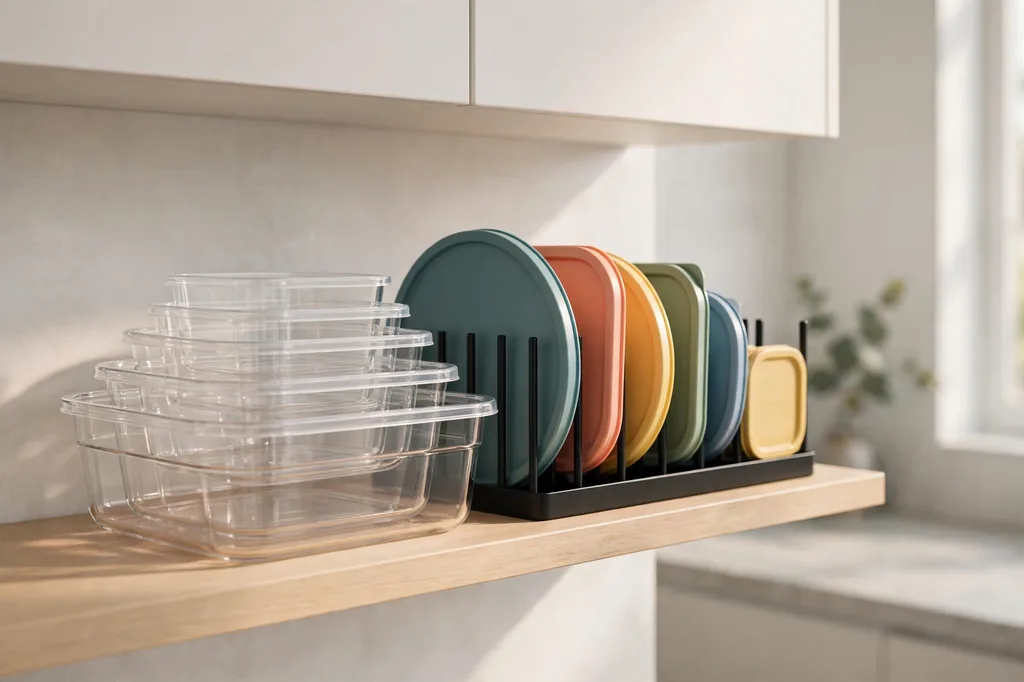
Lids are the hard part. Containers stack; lids slide. Any of these tupperware organization ideas will beat the current pile-of-plates situation, so pick the one that fits your space:
- File-fold lids vertically. This is the single highest-impact change you can make. Store lids upright, like files in a filing cabinet, sorted large to small. You see every lid at a glance, and you can slide one out without disturbing the rest. A dedicated lid organizer with dividers does this beautifully in a cabinet; in a drawer, a bamboo tray with slots works the same way.
- Use a magazine holder. A simple plastic or wire magazine file costs a few dollars and is exactly the right shape for lids. Stand them up, file-style, and tuck the holder on a shelf. One holder per lid size family keeps everything scannable.
- Repurpose a dish rack. A small dish-drying rack or plate rack, stood on its end in a base cabinet, makes an excellent free lid organizer — the slots are already sized for things you want upright. Check the dollar store before buying anything fancy.
- Sort small lids into a basket. The tiny sauce-container and dip-cup lids are the ones that vanish into the abyss. Give them their own small basket at the front of the cabinet or drawer, and they’ll stop migrating to the back.
Whatever method you choose, the principle is the same: lids live separately from containers, upright, and sorted by size. Lids stored flat in a stack become an excavation project the moment you need the one on the bottom. Lids stored loose in a bin become a grab bag. Upright and separated is the only arrangement where grabbing the right lid takes two seconds, which is the whole test of a system.
If your lids are a mixed-brand collection with odd shapes, add one more trick: a small dot of nail polish or a permanent marker stripe on the edge of matching lid-and-container pairs. When every piece is translucent and looks the same, color coding does the matching for you at a glance.
Smart Homes for the Containers Themselves
With lids handled, the containers are easy. The goal is simple: nest them by size, keep the ones you use most at the front, and never stack a container with its lid on — that’s two pieces occupying the space of one, and it undoes all your work.
If your collection is mostly one brand, nest containers inside one another from largest to smallest. Most modern sets are designed for exactly this, and a full set collapses into the footprint of its largest piece. Different brands often don’t nest cleanly, which is another argument for standardizing on one or two matching sets over time.
Location matters as much as method. A deep drawer near the dishwasher or the fridge beats a deep cabinet every time, because you can see everything at once instead of excavating from the back. If a drawer is available, give containers the whole thing: bases nested on one side, lids filed on the other. If you’re stuck with a cabinet, a pull-out shelf or a simple wire riser doubles the usable space and brings the back row forward.
For glass containers — heavier and more fragile — store them with a little breathing room rather than jammed tight, and keep their silicone or plastic lids filed nearby, never snapped on for storage. Glass doesn’t stain and doesn’t hold odors, so if your plastic set is aging out, transitioning your everyday rotation to glass is worth considering when the budget allows.
One more practical arrangement that families love: the lunch-packing station. If you pack lunches daily, group the small and medium containers you actually use for them together — with their lids — in one easy-to-reach spot. It doesn’t have to be pretty; it just has to be faster than the matching game at 7 a.m.
Keeping the System Alive After the First Month
The sad truth about every organization project is that systems don’t maintain themselves — people do. The good news is that container systems are easy to keep if you set two simple rules.
First: the matching rule. Nobody puts a lid or container back without its partner accounted for. This sounds fussy, but it takes three seconds: when the dishwasher is emptied, lids go straight to the lid file and containers go straight to the nest. The avalanche never happens when the pieces land in their zones every single time.
Second: one in, one out. New set arrives as a gift? Lovely — retire the two most stained or mismatched pieces from your old rotation. This is the rule that stops the collection from silently regrowing, and it applies to other small kitchen odds and ends just as well.
Finally, give the system a five-minute audit every couple of months. Pull the lid file, toss anything cracked or orphaned, and check whether the containers still match how you actually cook. Kitchens change — you start meal prepping, the kids stop needing snack cups, you switch to glass — and a system that flexes with those changes is one you’ll actually keep.
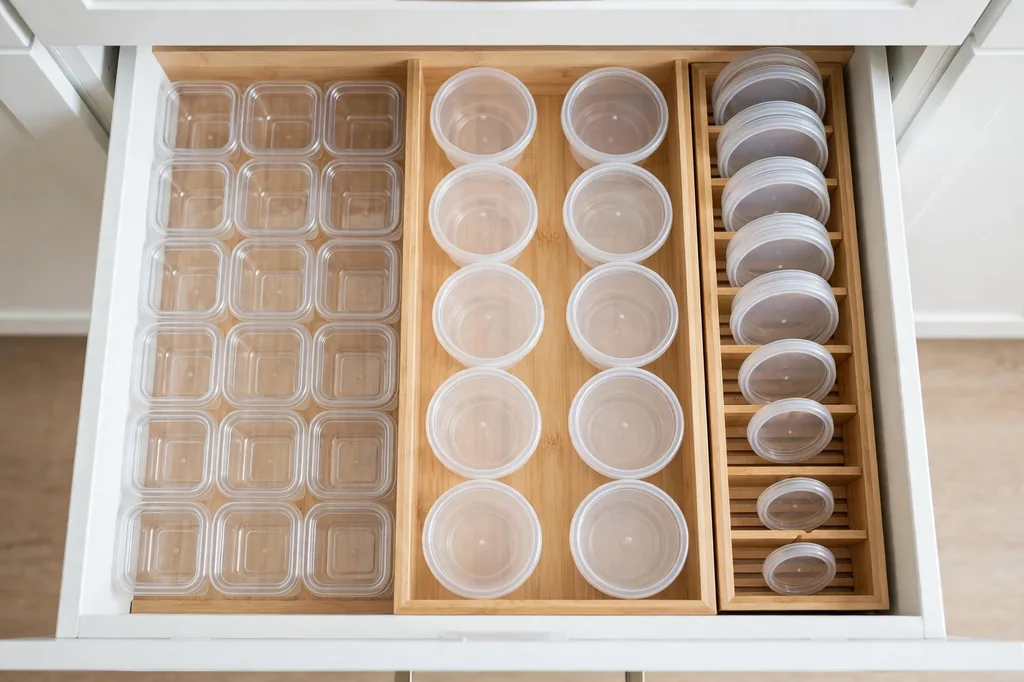
That’s it. Not a renovation, not a color-coded spreadsheet — just fewer pieces, filed lids, nested containers, and two small habits. The next time you open that cabinet, the only sound you’ll hear is the quiet slide of one lid coming out to meet its container. And honestly? That little daily win is worth the whole afternoon.