
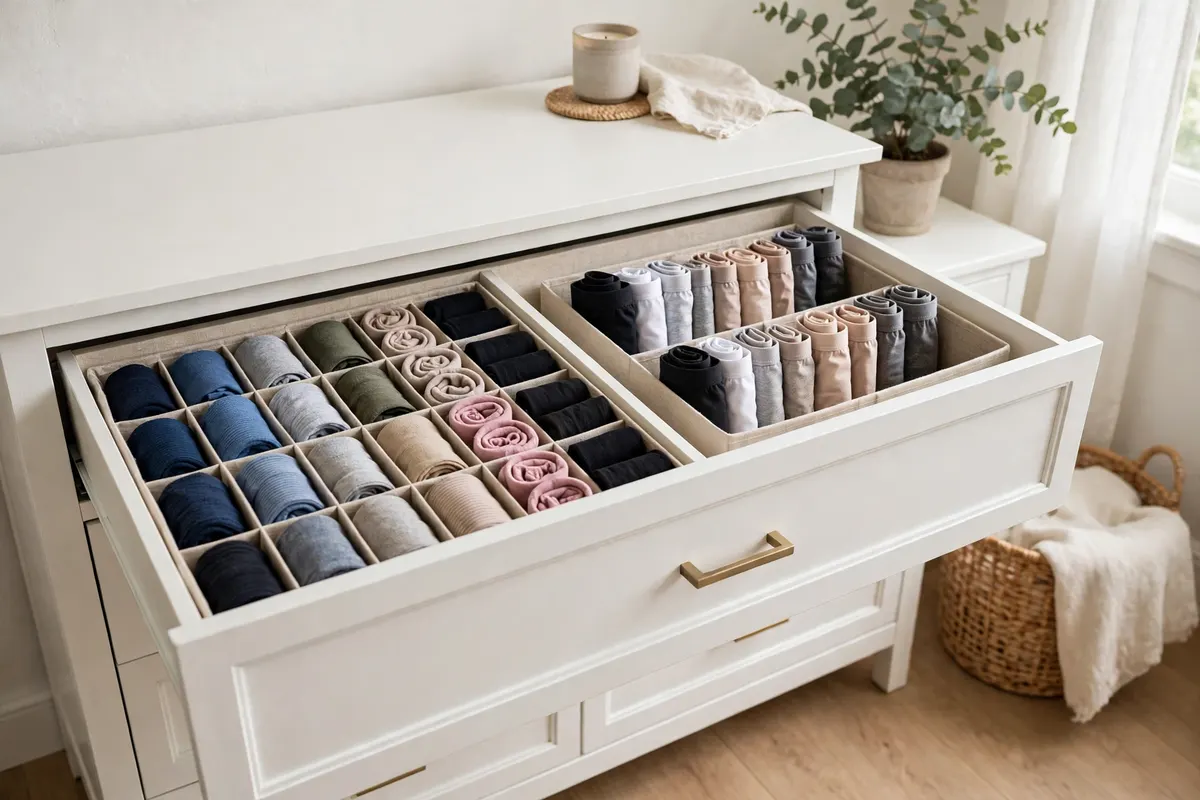

It is 7:12 in the morning, your alarm has already snoozed twice, and you are standing in front of an open drawer digging through a tangled pile of socks like you are panning for gold. You know there is a matching navy sock in there somewhere. You saw it yesterday. Somewhere under the stretched-out ankle socks and the lone dress sock with no partner, it is hiding — and your train, your meeting, or your school run does not care. Good sock drawer organization is not about having a drawer worthy of a magazine photo. It is about never having that frantic morning dig again.
The truth is, sock and underwear drawers are the hardest-working, least-loved drawers in the house. They get opened half-asleep, raided in a hurry, and stuffed shut when laundry comes out of the dryer warm. Nobody means to let them turn into chaos. It just happens, one unmatched sock at a time. The good news is that a drawer like this is also one of the fastest spaces in your home to fix. In about an hour, with a simple formula — categorize, fold, zone — you can turn a daily frustration into a drawer that practically dresses you.
This guide walks you through the whole process, from the honest declutter most of us avoid to the folding methods that protect your elastic, the dividers worth buying, and the small habits that keep it tidy. Whether you share a drawer with a partner or wrangle a whole family’s socks, there is a version here that fits your life.
Start With the Purge: What Stays and What Goes
Every drawer reset starts the same way: take everything out. Yes, everything. Dump the whole drawer onto your bed so you can see what you are really dealing with. Most people are surprised. There are usually pairs they forgot they owned, pairs they would never choose again, and at least a few singles whose partners vanished into the laundry void months ago.
Now sort with honest eyes. Hold each pair up and ask three questions: does it still fit comfortably, is the elastic still doing its job, and would I actually reach for this pair tomorrow? Anything with holes, thinning heels, or a stretched band that slides down inside your shoe has earned its retirement. The same goes for pairs you keep skipping over — the scratchy ones, the too-tight ones, the novelty pair someone gave you three Christmases ago. If you have not worn them in a year, you will not start now.
Be ruthless but not wasteful: worn-out cotton socks make excellent cleaning rags, and many areas have textile recycling drop-offs. The goal is not a nearly empty drawer; it is a drawer where everything inside is something you genuinely wear. For most adults, that means roughly ten to fourteen pairs of everyday socks, a handful of dress pairs, a few cozy pairs, and a similar count of underwear. If your drawer is overflowing, you almost certainly own more than you need — not less storage than you need.
While you are at it, do the same quick pass for underwear. Anything with frayed edges, faded elastic, or a waistband that rolls and digs is not serving you. Comfort is not a luxury here; it is the whole point of the drawer. Keep what feels good, let the rest go, and notice how much lighter the drawer already feels before you have bought a single organizer.
Sock Drawer Organization by Type, Not by Chaos
Here is where most sock drawers go wrong: everything gets tossed in together, so finding a pair means sorting through all of them every single morning. The fix is simple. Sort by type, and keep each type in its own spot. Athletic socks go together. No-show and ankle socks go together. Dress socks get their own section. Cozy, fuzzy, or thermal socks get theirs. When you reach for workout socks, you only look in one place.
Do the same for underwear, sorted by style rather than by color. Everyday briefs or boxers in one zone, the nicer pairs you save for certain outfits in another, and sleep or lounge styles in their own spot if they live in this drawer. Sorting by style sounds fussy, but it is what makes getting dressed thoughtless. You stop hunting and start grabbing.
If you share a drawer with a partner, give each person a clear half or a clearly marked section. Shared drawers fail when ownership is vague. A simple divider down the middle, or two different colored organizers, ends the quiet war over whose socks are whose. And if your dresser has a second drawer to spare, consider giving socks and underwear separate homes entirely — one drawer for socks, one for underwear.
For a bigger-picture refresh, the same sort-first logic works across the whole dresser. If your top drawers are fighting you too, these ideas for how to organize a dresser will help you rethink the full layout, not just this one drawer.
The Fold That Saves Your Elastic (and Your Sanity)
Let us talk about the ball. You know the one: you take two socks, wrap one cuff tightly around the other, and roll them into a hard little ball. It feels tidy for about five minutes. But that tight ball stretches the cuff of the outer sock every single time, which is exactly why so many socks end up with saggy ankles. It also turns your drawer into a pile of lumpy balls that roll around and hide each other. There is a better way, and it takes about the same amount of time.
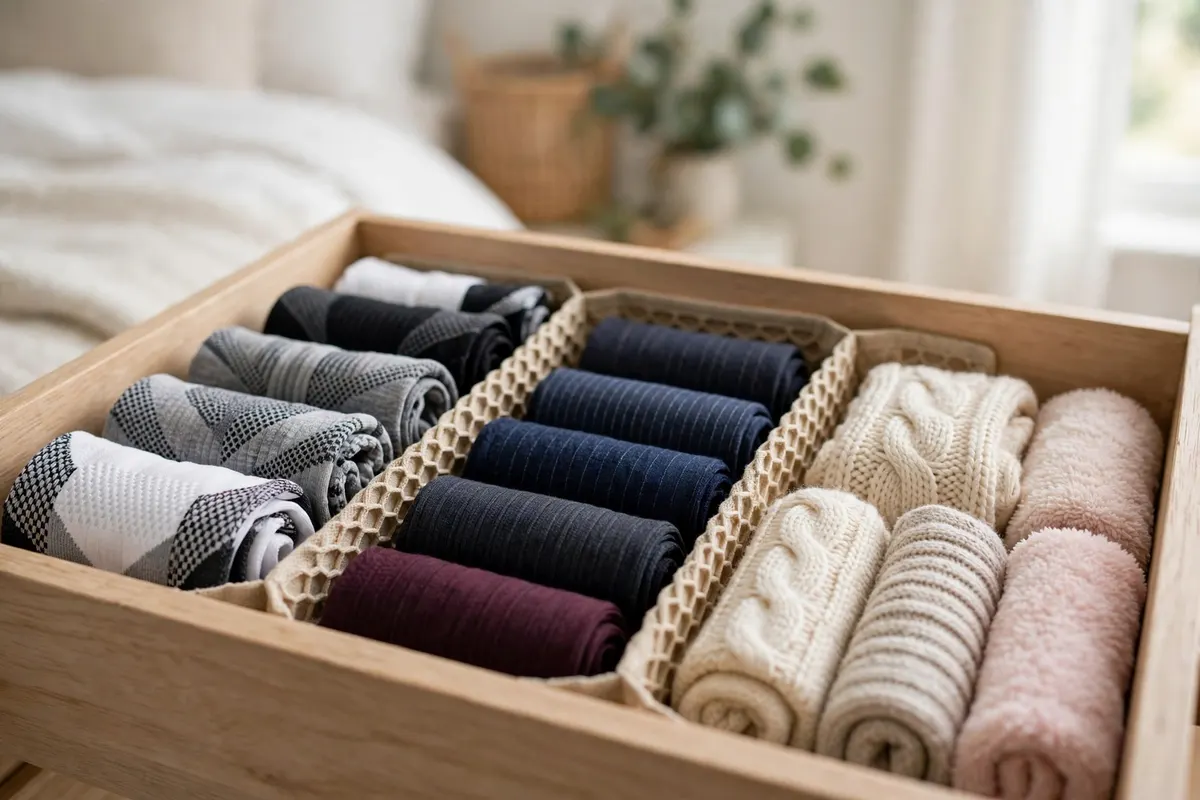
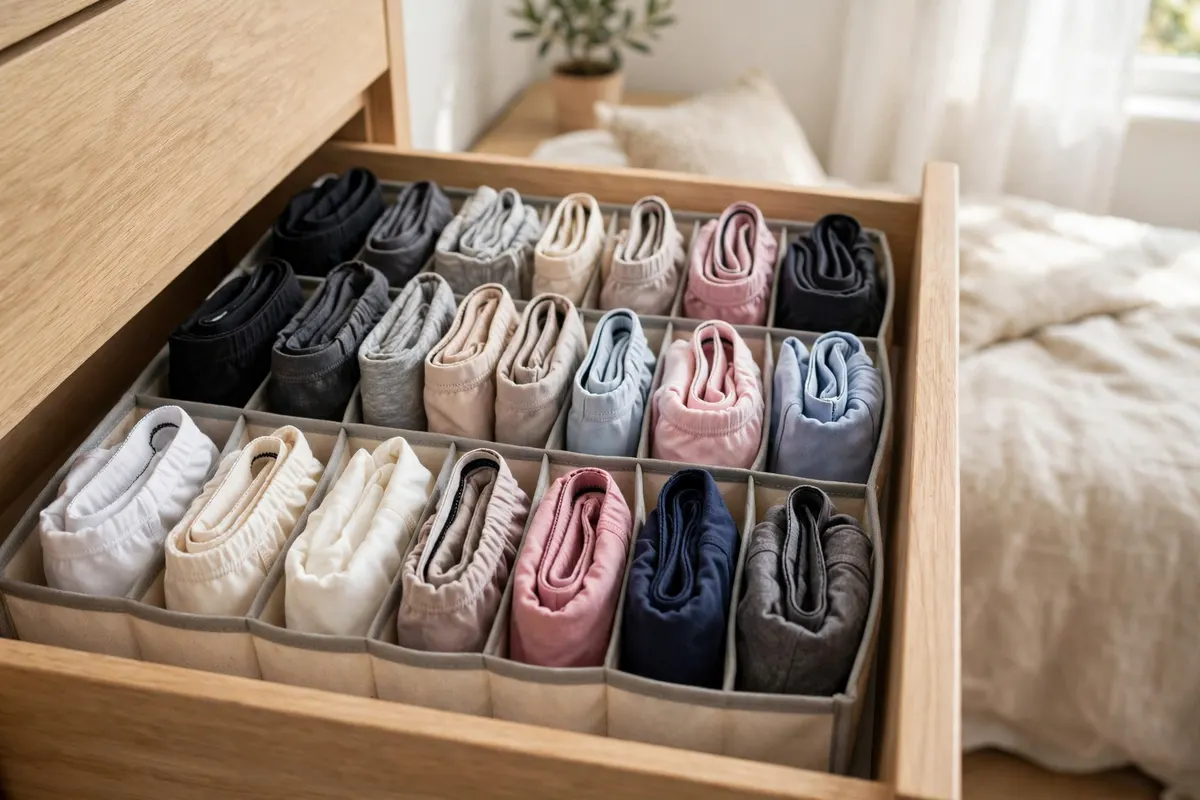
The simplest upgrade is the flat fold. Lay one sock on top of the other, fold the pair in half once, and lay it flat. Or roll them loosely — a gentle roll, not a stranglehold — so the pair stays together without stressing the elastic. Either method keeps pairs matched and cuffs intact. For underwear, the file fold is the real game changer: fold each pair into a small rectangle and stand it upright in a row, like files in a filing cabinet. You can see every pair at a glance, pull one out without disturbing the rest, and spot instantly when you are running low on a favorite style.
- Flat fold for socks: pair them, fold in half once, lay flat. Quick, gentle on elastic, and easy to stack.
- Loose roll for socks: roll the pair gently from toe to cuff without pulling the cuff over. Great for drawer dividers and travel.
- File fold for underwear: fold into a rectangle and stand upright in rows. You see everything, and nothing gets buried.
- Never ball socks tight: the stretched cuff is the number one reason socks stop staying up.
Folding feels like an extra chore the first time, but it pays you back every morning: flat-folded pairs take up noticeably less space than balls, and you stop re-folding the whole pile to find one pair. If folding everything feels like too much, start with your everyday and dress socks and let the cozy pairs stay loosely rolled. Good enough, done consistently, beats perfect once.
Zones, Dividers, and the Lost-Sock Corner
Once everything is sorted and folded, you need a way to keep the categories from sliding back into one big pile. This is where organizers earn their keep. You do not need an expensive system. A few well-chosen dividers will do more than a drawer full of fancy boxes.
Start with the shape of your drawer. Deep drawers suit spring-loaded dividers or long fabric boxes that split the space into lanes — one lane per sock type, one lane for underwear. Shallow drawers work beautifully with honeycomb organizers, fabric grids that give every pair its own little cell. Socks love honeycomb trays: each pair gets a compartment, nothing migrates, and the drawer looks instantly intentional. Small fabric boxes or repurposed gift boxes work just as well if you want to test a layout before buying anything.
- Honeycomb organizers: best for socks — one pair per cell, no sliding, no tangling.
- Fabric drawer boxes: best for file-folded underwear standing in neat rows.
- Spring dividers: best for deep drawers — adjustable lanes that grow or shrink with your categories.
- Small dish or pouch: best for the lost-sock corner (see below).
And now, the lost-sock corner. Every household needs one: a small pouch, a little box, or one corner cell where single socks wait for their partners. Instead of a lone sock rattling around the drawer, it sits in the corner. Once a month, check it against the fresh laundry — half the time the missing partner turns up. If a sock waits two months with no reunion, it is safe to let it go. This one habit ends the slow accumulation of singles that clogs so many drawers.
The same zoning idea scales beautifully to the rest of your closet. Once you have felt the calm of a drawer where everything has a zone, you will want it everywhere — and ideas for closet accessory organization can give belts, scarves, bags, and jewelry the same treatment.
Keep It That Way: One In, One Out and a Kids’ Version
A freshly organized drawer feels wonderful for about two weeks. Then laundry happens, someone is in a hurry, and the old chaos creeps back. Maintenance is not about perfection; it is about two small rules that do the heavy lifting for you.
The first rule is one in, one out. When a new pack of socks or underwear comes into the house, one old pair leaves. It does not matter which pair — pick the thinnest, the scratchiest, or the one you always skip. This rule alone stops the drawer from slowly overfilling, which is the real reason most organizers fail. Organizers do not fail because they are the wrong product; they fail because the drawer holds twice what it was designed to hold.
The second rule is a five-minute reset once a week, ideally when you put laundry away. Straighten the rows, re-pair anything that drifted, and check the lost-sock corner. Five minutes is all it takes when the system is already in place, and it is far easier than another full Saturday overhaul. If you fold laundry straight from the dryer into the drawer — pairs folded as they come out, straight into their zones — you may never need a reset at all.
For kids, the same system works with a few tweaks. Children do not file-fold, and expecting them to is a recipe for frustration. Give them honeycomb trays and let them drop one pair per cell — it feels like a game, and the cells do the organizing. Use pictures or colored labels if they cannot read yet: blue for school socks, red for sports socks. Keep their count low, too, with a quick size check every couple of months, since kids outgrow socks constantly. And if outgrown clothes wait in the same drawer for a younger sibling, these seasonal closet rotation ideas make the hand-me-down shuffle much less painful.
One last thought: the drawer you just fixed does not exist in isolation. When your jeans are just as easy to grab as your socks, mornings get smoother still, so if your denim pile needs the same treatment, these jeans organization ideas are a natural next step. But start with the socks. Small drawer, big payoff.
Tomorrow morning, try it: open the drawer, reach straight for the section you need, and grab a matched pair without digging. That quiet moment — no hunting, no frustration, no single sock mocking you from the bottom — is the whole point. A tidy drawer will not change your life, but a calmer first five minutes has a funny way of making the rest of the day feel easier. That is a pretty good return on one hour with a drawer, a few dividers, and an honest clear-out.