
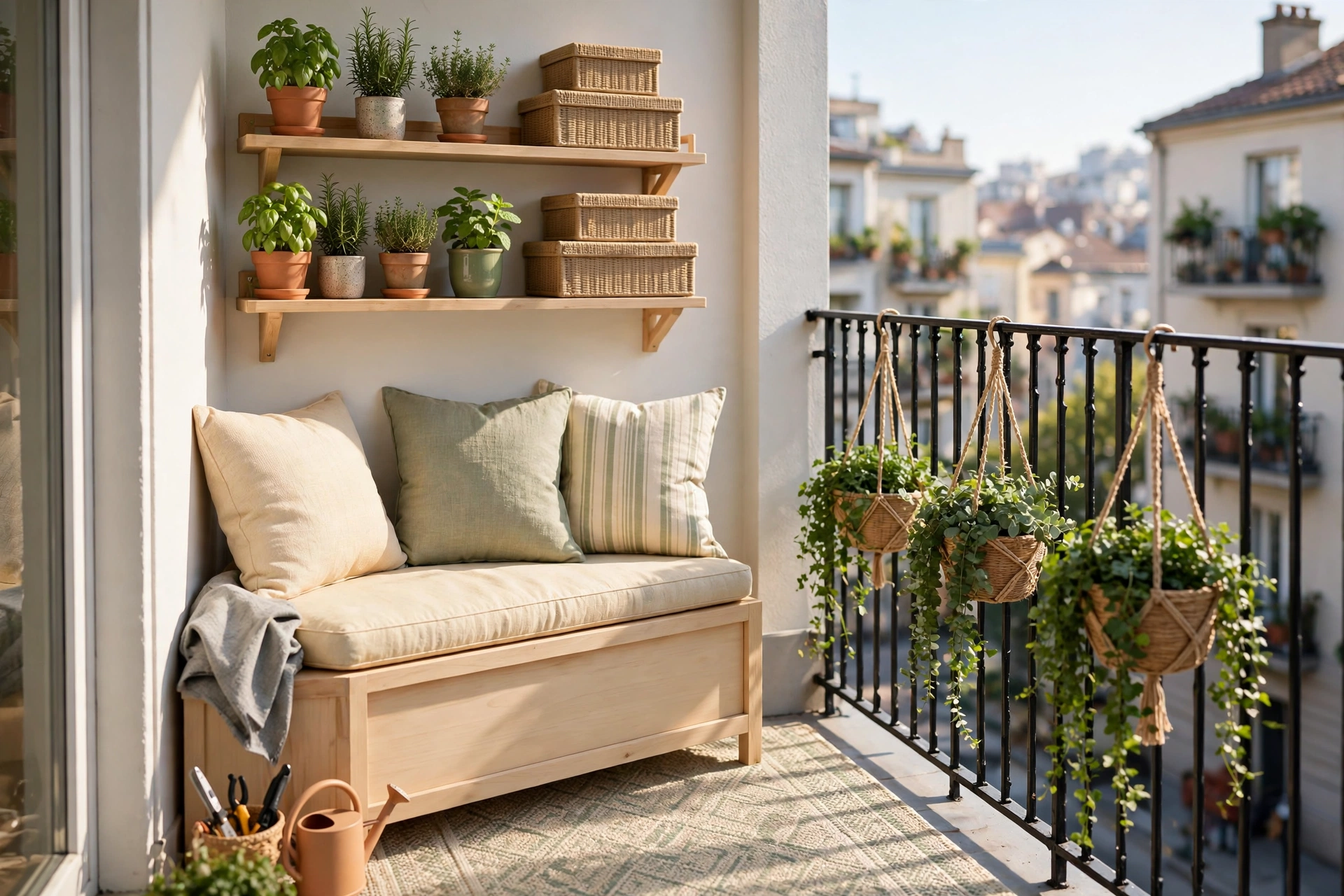

There is a special kind of sadness in a balcony that has quietly become a dumping ground. The deck chairs you meant to repaint two summers ago. The dead plant pots. The bag of potting soil split open in the corner, slowly dissolving into the floorboards. If your balcony is basically a storage unit with fresh air, these small balcony storage ideas will help you take it back — without spending a fortune or turning the space into a cramped shed.
Here is the truth most organizing advice skips: a balcony is the hardest small space to store things in. Everything out there has to survive sun, rain, and wind, and indoor storage tricks — fabric bins, open shelves, anything that hates moisture — die fast outdoors. But once you think of your balcony as a tiny room with weather instead of a patio, the whole puzzle gets solvable.
The Real Reason Balcony Storage Keeps Failing
Walk past any apartment block and you will see the same pattern: someone bought indoor-style storage, watched it warp and rust for a year, and gave up. The failure was never about tidiness. It was about using the wrong materials and fighting the space instead of working with it.
The most common mistakes on small balconies look like this:
- Bringing indoor furniture outside. A particle-board shelf that survives a hallway will swell, crumble, and grow mold after one rainy autumn. Outdoor storage must be outdoor-rated — resin, powder-coated metal, treated wood, or sealed bamboo.
- Choosing storage before deciding the balcony’s job. A balcony that has to hold the garden tools, the folding chairs, the kids’ scooters, and the drying rack will never feel calm. Pick one primary job — garden corner, reading nook — and let that decide what gets to live there.
- Ignoring the weather you actually have. Advice written for Arizona does not work in Manchester. Driving rain means sealed deck boxes and gasketed lids; brutal afternoon sun means UV-stable resin that will not crack or fade to grey chalk by August.
- Storing at floor level only. A typical apartment balcony is four to five feet wide. Every square foot on the floor is precious walking space, and filling it with boxes leaves you with a hallway that happens to be outside. Walls, railings, and overhead space do most of the heavy lifting on a truly tiny balcony.
- No “catch” system. Without one designated landing spot for the daily arrivals — parcels, watering cans, cushions pulled in before rain — everything lands wherever it lands.
Fix these five, and almost any balcony under sixty square feet can feel generous. The same “one job, one zone” thinking works indoors too — see our guide to studio apartment storage.
Small Balcony Storage Ideas That Do Double Duty
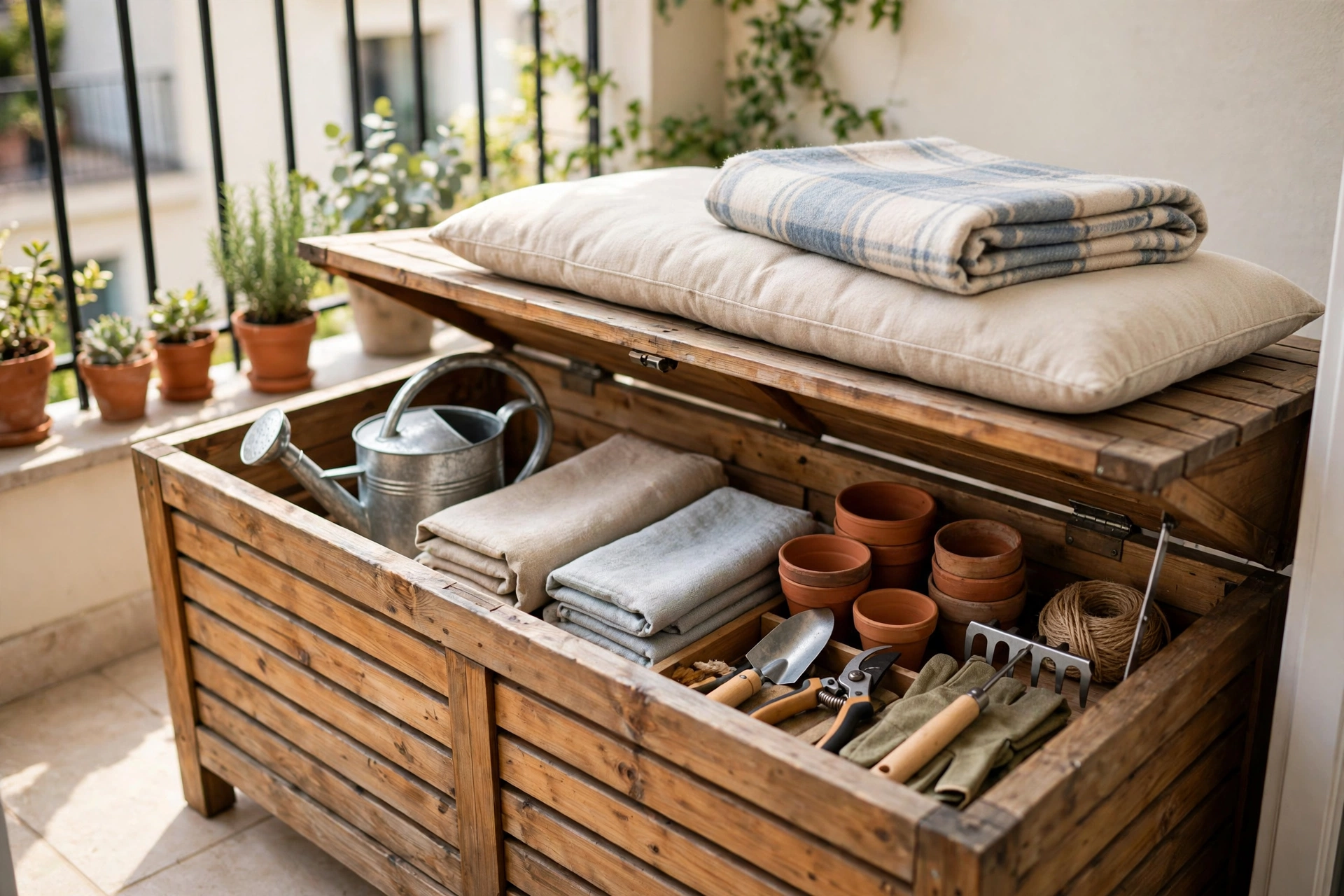
On a small balcony, every piece of furniture has to earn its floor space twice: once as storage, once as something you actually use. The single most transformative purchase for a tiny balcony is a storage bench — a seat with a weatherproof compartment underneath.
A good storage bench holds cushions, gardening gloves, trowels, and a coiled hose while giving you the only seat most tiny balconies have room for. Look for a top-lifting lid and a drainage gap underneath so water never pools. Resin deck boxes designed as benches are the workhorse here — they shrug off rain, weigh almost nothing, and wipe clean in seconds.
Beyond the bench, build your double-duty collection:
- A storage ottoman or two. Lighter than a bench, easy to rearrange, and perfect for potting soil, spare pots, or the lanterns you only use in summer. Tuck one under a rail-mounted table when guests come over.
- A rail-mounted drop-leaf table. This unsung hero clamps onto the railing, gives you a coffee surface or potting station, and folds flat when you are done. Hang a small fabric organizer underneath for seed packets and twine.
- Stackable crates that moonlight as side tables. Weather-treated wooden crates, stacked two high with a cushion on top, give you a side table plus hidden storage. Paint them to match your railing.
- A narrow rolling cart. A slim three-tier cart fits the sliver beside the door and wheels out as a drink trolley or mobile gardening station, then parks flat against the wall when not in use.
Rule of thumb: if a piece of furniture does only one job on a balcony this small, it has to go. Our narrow gap storage ideas run on that same one-piece-two-jobs logic.
Go Up, Not Out: Vertical Storage Wins Every Time
Your balcony floor is maybe forty square feet. Your balcony walls and railing are easily three times that, and most of it is empty air. Small balcony storage ideas that ignore vertical space are fighting with one hand tied behind their back.
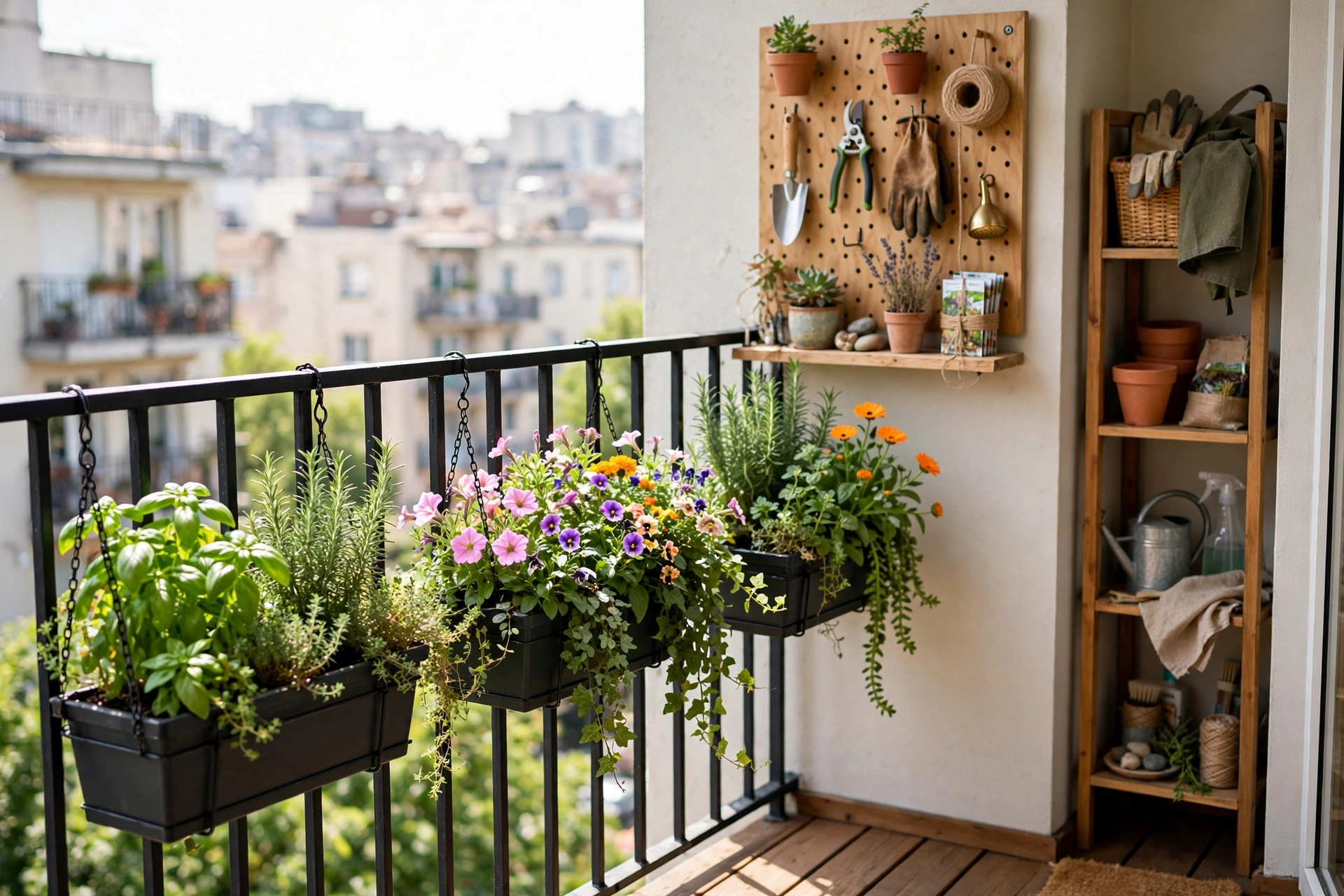
Start with the railing — the most underused real estate you own. Rail-mounted planter boxes turn the railing into a shelf for herbs, trailing flowers, even strawberries, without costing an inch of floor. Saddle-bag planters hang over both sides and double your growing space. Add hanging lanterns or solar lights and the balcony starts feeling like a room instead of a ledge.
Then move to the walls:
- A weatherproof pegboard or rail system. Mount one on the wall beside the door and your trowels, watering can, and pruning shears all have a visible, grabbable home. Move the hooks as your needs change through the seasons.
- Tiered plant stands and ladder shelves. A three- or four-tier stand holds more plants than four floor pots while using the footprint of one. A taller stand also doubles as a privacy screen, making the whole balcony feel more like your own.
- High shelves near the ceiling. That strip of wall above the door and just under the overhang is dead space — perfect for a slim shelf for the things you use twice a year: Christmas lights, citronella candles, the spare tablecloth. Labeled weatherproof bins keep it tidy.
- Over-the-door style hooks on the balcony door itself. The back of the door is free hanging space for a hand broom or a bag of birdseed — renter-friendly and instantly reversible.
One caution: check your lease before drilling into exterior walls — drilling into the building facade is often off-limits. Adhesive outdoor hooks, tension-rod shelving, and rail clamps give you the same vertical storage without touching the structure.
Hide the Practical Stuff (It Still Deserves a Home)
Every balcony has an awkward category: the watering can, the bag of compost, the folded tarpaulin, the plant feed. These items make a balcony look messy even when it is organized, because they look utilitarian no matter how neatly you line them up. You genuinely need them — so give them a concealed home instead of decluttering them.
A slim, tall outdoor cabinet is the best single solution here. It takes up the footprint of a laundry basket, closes with a door, and swallows the watering can, compost bag, spray bottles, and spare pots whole. Position it nearest the door — a two-step grab when gardening, out of sight over coffee.
For the things too bulky for a cabinet, go camouflage:
- Store potting soil and compost in a lidded deck box rather than leaving the torn bag in the corner. It stays dry, it pours cleanly, and it looks like furniture.
- Coil hoses and hang them on a wall hook behind a plant stand, where greenery hides the coil.
- Keep a handled tote inside the cabinet with the trowel, gloves, scissors, and plant ties you use weekly. Grab the caddy, garden, put it back.
- Fold tarps and outdoor covers into the bottom of the storage bench in a labeled bag — no unfolding three tarps to find the right one in October.
That “one concealed home per category” habit is what keeps a balcony tidy month after month. If the balcony is really holding things that belong indoors, our small bedroom storage guide has strategies for pulling storage back inside.
Weatherproof Everything: The Step Everyone Skips
The cleverest storage bench in the world still fails without weatherproofing. Outdoor storage is not “indoor storage, but outside” — it is a different discipline. Five non-negotiable habits:
- Seal the lids. Deck boxes and benches with rubber gaskets keep rain out; the ones without will collect a puddle every storm. If yours lacks a gasket, a bead of outdoor silicone around the rim does the job.
- Lift everything off the floor. Even waterproof boxes last longer on small risers or furniture glides. Standing water rots wood, rusts metal, and breeds mildew under resin. A centimeter of air gap is enough.
- Use desiccant and ventilation together. Sealed storage in a damp climate grows mildew — the irony of waterproof boxes. Toss reusable silica gel packs in each box and crack the lid on dry days to let air circulate.
- Choose fabrics that forgive. Cushions and throws on the balcony should be quick-dry outdoor fabric, or live inside the sealed bench. A cheap waterproof cover costs less than replacing a moldy cushion.
- Do a twice-yearly audit. Every spring and autumn, empty every box, wipe it down, and ask: did I touch this in the last six months? Balconies become the graveyard of good intentions; the audit keeps the storage honest.
That rhythm is also the moment to rotate seasonal items — heavy blankets in, light cushions and herb pots out. Think of the balcony as a tiny walk-in closet: everything has a season, and off-season things get stored, not stacked in the corner.
Your Weekend Balcony Storage Plan
No renovation budget needed. Here is a realistic two-day plan that takes most balconies from chaotic to calm:
- Saturday morning — the purge (2 hours). Pull everything off the balcony. Bin the dead pots, dried-out soil, and anything broken beyond repair. Be honest about the “someday” pile — if you have not fixed that chair in two years, it is not getting fixed on a balcony.
- Saturday afternoon — clean and zone (2 hours). Sweep and wash the floor and railing. Decide the balcony’s one job, then sort what remains into three zones: stays, hidden storage (needed but ugly), and goes back inside.
- Sunday morning — install (3 hours). Set up your double-duty pieces: storage bench, rail-mounted table, pegboard or tiered stand. Put the practical stuff in its concealed homes and hang the rail planters.
- Sunday afternoon — the finishing touches (1 hour). Add the one comfort item that makes it a room — an outdoor rug, solar string lights, a cushion on the bench. This stops the slide back into dumping ground, because now it is a place you actually use.
A balcony you never sit on will always become storage, no matter how clever the boxes are. The tidy ones are the ones that get used — morning coffee on the bench, herbs snipped from the rail planter, ten quiet minutes with a book. Design for the life you want out there, and storage becomes part of it, not a chore bolted on.
Small spaces reward the same thinking everywhere: fewer, harder-working pieces, everything with a home, a regular honest audit. Get those right and your tiniest outdoor square footage becomes the favorite room of the house — best light, freshest air, and not a single split bag of soil in sight. For more double-duty thinking indoors, browse our small living room storage ideas.