

Let me guess how your scarves live right now: a tangled nest at the bottom of a drawer, a couple crumpled over a hanger, and that one beautiful silk square you love but never wear because it’s always buried somewhere. The good news is that the best scarf storage ideas aren’t complicated — they just make every scarf visible and easy to grab, which is exactly when you start wearing them again.
Scarves are awkward things to store. They’re long, they’re slippery, and they come in wildly different fabrics — a featherweight silk and a chunky knit need completely different treatment. One method for everything is how you end up with a mess. In this guide, you’ll find hanging systems, drawer methods, small-space solutions, and fabric-specific care, so you can mix and match the scarf storage ideas that fit your closet, your collection, and the way you actually get dressed in the morning.
Start With a Five-Minute Scarf Audit
Before you buy a single organizer, pull every scarf you own onto the bed. All of them — the good ones, the forgotten ones, the ones still carrying a tag from two Christmases ago. Among all the scarf storage ideas worth trying, this audit is the unglamorous step that makes every other one work, because a system sized for thirty scarves will never suit a collection of twelve.
Sort them into four piles, and be honest with yourself:
- Wear weekly: your everyday heroes — the grey pashmina, the warm plaid, the black wool that goes with everything.
- Wear sometimes: the dressy silks, the statement prints, the special-occasion pieces.
- Off-season: the heavy knits if it’s spring, or the featherlight linens if it’s October.
- Let go: the pilled one you keep “for around the house,” the gift that never suited you, the duplicate you forgot you bought. Bag them for donation today — not “someday.”
This takes five minutes and it tells you exactly what you need. Six daily scarves want grab-and-go hanging; twenty special pieces want protected drawer space. Once you know your numbers, the right method picks itself.
Scarf Storage Ideas for Hanging (Best for Visibility)
Hanging wins on one metric that matters more than anything else: you can see every scarf at once. When your scarves are visible, you actually wear them — and a scarf worn twice a week justifies its space in a way a buried one never does. These scarf storage ideas all use vertical space your closet rod already provides.
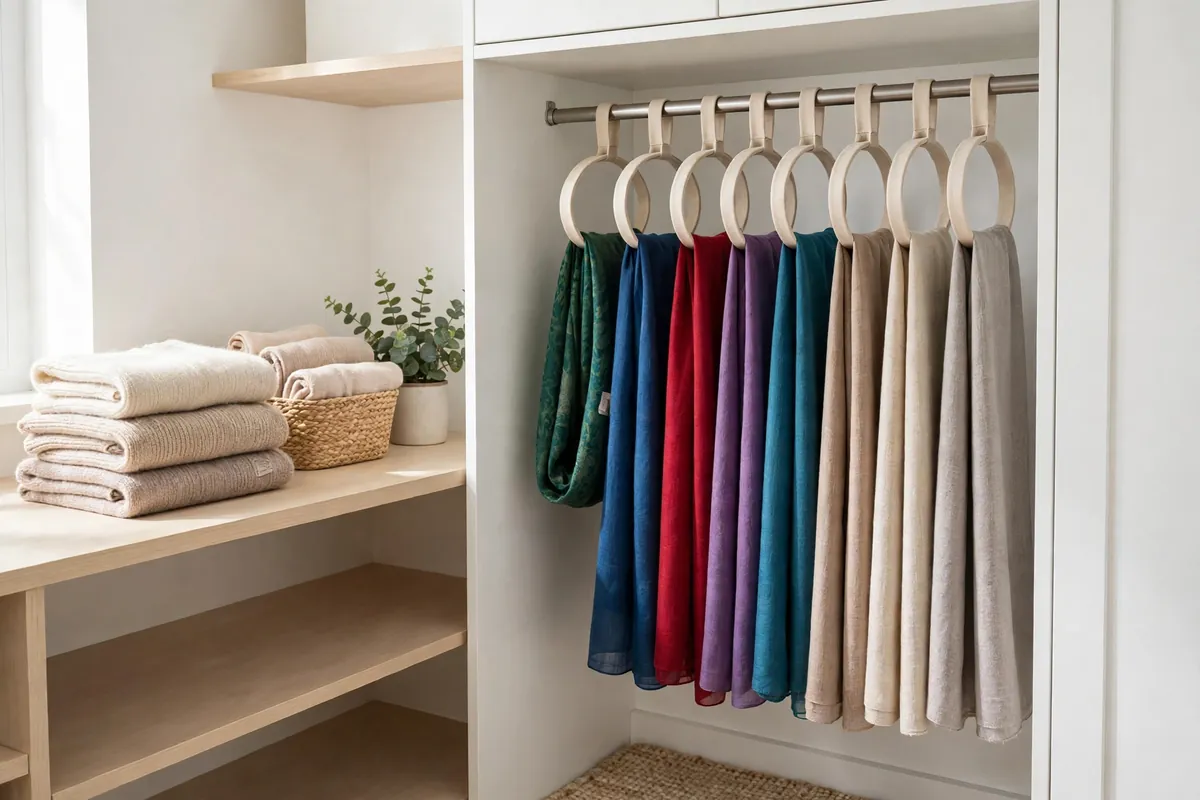
1. Multi-loop or ring-style scarf hangers
A hanger with loops or rings holds eight to twelve scarves on a single hook of closet rod. Drape each scarf loosely through its own loop — no knots, no threading and pulling, just a gentle fold over the bar. Wooden rings look beautiful, while smooth plastic or metal ones slide silk more easily.
2. Shower curtain rings on a regular hanger
On a budget? Clip a dozen shower curtain rings onto a sturdy hanger and thread one scarf through each ring. It costs almost nothing, it holds just as much, and it works beautifully in kids’ closets too. Choose smooth, snag-free rings and avoid anything with a sharp closure.
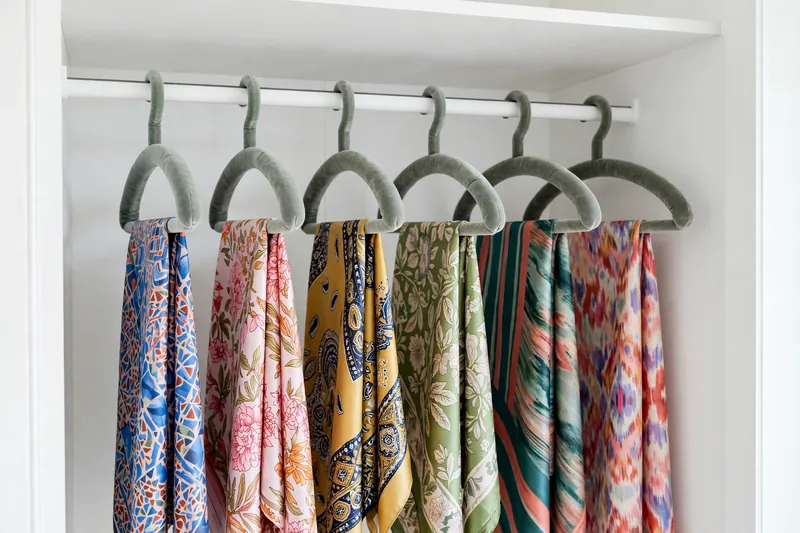
3. Padded velvet hangers, one scarf each
For silk squares and delicate pashminas, nothing beats a padded or velvet hanger. Drape the scarf over the bar — never clip it — and hang it like you’d hang a blouse. Velvet’s slight grip keeps slippery fabrics from sliding into a heap, which is the whole battle with silk.
4. S-hooks on a tension rod
Mount a short tension rod inside a deep closet, on a wall, or even between two shelves, then hang scarves from individual S-hooks. This is one of the cleverest scarf storage ideas for renters because nothing gets drilled or glued — the rod comes out cleanly on moving day. It also doubles as a little display: your prettiest scarves become decor.
5. Hanging fabric pocket organizers
The narrow fabric organizers sold for shoes work brilliantly for folded scarves. Each pocket holds one or two, everything is visible, and the whole thing hangs on a hook.
A word of caution about weight: hang only what the fabric can take. Lightweight silks, cottons, and medium knits hang happily for years. Very heavy blanket scarves can stretch at the fold line if hung for months, so give those the drawer treatment below. And never hang by clasps, pins, or knotted corners — the tension concentrates in one spot and distorts the weave.
Drawer and Shelf Methods That Prevent Wrinkles
Hanging shows everything off, but drawers protect. Wool, cashmere, and chunky knits actually prefer drawers: no gravity tugging at the fibers, no dust settling on the shoulders, no fading from closet light. The trick is how you put them in.
Roll, don’t fold
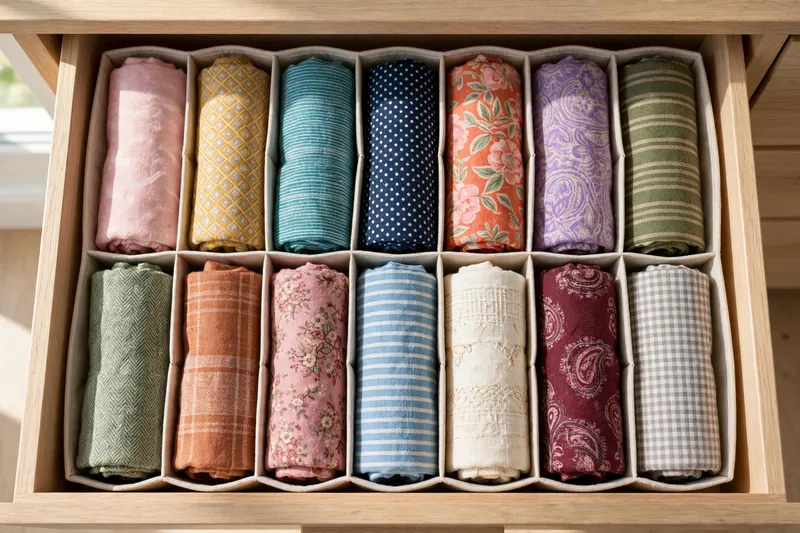
Rolling beats folding for almost every scarf. Lay the scarf flat, fold it lengthwise into a long strip, and roll it loosely from one end into a soft cylinder. Folds create sharp crease lines that set into the fabric; a roll distributes the bend across a curve, so nothing creases. Store the rolls upright, side by side, like files in a filing cabinet. You see every color at a glance and you can pull one out without disturbing the rest.
Divided drawer organizers
A fabric or bamboo divider with individual compartments turns one deep drawer into a dozen tidy slots. One roll per slot keeps things from collapsing into each other, and the dividers stop the classic drawer problem — the whole pile shifting every time you open it. If you don’t have a spare drawer, the same dividers work inside a lidded box on a closet shelf.
File-folded stacks in open bins
If you prefer shelves, use the file-folding method: fold each scarf into a compact rectangle and stand the rectangles upright in an open basket or bin, spines facing up. You can read the “spines” like book titles. One bin for winter knits, one for lightweight scarves, and you’re done. Keep the bins shallow enough that nothing gets buried — two rows deep is the maximum.
Baskets for the everyday pile
Let’s be honest: most of us have three or four scarves we grab constantly. A single attractive basket on a closet shelf or in the entryway holds those daily favorites, wrinkles and all. A basket for the daily rotation plus a proper system for the rest is a realistic compromise — and realistic systems are the ones that survive. If winter accessories are part of your daily pile, our hat and glove organization guide pairs perfectly with this setup.
Scarf Storage Ideas for Small Closets and Tight Spaces
No spare rod, no spare drawer, no spare inch? Some of the smartest scarf storage ideas were invented by people with tiny closets, because necessity really is the mother of a tidy wardrobe.
- Back-of-door hooks: A row of adhesive or over-door hooks on the inside of your closet door holds your five most-worn scarves. Use wide, smooth hooks — narrow metal points can snag delicate weaves. This keeps daily favorites off the rod entirely, freeing it for clothes.
- Over-the-door clear organizer: The clear-pocket shoe organizers aren’t just for kids’ scarves. One pocket per scarf, fully visible, zero closet space used. Best for cotton, jersey, and synthetics rather than precious silks, which deserve gentler housing.
- Under-shelf baskets: Wire or fabric baskets that hook onto an existing closet shelf create a brand-new layer of storage in dead air. Slide rolled scarves in, label the front, and you’ve doubled a shelf without a single tool.
- A slim wall rail: A short rail with evenly spaced hooks on a bedroom wall turns a curated handful of scarves into decor. Keep it to the pieces you wear constantly; delicate or valuable scarves stay protected inside the closet.
- The end of the bed: In a studio or dorm, a narrow basket or a lidded box at the foot of the bed works as a scarf station. It sounds improvised, but it’s exactly where you get dressed — and storage that lives where you dress is storage that gets used.
Small-space rule of thumb: if you can’t see it, you won’t wear it. In tight quarters, favor visibility over capacity — eight scarves you can see beat twenty you can’t reach.
Protecting Delicate Fabrics: Silk, Cashmere, and Pashmina
The scarves you love most are usually the ones that need the most care. Silk, cashmere, and fine pashmina respond badly to the two most common storage sins: compression and snags. Treat them differently from your everyday knits and they’ll look new for years.
- Silk: Hang on padded hangers for daily-wear pieces; for long-term storage, roll loosely around a tube of acid-free tissue and keep in a breathable cotton bag or lined drawer. Never seal silk in plastic — trapped moisture causes yellowing and mildew. Keep silk out of direct sunlight, which fades dyes surprisingly fast, and let it rest flat for a day after steaming before putting it away.
- Cashmere and fine wool: Fold loosely or roll, never hang heavy pieces for months at a time — gravity stretches the knit. Store with cedar blocks or lavender sachets (moths love a dark, undisturbed drawer), and always put cashmere away clean; body oils and perfume attract pests faster than anything else.
- Pashmina and large wraps: These drape beautifully on wide, smooth bars — a towel bar mounted inside a closet door works wonderfully. Fold once lengthwise over the bar so the weight spreads across the fold, not along an edge.
One more fabric rule worth memorizing: put perfume, hairspray, and sunscreen on before the scarf. Alcohols and oils in those products react with dyes and weaken silk fibers, and no storage system can undo a stain that set on day one. The same gentle-storage principles apply to other knits too — our sweater storage ideas cover folding and shelf methods that keep woolens in shape.
Seasonal Rotation and a 10-Minute Maintenance Routine
Even the best system drifts if you never touch it. Twice a year — once when the heavy coats come out, once when they go back — do a quick seasonal closet rotation for your scarves. Move the off-season pieces to a labeled bin on a high shelf or under the bed, and bring the current season’s scarves to the front. A rotation is also a natural moment to check for moth damage, loose threads, and stains that need treating.
Between rotations, a tiny maintenance habit keeps everything tidy:
- Weekly: re-roll any scarf you tossed back in a hurry. Thirty seconds, tops.
- Monthly: check that hanging scarves haven’t slipped into bunches, and wipe down the hanger or organizer.
- Seasonally: launder or dry-clean before storing off-season pieces — clean fibers store better and attract fewer moths.
That’s the whole routine. Ten minutes a season, and your scarf storage never slides back into the tangle.
Conclusion: Pick the System You’ll Actually Use
The perfect scarf storage method doesn’t exist — but the perfect one for you is the one you’ll maintain on a tired Tuesday evening. If you love seeing your collection, hang it. If you baby your cashmere, roll it into drawers. If your closet is the size of a phone booth, claim the back of the door. Start with the audit, pick one hanging method and one drawer method from the scarf storage ideas above, and give it a week. My bet: you’ll wear scarves you forgot you owned.
And scarves are only one corner of a calm closet — when you’re ready for the next one, our closet accessory organization guide gives belts, bags, and jewelry the same visible, grab-and-go treatment.