

It’s 7:40 on a Monday morning. Your alarm decided to betray you, your interview — sorry, your meeting — starts at nine, and you’re standing in front of your rental closet staring at one sad sagging rod, a small mountain of shoes on the floor, and your good blazer slowly getting wrinkles under a pile of laundry you meant to fold on Thursday. You rent. You can’t drill, mount, or bolt anything into these walls without your landlord charging you a small fortune on move-out. So the closet stays a mess, and the mornings stay chaotic.
Here’s the thing nobody told me when I signed my first lease: renter friendly closet organization has nothing to do with expensive custom systems. It’s about temporary, no-damage tricks that double the space you already have — tension rods, freestanding units, adhesive hooks, and a little bit of strategy. Everything I’m about to share comes out clean on moving day, leaves no holes, and costs less than a nice dinner out.
I learned this the hard way over three different apartments, one very strict landlord, and exactly one lost deposit (never again). The system below is what I wish someone had handed me on day one.
What “Renter Friendly” Actually Means for a Closet
Before you buy a single organizer, get clear on the ground rules. A solution is only renter friendly if it checks all three of these boxes:
- Zero permanent damage. No drilling, no screws, no anchors. If it can’t be removed in under ten minutes with a hairdryer and some patience, it’s not for a rental.
- It comes with you. The best rental organizers are investments you take to the next apartment — garment racks, cube shelves, clear bins. You’re buying for your life, not your lease.
- It respects the space. Most rental closets are small, shallow, and weirdly shaped. Solutions need to work inside the closet you actually have, not the dream closet on social media.
Also — and this matters more than people admit — read your lease before you start. Most leases are fine with tension rods and adhesive hooks, but some specifically ban anything stuck to painted walls. Know where you stand. Five minutes of reading now saves a deposit argument later.
Double Your Hanging Space Without Touching a Wall
The single highest-impact change in a rental closet is almost always the same: a second hanging rod. Most builder-grade closets have one rod mounted high with a dead, empty zone underneath where short things like shirts and blouses dangle uselessly. That dead zone is free real estate.
You have two no-drill options, and which one you pick depends on your walls:
- A tension-rod doubler: a spring-loaded tension rod wedged between the two side walls below your main rod. It takes about three minutes to install, costs less than a pizza, and instantly creates a second tier for shirts, skirts, and pants. This is the renter’s classic for a reason.
- A hanging double-rod extender: hooks over your existing rod and hangs a second rod below it. No wall contact at all — perfect if your side walls are too far apart for a tension rod to grip.
One honest warning: tension rods are for light loads. They’re brilliant for shirts, blouses, and summer dresses. They are not for twenty heavy winter coats — that much weight will make the rod slip and drop everything at 2 a.m., and your downstairs neighbor will never forgive you. Keep the heavy stuff on the original mounted rod. Speaking of which, if coats are the culprit in your closet, this pairs perfectly with the strategies in how to organize a coat closet without losing your mind — the same principles work on any overstuffed hanging space.
While you’re at it, swap your bulky mismatched hangers for a set of slim velvet hangers. They’re cheap, they grip clothes so nothing slides off, and they take up roughly half the rod space of plastic tube hangers. In a small rental closet, hanger real estate is everything.
Use the Door You Already Have
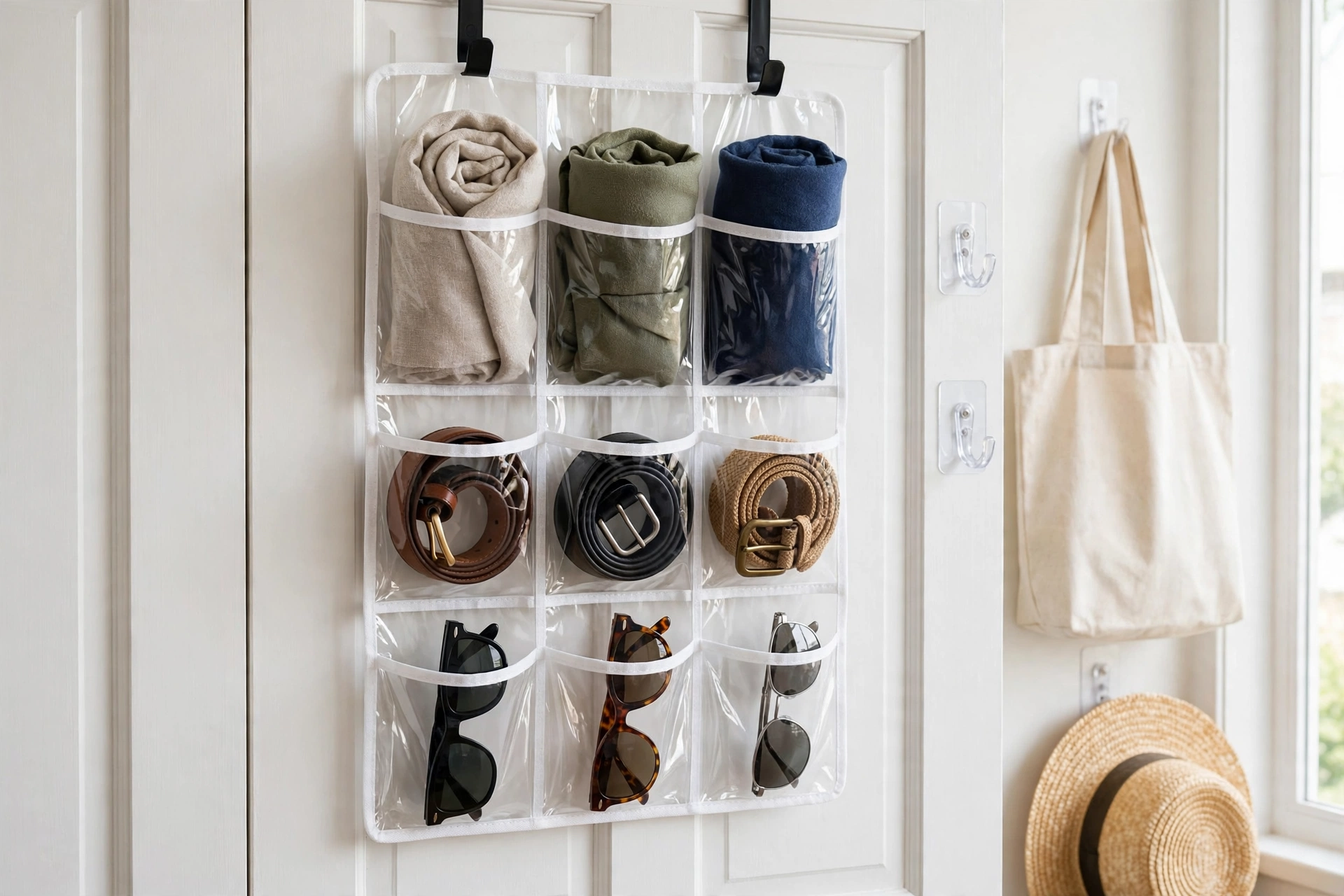
Every rental closet has a door, and the inside of that door is storage space you’re currently paying rent on and not using. Over-the-door organizers are the highest square-footage win in renter friendly closet organization, full stop.
What to put there depends on the style you choose:
- Clear-pocket organizers: perfect for rolled scarves, belts, sunglasses, gloves, and all the little things that vanish into drawers. The clear pockets matter — if you can see it, you’ll actually use it.
- Wire or hook racks: better for bags, totes, and tomorrow’s outfit. Some versions have shelves deep enough for folded jeans.
- A shoe-specific over-door rack: if the shoe situation is your biggest pain point, this single item can clear your entire closet floor.
One practical tip: some metal over-door hooks can scratch paint on the door’s top edge. A tiny square of felt furniture padding on the underside of each hook costs almost nothing and keeps the paint — and your deposit — intact. For shoe overflow that doesn’t fit the door, the ideas in shoe organization for small closets give you more floor-friendly options that still require zero drilling.
Adhesive hooks are the door’s best friend. A few strips-rated hooks on the closet’s side wall hold belts, tomorrow’s lanyard, your gym bag, or the outfit you’ve planned for the morning. Two rules: check the weight rating (most hold 3–5 pounds per hook, and believing otherwise ends in a 3 a.m. crash), and remove them slowly — pull the tab straight down, never toward you. A quick blast of warm air from a hairdryer softens stubborn adhesive on move-out day.
Take Storage to the Floor: Freestanding Is Your Friend
If you can’t build into the walls, build up from the floor. Freestanding furniture doesn’t care about your lease, and it all moves with you to the next place.
- A narrow drawer unit or cube shelf on the closet floor turns the dead space under your hanging clothes into a dresser. Folded jeans, sweaters, and workout clothes live here beautifully — and the closet quietly absorbs the dresser’s job, giving your bedroom its floor space back.
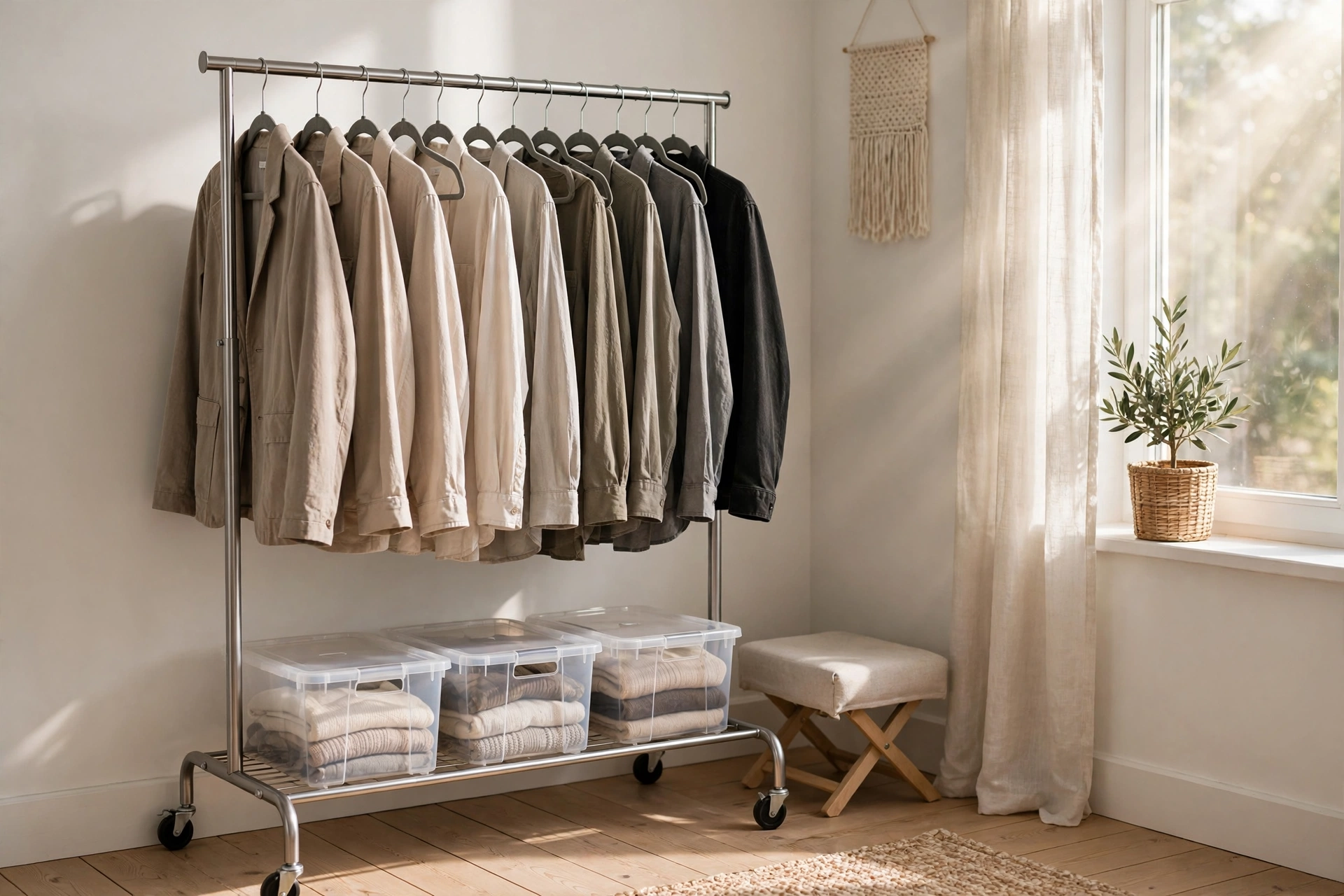
- Stackable clear bins on the top shelf swallow out-of-season clothes, spare bedding, and the “someday” pile. Clear matters more than pretty here: opaque bins become mystery boxes within a month. Label everything with a strip of masking tape and a marker — unglamorous, but it works.
- A freestanding garment rack beside or inside a walk-in handles overflow and doubles as a weekly outfit planner. Lay out five work outfits on Sunday night and your Monday-morning self will thank you. This is also the single best cure for the “chairdrobe” — that chair where clean-but-worn clothes go to die.
- A storage ottoman tucks into a corner, holds bulky sweaters or spare linens, and gives you somewhere to sit while you put on your shoes. In a tiny rental bedroom, every piece of furniture should earn its keep twice.
Here’s a mindset shift that changed my rentals: stop buying organizers for the apartment and start buying them for your life. A good garment rack or cube unit survives three moves. The cheap tension rod that barely grips? That’s a lesson, not an investment. Before adding anything new, it’s worth a quick pass through your wardrobe with the no-buy month declutter approach — organizing twelve things you actually wear beats organizing forty you don’t, and you’ll buy fewer organizers too.
Contain the Small Stuff: The Systems That Keep It Tidy
Here’s an uncomfortable truth about closets: the big stuff rarely causes the mess. It’s the socks, the scarves, the belts, the lone glove, the charging cable you threw in “temporarily” in 2024. Small things without homes become closet entropy.
The fix is containment — giving every small category a visible, easy-to-reach home:
- Drawer dividers or small boxes inside any drawer unit, so socks, underwear, and accessories each have their own lane. Without dividers, a drawer is just a smaller messy closet.
- A hanging fabric shelf organizer hooked over the main rod for folded knits and tees. Keep it to light items — overloaded fabric shelves sag into sad hammocks.
- A labeled “donation” bag or bin living permanently in the closet corner. When you try something on and it doesn’t fit or you just don’t love it anymore, it goes straight in the bag instead of back on the rod. When the bag’s full, it leaves the apartment.
That donation bin does quiet psychological work. Every time you open the closet, you’re reminded that the door swings both ways — and keeping the wardrobe lean is the real secret behind every “effortlessly organized” closet you’ve ever envied. If duplicates are your particular weakness (three black cardigans, anyone?), the rule of one for decluttering duplicates is the perfect companion exercise before you organize a single hanger.
Keep It That Way: The 10-Minute Weekly Reset
An organized rental closet stays organized for exactly one reason: putting things away is easy. Not willpower, not a personality transplant — ease. Every system above was chosen because the “put away” motion takes under five seconds. That’s the whole secret.
To keep it there, run a 10-minute weekly reset — Sunday evening works for most people:
- Rehang anything draped over the garment rack or chair. (Be honest about the chair.)
- Return stray shoes to their door rack or shelf.
- Toss anything that migrated in during the week — mail, bags, random objects — back to its real home.
- Glance at the donation bag. Anything to add? Anything ready to leave?
That’s it. Ten minutes, once a week, and the closet never slides back into chaos. Take a quick photo of the closet on the day you finish organizing it — that “after” picture becomes your reset target. When things drift, you’re not reorganizing from scratch; you’re restoring a known good state.
The Bottom Line for Renters
You don’t need permission from your landlord or a contractor’s budget to have a closet that works. A tension rod, some slim hangers, an over-the-door organizer, a few clear bins, and a floor unit you can take with you — that’s a complete renter friendly closet organization system for well under a hundred dollars, installed in an afternoon, and removed in minutes when the lease ends.
Start this weekend. Pick the one change that addresses your biggest pain point — usually the second rod or the door organizer — and do just that. Momentum beats perfection every time. Your future Monday-morning self, standing calmly in front of a closet where everything is visible and reachable, will be very glad you did.
[…] rather than soft sling-style shelves, which bow under weight and squeeze everything together. For rental closets you can’t drill into, a hanging organizer hooks right over the rod and is completely […]
[…] while freeing the sideboard for the boring-but-necessary items. If you’re renting, look for renter-friendly, no-drill storage ideas — the same damage-free principles that protect your deposit in a closet work just as well on […]
[…] against the side walls with no drilling, no brackets, and no deposit drama. There are plenty of renter-friendly closet organization ideas that leave zero trace […]