

The dining room is often the smallest room in a small home — and the one expected to do the most. It hosts holiday dinners, doubles as a homework station, holds the good dishes nobody admits to owning, and somehow also becomes the landing strip for mail, keys, and whatever bag you carried in from the car. If you’re searching for small dining room storage ideas, you probably already know the problem: every piece of furniture in a tiny dining space has to earn its floor space twice over, and most standard dining furniture was built for rooms twice your size.
Here’s the good news. A small dining room doesn’t need a full renovation to store everything it needs to store. It needs smarter choices — shallower furniture, vertical thinking, pieces that serve two purposes, and a ruthless clarity about what actually belongs in this room. This guide walks through the ideas that work in real dining rooms of 100 square feet or less, tested in apartments, starter homes, and dining nooks carved out of larger spaces.
Start With One Slim Sideboard
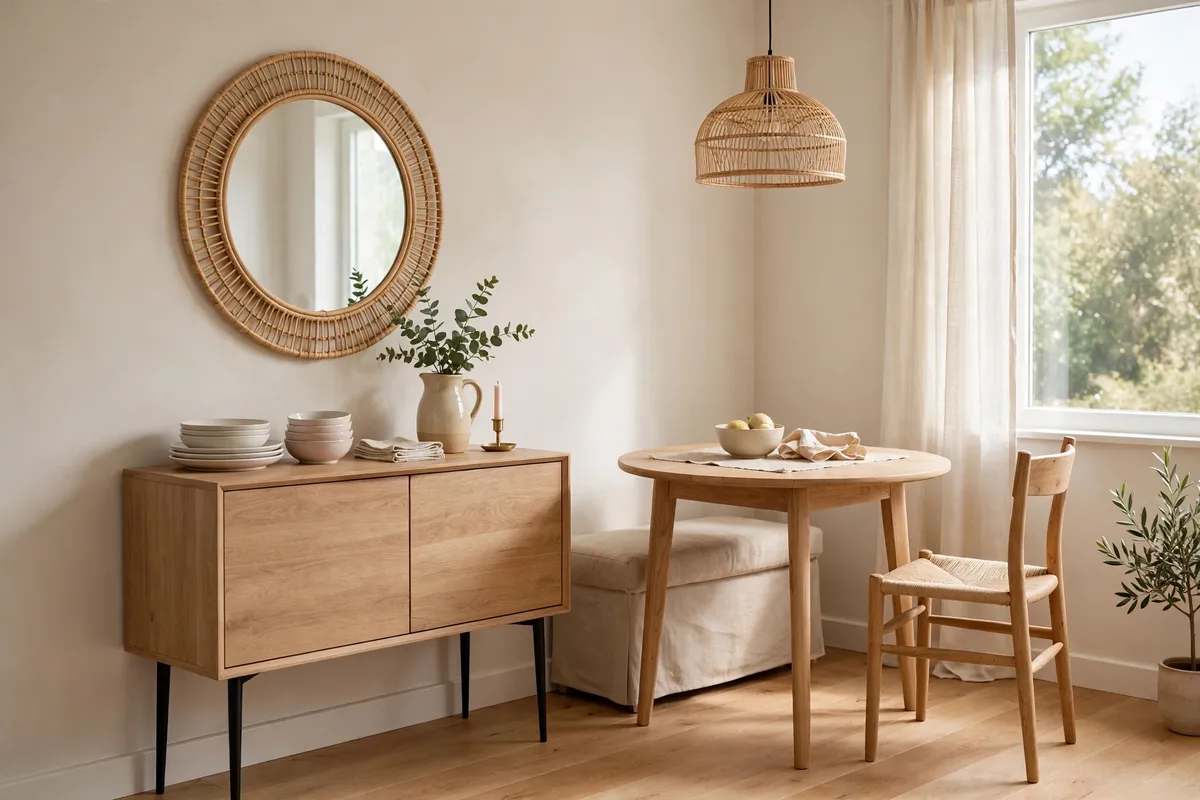
Every small dining room storage plan should start with one workhorse piece, and the sideboard is the hardest-working candidate in the room. The problem isn’t the sideboard itself — it’s the size most people buy. A standard buffet is 18 to 20 inches deep, which in a tight dining room means the chairs on that side barely push back before someone’s back is against the drawers. Look instead for a slim sideboard or console in the 12 to 16-inch depth range. That six-inch difference is enormous: it preserves your walkway, lets drawers open fully without hitting chair backs, and visually keeps the wall from closing in on you.
A taller, leggy piece helps even more. When you can see floor underneath furniture, the room reads as larger — it’s a small visual trick, but in a 10-by-10 dining room it genuinely changes how the space feels. Hang a mirror or a piece of art above the sideboard and the effect multiplies; the reflected light makes a cramped corner feel twice as airy.
Inside the sideboard, think in layers rather than piles. Shelf risers turn one shelf into two levels of short stacks — plates below, cereal bowls or ramekins above. Drawer dividers give cutlery, napkins, candles, and the inevitable junk (batteries, rubber bands, the menu from the pizza place) their own zones instead of one tangled heap. A shallow sideboard with organized drawers holds a surprising amount: everyday dishes, the table linens you actually use, serving utensils, placemats, and coasters can all live here if every inch is assigned a job.
Small Dining Room Storage Ideas for the Walls
Floor space is the scarcest thing in a small dining room. Wall space, by contrast, is usually going begging. A dining room with bare walls and an overstuffed buffet has its priorities backward.
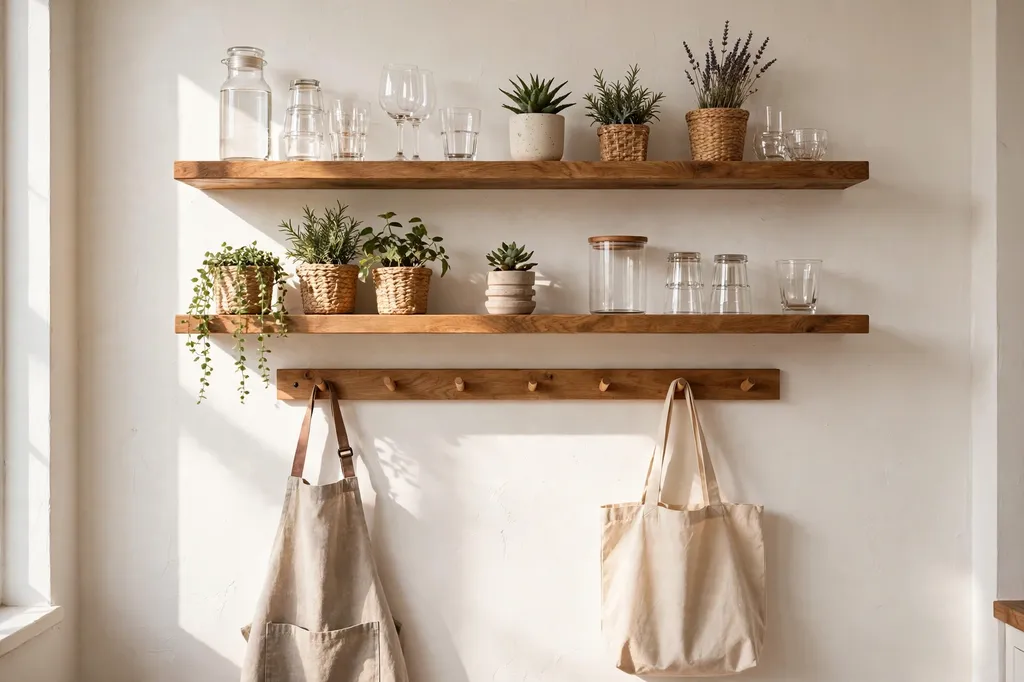
Floating shelves above the sideboard or on the least-used wall are the single highest-impact upgrade you can make. Two or three shelves, hung high enough to keep the tabletop clear, give you display space for glassware, a few cookbooks, small plants, or a row of matching baskets that swallow clutter whole. Keep the shelves shallow — 8 to 10 inches — so they don’t loom over the table, and leave breathing room between objects. A shelf packed edge to edge reads as clutter; a shelf with four intentional items reads as a design choice.
For the wall nobody looks at, consider a plate rack or peg rail. A wooden peg rail with shaker-style pegs costs almost nothing and holds everything from aprons and tote bags to a basket of fruit or a wreath that changes with the season. Plate racks and small wall-mounted spice-style shelves put pretty dishes on display while freeing the sideboard for the boring-but-necessary items. If you’re renting, look for renter-friendly, no-drill storage ideas — the same damage-free principles that protect your deposit in a closet work just as well on dining room walls.
Choose Furniture That Does Double Duty
In a small dining room, single-purpose furniture is a luxury you can’t afford. Every piece should do at least two jobs, and the best pieces do three.
- A storage bench instead of side chairs. One bench tucked along one side of the table seats as many people as two or three chairs, takes up less visual space, and — if you choose a bench with a lift-up seat or a built-in cubby — hides table linens, board games, or the craft supplies the kids use at this table every afternoon.
- A drop-leaf or extendable table. Daily life needs a table for two or four; Thanksgiving needs seating for ten. A table that folds down to a console width when the crowd goes home means the room doesn’t spend 360 days a year sized for five of them.
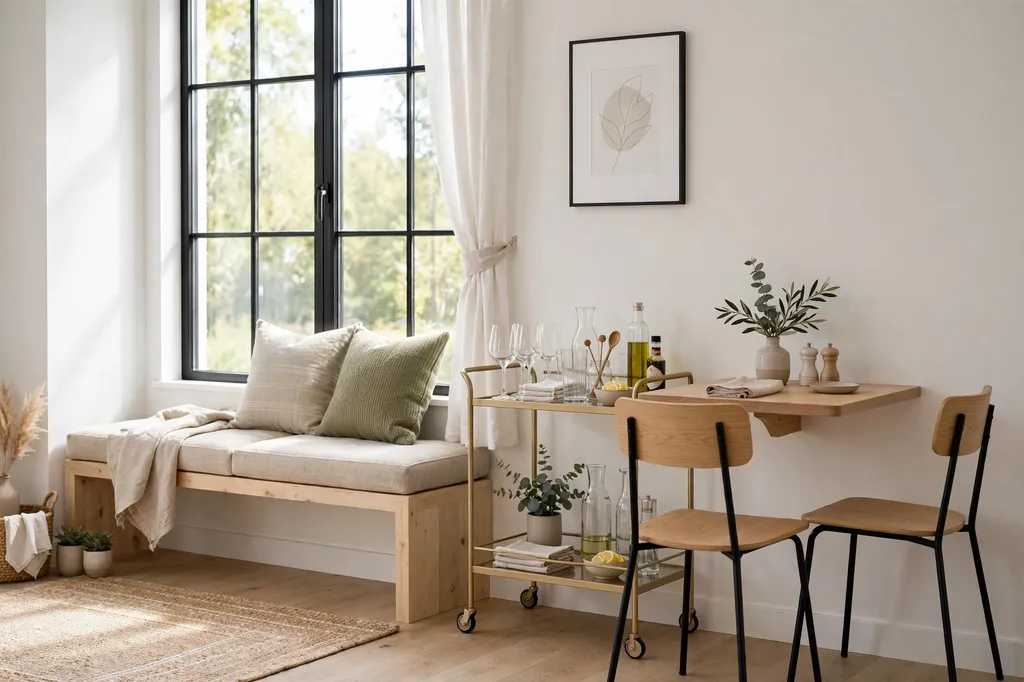
- A bar cart that moonlights. A slim bar cart holds glassware and a few bottles between dinner parties, then rolls wherever the action is when guests arrive. Between parties it can park in a corner and hold a small plant and your placemat stack.
- An ottoman that stores and seats. A storage ottoman slides under a window or into a corner, hides the tablecloth you never fold, and gives a guest somewhere to sit when the table expands beyond its normal chair count.
- A kitchen island or rolling cart as the divider. In open-plan spaces where the “dining room” is really just the end of the kitchen, a narrow rolling island or cart creates the boundary while adding storage. If you’re sorting out the kitchen side of that boundary too, these studio apartment storage ideas that make a small space work hard apply the same double-duty logic to combined living spaces.
Turn Dead Corners and Awkward Nooks Into Storage
Every dining room has at least one spot that never quite gets used: the corner behind the door, the sliver between the hutch and the wall, the alcove that fits nothing standard. Small-space veterans learn to read these spots as opportunities, not problems.
A tall, narrow etagere or corner shelving unit fits exactly where a square cabinet can’t. Because corner units read as furniture rather than storage, they hold the pretty stuff up top — cookbooks, a vase, a small stack of cloth napkins — while baskets on the lower shelves handle the less photogenic reality. In the dead space beside a sideboard, a slim rolling cart (the 6-inch-wide kind sold for narrow kitchen gaps) slides in and holds napkins, trivets, and candles in perfectly reachable order.
If your dining room has an underused window, treat the wall beneath it as a built-in bench opportunity. A low, wide storage bench under the window reads as a window seat, adds seating, and swallows bulky items like the holiday tablecloths, the folding chairs, and the serving platters that only appear twice a year. And if you’re lucky enough to have an actual architectural oddity nearby — like stairs — the same principle behind under-stair storage that turns dead space into gold works in miniature under and around any dining nook.
Measure first, always
Before buying anything for an awkward nook, measure the nook, the door swing, and the chair clearance — then write the numbers on your phone. Small rooms punish guessing. You need at least 32 to 36 inches of circulation between the table edge and any furniture or wall, or everyday meals turn into a shuffling sideways dance. A piece that technically fits but blocks a drawer or door isn’t storage; it’s a barricade.
Keep the Table Clear With a Hosting Station System
Here’s the real secret of small dining rooms that always look tidy: the table stays clear because everything has a specific home somewhere else. Set up what organizers call a hosting station — one defined zone (the sideboard top, one shelf, one drawer bank) that holds the full kit for the two or three scenarios your dining room actually serves.
Most dining rooms serve three recurring scenarios: everyday meals, guests, and the once-a-quarter big event. Your station should hold:
- Everyday: placemats or a table runner, the everyday napkins, salt and pepper, and the current candle or centerpiece.
- Guests: the good napkins, cloth placemats, serving spoons, a trivet stack, and a tray you can load in the kitchen and carry straight to the table.
- Big events: the extension leaf hardware, extra place cards, the tablecloth, and the serving dishes that live in the back of the sideboard until November.
When each scenario has its kit in one place, setting up takes five minutes and — more importantly — putting it all away takes five minutes, which means it actually gets put away instead of putting it all away taking five minutes, which means it actually gets put away instead of living on the table for a week. This is the same principle that keeps clutter from colonizing a small bedroom: give every category a bounded home, and the surfaces stay free. Small bedroom storage ideas that really work are built on exactly this logic, and it translates room for room.
Make Seasonal Storage Work Harder
A small dining room often ends up storing things that don’t belong to any season of daily life: the Christmas china, the summer picnic set, the chargers that appear at two meals a year. These items don’t need prime real estate — they need a labeled box in the highest, deepest, least-accessible spot in the room, because you touch them twice a year.
Assign your best zones to daily items and your worst zones to seasonal ones. Top of the sideboard and the high floating shelf: seasonal. Eye level and drawer height: daily. One clear bin per season or event, labeled on two sides so you can read it without pulling it down, turns “somewhere in the dining room” into a thirty-second retrieval instead of a twenty-minute excavation. If seasonal overflow is eating space throughout the house, a broader seasonal plan — like the approach in small living room storage ideas that make a tiny space feel twice as big, which treats every zone by how often it’s touched — brings the same relief room for room.
One last seasonal rule: the day the decorations or the extra settings go back into their bins, take five minutes to note what you didn’t use. The fondue set you haven’t touched in four years isn’t a tradition; it’s a square foot of your dining room. Letting it go is the fastest storage upgrade available, and it’s free.
The Five-Minute Nightly Reset
Even the best small dining room storage ideas fail if the system slowly rots. Small rooms show neglect fast — two jackets, a laptop, and a mail pile make a 120-square-foot dining room feel like a storage unit. The fix is a nightly reset so short it barely counts as a chore.
Set a timer for five minutes after dinner. Everything on the table that isn’t a centerpiece goes home: mail to the basket, dishes to the kitchen, bags to their hooks, the laptop to its shelf. Wipe the table. That’s it. Five minutes a day is the difference between a dining room that always looks inviting and one that makes you avoid the room. Kids can own parts of this — the toy basket, the placemat stack — and in a dorm or shared apartment this same five-minute habit is what keeps a tiny shared space livable, as any dorm room organization routine will tell you.
A small dining room doesn’t need to be big. It needs to be intentional: one slim sideboard doing the heavy lifting, walls working instead of standing bare, furniture earning double duty, dead corners put to work, and a five-minute habit that keeps it all honest. Start with whichever idea is easiest for your room this weekend — you’ll be surprised how much space you were already standing in.