
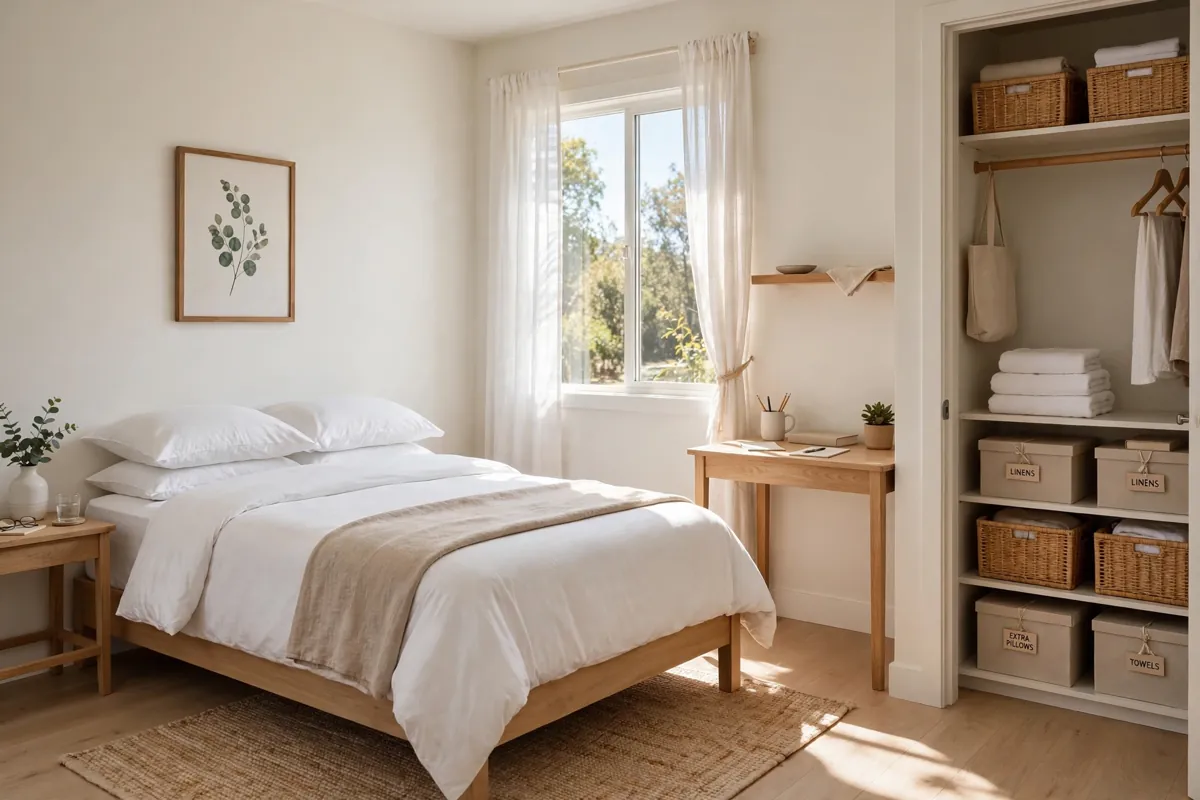

Every home seems to have one: the room with no real job. It starts out as a guest bedroom, then slowly collects the boxes you never unpacked, the treadmill nobody uses, the bag of clothes meant for charity three moves ago, and a broken lamp you keep meaning to fix. If you want to know how to declutter a spare room and turn it into a space you actually use, the good news is that it is one of the most satisfying projects in the whole house — because the change is so visible, and so fast. In a single weekend, you can go from a door you keep shut out of embarrassment to a room you genuinely enjoy walking into.
The reason spare rooms get so bad is simple. Unlike a kitchen or a bathroom, nobody has to use the spare room every day, so the mess never forces a decision. It becomes the easiest place in the house to put things you do not want to deal with. That is also why clearing it feels so freeing. You are not just tidying a room; you are taking back square footage you already own.
Start by Deciding What the Room Is For
Before you move a single box, decide what this room will actually do in your life. This is the step most people skip, and it is the reason so many spare rooms fill up again within six months. If you clear a room without giving it a job, it will quietly go back to being a storage cupboard with a door.
Think honestly about what your household is missing. Do guests stay over often enough to justify a proper guest room? Do you work from home at the kitchen table and wish you had a door to close? Would a reading corner, a craft space, or a small home gym get used every week? Pick one main job, and at most one secondary one. A guest room that doubles as a home office works beautifully. A guest room that is also a gym, a craft store, and an overflow closet does not.
Walk into the room and picture the finished version. Where would the bed or desk go? What needs to stay, and what is only there because it had nowhere else to go? Write the room’s new job on a sticky note and put it on the door. Every item you pick up from now on gets judged against it: does this belong in a guest room, an office, or whatever you chose? If not, it leaves.
How to Declutter a Spare Room, Step by Step
Learning how to declutter a spare room is mostly about having a system and sticking to it, because the room will look worse before it looks better. That is normal, and it is not a sign that you are doing it wrong. Set aside a full day if you can, or two or three shorter sessions across a weekend. Put on music, open the window, and gather your supplies before you start: bin bags, a box for donations, a box for things that belong in other rooms, and a laundry basket for anything that needs washing.
Work in this order, and do not skip ahead to buying storage boxes. Storage comes last, once you know what is actually staying.
- Clear the floor first. Everything on the floor goes into one of your four piles: keep, relocate, donate, or bin. Getting the floor visible gives you room to work and an instant sense of progress.
- Empty every surface. Dresser tops, shelves, windowsills, and the top of the wardrobe all get cleared completely. Dust them as you go, so you are not putting clean things back onto dirty shelves.
- Open every drawer, cupboard, and box. This is where the real clutter hides: old cables, half-used notebooks, chargers for phones you no longer own, and paperwork from years ago. Be honest about duplicates. You do not need four phone chargers in a room nobody sleeps in.
- Deal with the big items. The exercise bike, the broken chair, the spare mattress leaning against the wall. Big items take up the most space and the most mental energy, so deciding on them early frees the rest of the project.
- Take the donations and rubbish out the same day. Bags sitting by the door have a way of migrating back inside. Load the car, drop them off, and enjoy the empty floor.
If you get stuck on a category of items, put it in a “decide later” box with a date written on it, and give yourself two weeks. If you have not opened the box by then, donate the whole thing unopened. This trick works because it separates the decision from the emotion of the moment. It also stops one tricky drawer from stalling the entire room, which is how many decluttering sessions quietly die.

What to Do With the Tricky Stuff
Every spare room has a layer of things that are hard to let go of, and they are almost always the same culprits: sentimental items, “just in case” supplies, and things that belong to someone else in the household. Handle them with a plan rather than willpower alone.
Sentimental items deserve real attention, not a rushed bin bag. Set them aside in one box and go through them when the rest of the room is done and you have energy to spare. Keep the pieces that genuinely spark a memory — the letter from your grandmother, your child’s first drawing — and photograph the rest before letting them go. A photo takes up no shelf space and still keeps the memory. If you want a gentler, more detailed approach to this part, our guide to decluttering sentimental items walks through it step by step.
“Just in case” items are a different trap. Ask yourself when you last used it and what would actually happen if you needed it again. A spare set of curtains for a window you no longer have, a box of cables for devices you replaced years ago, a stack of moving boxes “in case you move” — these are not insurance, they are rent you pay in floor space. If replacing an item would cost less than a takeaway dinner, let it go.
For things that belong to other people, set a clear boundary. Give each person a labelled box and a deadline — a week is fair — and explain that anything left after that will be donated. This is kinder than it sounds, because it gives them a real choice instead of a silent resentment building up in a room nobody uses. If the overflow has already spilled beyond one room, you may also find our guide to decluttering a storage unit useful, since the same decide-and-deadline system works there too.
Set the Room Up for Its New Job
Once the room is empty and clean, it is time for the fun part: putting it back together as something you will actually use. Start with the biggest piece of furniture the new job requires, and build around it. For a guest room, that is the bed. For an office, the desk. For a reading room, a comfortable chair with good light. One anchor piece stops the room from drifting back into a dumping ground, because it gives every other decision a reference point.
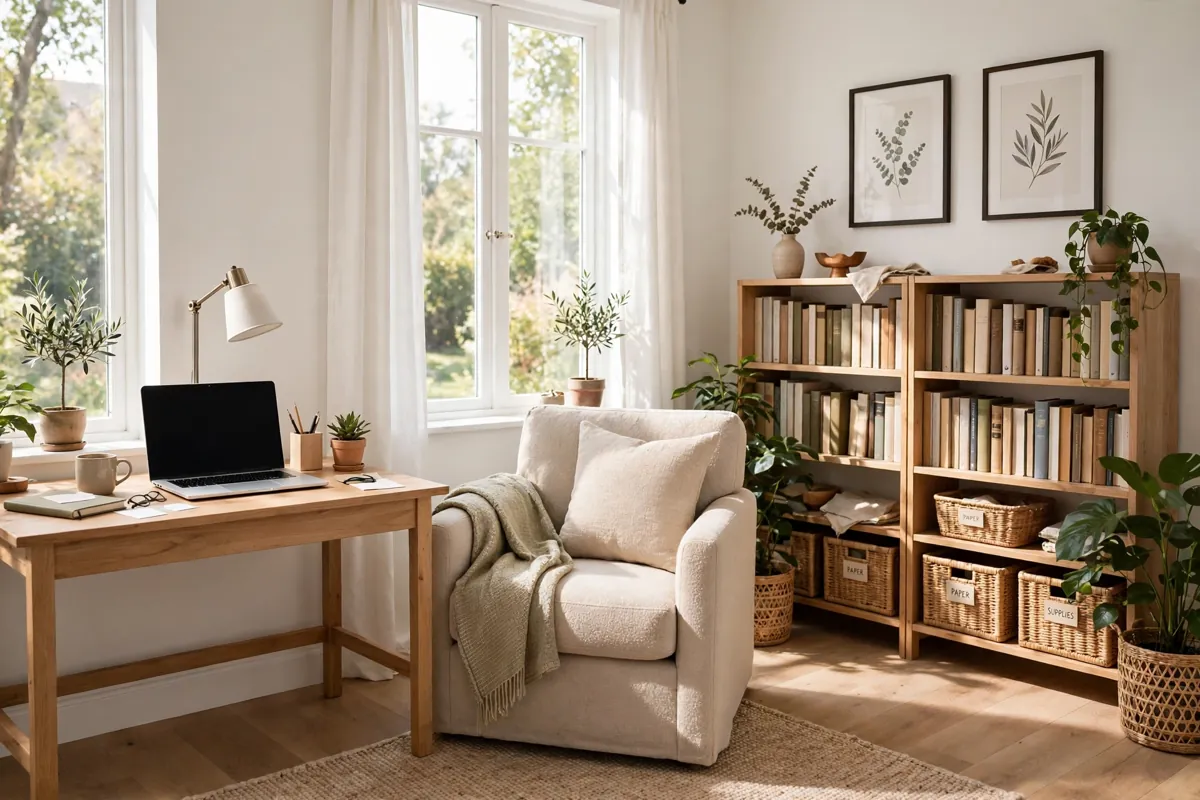
If the room needs to do two jobs, choose furniture that can switch roles. A daybed works as a sofa by day and a bed at night. A wall-mounted fold-down desk disappears when guests arrive. A storage ottoman holds spare bedding and gives visitors somewhere to sit. The goal is not to cram in every possible function; it is to make the two jobs you chose feel intentional rather than improvised. If you are leaning toward a work setup, our tips for decluttering a home office will help you keep the workspace side of the room calm and focused.
Then add the small touches that make a room feel finished rather than merely empty. Fresh bedding, a bedside lamp, a hook on the back of the door, a small tray with a phone charger for guests. These details cost very little, but they are what turns a cleared room into a room people want to spend time in. If the new job is a guest room, it is worth borrowing a few ideas from how to declutter a bedroom, because a guest sleeps better in a room that feels like a bedroom, not a storeroom with a bed in it.
Finally, give everything left in the room a proper home. Closed storage — a wardrobe, a chest of drawers, baskets on a shelf — keeps the room looking calm even when life gets busy. Label the boxes you do keep, and leave a little empty space on every shelf. A room that is full to the brim has nowhere to absorb the next thing that comes in, and that is exactly how the clutter creeps back.
Keep It From Sliding Back
The hardest part of decluttering a spare room is not the weekend of work; it is the six months afterwards. Spare rooms slide back quietly, one “temporary” box at a time. The fix is a simple rule everyone in the household agrees on: nothing enters this room without a home already waiting for it. No “just for now” piles, no “I will sort it at the weekend” boxes by the door.
A five-minute reset once a week is enough to hold the line. Put stray items back where they belong, shake out the bedding or wipe the desk, and check that the surfaces are still clear. Tie it to something you already do, like Sunday evening before the week starts, so it becomes a habit rather than a chore you have to remember. And once a season, do a quick fifteen-minute pass: anything that has crept in without a real purpose goes straight into the donation box.
It also helps to use the room. A guest room that hosts a friend once a month stays tidy because someone is always about to see it. An office you sit in every morning stays tidy because you notice the mess. A reading corner with your current book on the chair stays tidy because it is yours. Use is the best maintenance there is.
A Room You Will Actually Enjoy
A spare room does not need a renovation or a big budget to become useful. It needs a decision about its job, a weekend of honest sorting, and a few small habits to keep it that way. The reward is a room that earns its place in your home — a comfortable bed for the people you love, a quiet desk for your work, or simply a peaceful corner that is yours. Open the door, enjoy the empty floor, and start with the biggest box. Your future self, walking into a calm and purposeful room, will be glad you did.