
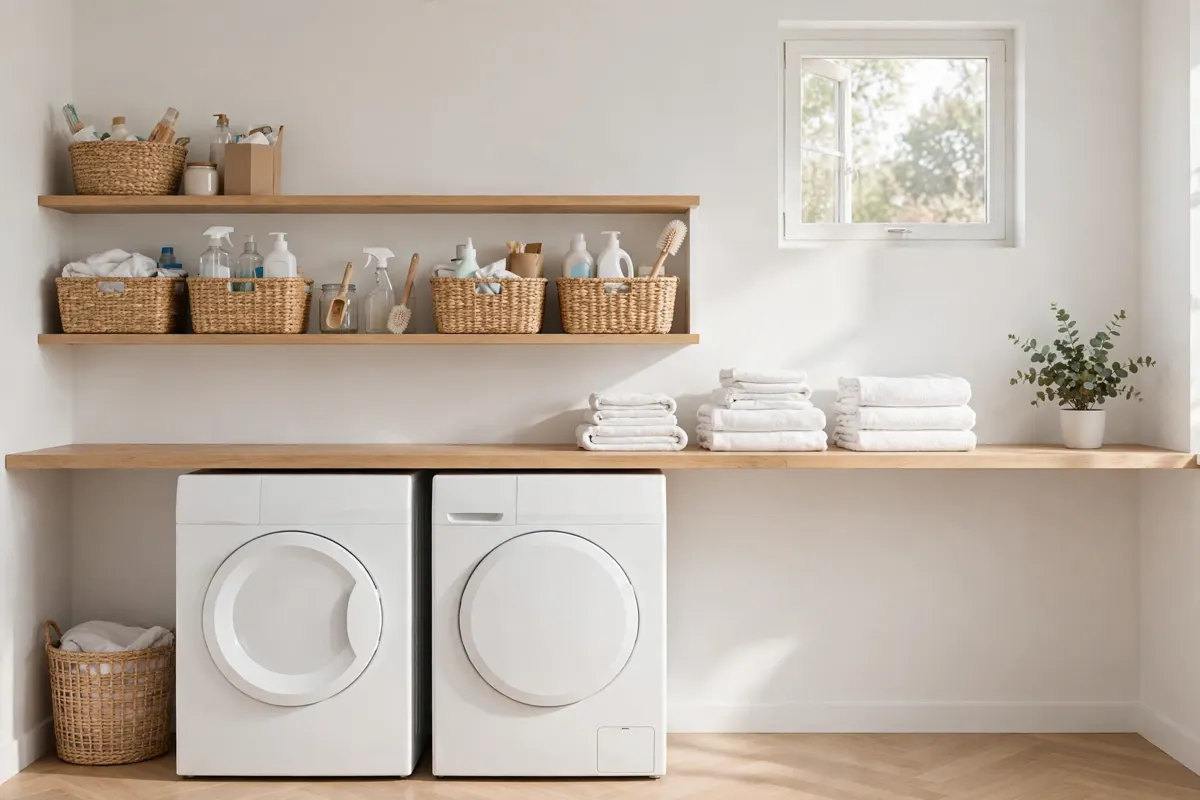

There is a particular kind of tired that only the laundry room can produce. Not the satisfying tired of a job finished — the heavy, low-level tired of walking into a room that never quite gets clean, never quite gets organized, and somehow always seems to be holding your household hostage. If you have ever wondered how to declutter a laundry room without turning the whole project into a weekend-devouring renovation, this guide is for you. No buying an entire container-store aisle. No waiting until you have the perfect shelving system. Just a calm, practical afternoon that turns the most chaotic room in the house into one that actually works.
Here is the honest truth about laundry rooms: they are not just laundry rooms. Over time they become the overflow drawer of the entire home — old paint cans, cleaning products for jobs you no longer do, a mismatched sock graveyard, detergent you bought on sale in 2022 and never loved. The washing machine area becomes the place where things go to be forgotten, and every time you carry a basket in there, the clutter silently accuses you.
The good news: the laundry room is one of the fastest rooms in the house to declutter. It is small, it has a clear purpose, and most of what is in there can be decided in about five seconds. You need about two to three hours, four bags or boxes, and honesty about the stain remover you have never once used.
How to Declutter a Laundry Room: Where to Start
Before you touch a single bottle, set yourself up for a smooth afternoon. The difference between a decluttering session that finishes and one that peters out at the halfway mark is almost always preparation. Gather four containers and label them: Trash, Recycle, Relocate (things that belong in another room), and Donate/Pass on (usable things you simply do not need). A laundry basket or two also helps for the inevitable pile of clothes that are about to come out of the woodwork.
Next, give yourself a real time boundary. Two to three hours is realistic for most laundry rooms — even messy ones — because the room itself is small. Set a timer if you need to. When the time is up, you are done for the day; whatever remains can wait for a second pass. This is not a failure mode. It is a strategy that keeps you from burning out and abandoning the project mid-chaos, which is one of the most common decluttering mistakes people make.
Finally, start a load of laundry before you begin. By the time you finish, you will have clean clothes to put away in your newly calmed space — a small reward built right into the process.

Pull Everything Out — Yes, Everything
The single most powerful move in learning how to declutter a laundry room is the full pull-out. Take everything off the shelves, out of the cabinets, off the top of the washer and dryer, and out of every corner. Everything. Put it in the hallway, on the kitchen table, wherever you have space. It feels extreme the first time you do it, but it is the only way to see what you actually own — and seeing is the first step to deciding.
Most people are stunned at this stage: the half-used detergent you forgot you had, three mostly-full stain sticks bought because you could not find the first one, two brands of dryer sheets, and a lint graveyard behind the dryer you will pretend you did not see. Duplicates hiding from you was probably the whole problem.
With the room empty, clean it properly. Wipe down the shelves, clean out the lint trap (and the vent hose behind the dryer if you can reach it safely — it is a fire-safety issue as well as a tidiness one), sweep or mop the floor, and wipe the tops of the machines. Starting the declutter on genuinely clean surfaces changes the whole feeling of the project. You are not just tidying; you are giving the room a fresh start, and that distinction matters for how you feel about maintaining it afterward.
Declutter Laundry Room Supplies: What Stays, What Goes
Now comes the sorting. Work through the pile category by category instead of item by item — it is much faster, and it stops duplicates from hiding. Here is the typical inventory of a real-life laundry room and what to do with each category:
- Detergent, softener, and stain removers. Keep one of each that you actually use, plus a backup of your go-to detergent if you buy in bulk. Toss anything expired or separated. Three open bottles of the same thing? Consolidate into the newest container and recycle the empties. The simple rule: if you cannot remember the last time you reached for it, you do not need it.
- Cleaning products that migrated here. Keep a small caddy with your most-used items and relocate the rest to wherever they are actually used. Sixteen half-empty spray bottles under a sink is not a system; it is a storage problem wearing a disguise.
- Odd tools and hardware. Light bulbs, extension cords, the drill you used to hang the shelf. They do not live here — into the Relocate box.
- Hangers. Keep enough for one full drying rack plus a few extras, and let the rest go. Wire hangers from the dry cleaner tangle, bend, and multiply.
- Old linens and rags. A few rags are genuinely useful; a towering bag of them is not. Keep your best half-dozen and recycle the rest (many textile banks accept worn-out textiles).
- Lint, tags, and debris. Empty every lint trap, dustbin, and corner. Throw away clothing tags, pocket lint, and the single sock widowed since 2021. Yes, it is time.
- Things that belong nowhere near laundry. Holiday decorations, paint cans, sporting equipment, the box of cables you have been meaning to sort. This is your biggest Relocate pile — most “laundry room clutter” is actually other rooms’ clutter squatting in the laundry room.
Be honest about the almost-finished products, too: that last inch of detergent, the dried-out fabric sheets, the dead stain pen. Letting them go is not wasteful. Tripping over them for two years is the wasteful part.
Taming the Laundry Pile Itself
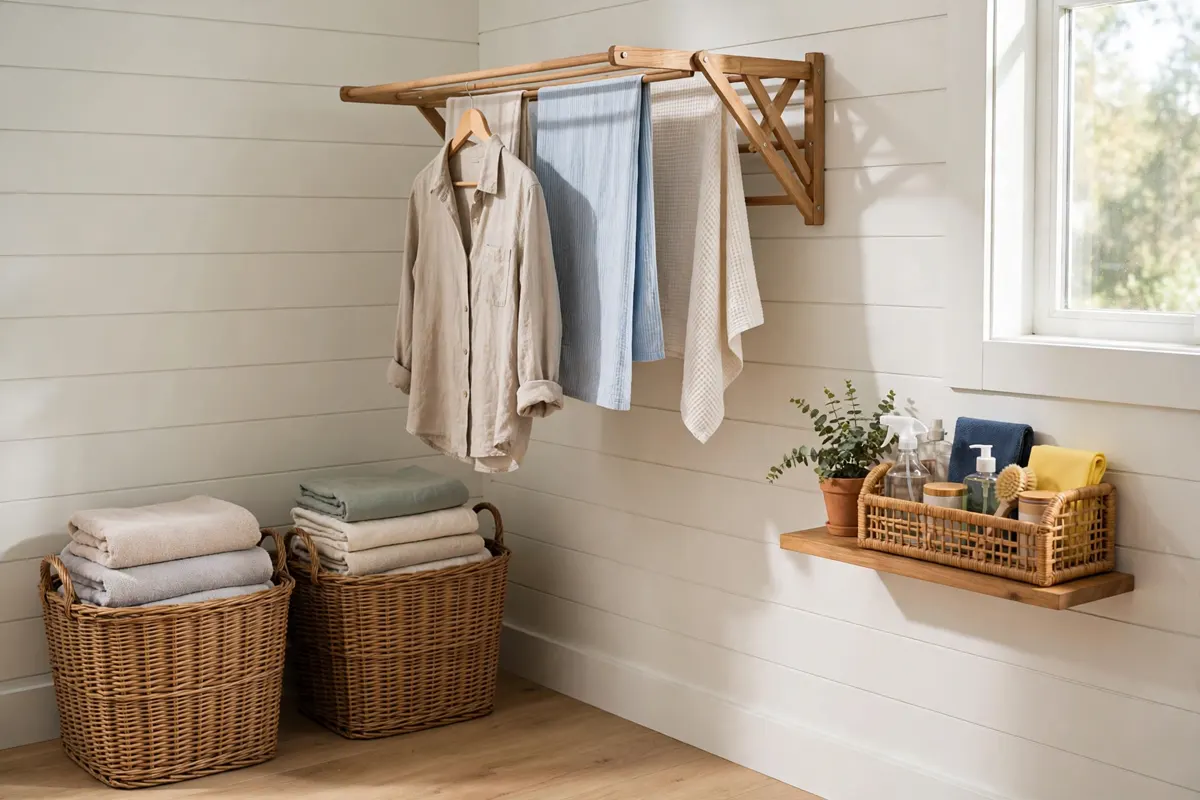
Here is the uncomfortable part of any honest guide on how to declutter a laundry room: the laundry itself is clutter. Not the concept — the physical, ever-present mountain of clothes waiting to be washed, drying, or “folded” (read: sitting in a basket for four days). A decluttered room with three overflowing baskets in the middle of the floor does not feel calm.
First, sort and process what is already there. One basket of clean laundry? Fold it and put it away now, while the room is empty and you have momentum. Dirty laundry? Start a load — you already did that before you began, hopefully. The goal at the end of your decluttering session is a room with zero orphaned piles on the floor. Everything should have a home: dirty clothes in hampers, clean clothes folded or hung, drying clothes on a rack or rod.
Second, right-size your hamper system: one per person or per zone is plenty, and slightly-too-small beats too-big. A huge hamper lets laundry accumulate until wash day becomes a marathon; a modest one fills at the pace of a normal wash cycle, so laundry keeps moving instead of pooling. Our minimalist laundry system guide walks through this in detail.
And the single sock basket — the one every household accumulates — needs a rule. Keep a small basket for loners, but set a deadline: if a sock has not found its mate within a month, it becomes a rag, a duster, or it leaves. Widowed socks should not get permanent residency.
Create Simple Zones That Stay Tidy
With everything sorted, it is time to put things back — but not where they were. The key to a laundry room that stays decluttered is zones: small, obvious areas where one category of thing lives, so that anyone in the household can put something back without thinking. If you have a small laundry space to work with, these ideas scale down beautifully — take a look at our small laundry room storage ideas for layouts that make tight spaces pull their weight.
- The wash zone. Detergent, stain remover, and dryer balls together within arm’s reach of the washer — in a caddy, on a shelf, or on a small tray. One spot, visible, contained. If it does not fit in the caddy, you own too much of it.
- The drying zone. A folding drying rack for delicates, hangers for drip-dry shirts, and your sock basket. Give clothes breathing room so they are not piled on each other taking three days to dry.
- The folding zone. Any clear surface — the top of the dryer, a countertop. The rule: folding happens here, the same day the dryer finishes. No “I will fold it later” baskets.
- The cleaning caddy. One caddy with your most-used cleaning products. If a product cannot fit in the caddy, it lives somewhere else — which is your built-in test for whether it belongs in the laundry room at all.
- The catch-all tray — with a limit. A small tray by the door holds pocket contents and household strays. The limit: when the tray is full, it gets sorted. A tray is a holding pen, not a landfill.
Label things if it helps — “stain removers” on a basket beats “please put things back where they go” every time. And keep the floor clear: nothing stored directly on the floor except the hamper. This single habit is what separates a laundry room that stays decluttered from one that quietly slides back into chaos.
Keep It Clutter-Free for Good
The decluttering afternoon is the easy part. The real work is the five minutes a week that keeps the room from drifting back — because drift is the natural state of a laundry room. Adopt the one-in-one-out habit for this room: when you buy a new cleaning product, the old one goes out. This simple one-in-one-out rule is the difference between a system that holds and a system that slowly fills back up.
Do a quick weekly reset. When you start your first load of the week, take two minutes: wipe the machine tops, toss the pocket junk into its tray, check for products that are almost empty and add them to the shopping list. Two minutes, once a week, while the washer fills. Tie it to a routine you already have so it becomes automatic instead of another task to remember.
And watch for the two biggest relapse triggers: the “just for now” placement that becomes permanent in an empty corner — if it is not laundry-related, it does not live here, full stop — and overbuying. Bulk deals are only deals if you have somewhere sensible to store the bulk; otherwise they are just future clutter you paid for in advance.
The Laundry Room You Actually Want
Here is what the finished room feels like: you walk in with a basket, and there is room to set it down. You reach for the detergent without moving three other bottles. The floor is visible. There is nothing on top of the machines except the machines. It is not magazine-styled and it does not need to be — it is a working room that does its job quietly, and that is the whole point.
Learning how to declutter a laundry room is really about giving yourself permission to have less in there than you think you need. Fewer products, fewer “just in case” items, fewer other rooms’ belongings. What is left is a small, calm space that makes a weekly chore feel a little lighter — and on laundry day, a little lighter is everything.