
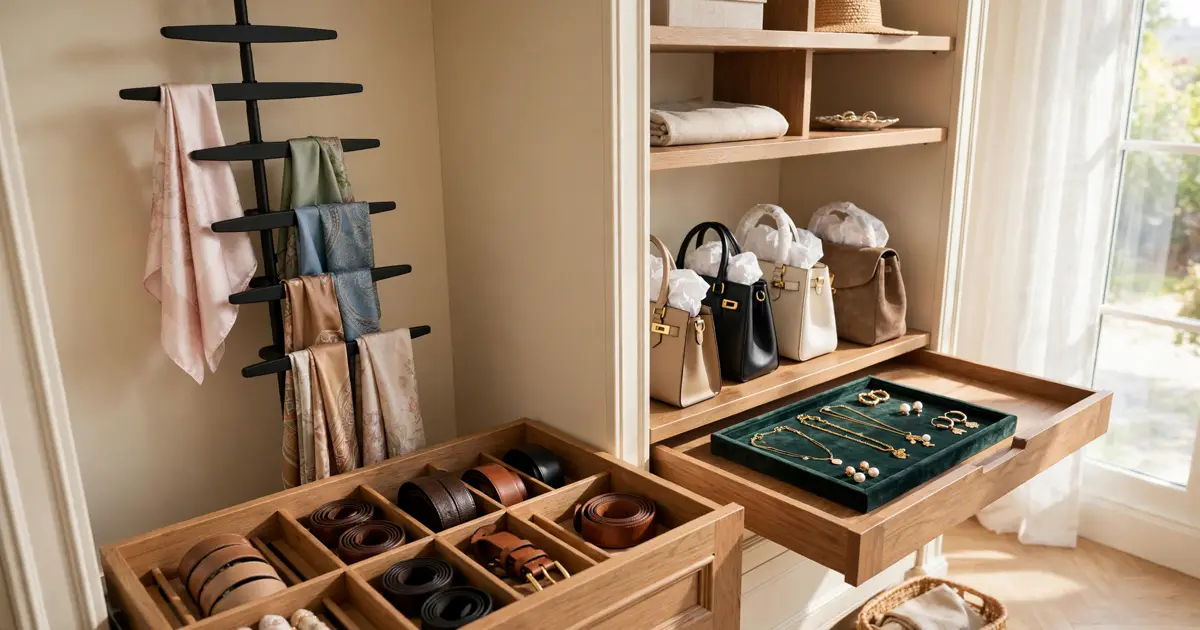

Last Tuesday I spent twelve minutes — twelve actual minutes, with a clock running — looking for one brown leather belt. Not a fancy belt. A plain, worn-in brown belt I have owned for six years. It was not lost. It was in my closet, folded (if you can call it that) in a drawer with eleven other belts in a single tangled snake-pit, and that drawer is exactly why this closet accessory organization project exists. I sat on the floor, freed the brown belt from a stranglehold it had on a striped fabric one, and thought: my clothes are organized. Why do my accessories still live like squatters?
If your closet looks respectable from a distance but hides a belt drawer of doom, a scarf pile you are afraid to touch, and a bowl of single earrings whose partners vanished like socks, this one is for you. Here is the system I built in a single weekend — and it has survived six months without backsliding.
The 10-Minute Accessory Audit: Closet Accessory Organization Starts Here
Before you buy a single hanger or tray, take every accessory out of the closet and put it on the bed. All of it. The scarf you have not seen since spring (mine was buried under two winter coats on a shelf I never use). The belt drawer. The handbags. The little jewelry bowl on the dresser that has slowly become a jewelry swamp. This is the uncomfortable part, and it is the part that matters most, because most closet accessory organization failures are not storage failures — they are ownership failures. We buy tools for thirty belts when we only wear four.
Set a timer for ten minutes and sort into three piles, quickly:
- Love and wear: the pieces you actually reach for, week after week.
- Maybe: damaged, duplicates, or “someday” items. Put these in a bag with today’s date. If you have not opened the bag in three months, it leaves.
- Leave: broken clasps, stretched-out hats, the scarf that pills every time you look at it. Donate or toss.
I cut my accessory collection by nearly half in that audit, and nothing I kept was something I missed. If the “love and wear” pile still feels big, pair this audit with a full wardrobe review — I wrote about my own purge method in my guide on deciding what to keep, toss, or donate in your wardrobe, and the keep-or-release logic works just as well for scarves as it does for sweaters.
Now give every surviving accessory a category — belts, scarves, handbags, jewelry, sunglasses and watches, hair accessories — and a dedicated home. Categories are the whole game. A belt cannot get tangled if belts live in a belt-only zone with a system built for belts.
Belts: Rolled vs. Hung (Both Work — Here Is How to Choose)
The great belt debate nearly split my household. My husband hangs his. I roll mine. Both methods work if you commit to one, and the deciding factor is your closet, not your philosophy.
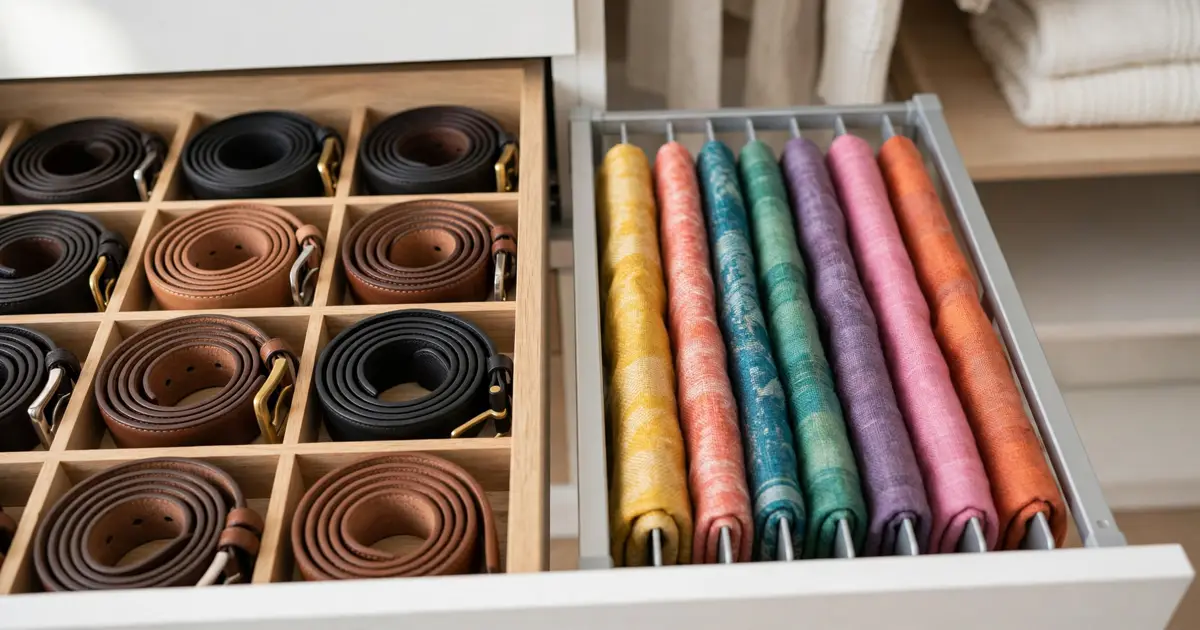
Rolling is best when you have a drawer or a shelf and limited rod space. Take the belt, wrap it around itself starting at the buckle end, and tuck the tail in — a tight roll the size of a donut hole. Stand the rolls upright in a drawer, honeycomb-style, or line them in a divided drawer organizer. When you need one, you see every buckle at a glance, and you pull one roll without disturbing the others. This is what fixed my snake-pit drawer. Eleven rolls, one drawer divider, zero tangles.
Hanging works if you have rod space or a wall to spare. A dedicated belt hanger — the kind with a ring of hooks, or a simple multi-arm rack — lets each belt hang straight, which is genuinely better for thick leather belts that hold a curl if rolled. The trick is to keep the belt hanger at the side of the closet, not sandwiched between clothes, or you will knock shirts off reaching for it. Command-style adhesive hooks on the inside of a closet door work well for renters; I use three of them, and nothing has fallen in a year.
One rule either way: never loop a belt through your jeans when you store them. It stretches the loops, warps the belt, and turns getting dressed into a small wrestling match. Belts have a home now. They live there.
Scarves and the Filing Method: Closet Accessory Organization for the Slippery Stuff
Scarves are the reason closet accessory organization feels impossible. They are soft, they slide, and they multiply every winter. I have two systems depending on the scarf, and both beat the pile.
For everyday scarves, I stole the filing method from clothes folding: fold each scarf into a rectangle about the width of your hand, then stand them upright in a drawer or a narrow bin, spine-up, like files in a filing cabinet. You can see every scarf’s edge at once. No digging. The first time I opened that drawer and saw the scarf I had been missing since spring — a mustard-yellow knit my sister gave me — I felt like I had found money. It was right there. It had been right there for months, buried in the pile.
For silk scarves and pashminas, filing creases them and hanging stretches them. These live in a pull-out scarf rack — the tiered kind with smooth, snag-free bars. If your closet does not have one, a hanger with large rings works, but check the rings for rough edges first. The scarf-slide — gently pulling the scarf through a large ring to display and grab it in one motion — is worth trying for the scarves you wear weekly; it keeps them visible and wrinkle-free without any hardware.
Bulky winter scarves and wraps go in a clear bin on a high shelf, labeled by season. “Winter scarves” in sharpie on painter’s tape is not pretty, but it is honest, and honesty is what gets things put back where they belong.
Handbags: Stuff Them, Stand Them, Stop the Pile
A handbag stored empty and flat will lose its shape. I learned this on a structured leather tote that arrived from a trip looking like a deflated accordion. Now every bag I own gets stuffed before it is stored — tissue paper for the nice ones, a rolled-up old t-shirt for the casual ones. The rule is simple: a bag should look like a bag even when you are not wearing it.
Storage method depends on the bag:
- Shelf storage: the gold standard. Bags stand upright, side by side, like books on a shelf. Adjustable shelf dividers keep them from flopping into each other. This is where your everyday workhorses live — within arm’s reach, visible, easy to grab.
- Hooks: great for crossbodies and totes you wear weekly. Hang by the strap from sturdy hooks on a closet wall or rod — never by a delicate chain, which stretches. And please, not five bags on one hook. The weight warps straps and dents the bag at the bottom of the pile.
- High-shelf bins: for clutches, evening bags, and seasonal bags. Clear bins or dust bags, one per bin or in dust bags inside the bin, labeled. The bin goes where you can reach it without a ladder, or the “special occasion” bag becomes a “never again” bag.
- Under-bed storage: if your closet is tiny, flattened-but-stuffed bags in a slim under-bed bin are perfectly respectable. Just keep the dust bags on.
Renters, I have a whole playbook for you — see my renter-friendly closet organization ideas for more no-drill, deposit-safe storage tricks that pair perfectly with everything on this page.
Jewelry That Does Not Tangle: Earring, Ring, and Necklace Systems
The junk bowl is where earrings go to lose their backs. Mine held, at last count, fourteen earring backs and nine single earrings, and I wore exactly none of them because getting dressed around a junk bowl takes too long. Jewelry needs the most structure of any accessory because it is the smallest and the tangliest.
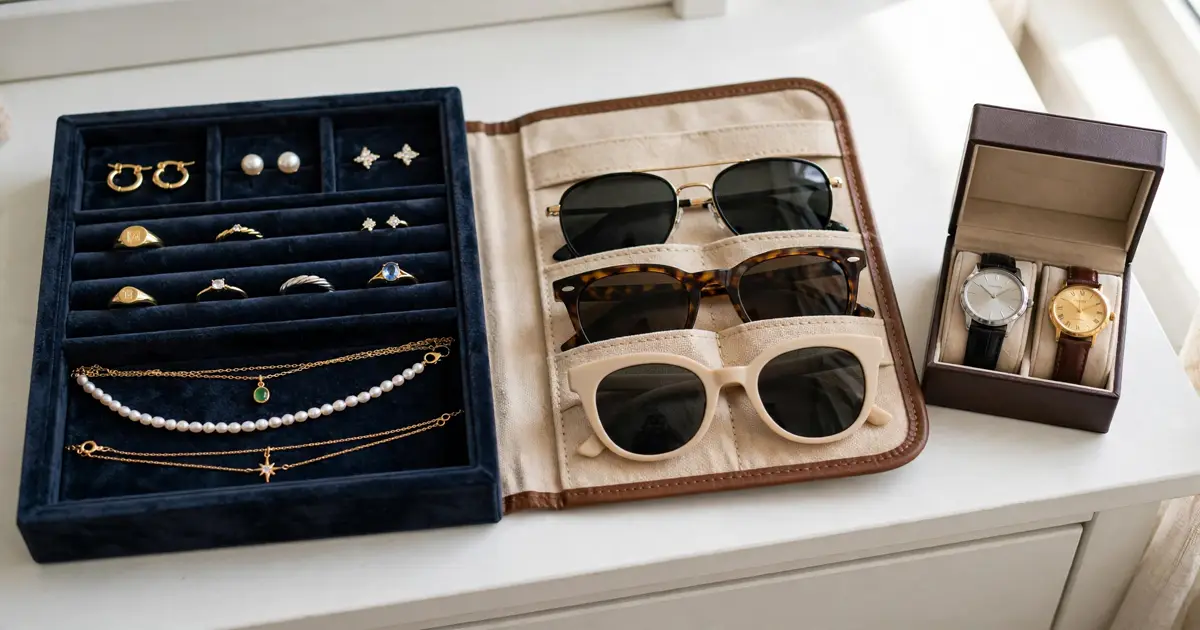
Earrings: a velvet-lined tray with divided compartments, or a wall-mounted earring organizer if drawer space is tight. Every pair gets one slot. The backs stay attached to the earrings — always. I attach backs the second earrings come out of my ears. This one habit eliminated my single-earring graveyard entirely.
Rings: ring rolls or small divided trays. Keep a small ring roll in your suitcase permanently so your everyday ring never ends up loose in a toiletry bag.
Necklaces: hang them. A necklace folded into a drawer becomes a knot with a chain attached — it is physics, and it is undefeated. Individual hooks on the back of a closet door, a wall-mounted bar, or a dedicated necklace stand keep each one separate. Weekly-wear pieces hang on the door; special-occasion ones live in a felt-lined drawer, each in its own little pouch.
Bracelets: a small stand or a dedicated tray row. Bangles can live on a vertical rod — slide them on like napkin rings, and you can see the whole collection at a glance.
Sunglasses, Watches, and Hair Accessories: The Small Stuff Drawer
The miscellaneous category — sunglasses, watches, scrunchies, headbands, the hair clip situation — is where closet accessory organization systems go to die. The fix is one shallow drawer (or one section of a drawer) with small compartments, and strict rules.
Sunglasses: each pair in its case or in its own compartment. Stacking them lens-down in a drawer is how scratches happen. I keep the daily pair on a small stand by the door and the rest in the drawer.
Watches: a watch box or watch pillows in a drawer compartment, one per slot, face up. If you have more than six watches, the 10-minute audit from earlier wants a word with you.
Hair accessories: a small lidded bin or a hanging organizer with clear pockets on the closet door — scrunchies in one pocket, clips in another, headbands on a single hook.
This is also the drawer where the “one in, one out” rule earns its keep. Buy a new pair of sunglasses? An old pair leaves. Accessories are small, which makes it easy to underestimate how many you own. Count them once. I bet you have more hair ties than you have fingers.
Keeping It Organized: The Two-Minute Reset
Here is the unglamorous truth about every organization system I have ever built: the system does not fail. The maintenance fails. So I built maintenance into the routine — a two-minute accessory reset I do when I take my jewelry off at night. Rings back in the roll, necklace hung, belt rolled, scarf filed. Two minutes. It is the difference between a system that lasts and a system that reverts to the snake-pit drawer by February.
Once a season, run the 10-minute audit again. Accessories drift — a gift, a sale, a souvenir — and a quarterly check keeps the collection honest. This pairs naturally with swapping seasonal clothes — and if you are still rotating your wardrobe twice a year, my capsule wardrobe guide will help keep the clothes lean too, which means fewer accessories competing for your attention in the first place.
If your whole closet could use the same treatment, start from the top: my shoe organization ideas for small closets and my guide to organizing a kids’ closet use the same category-and-home logic, and they will get the rest of your closet matching this newfound calm.
That brown belt from the beginning of this story? It lives in a roll now, in the front of the drawer, buckle facing up. I can find it in ten seconds. Sometimes the best closet accessory organization is not a beautiful system — it is just never spending twelve minutes on the floor again.
[…] the same time, the same sort-first logic applies to the rest of your wardrobe. A tidy approach to closet accessories like belts, scarves, and bags keeps the small things from undoing the good work you do with your […]
[…] the calm of a drawer where everything has a zone, you will want it everywhere — and ideas for closet accessory organization can give belts, scarves, bags, and jewelry the same […]