

Declutter Together Before You Divide Anything
Every couple has a closet story. Maybe you moved in together and one of you quietly took over eighty percent of the rod while the other folded jeans on a shelf the size of a cutting board. Maybe the closet has slowly turned into a textile version of a border dispute, with stray sleeves crossing into enemy territory. The starting point for shared closet organization is never a new rod or matching hangers. It’s both of you, in the same room, pulling everything out and deciding together what actually deserves to live in there.
Set aside a weekend morning and take literally everything out of the closet — both wardrobes, the shoes, the bags on the top shelf, the box of scarves nobody has touched since 2023. Sort every item into three piles: keep, donate, and toss. The goal is honesty, not judgment. Nobody gets to veto the other person’s keeps, but both of you get to ask one question about anything questionable: “Have you worn this in the last year?” If the answer is no, and there’s no solid reason like a formal event coming up, it goes.
Watch for duplicates, because couples are surprisingly good at accumulating them. Two black hoodies that serve the same purpose. Three denim jackets between two people. The “just in case” blazer that has survived four moves without attending a single meeting. Keep the favorite, let the rest go. If you need a structured method for this part, our guide to decluttering your wardrobe with a keep, toss, and donate system walks through the whole decision process step by step.
One more thing before you put anything back: this is the only fair moment to measure. Once both wardrobes are reduced to what you actually wear, you can see the true size of each person’s clothing life — and divide the closet based on that reality, not on who yelled “dibs” first.
Here’s the mistake almost every couple makes: splitting the closet fifty-fifty down the middle. It sounds fair, and it feels fair, and it is completely wrong — because nobody’s wardrobe is the mirror image of their partner’s. If one of you owns eleven dresses and the other owns four button-downs, an equal split gives one person a wasteland and the other a war zone. Shared closet organization works when you divide by need, not by square footage.
Start by taking inventory of what each person kept. Count the long-hanging items (dresses, coats, suits), the short-hanging items (shirts, blouses, pants folded over hangers), the things that should be folded (sweaters, jeans, t-shirts), and the shoes and accessories. This takes ten minutes and answers the only question that matters: what kind of storage does each wardrobe actually require?
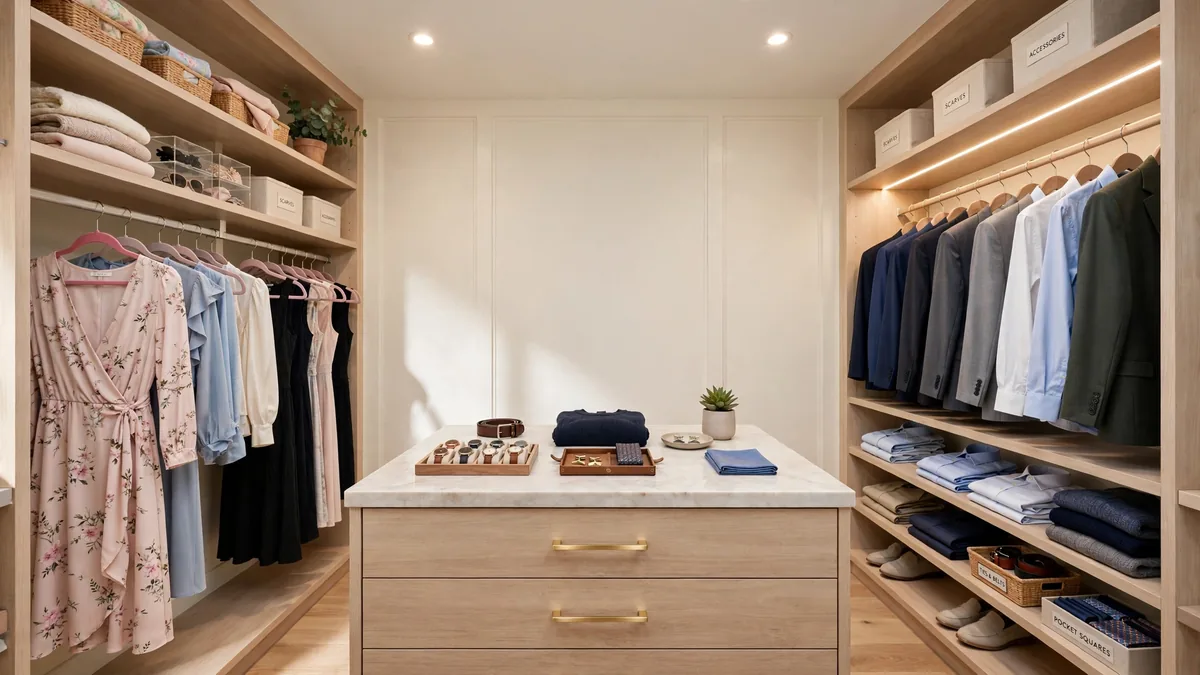
For a reach-in closet, the simplest division is left and right, with each person getting a side shaped around their own inventory. For a walk-in, you have better options: a mirrored layout on opposite walls when your needs are similar, or a customized zone per person when they aren’t. Either way, reserve a small shared section for things that belong to both of you — guest-worthy coats, formal wear, the seasonal pieces currently in rotation. Think of it as three territories: yours, mine, and ours.
Make the borders visible so nobody has to guess. Different colored hangers for each person, labeled shelf dividers, or a strip of washi tape along the rod all work. A visible boundary prevents the slow creep — that quiet phenomenon where one person’s shirts migrate two feet to the right every month until the other person is dressing out of a drawer.
Double Your Hanging Space Without a Renovation
Most closets were built for one person with a 1990s wardrobe, and they show it: a single rod, one shelf, and a yawning stretch of empty air above and below. The good news is that you don’t need a contractor to fix this. A few affordable upgrades can genuinely double the hanging space for two people.
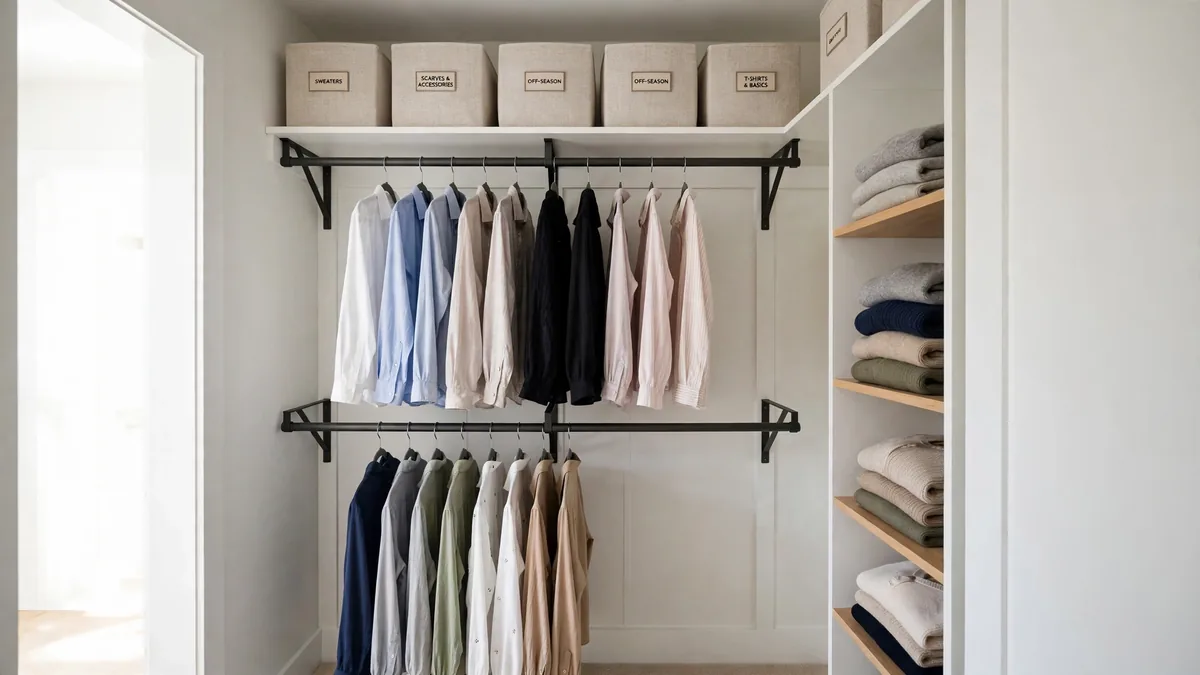
The single biggest win is the double rod. A second rod mounted about forty inches below the top one instantly creates two levels for short items — shirts, blouses, folded pants, jackets — turning one rod’s worth of space into two. Add an adjustable closet system, the kind with vertical tracks you screw into the wall studs, and each partner can configure their own zone differently: tall single-rod space for dresses on one side, double-rod plus shelving for shirts and sweaters on the other.
Then there’s the hanger upgrade, which sounds trivial until you see the math. Slim velvet hangers are a fraction of the thickness of standard plastic ones, and they grip clothes so nothing slides off. Switching both wardrobes to slim velvet hangers can free up a third of your rod space overnight — which, in a shared closet, is the difference between breathing room and a daily wrestling match. Matching hangers also make the closet look calmer, and that visual calm actually helps both of you maintain the system.
Don’t forget the dead zones. The top shelf becomes genuinely useful with clear labeled bins for off-season items — one set of bins per partner, so there’s no rummaging through each other’s stuff. The floor is prime real estate for a low shoe rack or rolling bins for gym clothes and pajamas.
Shoes, Bags, and the Small Stuff That Starts Fights
Clothes are the easy part of sharing a closet. The real friction comes from everything else — the shoes migrating across the floor, the handbags colonizing shelves, the belts tangled into a single organism behind the door. This is where shared closet organization gets granular, and where a little structure pays off enormously.
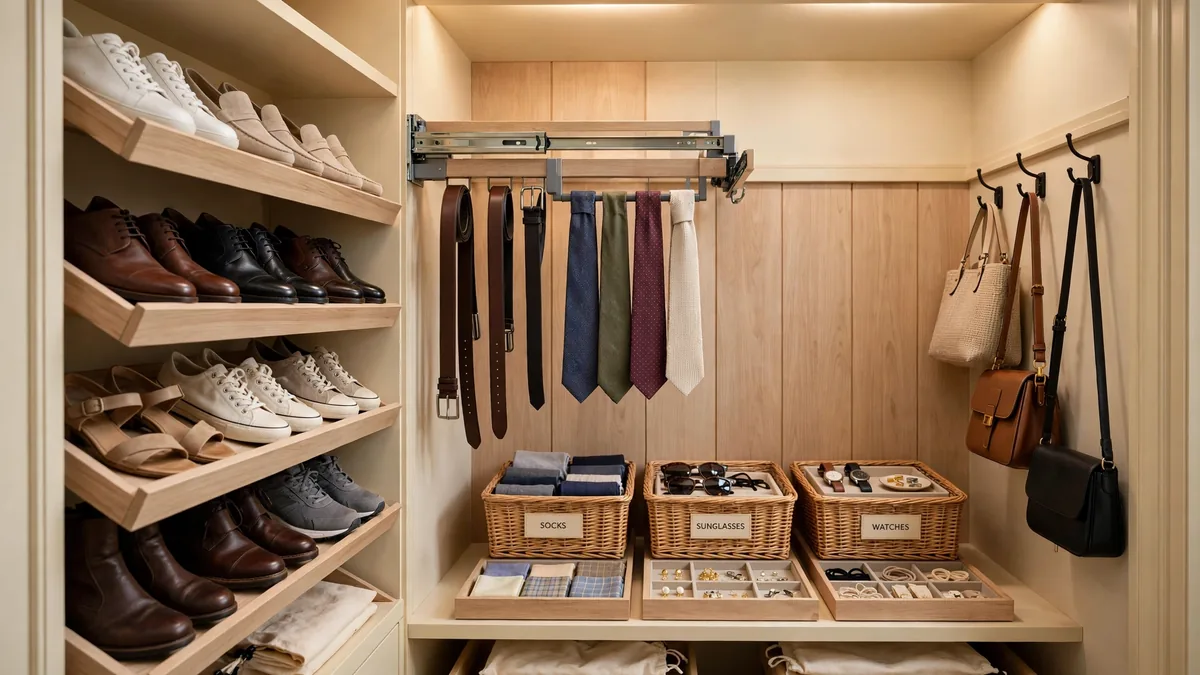
Shoes deserve their own real estate, allocated the same way as hanging space: by inventory, not by halves. Count them. If one of you owns twenty pairs and the other owns six, the shoe wall belongs mostly to one person and nobody should feel bad about it. Slanted shoe shelves or pull-out shoe racks keep pairs visible and off the floor — shoes on the floor are the number one source of “your stuff is in my way” arguments. For tight closets, an over-the-door shoe organizer on the inside of the closet door adds a full row of storage that costs almost nothing. We go deep on the best layouts for this in our guide to organizing shoes in a small closet, and most of those ideas scale perfectly to two people’s footwear.
Accessories need homes with walls. Belts, ties, and scarves do terribly on a single hook, where they become a knot that neither partner wants to untangle. A pull-out belt and tie rack in each person’s zone gives every item its own slot. Handbags do best standing upright on a shelf with dividers between them. Jewelry, sunglasses, and watches belong in shallow trays or drawer inserts, one tray per person, so small valuables never end up in a communal jumble.
The principle for all of this is the same: small items need containers, and containers need owners. A basket labeled with one person’s name for sunglasses, another for the other’s — it takes five minutes and eliminates an entire category of morning irritation.
Daily Systems That Survive Real Mornings
A beautifully organized shared closet lasts about four days without systems. Real life — late nights, rushed mornings, laundry day — will undo any layout that depends on perfect behavior from two imperfect humans. The systems below are built for the way people actually live.
Start with laundry, because laundry is where shared closets go to die. Put a hamper in or right next to the closet — one per person if you have the space, or a divided double hamper if you don’t. Clothes on the floor are a decision deferred; a hamper two steps away turns that decision into a reflex. Equally important: a designated spot for the “worn once, not dirty yet” clothes. Those jeans you can wear one more time and the sweater that only needs airing don’t belong back on a hanger and definitely don’t belong on the floor. A single hook or a small valet rod per person absorbs this entire category.
Then build in the five-minute reset. Once a week — Sunday evening works for most couples — both of you spend five minutes putting your own zone back in order: rehang the strays, return shoes to the rack, toss the empty hangers in one spot. Doing it together means it actually happens, and it catches the drift before the drift becomes the new normal.
Two maintenance habits keep the closet from slowly refilling. First, rotate seasonally: when the weather turns, move off-season clothes into labeled bins on the top shelf or under the bed, and bring the current season forward. Only the clothes you can wear right now should occupy prime closet real estate — trying to fit two people’s full year-round wardrobes into one closet is a fight against physics. Our seasonal wardrobe rotation guide has the full method. Second, adopt a one-in-one-out rule for both wardrobes: every new item that comes in means one old item goes out, for each person equally. Here’s how the one-in-one-out rule works in practice. It’s the simplest possible agreement, and it means the closet never quietly doubles in size again.
And here’s a trick worth stealing from the pros: the “marriage saver” drawer. Give each person one small drawer or lidded bin where they’re allowed to be messy — no folding standards, no judgment. Make it small and make it close, so you don’t have to look at it. It acknowledges that two people have different tidiness levels and builds that difference into the system instead of fighting it.
Keep the Peace: Write Down the Rules
The couples who share closets happily aren’t the ones who never disagree. They’re the ones who made the decisions once, clearly, and then stopped renegotiating them every Tuesday. Before you call the project done, agree on a few simple rules out loud — and actually say them, because unspoken expectations are where resentment breeds.
- Zones are permanent until you both agree to change them. Neither person unilaterally expands into the other’s side, no matter how good the sale was.
- Each person maintains their own zone. You can offer to help, but you can’t be drafted into folding someone else’s sweaters.
- New purchases follow one-in-one-out. No exceptions for “but it was on clearance” — that’s exactly when the rule matters most.
- Seasonal resets happen together, twice a year. Put them on the calendar like any other appointment.
- The shared zone is shared work. Whoever notices the “ours” section getting messy fixes it or asks for a two-minute joint tidy.
If your combined wardrobe still feels like too much for one closet even after decluttering, consider whether the problem is volume rather than organization. Many couples discover that building a smaller, more intentional wardrobe each — something like a capsule wardrobe — solves the space problem at its root. Fewer, better pieces that all work together mean less hanging space needed, easier mornings, and a closet that stays organized almost by itself.
Finally, schedule a check-in. Not a dramatic summit — just a casual look at the closet together every few months. Wardrobes change, hobbies change, jobs change, and the system should change with them.
Sharing a closet is really a small exercise in sharing a life: noticing what the other person needs, making room for it, and building systems that respect both people’s habits instead of fighting them. Declutter together, divide by need instead of by halves, give everything a labeled home, and keep it running with five-minute resets and honest rules. Do that, and the closet stops being contested territory — it becomes one of those quiet corners of the house that just works, morning after morning, for both of you.