
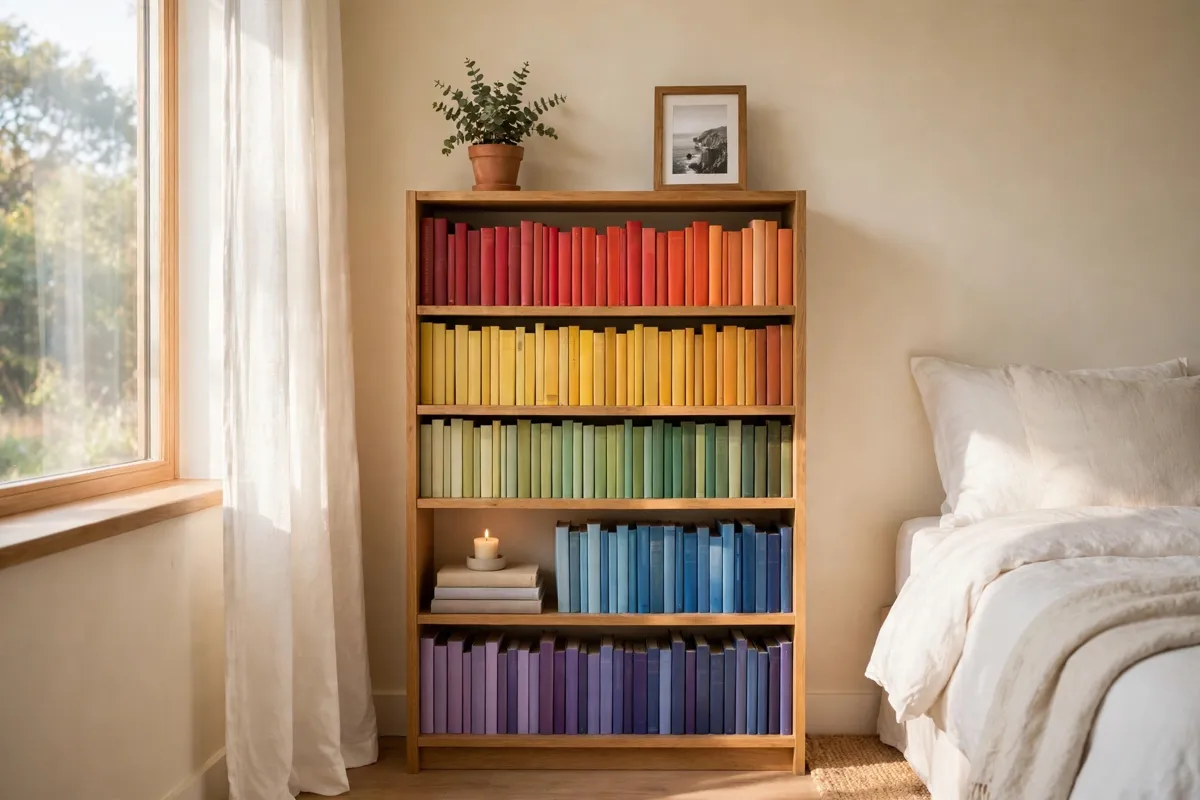

A bedroom bookshelf should feel like a quiet invitation, not a chore you walk past every morning. Yet most of us end up with the same problem: books stacked sideways, a tangle of chargers draped over the top shelf, and that one pile of “I’ll sort it later” paperbacks that has been there since spring. If that sounds familiar, these bedroom bookshelf organization ideas will help you turn a cluttered shelf into something genuinely useful — and genuinely lovely to look at. The goal is not a shelf that looks like a shop display. It is a shelf that holds what you actually read, keeps the things you reach for close at hand, and still leaves a little breathing room so the whole bedroom feels calmer.
Start by Emptying the Shelf Completely
Every good bookshelf reset starts the same way: take everything off. All of it. The books, the candles, the framed photo that has been leaning at an angle for months, the plant that is quietly dying in the corner. Wipe the shelves down, and then look at the empty wood with fresh eyes. An empty shelf tells you things a full one never will — how deep it is, where the light falls, which shelves are easy to reach and which ones you will honestly never touch without a stretch.
Now sort what came off into four piles on the bed: keep on this shelf, move elsewhere, donate or pass on, and throw away. Be honest with yourself here. The novel you finished three years ago and will never reread does not need prime bedroom real estate. Neither does the textbook from a course you completed in 2019. Books you love, books you are currently reading, and books you genuinely plan to read soon earn their place. Everything else can live in another room or find a new home. If you are working through a bigger clear-out at the same time, a minimalist guide to decluttering bookshelves can help you make those keep-or-let-go decisions without the guilt spiral.
While you sort, gather the non-book items too. Charging cables, reading glasses, lip balm, a notebook, a small clock — these are the everyday things that end up scattered across a bookshelf because there is nowhere better for them. Decide now whether each one belongs on the shelf or whether it would be happier in a drawer or on your nightstand.
Bedroom Bookshelf Organization Ideas That Actually Work in Real Bedrooms
Once you know what is staying, it is time to put it back with intention. The single most useful principle is also the simplest: put the things you use most at eye level and within easy reach of the bed. Your current read, your reading glasses, and your phone charger belong on the middle shelf. The books you rarely touch — old favourites, reference books, the complete works of someone you admire but seldom open — can live higher up or lower down.
Try grouping books by how you actually use them rather than by strict rules. A bedtime reading stack of two or three books, laid horizontally with a small plant or candle on top, feels welcoming and gives the shelf a natural focal point. Your favourite novels, the ones you reach for again and again, can stand upright together. Cookbooks or hobby books you consult rather than read cover to cover can share a lower shelf. The point is that the arrangement matches your life, not a photographer’s idea of a perfect shelf.
Leave gaps on purpose. A shelf packed edge to edge looks heavy, and pulling one book out disturbs five others. Aim for about a hand’s width of empty space on each shelf, held in place with a bookend or a small object. That breathing room is what makes a bookshelf feel calm instead of cramped — and it gives you space to add a new book without rearranging everything.
- Keep your current read visible. Place it face-out or on top of a small horizontal stack so you can grab it without thinking.
- Group by use, not just by author. Bedtime reads together, reference books together, favourites together.
- Leave breathing room. A hand’s width of empty space per shelf keeps the whole unit feeling calm.
- Use the top shelf for display only. A framed photo, a small plant, or a favourite object — never the things you need daily.
- Keep the bottom shelf for heavy or rarely used books. It is the hardest to reach, so do not put your current read down there.
Arrange Books by Colour, Size, or Story — Pick One System and Commit
There are three classic ways to arrange books, and each one suits a different kind of reader. Sorting by colour creates a beautiful rainbow or gradient effect and works wonderfully if your bedroom is your calm retreat and you love the visual impact. The trade-off is that finding a specific title takes longer, because your memory has to work by colour rather than by author or subject. Sorting by size — tallest books together, paperbacks together — looks tidy and makes the shelf feel structured, and it is genuinely practical because books of similar height stand up straighter and are less likely to lean. Sorting by subject or author is the most useful if you actually browse your shelf looking for something to read; it turns the bookshelf into a small personal library you can navigate without thinking.
Whichever system you choose, commit to it for the whole shelf. Mixing colour-sorting on one shelf and author-sorting on the next looks accidental rather than intentional, and it makes the shelf harder to use. If you love the look of a colour gradient but still want to find things easily, try a compromise: arrange by colour within each subject group. Your novels can run from deep blue to warm cream across one shelf, while your non-fiction sits in its own colour flow on the next. You get the beauty and most of the practicality.

Make Room for the Things That Aren’t Books
A bedroom bookshelf is never just for books, and pretending otherwise is why so many shelves end up looking chaotic. The trick is to give every non-book item a deliberate home. A small woven basket on the bottom shelf can hold charging cables and a spare phone charger, out of sight but easy to grab. A pretty box or a lidded container on a middle shelf can keep a journal, a pen, and the odds and ends that otherwise drift across every flat surface in the room. When these things have a container, the shelf looks tidy even when life inside the box is slightly untidy — and that is a perfectly fair trade.
Plants are the easiest way to make a bookshelf feel alive — a small pothos or snake plant tolerates low light and forgiving watering. Keep the pot small so it softens the shelf without swallowing it. One plant per shelf is usually enough.
Photographs and keepsakes deserve a place too, but limit them. One framed photo per shelf, or a small cluster of two or three meaningful objects on the top shelf, adds personality without turning the bookshelf into a display cabinet. The test is simple: if you took the object away, would the shelf feel emptier or calmer? If the answer is calmer, the object was clutter. If the answer is emptier, it earns its place. Think of your shelf as part of the wider bedroom, not as an isolated project — the way it sits alongside your other storage matters, and if your wardrobe needs the same treatment, these bedroom closet organization ideas use the same keep-it-simple principles.
Keep It Tidy With a Five-Minute Weekly Reset
The best bookshelf system is the one you can maintain without thinking about it, and maintenance is where most organization projects quietly fail. The fix is a tiny weekly ritual rather than another big clear-out. Once a week — Sunday evening works well, or whenever you change your sheets — spend five minutes on the shelf. Straighten leaning books, return anything that has migrated there from another room, and check whether your current read has finished and needs swapping for the next one. Five minutes is short enough that you will actually do it, and regular enough that the shelf never slides back into chaos.
Use the same moment to practise the one-in, one-out rule. When a new book arrives in the bedroom, an old one leaves — onto a giveaway pile, into another room, or back to the library. This single habit prevents the slow creep that fills shelves over months without anyone noticing. It also makes you more deliberate about what you bring home, which is a quiet kindness to your future self and your future shelf space.
Four times a year, take a slightly deeper look: books untouched for a year, magazines colonising the bottom shelf, a plant that needs replacing, a candle you never light. A seasonal pass keeps the shelf honest. If your bedside table has drifted the same way, these bedroom nightstand organization ideas will help you reset it, and if floor space is tight, these small bedroom storage ideas that really work show how to make every inch of the room earn its keep.
- Five minutes, once a week. Straighten books, return strays, swap your finished read for the next one.
- One in, one out. Every new book means an old one leaves the shelf.
- A seasonal check, four times a year. Remove unread books, dead plants, and anything gathering dust.
- Dust the shelves, not just the books. A quick wipe during your weekly reset stops the grey film that makes even a tidy shelf look tired.

Small Bedrooms Need Smarter Shelves, Not Fewer Books
If your bedroom is small, the bookshelf has to work harder — and it can, with a little creativity. A narrow vertical bookcase tucked beside the bed uses floor space you were not using anyway and keeps books within arm’s reach. Floating shelves above the bed or above a desk turn dead wall space into storage without taking a single centimetre of floor. A short bookcase that doubles as a bedside table is one of the best small-bedroom tricks there is: books on the lower shelves, a lamp and your phone on top, and nothing extra to buy.
Think vertically before you think about buying more furniture. Most bedrooms have a full metre of unused wall above a chest of drawers or beside a wardrobe door, and two floating shelves there can hold twenty paperbacks. Keep the heavier books low — a floating shelf full of hardbacks needs solid fixings, and it is worth using proper wall anchors rather than the small screws that come in the box. Lighter paperbacks and your current reads can go higher, where they are easy to see and grab.
Finally, remember that a bedroom bookshelf does not have to hold your entire library — only the books that belong in your bedroom: the ones you read at night, the ones that comfort you, and the ones you are excited to open next. The rest can live in the living room or hallway. Giving your bedroom shelf one clear job is what makes it feel peaceful instead of crowded. Start with one shelf this weekend and notice how different the whole room feels.
Your bedroom should help you rest, and a tidy bookshelf is a surprisingly big part of that. When the books you love are easy to find, the things you need are exactly where you expect them, and there is a little calm empty space on every shelf, the room does its job quietly in the background — and you get to simply enjoy reading in it.
[…] and frees the nightstand for a lamp and a glass of water. For more bedroom-specific layouts, these bedroom bookshelf organization ideas show how to fit shelving around beds and wardrobes without the room feeling […]